Bait-ul-Mal Medical Help: Rs 200,000 for a Kidney Transplant, No Refund of Past Bills
Bait-ul-Mal policy lists up to Rs 200,000 for a kidney transplant and Rs 300,000 for treatment, paid to the hospital. Past bills are not repaid. See steps.
Short answer: Under Pakistan Bait-ul-Mal's policy, help for a kidney transplant is up to Rs 200,000 through a government hospital. The money buys medicines, implants and devices. It does not repay treatment you have already paid for, and the hospital's own charges are not paid from it.
Picture a family that pays for a transplant from its savings, then hears about Bait-ul-Mal and asks if the bill can be repaid. The answer in the policy is a flat no. The grant has to be agreed before the treatment, and it is paid to the hospital, not to you.
We read the Pakistan Bait-ul-Mal Individual Financial Assistance (IFA) policy PDF on the PBM projects page on 12 October 2026, including its section on the procedure for medical treatment. Our earlier note on Bait-ul-Mal medical assistance covers the website's Rs 1 million and the income limit. This article covers the rules the website leaves out.
A kidney transplant is listed at up to Rs 200,000
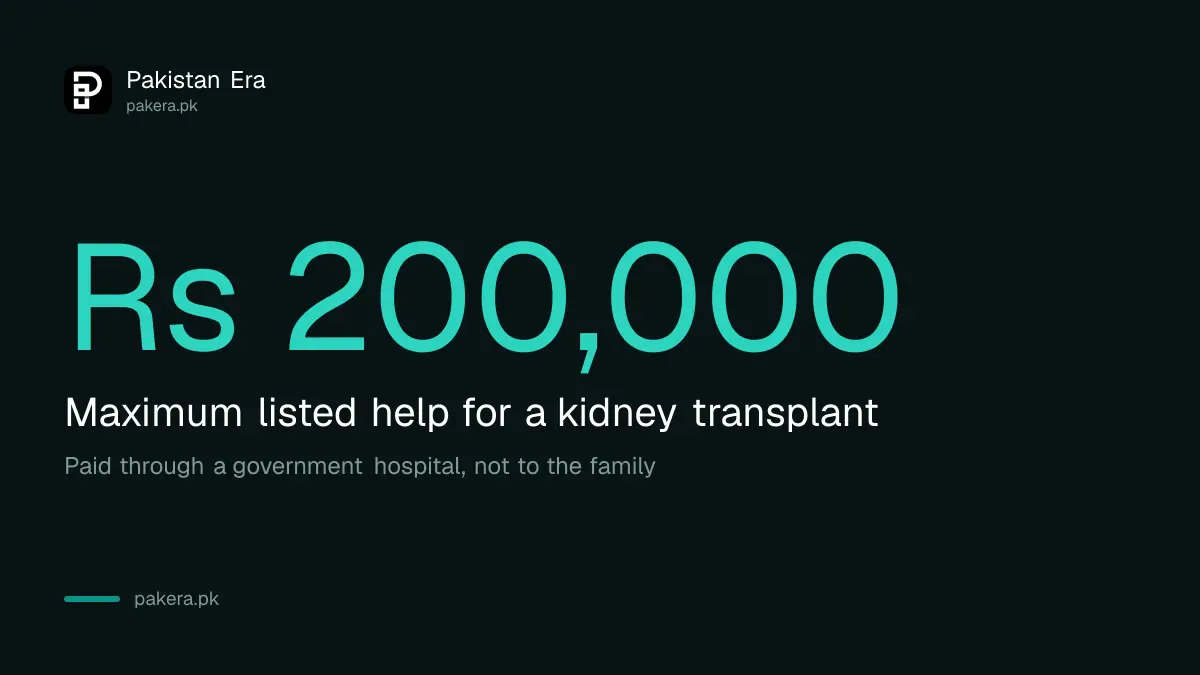
The policy says PBM will provide financial assistance up to Rs 200,000 for kidney transplant cases, through government hospitals. Kidney dialysis is separately listed among the major ailments covered. The amount is paid to the hospital, not to the patient or the family.
The policy sets other limits too. They are different from the Rs 1 million on the website, and the difference is who may approve what.
| Item | What the policy says |
|---|---|
| Ordinary medical help | Up to Rs 300,000 for medication, surgery or treatment of disability |
| Kidney transplant | Up to Rs 200,000, through government hospitals |
| Cases up to Rs 100,000 | Decided by the province without head office opinion |
| Managing Director's power | Rs 1 million, case by case, for lifelong treatment |
| Cochlear implant | Full cost, Managing Director up to Rs 1.5 million |
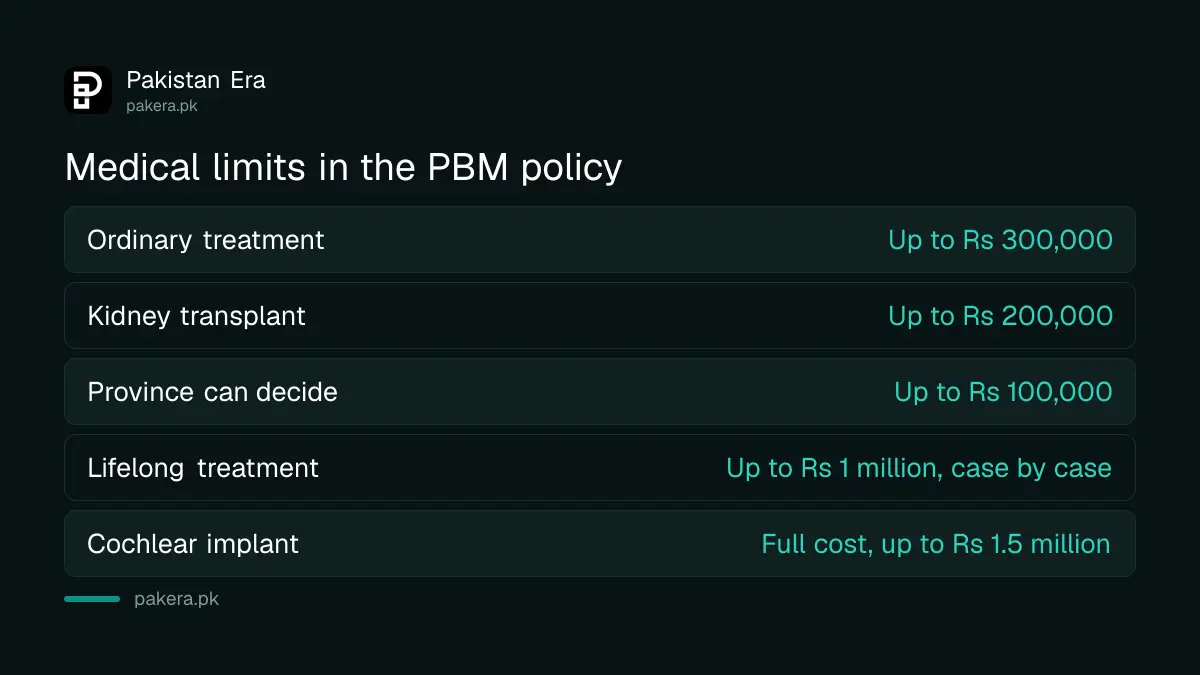
So the website's Rs 1 million is a ceiling for the Managing Director in a hard case, not the normal grant. A typical file is judged against the Rs 300,000 line.
PBM money buys medicines and devices, not the hospital's own charges
The procedure section lists what a hospital may buy with PBM funds. It names life-saving medicines that the hospital does not stock, including interferon for hepatitis and first-line chemotherapy drugs, and surgical items such as heart valves, a pacemaker, grafts and implants.
It also lists rehabilitative devices: hearing aids, artificial limbs, wheelchairs, tricycles, crutches and electro-larynx. Medicines that are not registered, or that are smuggled, cannot be bought from PBM funds.
The policy then says no hospital charges or government dues of any kind should be deducted from PBM funds, naming consultation fee, ICU, CCU and operation theatre charges, food, service and nursing charges. We read that to mean the grant pays for the items above and not for the hospital's own charges. Ask the hospital's medical social officer to confirm in your case.
That affects the family budget. Even with a grant, you may need to arrange for bed and theatre charges separately, or ask whether the hospital waives them for poor patients. Our note on what the Sehat Card covers now explains the other side of hospital cost.
Past treatment is not repaid, so apply before you pay
The policy says no medical bills of past treatment are reimbursed out of PBM funds. The request has to come before the treatment, with a cost estimate from the hospital. A receipt for an operation already done is not a valid claim.
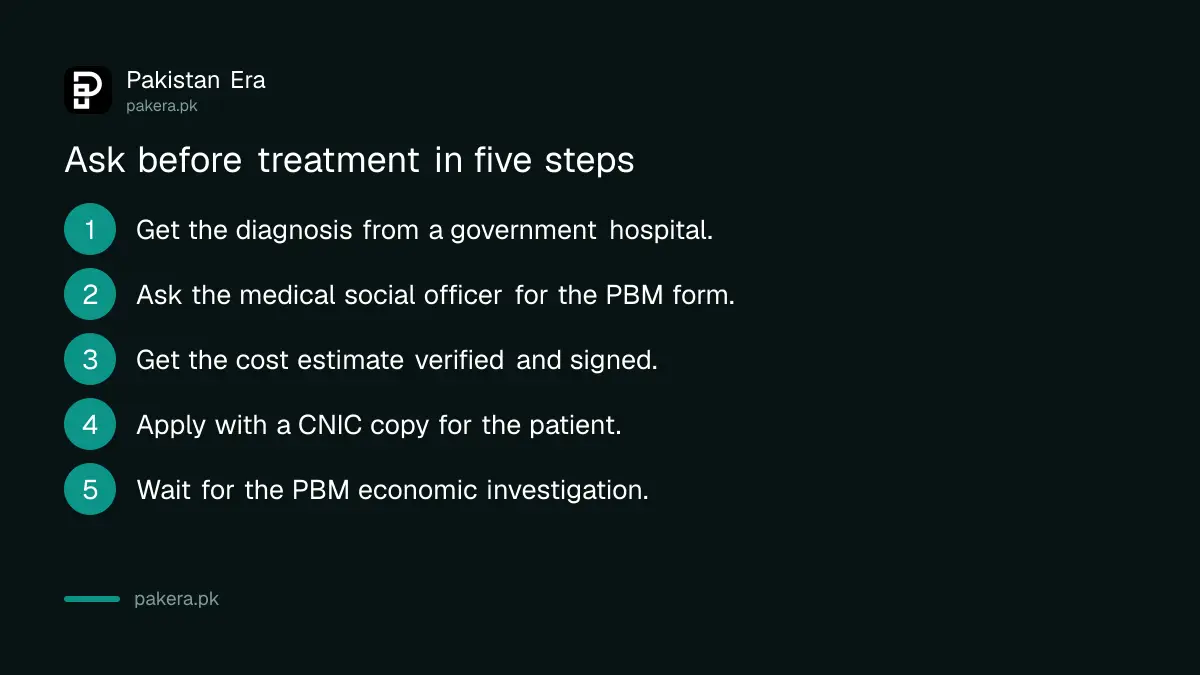
- Get the diagnosis and treatment plan from a government hospital consultant.
- Ask the hospital's medical social officer for the PBM clinical form for your condition.
- Have the cost estimate verified by the consultant, pharmacist, medical social officer and medical superintendent.
- Write the application with a CNIC copy, from the patient or a blood relation such as father, brother, sister, son or daughter.
- Submit it to the PBM provincial or regional office, and wait for the investigation of your economic status.
The policy says a fake estimate is the hospital committee's responsibility. So ask for the estimate on the PBM form and keep a copy. It also says medical help is given first come, first served, so a late application waits.
The hospital committee and the medical social officer do the filing
The policy asks government hospitals to form a committee of the concerned consultant, a budget and accounts officer, a pharmacist and a medical social officer. This committee picks cases with a better clinical outcome and sends them to PBM's provincial office.
The medical social officer is meant to be the single outlet in the hospital. That officer issues the PBM clinical forms for cancer, heart, hepatitis, surgical cases, medicines, hearing aids and limbs. Start with that desk, not the PBM district office.
The policy also says each hospital keeps a separate PBM account and a separate file for every PBM patient, and returns any unspent balance. So the grant is tracked. If a hospital says it has no PBM committee, ask whether the case can go through the provincial PBM office directly, and call 0800-66666.
Zakat or another body may already be paying
The PBM website bars applicants who already receive aid from another government organisation, and the policy's general stream names Zakat. Say so openly. A person who hides it risks recovery and a ban from PBM schemes, as the policy states for false declarations.
For a Punjab patient, Zakat's health help is explained in applying for Zakat help in Punjab. Compare both before you choose, because you may not be able to take both for the same bill.
Common questions
How much does Bait-ul-Mal pay for a kidney transplant?
The policy lists up to Rs 200,000 for kidney transplant cases, paid through government hospitals.
Can I claim back a bill I already paid?
No. The policy says no medical bills of past treatment are reimbursed out of PBM funds.
Does the grant pay for ICU or consultation?
The policy says hospital charges such as consultation, ICU, CCU and operation theatre are not to be deducted from PBM funds. Confirm with the hospital.
Who can apply for a patient?
The patient, or for a chronically ill patient a blood relation: father, brother, sister, son or daughter, with a CNIC copy.
Is Rs 1 million the usual amount?
No. That is the Managing Director's power in a hard case. The policy's ordinary medical line is up to Rs 300,000.
How we verified this
What we checked, where we read it, and what we could not confirm.
We read the Individual Financial Assistance policy PDF, including the medical procedure annexure, and the projects page on the Pakistan Bait-ul-Mal website on 12 October 2026. The policy carries board notes up to 2020. The Rs 1 million figure on the website and the Rs 300,000 and Rs 200,000 lines in the policy differ, so confirm the figure for your case with the hospital and the PBM office.
About the author

Public Services and Education Journalist
Fajr Riaz is a journalist and content writer at Pakistan Era, based in Lahore. She covers the questions people meet in everyday life in Pakistan: how a public service works, what a change in the rules means, and where to find a reliable answer.