Apply for Zakat Help in Punjab: Rs 2,000 a Month Rashan Card and Rs 50,000 Marriage Grant
Apply for Zakat help in Punjab at your Local Zakat Committee: Rs 2,000 a month Rashan Card, Rs 50,000 marriage grant and student stipends. Who qualifies, how.
In Punjab, you apply for Zakat help at the Local Zakat and Ushr Committee of the area where you live, not online. The Zakat and Ushr Department lists a Zakat Rashan Card of Rs 2,000 a month for the very poor, a Rs 50,000 marriage grant paid to a mobile wallet, and yearly stipends for students of Rs 5,000 to Rs 20,000.
We read each programme page on the Punjab Zakat and Ushr Department's website, zakat.punjab.gov.pk, on 2 October 2026. The money comes from Zakat collected under the Punjab Zakat and Ushr Act 2018. The committee in your own area decides whether you are a mustahiq, a person entitled to receive Zakat. That decision is called istehqaq.
Punjab has a lot of these committees. The department's own count runs from 323 in Jhelum to 1,387 in Faisalabad, with 1,284 in Lahore. There is almost certainly one near you.
Punjab Zakat pays four kinds of help
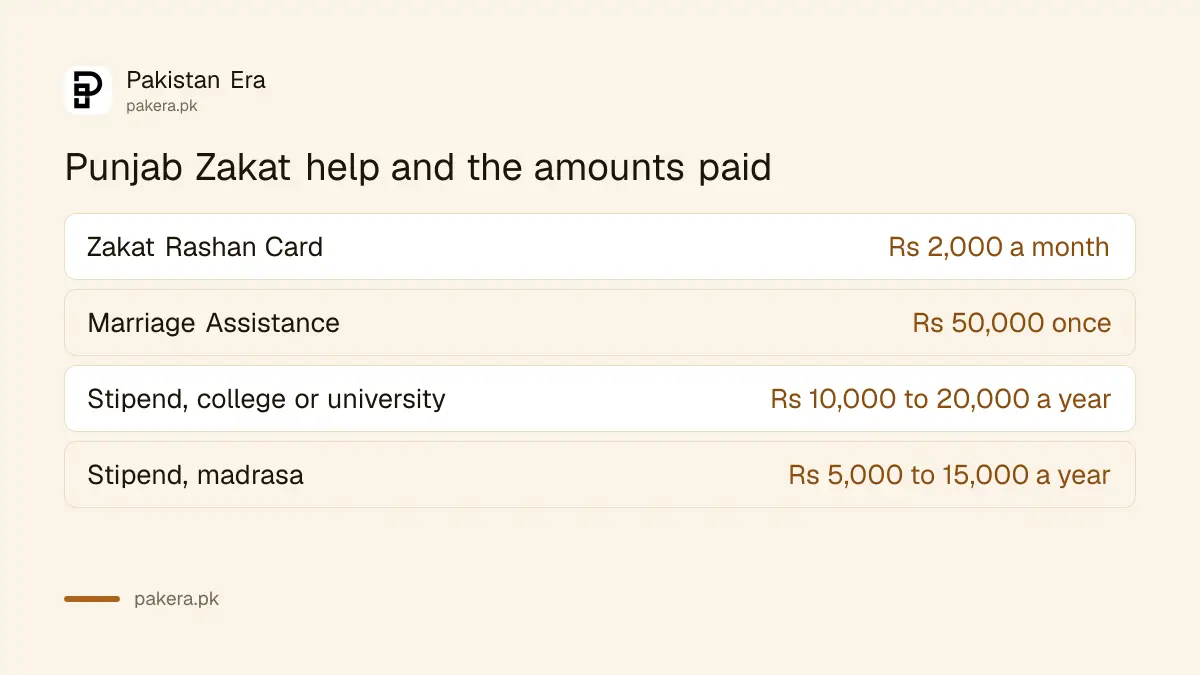
The Punjab Zakat and Ushr Department lists a monthly Rashan Card grant, a one-time marriage grant, general education stipends and stipends for students of registered religious schools. Each one is decided by your Local Zakat Committee first.
| Programme | Amount on the department's page | Where to apply |
|---|---|---|
| Zakat Rashan Card | Rs 2,000 a month | Local Zakat Committee of your area |
| Marriage Assistance | Rs 50,000, through a mobile wallet | Local Zakat Committee of your area |
| Education Stipend (General) | Rs 10,000 to Rs 20,000 a year | Head of your college or university |
| Education Stipend (Deeni Madaris) | Rs 5,000 to Rs 15,000 a year | Head (Mohtamim) of your madrasa |
The department also funds leprosy patients through one committee in Rawalpindi. That is a single programme, not one you apply to.
The Zakat Rashan Card is Rs 2,000 a month for the poorest
The Zakat Rashan Card pays Rs 2,000 a month to an adult Muslim below the poverty line who is unemployed and has no pension. It is paid through branchless banking after a thumbprint check. Only one person per household can get it.
The department calls it a grant for the "chronic poor", meant to protect them from hunger. Many people still call it Guzara Allowance, and the page address still uses that name. The page's rules are strict, and it helps to read them before you go:
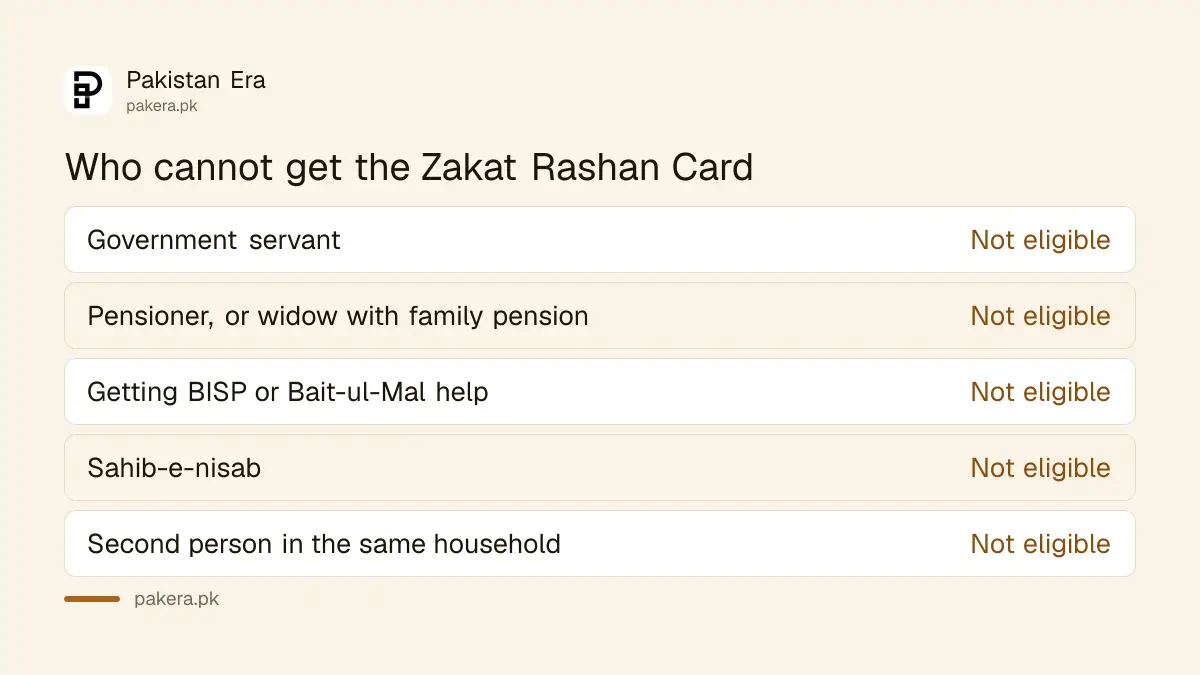
- You must be an adult Muslim, living below the poverty line, and entitled to Zakat under Shariah.
- You must be unemployed, and not a government servant, a pensioner or a habitual beggar.
- You must not be sahib-e-nisab, meaning you do not own wealth above the level that makes Zakat due on you.
- Orphans, widows, divorced women, people with disabilities and old people get preference.
- Widows who already get a family pension are not eligible.
The biggest catch is the last rule on the page. If you already receive help from Pakistan Bait-ul-Mal, Punjab Bait-ul-Mal, the Punjab Social Protection Authority, BISP or any other public body, you are not eligible. Choose the programme that suits you best, because you cannot stack them.
Apply for the Rashan Card in five steps
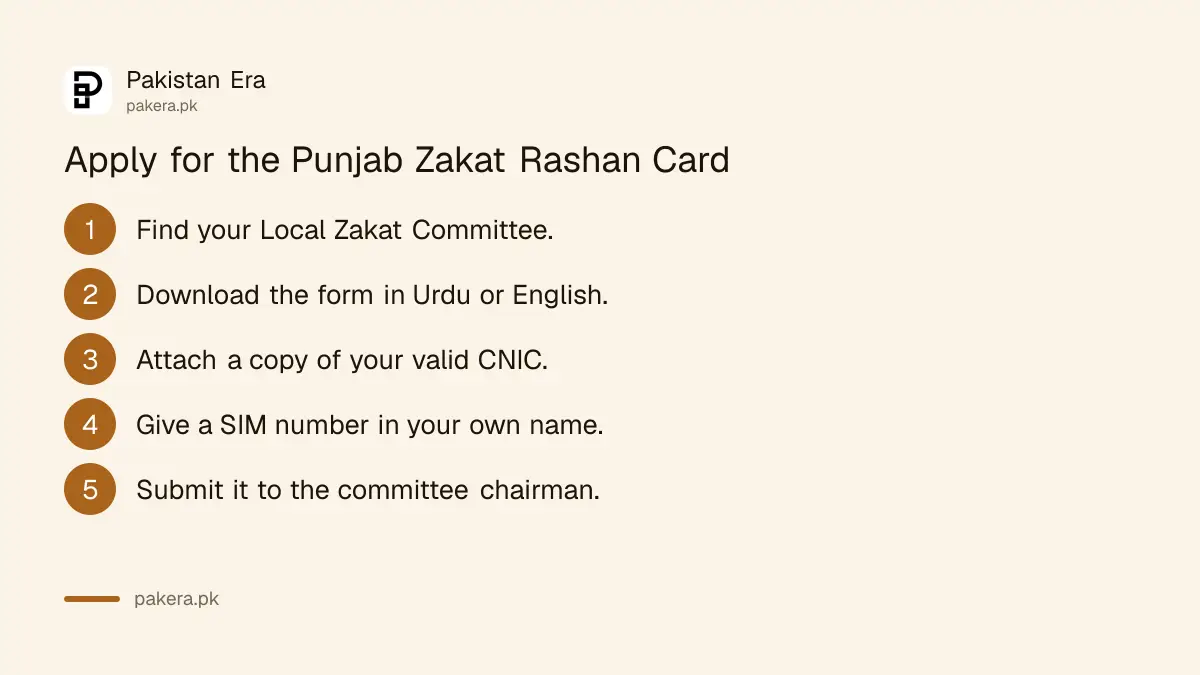
Get the form from the department's website, fill it in, and take it with your CNIC to the Chairman or Administrator of your Local Zakat Committee. The committee records its decision in its registers. Payment then reaches you through branchless banking.
- Find your committee. Ask at your union council, mosque or the District Zakat Office. Since district committees are not working at present, the department says the Deputy Commissioner acts as Administrator in each district.
- Download the form. The Rashan Card page has the form in Urdu and English.
- Attach your CNIC copy. Your CNIC must be valid.
- Use a SIM in your own name. The page says the mobile number you give must be registered against your CNIC. Payment depends on it.
- Submit to the committee. The Chairman or Administrator decides your istehqaq. Ask that your name be entered in the committee's Istehqaq Register, form LZ-19, and its Resolution Register.
The committee can reject you. The page says so plainly: it looks at your financial condition and "may determine or reject" your case. There is no online application, so be wary of anyone selling one.
The marriage grant is Rs 50,000 through a mobile wallet
Punjab's Zakat marriage grant pays Rs 50,000 to a poor unmarried woman, or to her parent or guardian, who cannot afford the wedding. You apply at your Local Zakat Committee, and the money is paid through branchless banking.
The Local Zakat Committee checks your case and passes it to the District Zakat Committee, which releases the money. The form is on the department's Marriage Assistance page in Urdu and English.
Families of registered industrial and mine workers have a separate and larger workers' marriage grant. It is paid by the Punjab Workers Welfare Fund, so check that first if a parent is a registered worker.
Students apply through their own institution
Students do not go to the Local Zakat Committee alone. A poor student applies to the head of a government-recognised college, university or registered madrasa in Punjab. The committee confirms entitlement, and the institution pays the stipend.
The general stipend is Rs 10,000 a year at intermediate level, Rs 15,000 for BS, graduate and postgraduate study, and Rs 20,000 for engineering, medical and computer science. An institution committee of the head, the class teacher and a District Zakat nominee endorses each case.
For religious schools, the madrasa must be registered with the Zakat and Ushr Department and cleared by the Punjab Home Department. Stipends are Rs 5,000 a year for Hifz and Nazira, Rs 9,000 for Mouqoof Aleh and Rs 15,000 for Daura Hadith, paid in cash by the madrasa.
Zakat on your own bank savings is a separate matter. If you want to stop the bank deducting it, that is done with a CZ-50 declaration.
Common questions
Can I apply for Zakat online in Punjab?
No. The department's pages say you apply to your Local Zakat and Ushr Committee for the Rashan Card and marriage grant, and to your institution for stipends.
How much is the Zakat Rashan Card?
Rs 2,000 a month, according to the Punjab Zakat and Ushr Department's page, paid through branchless banking after a thumbprint check.
Can I get the Rashan Card and BISP together?
No. The page says anyone already receiving help from BISP, Bait-ul-Mal or another public body is not eligible.
Who decides if I deserve Zakat?
The Chairman or Administrator of the Local Zakat Committee where you live. The decision is called istehqaq.
Is the CM Punjab Rahmat Card the same thing?
No. The Rahmat Card is a separate scheme run by the same department, with its own registration.
Who do I call if my committee does not respond?
The Administrator Zakat and Ushr Punjab, 2-Court Street, Lahore, on 042-99210697, as listed on the department's contact page.
How we verified this
What we checked, where we read it, and what we could not confirm.
Last checked on 2 October 2026. We read the Punjab Zakat and Ushr Department's pages for the Zakat Rashan Card, Marriage Assistance, both Education Stipend programmes, Local and District Zakat Committees, and Contact Us. All amounts are as shown on those pages on that day. The Rashan Card page also mentions October 2014 as the date payment moved to branchless banking, so the Rs 2,000 rate may not be recent; ask your committee to confirm it. We did not visit a committee or submit a form.
About the author

Public Services and Education Journalist
Fajr Riaz is a journalist and content writer at Pakistan Era, based in Lahore. She covers the questions people meet in everyday life in Pakistan: how a public service works, what a change in the rules means, and where to find a reliable answer.