Defence Savings Certificate Profit Rate History in Pakistan: Every Change From 2000 to 21 October 2026 (Full List)
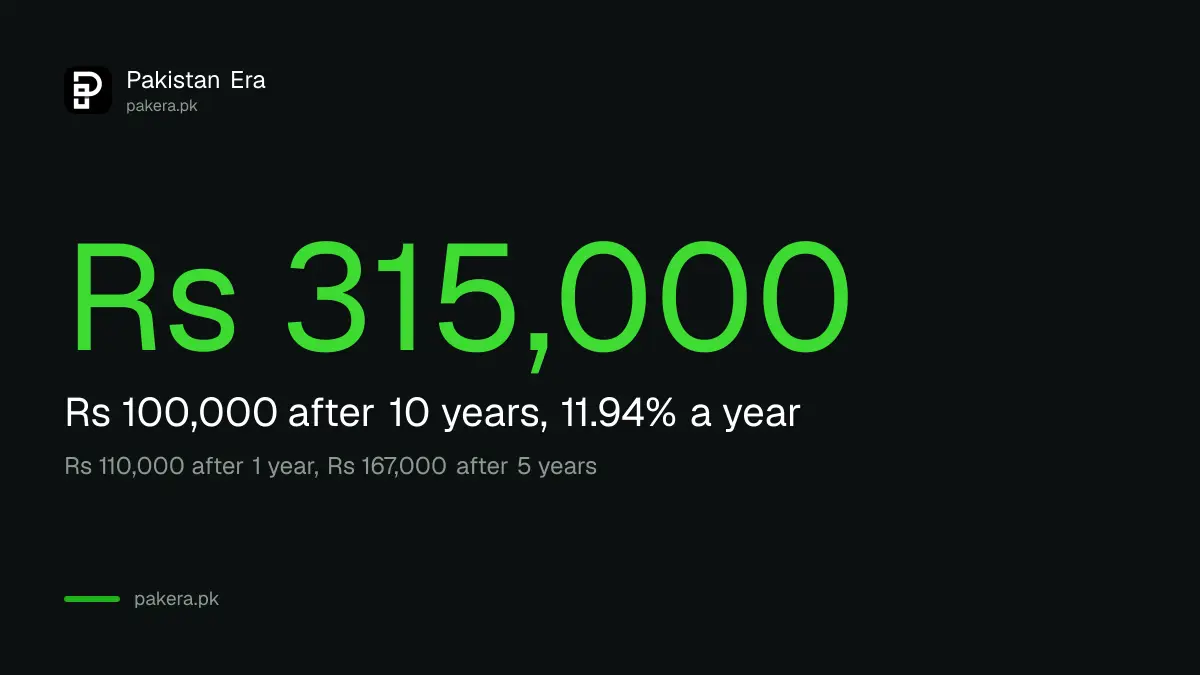
Defence Savings Certificate rate is 11.94% from 21 October 2026, so Rs 100,000 becomes Rs 315,000 in 10 years. See every change since 2023 and highs since 2000.
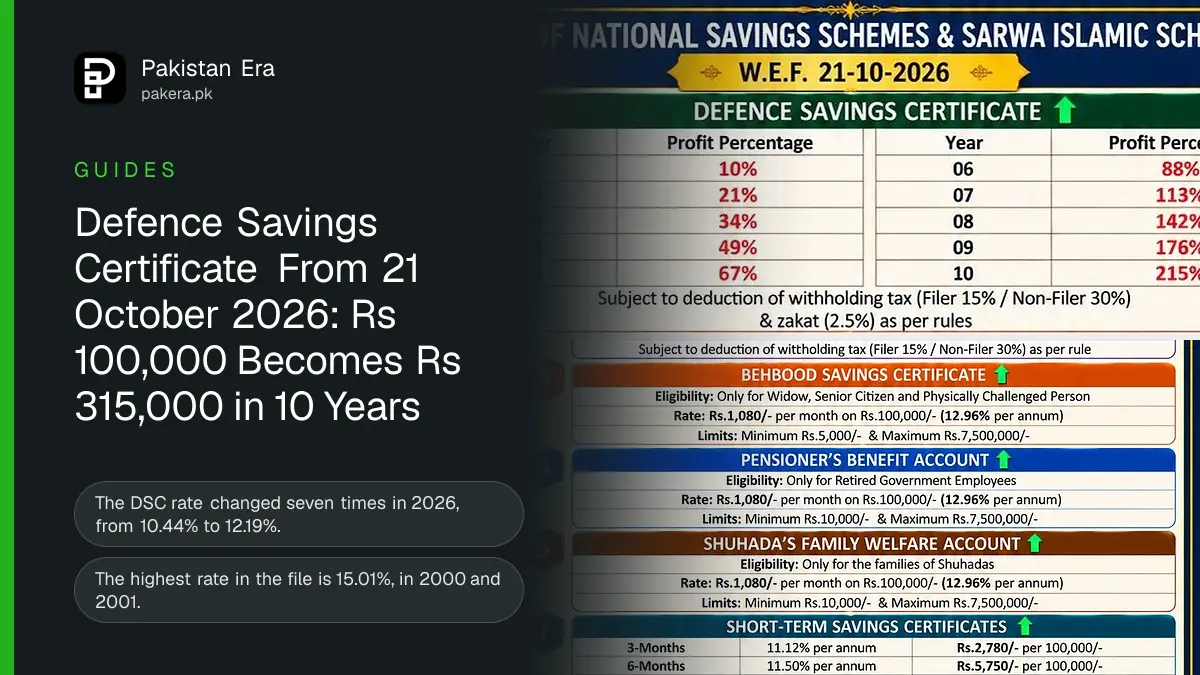
A Defence Savings Certificate bought from 21 October 2026 grows Rs 100,000 to Rs 315,000 in 10 years, a rate National Savings lists as 11.94% a year. Below is every Defence Savings Certificate (DSC) rate change since 2023, the highs and lows since January 2000, and what each one meant for Rs 100,000 held to maturity.
We downloaded National Savings' own DSC history file from savings.gov.pk on 12 November 2026. It lists every rate period from 1 January 2000 to date, with the value of Rs 100,000 at the end of each of the 10 years.
The DSC rate is 11.94% from 21 October 2026
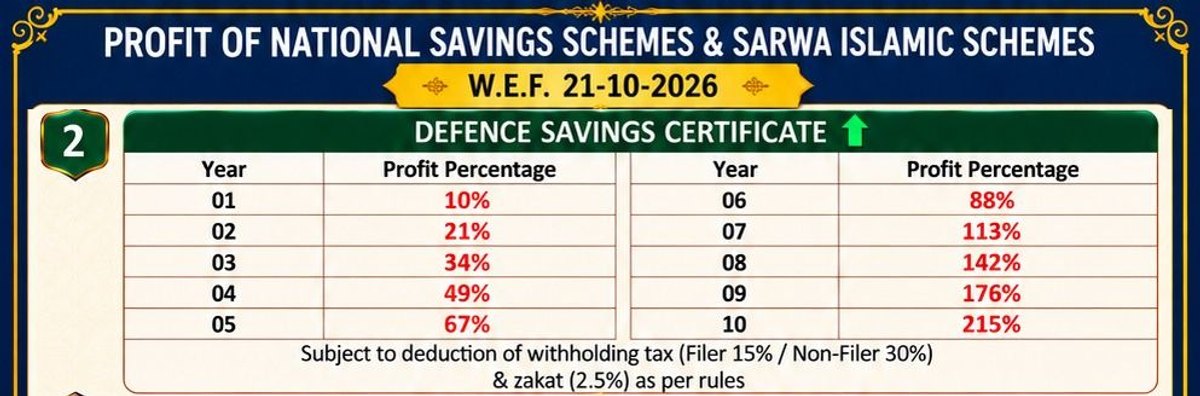
From 21 October 2026, Rs 100,000 in a Defence Savings Certificate becomes Rs 315,000 after 10 years. National Savings lists this as 11.94% a year. Before that, from 1 to 20 October, the same Rs 100,000 would have grown to Rs 305,000 (11.80%).
The rate card prints the same thing as a profit percentage for each year. After year 1 you have earned 10%, after year 5 67%, and after year 10 215%. In rupees, that is Rs 110,000 after one year, Rs 167,000 after five and Rs 315,000 after ten.
The DSC is a 10 year certificate. There is no monthly or yearly payout. The whole profit is added to the value and paid when you cash the certificate.
Every DSC rate change since April 2023: the full list
The table shows each period in the file from April 2023, newest first. The value columns are for Rs 100,000 at the end of year 1, year 5 and year 10.
| From | To | Rate | After 1 year | After 5 years | After 10 years |
|---|---|---|---|---|---|
| 21 Oct 2026 | Till date | 11.94% | Rs 110,000 | Rs 167,000 | Rs 315,000 |
| 1 Oct 2026 | 20 Oct 2026 | 11.80% | Rs 110,000 | Rs 166,000 | Rs 305,000 |
| 4 Sep 2026 | 30 Sep 2026 | 11.61% | Rs 110,000 | Rs 163,000 | Rs 300,000 |
| 18 Jul 2026 | 3 Sep 2026 | 11.94% | Rs 110,000 | Rs 166,000 | Rs 309,000 |
| 10 Jun 2026 | 17 Jul 2026 | 12.19% | Rs 110,000 | Rs 167,000 | Rs 316,000 |
| 23 Jan 2026 | 9 Jun 2026 | 10.44% | Rs 107,000 | Rs 148,000 | Rs 270,000 |
| 5 Jan 2026 | 22 Jan 2026 | 11.08% | Rs 109,000 | Rs 158,000 | Rs 286,000 |
| 4 Nov 2025 | 4 Jan 2026 | 11.31% | Rs 109,000 | Rs 158,000 | Rs 292,000 |
| 17 Sep 2025 | 3 Nov 2025 | 11.42% | Rs 109,000 | Rs 158,000 | Rs 295,000 |
| 21 Aug 2025 | 16 Sep 2025 | 11.54% | Rs 109,000 | Rs 158,000 | Rs 298,000 |
| 28 Jul 2025 | 20 Aug 2025 | 11.61% | Rs 109,000 | Rs 158,000 | Rs 300,000 |
| 27 Jun 2025 | 27 Jul 2025 | 11.76% | Rs 109,000 | Rs 158,000 | Rs 304,000 |
| 19 May 2025 | 26 Jun 2025 | 11.91% | Rs 109,000 | Rs 158,000 | Rs 308,000 |
| 20 Mar 2025 | 18 May 2025 | 12.12% | Rs 109,000 | Rs 160,000 | Rs 314,000 |
| 25 Feb 2025 | 19 Mar 2025 | 12.01% | Rs 107,000 | Rs 152,000 | Rs 311,000 |
| 14 Feb 2025 | 24 Feb 2025 | 12.12% | Rs 109,000 | Rs 160,000 | Rs 314,000 |
| 31 Jan 2025 | 13 Feb 2025 | 11.98% | Rs 109,000 | Rs 158,000 | Rs 310,000 |
| 10 Dec 2024 | 30 Jan 2025 | 12.19% | Rs 109,000 | Rs 159,000 | Rs 316,000 |
| 4 Nov 2024 | 9 Dec 2024 | 12.26% | Rs 109,000 | Rs 159,000 | Rs 318,000 |
| 25 Sep 2024 | 3 Nov 2024 | 12.51% | Rs 108,000 | Rs 156,000 | Rs 325,000 |
| 14 May 2024 | 24 Sep 2024 | 13.57% | Rs 112,000 | Rs 175,000 | Rs 357,000 |
| 19 Mar 2024 | 13 May 2024 | 13.76% | Rs 112,000 | Rs 175,000 | Rs 363,000 |
| 21 Feb 2024 | 18 Mar 2024 | 13.67% | Rs 112,000 | Rs 175,000 | Rs 360,000 |
| 26 Jan 2024 | 20 Feb 2024 | 14.22% | Rs 112,000 | Rs 180,000 | Rs 378,000 |
| 19 Dec 2023 | 25 Jan 2024 | 14.34% | Rs 112,000 | Rs 180,000 | Rs 382,000 |
| 30 Oct 2023 | 18 Dec 2023 | 14.46% | Rs 112,000 | Rs 185,000 | Rs 386,000 |
| 10 Apr 2023 | 29 Oct 2023 | 14.87% | Rs 112,000 | Rs 185,000 | Rs 400,000 |
The rate changed seven times in 2026: on 5 January, 23 January, 10 June, 18 July, 4 September, 1 October and 21 October. The 10 year value moved between Rs 270,000 and Rs 316,000 in that time.
One detail in the file is worth knowing. The rate column shows 11.94% for both 18 July and 21 October 2026, but the 10 year value is Rs 309,000 in July and Rs 315,000 now. The value columns are what National Savings pays, so read those, not the percentage.
The highest DSC rate was 15.01%, in 2000 and 2001
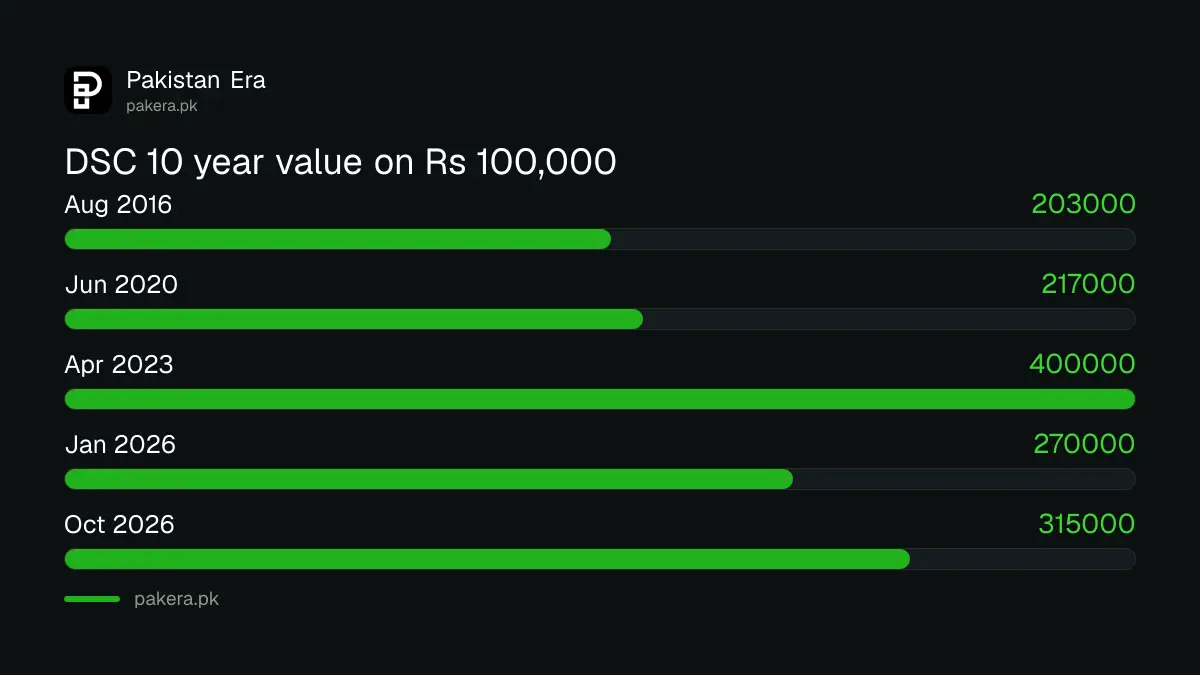
The file starts on 1 January 2000, when the DSC paid 15.01% and Rs 100,000 grew to Rs 405,000 in 10 years. The same 15.01% came back from July to December 2001. The lowest was 7.34%, from August to September 2016, when Rs 100,000 grew to only Rs 203,000.
| Moment | Rate | Rs 100,000 after 10 years |
|---|---|---|
| January to June 2000 (start of the file) | 15.01% | Rs 405,000 |
| June 2008 to September 2010 | 12.16% | Rs 315,000 |
| January to September 2011 | 13.54% | Rs 356,000 |
| August to September 2016 (lowest) | 7.34% | Rs 203,000 |
| July to October 2019 | 13.02% | Rs 340,000 |
| June 2020 | 8.06% | Rs 217,000 |
| April to October 2023 (recent high) | 14.87% | Rs 400,000 |
| 23 January to 9 June 2026 (2026 low) | 10.44% | Rs 270,000 |
| From 21 October 2026 | 11.94% | Rs 315,000 |
Today's Rs 315,000 is the same 10 year value the DSC paid from June 2008 to September 2010. It is well below the Rs 400,000 of 2023, when the State Bank's policy rate was at its peak. The policy rate history shows the same fall and rise.
What the changes mean for Rs 10 lakh held 10 years
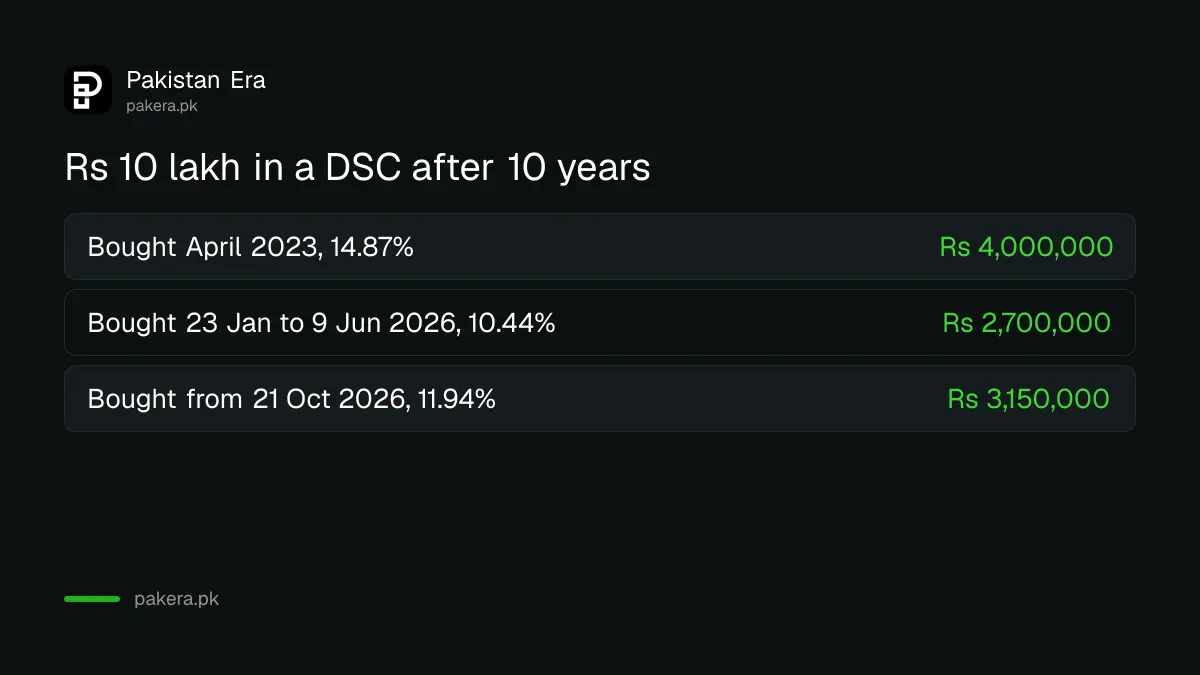
Multiply the Rs 100,000 figure by ten. Rs 1,000,000 bought from 21 October 2026 becomes Rs 3,150,000 after 10 years, before tax. Bought at the 2026 low, between 23 January and 9 June, it would have become Rs 2,700,000.
That is a gap of Rs 450,000 on the same Rs 10 lakh, decided only by the month you bought. Bought at the April 2023 high, it would have become Rs 4,000,000.
Tax comes off the profit, not the whole amount. National Savings' DSC page says withholding tax is 15% of the profit for people on the Active Taxpayer List and 30% for others. Zakat is deducted at source as per rules. On Rs 2,150,000 of profit, a filer's 15% is Rs 322,500, which leaves Rs 2,827,500, by our arithmetic.
How to check the DSC rate for your own certificate
National Savings publishes the current rate card and the full DSC history file. Both are free.
- Open the National Savings latest profit rates page.
- Look at the rate card for today's DSC year by year profit.
- Open the Defence Savings Certificate historical profit rates PDF linked on the same page.
- Find the row whose From and To dates cover the date you bought your certificate.
- Read across to the year you are in, then multiply by your amount in lakh.
The year by year value of a certificate bought now is set out in our DSC value by year table. How to buy one, and the papers you need, are in buying Defence Savings Certificates.
Common questions
What is the Defence Savings Certificate rate today?
11.94% a year from 21 October 2026, which turns Rs 100,000 into Rs 315,000 after 10 years.
How many times did the DSC rate change in 2026?
Seven times: 5 January, 23 January, 10 June, 18 July, 4 September, 1 October and 21 October 2026.
What was the highest DSC rate ever?
In the file from 2000, the highest was 15.01% a year, when Rs 100,000 grew to Rs 405,000 in 10 years. It applied in the first half of 2000 and again in the second half of 2001.
Does a new rate change my old certificate?
The history file lists a value table for each purchase period, which suggests a certificate keeps the table of the period it was bought in. National Savings does not say this in words, so confirm it with your centre.
Can I cash a DSC before 10 years?
Yes. National Savings says a DSC can be cashed at par any time, but no profit is paid if you cash it before one full year.
What is the minimum amount for a DSC?
Rs 500, with no upper limit, according to the National Savings DSC page.
How we verified this
What we checked, where we read it, and what we could not confirm.
Last checked 12 November 2026. Every rate, period and value comes from National Savings' Defence Savings Certificate history file (DSC_211026_update.pdf) and its rate card dated 21 October 2026, both on savings.gov.pk. Purchase, encashment and tax rules come from the National Savings DSC product page, read the same day. The Rs 10 lakh and tax figures are our arithmetic. National Savings does not give a reason for any change.
About the author

Senior Writer, Public Services and Technology
Shahid joined us in 2024 as an author. He is a senior contributor to Pakistan's leading technology websites. He writes detailed articles, mostly covering his expertise in the latest tech, mobiles, apps, gadgets, and step-by-step guides. His ideology is to help people understand the latest trends and explain complex methods through very easy-to-understand guides.