How to Stop Zakat Deduction From Your Bank Account in Pakistan
Stop Zakat deduction in Pakistan with a sworn CZ-50 declaration filed 30 days before 1 Ramazan. Who qualifies, the Rs 503,529 nisab, and how refunds work.
To stop your bank deducting Zakat, file a sworn declaration on Form CZ-50 with your bank at least 30 days before 1 Ramazan. Ramazan 1448 is expected in early February 2027, so file in December 2026. Savings balances below the nisab, Rs 503,529 this year, are not deducted at all.
The deduction is 2.5 per cent of the balance in savings and profit and loss sharing accounts on the first day of Ramazan. It happens once a year, on one morning, and many account holders only notice it afterwards.
We read the Zakat and Ushr Ordinance, 1980, the Zakat (Collection and Refund) Rules, 1981, the provincial Zakat Acts, and the 2026 nisab notification sent to banks through the State Bank of Pakistan on 27 September 2026.
Which bank accounts have Zakat deducted
Zakat is cut at source from savings accounts, profit and loss sharing accounts and similar accounts, plus some fixed deposits and savings certificates. Current accounts and foreign currency accounts are not cut at source. Those are left to your own assessment.
The First Schedule of the 1980 Ordinance lists the assets banks deduct from. For a savings account, the rate is 2.5 per cent of the balance "at the commencement of the day on the Valuation Date", which the Ordinance defines as the first day of the Zakat year, 1 Ramazan.
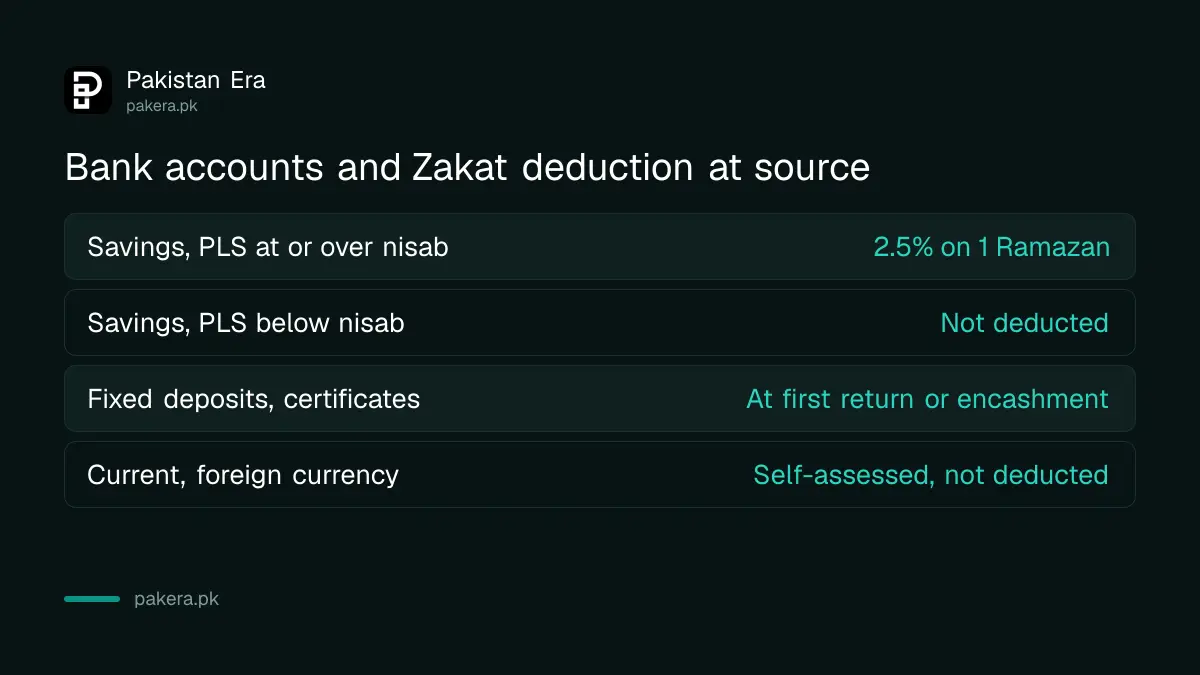
| Account or asset | Deducted by the bank? |
|---|---|
| Savings and PLS accounts, balance at or above the nisab | Yes, 2.5 per cent on 1 Ramazan |
| Savings and PLS accounts, balance below the nisab | No |
| Fixed deposits and savings certificates | Yes, when the first return is paid or on encashment |
| Current accounts and foreign currency accounts | No, self-assessed |
| Assets bought with foreign currency, or held and paid out in foreign currency | No |
So moving money into a current account is not evasion. The law itself puts current accounts in the Second Schedule, where Zakat is paid "on self-assessment basis", not taken by the bank. Banks also shut for the day of deduction, which is why bank timings in Ramazan list 1 Ramazan as a bank holiday.
The nisab for 2026 is Rs 503,529
The Administrator General Zakat notified the nisab for Zakat year 1446-47 AH at Rs 503,529. Banks do not deduct from a savings account whose balance on 1 Ramazan is below that. Last year it was Rs 179,689.
The Ministry of Poverty Alleviation and Social Safety sent the figure to the State Bank on 16 February 2026. The State Bank passed it to banks in BPRD Circular Letter No. 03 of 2026, dated 17 February 2026. The Punjab Zakat and Ushr Department shows the same figure on its website.
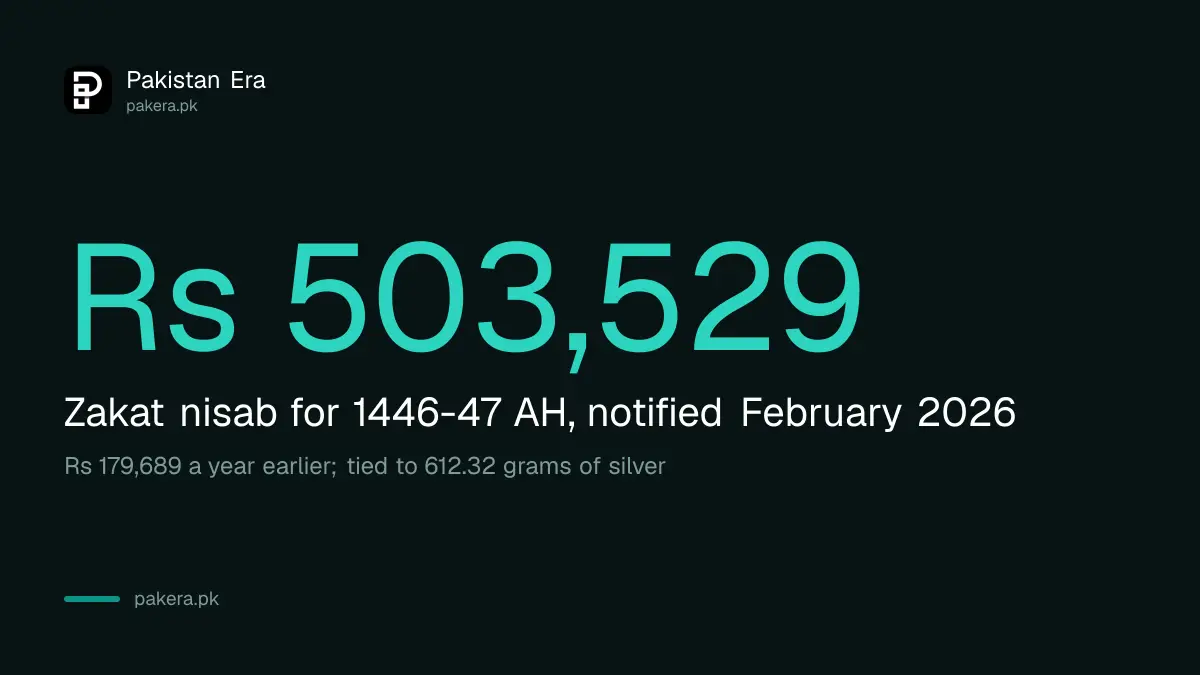
The nisab is tied to silver. The Ordinance defines it as the value of 612.32 grams of silver, notified for each Zakat year. For a person whose Zakat assets are only gold, it is 87.48 grams of gold, about 7.5 tola. The silver link is why it almost tripled in one year, from Rs 179,689 in February 2025. The figure for Ramazan 1448 will be notified shortly before it starts, so do not assume it stays at Rs 503,529.
Who can stop the deduction with Form CZ-50
A Muslim citizen can stop compulsory deduction by swearing that, under his faith and the fiqh he follows, he is not obliged to pay Zakat in the way the law lays down. Non-Muslims and foreign citizens are outside the law and do not need the form.
Section 1(3) of the Ordinance sets out the declaration. You must state that you are a Muslim, name your fiqh, and state that your faith and fiqh do not oblige you to pay the whole or any part of Zakat in the manner the Ordinance sets. The law does not list which fiqhs qualify. That is your declaration, made on oath.
The Federal Shariat Court can, on anyone's application, decide whether a declaration is valid under the fiqh it names. If it rules that it is not, the person becomes liable to pay.
Section 1(2) applies the Ordinance, for payment and recovery, "only to Muslim citizens of Pakistan". Section 3(3) says anyone who proves they are not a Muslim, or not a citizen, gets back what was deducted. If that is you, ask your branch what Zakat status your account carries.
How to file the CZ-50 declaration with your bank
Write the declaration on stamp paper, swear it before an oath commissioner, notary or magistrate with two witnesses who identify you, and hand it to your bank branch at least 30 days before 1 Ramazan. Keep an attested copy.
- Get the stamp paper. Form CZ-50 is sworn on stamp paper. See issuing an e-stamp paper for how to buy one now.
- Fill in Form CZ-50. Your name, your father's or husband's name, age, address, fiqh, and the assets you are declaring for.
- Swear it with two witnesses. Before a magistrate, oath commissioner, notary public or anyone else allowed to give an oath. The two witnesses sign that they know you.
- Submit it to your bank. The law says the declaration goes to the "Deducting Agency", which is the bank branch that holds the account.
- Get it acknowledged. Ask the branch to stamp your copy, and to confirm your account is marked exempt before Ramazan.

The copy of the Rules on the Ministry's website, corrected to September 1989, prints "On Rs. 4 Stamp Paper" at the top of the form. That value is decades old. Ask your bank which stamp value it accepts today.
Filing rules that trip people up
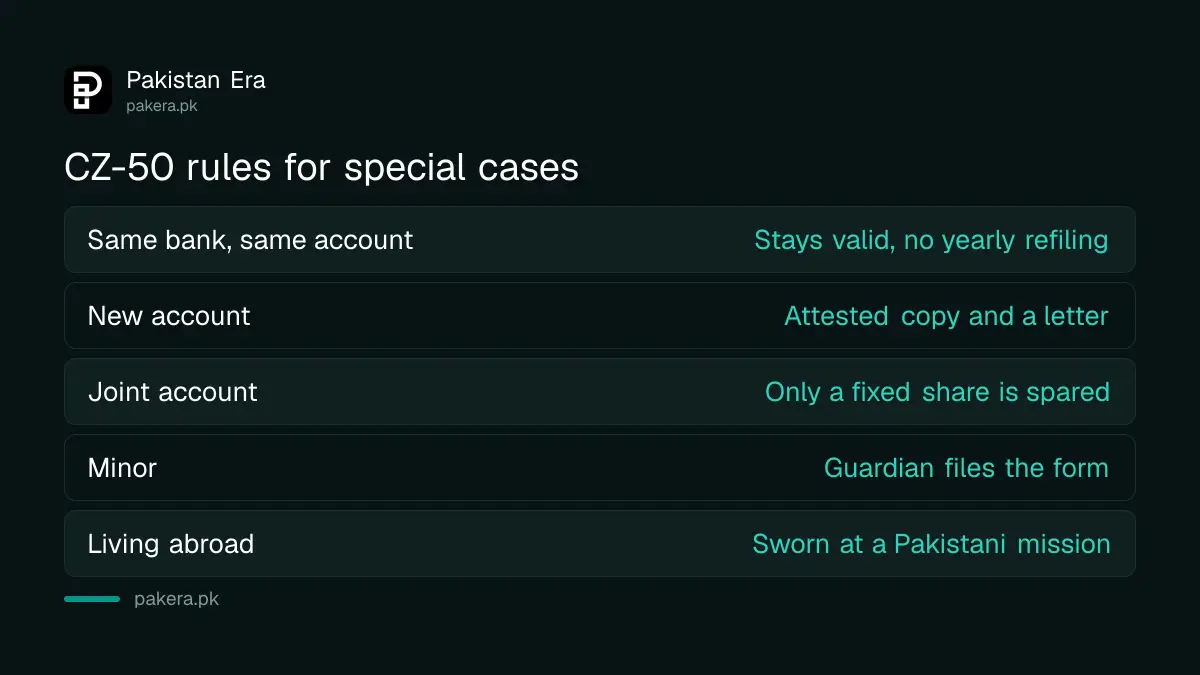
One declaration lasts for as long as the bank holds it and the account stays open. A new account at a new bank needs its own copy. Joint accounts, minors and Pakistanis abroad each have their own rule in the 1981 Rules.
- It does not expire each year. Section 1(3)(b) keeps it valid while the declaration and the asset stay with the same bank.
- A new account needs paperwork. Rule 20 says to give an attested copy with a letter listing the new account before 1 Ramazan.
- Joint accounts. If only one holder files and the shares are fixed in advance, only that share is spared. Otherwise Zakat is deducted from the whole account.
- Minors. The guardian makes the declaration. The form's note says a minor is taken to follow the father's fiqh.
- Living abroad. You can swear it before a Pakistani diplomatic or consular officer in that country.
Missed the deadline and still want a refund
If Zakat was deducted, you can still claim it back. The law allows a refund for a valid declaration, for people who are not Muslim or not citizens, and for anyone who was not holding nisab for the whole previous year.
Section 3(3) of the 1980 Ordinance lists these grounds. In Punjab, the Punjab Zakat and Ushr Act, 2018 adds a clock. The claim must be made within 90 days of the deduction, or the money is treated as sadaqah. The Council must decide the claim within 60 days.
Since the 18th Amendment, the provinces make their own Zakat laws. Punjab's 2018 Act and Sindh's 2011 Act both repeal the 1980 Ordinance in their province and repeat the 30-day declaration rule. Balochistan repealed its 2012 Zakat Act by an ordinance on 15 May 2026 and moved Zakat work to its Board of Revenue. We could not confirm whether that ordinance has since become an Act.
If your branch ignores a declaration you filed in time, raise it with the bank in writing first. A bank that still does nothing can be taken to the Banking Mohtasib.
Common questions
What is the last date to submit CZ-50 for 2027?
At least 30 days before 1 Ramazan 1448. Ramazan is expected in early February 2027, subject to the moon, so submit in December 2026 to be safe.
What is the Zakat nisab in 2026?
Rs 503,529 for Zakat year 1446-47 AH, notified by the Administrator General Zakat. Savings accounts below that on 1 Ramazan are not deducted.
Is Zakat deducted from current accounts?
No. Current accounts and foreign currency accounts are in the Second Schedule, which is paid on self-assessment, not deducted by the bank.
Do I have to file CZ-50 every year?
No. It stays valid while the declaration and the account remain with the same bank. A new account elsewhere needs a new attested copy.
Do non-Muslims need to submit CZ-50?
No. The Ordinance applies only to Muslim citizens for payment. A non-Muslim whose account was deducted can prove it and claim a refund under section 3(3).
Can I get Zakat back after it was deducted?
Yes, on the grounds in section 3(3). In Punjab the claim must be made within 90 days of the deduction.
How we verified this
What we checked, where we read it, and what we could not confirm.
Last checked on 27 September 2026. Sections 1(2), 1(3), 1(3A), 2 (nisab, sahib-e-nisab, Valuation Date, Zakat year), 3 and the First and Second Schedules are read in the Zakat and Ushr Ordinance, 1980 on the Pakistan Code. Rule 20 and Form CZ-50 are read in the Zakat (Collection and Refund) Rules, 1981, corrected to September 1989, on the Ministry of Poverty Alleviation and Social Safety website at pass.gov.pk. The Rs 503,529 nisab is read in the Ministry's notification of 16 February 2026, attached to State Bank BPRD Circular Letter No. 03 of 2026, and on zakat.punjab.gov.pk. The Rs 179,689 figure is from the notification of 26 February 2025 attached to BPRD Circular Letter No. 04 of 2025. The Punjab Zakat and Ushr Act, 2018 is read on the Punjab Code, the Sindh Zakat and Ushr Act, 2011 on the Sindh Code, and the Balochistan Zakat and Ushr (Repeal) Ordinance, 2026 in the Balochistan Gazette of 15 May 2026 on the Balochistan Code. The February 2027 date for Ramazan is an estimate, not an official date. We did not file a declaration ourselves.
About the author

Tax, Bills and Technology Writer
Ali Akhtar is a young and curious voice here at Pakistan Era. He is currently pursuing his A-Levels and has a growing interest in Pakistan’s changing industrial landscape and educational trends. Ali likes to write in a way that helps him explain and explore the world around him. His writing reflects the perspective of the new generation navigating the evolving trends of Pakistan where technology, youth innovation, and shifting opportunities are reshaping the country’s future.