Tax on Bank Profit and Savings in Pakistan
Tax is deducted before profit reaches you, on bank deposits, National Savings and Post Office accounts. Why your return looks lower.
Tax is deducted from the profit your savings earn before it reaches you. It applies to bank deposits, National Savings certificates and Post Office savings accounts alike.
The figure you see credited is already net of it, which is why the return people quote and the return they actually receive rarely match.
We read section 151 of the Income Tax Ordinance, 2001 on 2 September 2026, in the consolidated text FBR publishes on its own download site.
What the section covers
Section 151 is headed Profit on debt, which is the legal term for what most people call profit, yield, return or interest.
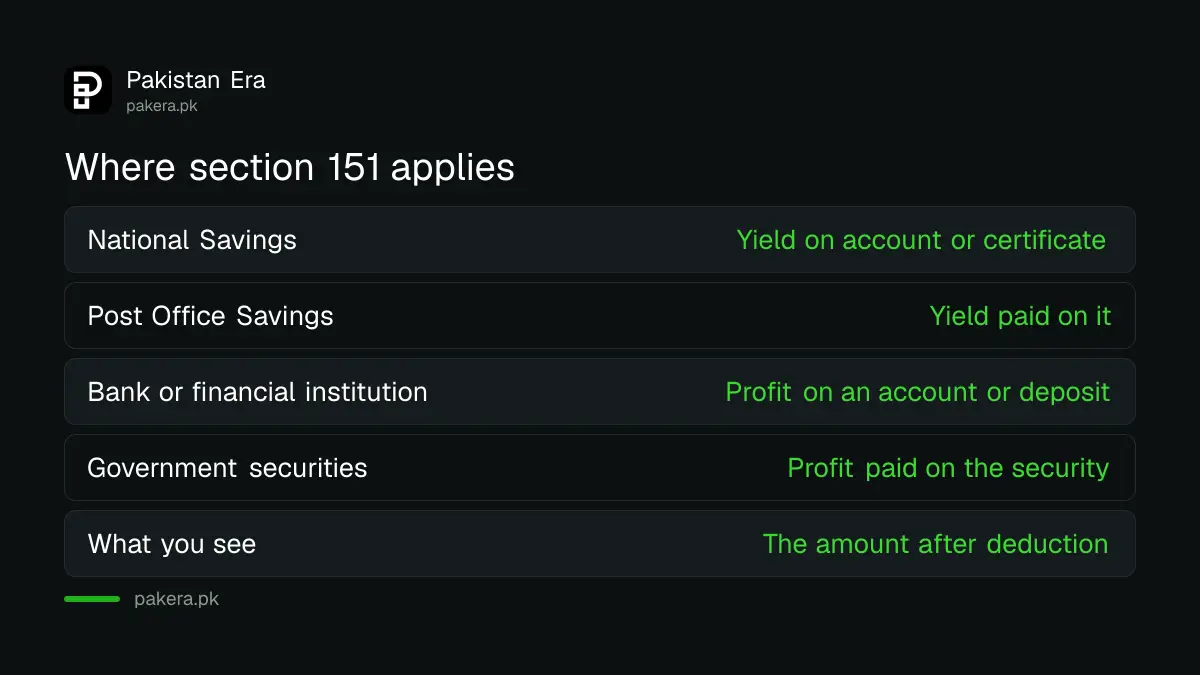
| Where the money is | Covered by section 151 |
|---|---|
| National Savings Scheme account, deposit or certificate | Yield paid on it |
| Post Office Savings Account | Yield paid on it |
| Bank or financial institution account or deposit | Profit paid on it |
| Federal, Provincial or Local Government security | Profit paid on it |
So the coverage is broad. Moving savings from a bank to National Savings does not step outside the section, and neither does buying a government security.
Why your actual return is lower than the rate
Advertised rates are gross. The deduction happens at the point the profit is paid, so what lands in the account is what remains afterwards.
This matters when comparing products. A certificate advertising one rate and a bank account advertising another are not comparable until you know what is deducted from each and at what point. Compare what actually reaches you.
Our guide to National Savings profit rates covers the published rates on those products, and this section explains why the credited amount differs from them.
Get the certificate every year
Whatever is deducted has to be deposited against your identity, and the certificate is your proof that it was.
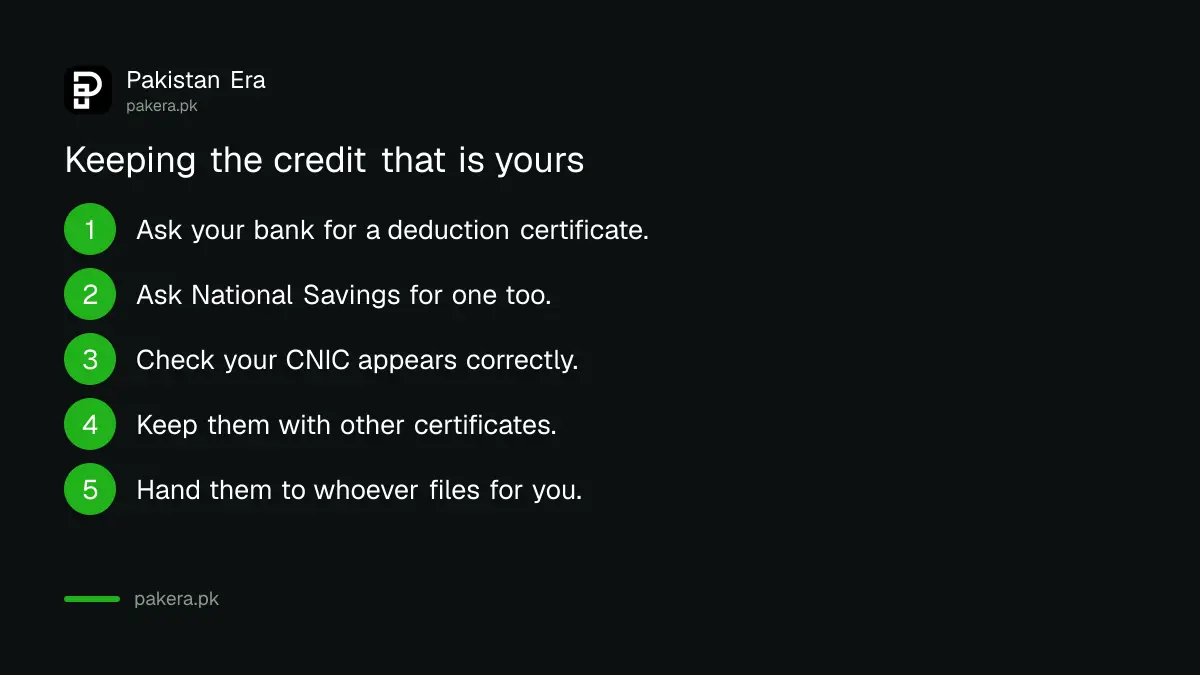
- Ask your bank for a tax deduction certificate for the tax year.
- Ask the National Savings centre for one if you hold certificates there.
- Check your CNIC appears on each of them correctly.
- Keep them with your other withholding certificates.
- Hand them to whoever prepares your return.
This is the same failure that repeats across every withholding tax we have written about. The money is taken, but if the deposit does not carry your identifier the credit never attaches to you, and no institution will chase it for you.
It is also worth giving these certificates to your employer, because section 149 requires your monthly salary deduction to be made after adjusting tax withheld from you under other heads, on documentary evidence. Our guide to how salary tax is deducted sets that out.
Filing decides whether any of it comes back
Tax deducted at source is only useful to somebody who files. If you never file a return, the deduction is simply a cost you carry.
Being off the Active Taxpayer List makes it worse still, because no refund is issued while a person is off the list. Our guide to the ATL surcharge and the 30 September deadline covers that and what returning to the list now costs.
For pensioners and others living on savings income, this is worth taking advice on rather than accepting. The deduction is automatic, the recovery is not.
Banks report more than the deduction
Separately from this section, banks report certain account information to FBR. That is a different obligation and it is worth understanding alongside the deduction, because people often conflate the two.
Our guide to what banks report to FBR covers what is and is not shared, and when.
The rate is not in this section
Section 151 sets out where the deduction applies. The rate sits elsewhere in the Ordinance and in the First Schedule, which changes with each Finance Act.
We are not quoting a percentage. The consolidated text FBR publishes is amended up to 20 February 2026, before the Finance Act, 2026 took effect on 1 July 2026. Different rates can also apply depending on whether you are on the Active Taxpayer List, which is another reason to check your own certificate rather than a published figure.
Common questions
Is tax deducted on bank profit in Pakistan?
Section 151 provides for deduction where a banking company or financial institution pays profit on an account or deposit.
Does it apply to National Savings?
Yes. Yield on an account, deposit or certificate under the National Savings Scheme is covered, as is a Post Office Savings Account.
Why is my profit less than the advertised rate?
Advertised rates are gross, and the deduction is made when the profit is paid.
How do I prove the tax was deducted?
Ask the bank or savings centre for a tax deduction certificate for the year and check your CNIC on it.
Can I get it back?
Only through your return, and refunds are not issued while you are off the Active Taxpayer List. Take advice on your own position.
What is the rate?
We do not quote one. Rates change with each Finance Act and can differ by filer status.
How we verified this
What we checked, where we read it, and what we could not confirm.
Last checked 2 September 2026. We downloaded the consolidated Income Tax Ordinance, 2001 from FBR's own download site, the version amended up to 20 February 2026, and read section 151 in it. That the section applies where a person pays yield on an account, deposit or certificate under the National Savings Scheme or a Post Office Savings Account, where a banking company or financial institution pays profit on a debt being an account or deposit maintained with it, and where the Federal Government, a Provincial Government or a Local Government pays profit on a security, is taken from that text. No rate or threshold appears on this page, because rates sit in the First Schedule, change with each Finance Act, can differ according to Active Taxpayer List status, and the published consolidated text predates the Finance Act, 2026 which took effect on 1 July 2026. Whether any deduction is adjustable or final in your circumstances depends on provisions we have not set out here, so take advice rather than assuming. Nothing here is tax or investment advice.
About the author

Tax, Bills and Technology Writer
Ali Akhtar is a young and curious voice here at Pakistan Era. He is currently pursuing his A-Levels and has a growing interest in Pakistan’s changing industrial landscape and educational trends. Ali likes to write in a way that helps him explain and explore the world around him. His writing reflects the perspective of the new generation navigating the evolving trends of Pakistan where technology, youth innovation, and shifting opportunities are reshaping the country’s future.