How Salary Tax Is Deducted in Pakistan
Tax comes off at your average rate for the year. Give payroll evidence of other tax withheld and credits, and the monthly deduction drops.

Your employer must adjust your monthly tax for tax already withheld from you elsewhere, and for certain credits, if you give them the documents. Most salaried people never do, and pay more every month than they need to.
The deduction is also worked out on your average rate for the whole year, not on the slab your salary happens to touch this month.
We read section 149 of the Income Tax Ordinance, 2001 on 1 September 2026, in the consolidated text FBR publishes on its own download site.
How the monthly deduction is worked out
Section 149 tells the person paying your salary what to do.
| Element | What the section says |
|---|---|
| When | At the time of payment |
| At what rate | Your average rate of tax for the year |
| On what | Your estimated income under the head Salary for the tax year |
| Less | Tax withheld from you under other heads |
| Less | Tax credit admissible under sections 61 and 63 |
Average rate matters. Your tax for the year is estimated first, then spread across your payments, so a bonus month does not push the whole month into a higher band the way people often assume.
The adjustment almost nobody claims
Tax is withheld from you in many places besides your salary. Section 149 requires the deduction to be made after adjustment of tax withheld from the employee under other heads, after obtaining documentary evidence.
So this is not a favour. It is what the section describes, provided you produce the evidence.
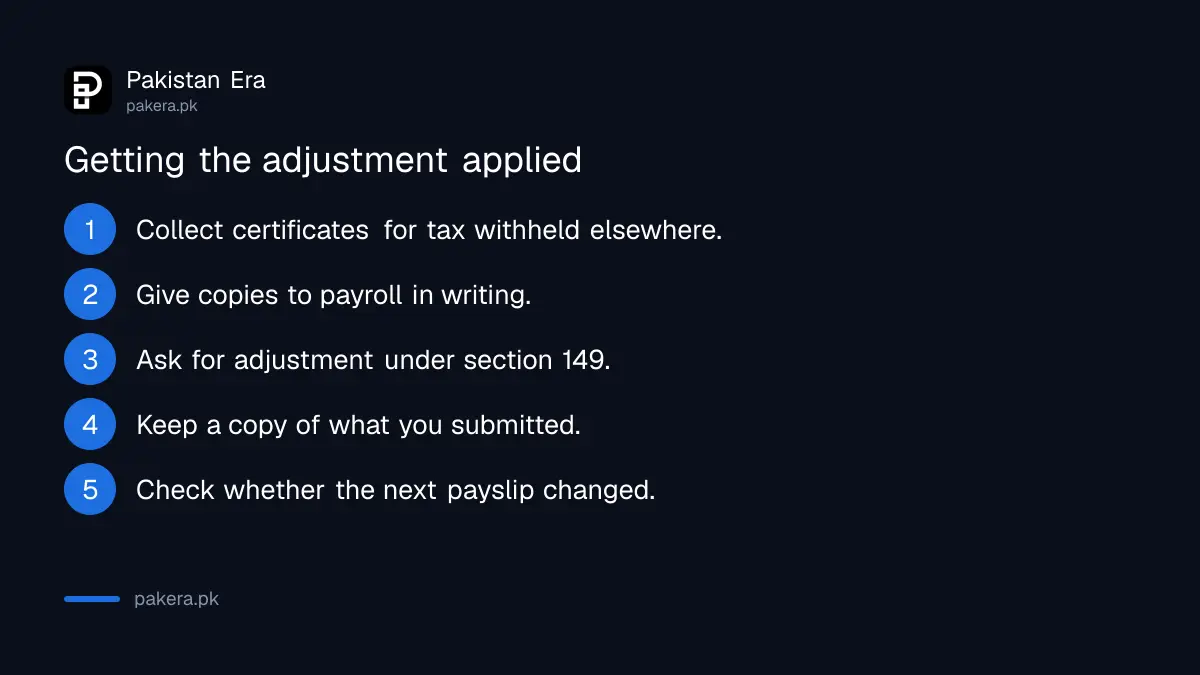
- Collect the certificates for tax already withheld from you this year.
- Give copies to your payroll or HR department in writing.
- Ask them to adjust your monthly deduction under section 149.
- Keep a copy of what you submitted and when.
- Check your next payslip to see whether it changed.
The same subsection covers tax credit admissible under sections 61 and 63, again on documentary evidence. If you are entitled to a credit, it can be reflected month by month rather than waiting for a refund after filing.
Why waiting until filing costs you
You can of course claim everything in your annual return. The difference is timing, and in Pakistan timing is money.
Tax adjusted through payroll stays in your hands each month. Tax claimed after filing has to come back as a refund, and a refund is a queue. Our guide to the ATL surcharge and the 30 September deadline notes that being off the Active Taxpayer List stops refunds being issued at all while you are off it.
So the order of preference is simple. Adjust it monthly if you can evidence it. File properly regardless.
Ask for your deduction certificate

Whatever your employer deducts has to reach FBR against your identity, and the certificate is your evidence that it did.
Ask payroll for it each year. Check that your CNIC or NTN appears correctly on it. If the amount deducted does not show against you, the credit does not attach to you, and nobody else is going to chase it.
This is the same failure we described for tax collected on a property transfer, in our guide to what tax you pay when you buy or sell property. The pattern repeats: the money was taken, but without your identifier on the challan it does not become your credit.
Where the rates come from
Section 149 does not contain the slabs. It points to Division I of Part I of the First Schedule, which is a separate part of the law that changes with each Finance Act.
We are not quoting a rate here. The consolidated Ordinance FBR publishes is amended up to 20 February 2026, which is before the Finance Act, 2026 took effect on 1 July 2026, so the table in the copy we can read is not current.
Our guide to the salary tax slabs for 2026-27 deals with the rates separately, and your own payslip and payroll department are the authority for your figures.
If you have more than one employer
The section speaks of every person responsible for paying salary. Where you draw salary from more than one place, each is looking at what it pays you, not at your total.
That can leave you under deducted across the year and facing a bill at filing. If it applies to you, tell your main employer and take advice, rather than discovering the gap in September.
Common questions
At what rate is my salary tax deducted?
At your average rate of tax for the year, computed on your estimated salary income, not on a single month in isolation.
Can other tax I have paid reduce my salary deduction?
Section 149 requires adjustment of tax withheld from you under other heads, after documentary evidence is obtained.
What about tax credits?
The section refers to credit admissible under sections 61 and 63, again on documentary evidence.
Why not just claim it when I file?
You can. Adjusting monthly keeps the money with you instead of turning it into a refund you have to wait for.
What is the deduction certificate for?
It is your evidence that the tax taken from your salary was deposited against your identity.
What is the rate this year?
We do not quote one here. The slabs sit in the First Schedule and change with each Finance Act.
How we verified this
What we checked, where we read it, and what we could not confirm.
Last checked 1 September 2026. We downloaded the consolidated Income Tax Ordinance, 2001 from FBR's own download site, the version amended up to 20 February 2026, and read section 149 in it. The requirement on every person responsible for paying salary to deduct tax at the time of payment at the employee's average rate of tax computed at the rates specified in Division I of Part I of the First Schedule on the estimated income chargeable under the head Salary for the tax year, and to do so after making adjustment of tax withheld from the employee under other heads and tax credit admissible under sections 61 and 63 during the tax year after obtaining documentary evidence, is taken from that text. No rate, slab or threshold appears on this page, because those sit in the First Schedule and the published consolidated text predates the Finance Act, 2026, which took effect on 1 July 2026. Whether a particular credit or adjustment applies to you depends on your own circumstances. Nothing here is tax advice, and your payroll department and a tax adviser are the authorities for your figures.
About the author

Tax, Bills and Technology Writer
Ali Akhtar is a young and curious voice here at Pakistan Era. He is currently pursuing his A-Levels and has a growing interest in Pakistan’s changing industrial landscape and educational trends. Ali likes to write in a way that helps him explain and explore the world around him. His writing reflects the perspective of the new generation navigating the evolving trends of Pakistan where technology, youth innovation, and shifting opportunities are reshaping the country’s future.