National Savings Profit Rates in Pakistan
Every National Savings rate read on savings.gov.pk, effective 1 October 2026: Behbood 12.72%, Regular Income 11.76%, Defence 11.80%.
Behbood Savings Certificates pay 12.72 per cent, Regular Income Certificates 11.76 per cent and Defence Savings Certificates 11.80 per cent. We read these on the National Savings website on 3 October 2026, where the rates are marked effective from 1 October 2026.
Updated 3 October 2026: National Savings changed its rates twice since this page was first written, on 4 September and again on 1 October 2026. Every figure below is the 1 October rate. The 1 October rate change is covered in full, scheme by scheme, with the September rates beside it.
Every figure below comes from the responsible body's own page and its rate card, not from a summary. Rates do change, so the date attached to them matters as much as the numbers.
The rates, as published
| Scheme | Rate from 1 October 2026 |
|---|---|
| Behbood Savings Certificates | 12.72% (Rs 1,060 a month per Rs 100,000) |
| Pensioners' Benefit Account | 12.72% (Rs 1,060 a month per Rs 100,000) |
| Shuhada Family Welfare Account | 12.72% (Rs 1,060 a month per Rs 100,000) |
| Defence Savings Certificates | 11.80% (Rs 100,000 grows to Rs 305,000 in 10 years) |
| Regular Income Certificates | 11.76% (Rs 980 a month per Rs 100,000) |
| Special Savings Certificates and Accounts | 11.60% for periods 1 to 5, 12.90% for the last period |
| Short Term Savings Certificates | 3 months 10.80%, 6 months 11.08%, 1 year 11.31% |
| Sarwa Islamic Term Account | 1 year 11.33%, 3 years 11.57%, 5 years 11.70% |
| Sarwa Islamic Savings Account | 11.33% |
| Savings Account | 10.00% |
The three highest rates are not open to everyone, and that is the most important thing to understand before comparing them with anything else.
The best rates are restricted, on purpose
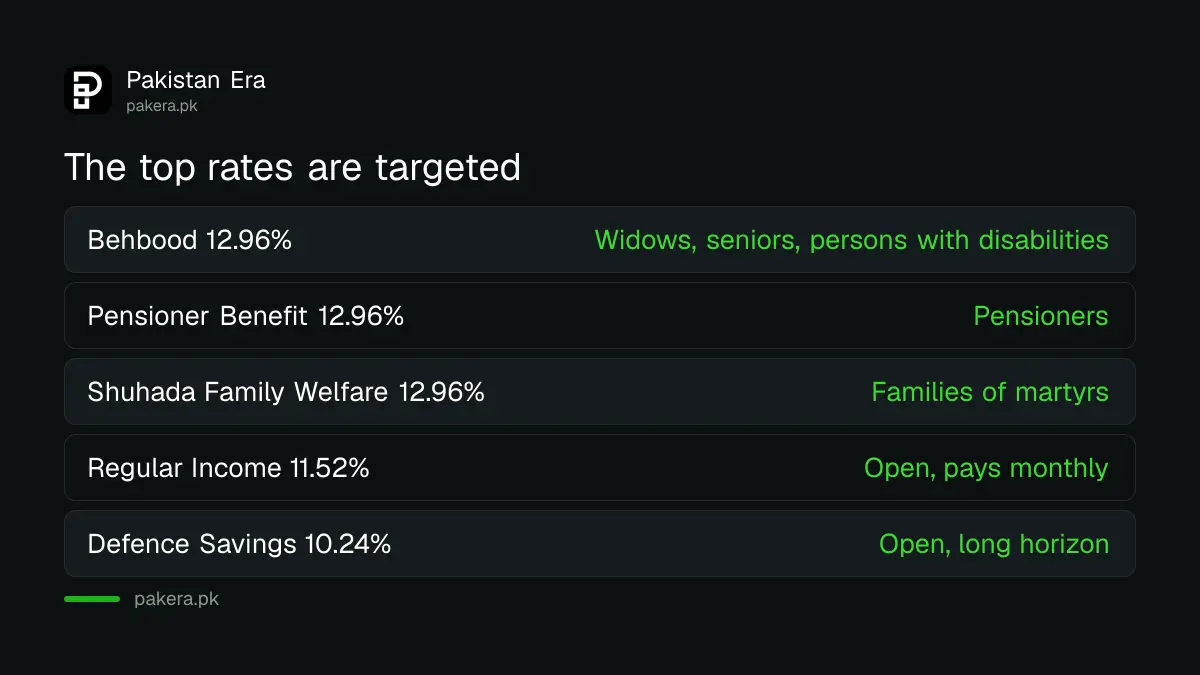
Behbood, the Pensioners' Benefit Account and the Shuhada Family Welfare Account all pay 12.72 per cent, and all three are targeted rather than general. They exist for specific groups the state has chosen to support, which is why they pay more than the schemes anyone can buy.
Behbood is for widows, senior citizens and persons with disabilities. The Pensioners' Benefit Account is for pensioners. The Shuhada Family Welfare Account is for the families of martyrs. The National Savings rate card lists a maximum of Rs 7.5 million for each of the three. The minimum is Rs 5,000 for Behbood and Rs 10,000 for the other two.
So do not plan around 12.72 per cent unless you actually qualify. If a relative qualifies and you do not, the account belongs to them, not to you. Arrangements that ignore that create problems later rather than returns now.
A rate is not a return
This is where savers in Pakistan are most often disappointed. A rate tells you what the certificate pays. What it buys you depends on what prices do over the same period.
If inflation over the year runs near or above the rate, the real return is close to nothing, even though the profit lands in your account exactly as promised. That is not a criticism of the scheme. It is arithmetic, and it applies equally to a bank deposit.
Compare these rates against what a bank actually offers you rather than against a headline. When you open a bank account in Pakistan, the schedule of charges matters as much as the profit rate on small balances.
Tax comes off the profit
The National Savings rate card for 1 October 2026 says withholding tax is 15 per cent for filers and 30 per cent for non-filers. That applies to Regular Income, Defence Savings, Special Savings, Short Term certificates, the Savings Account and the Sarwa Islamic schemes. Zakat is also deducted on several of them, as per the rules.
Behbood and the Pensioners' Benefit Account are different. National Savings says on its scheme pages that no withholding tax is collected on their profit, and the rate card shows no tax line for them. Being a filer halves the tax on the other schemes, so filing an income tax return is worth real money on a long certificate.
Choosing between the schemes
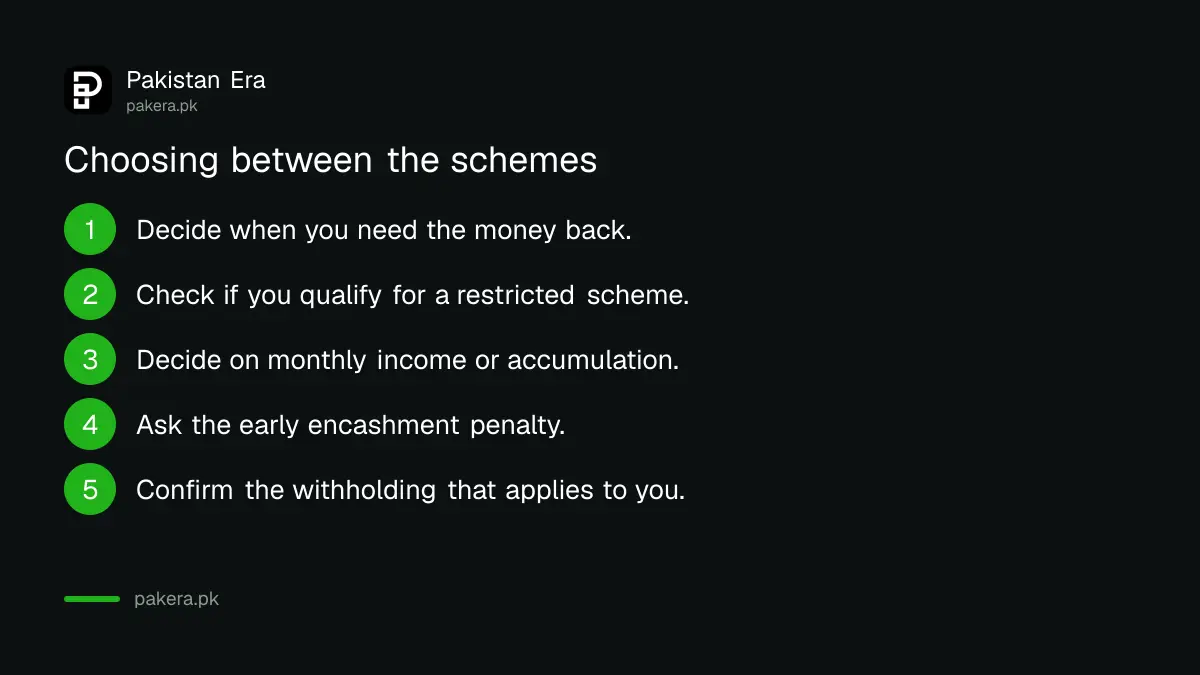
- Decide when you need the money back, because term length is the real limit.
- Check whether you qualify for a restricted scheme before comparing rates.
- Decide if you need monthly income or can leave the profit to build up.
- Ask what the penalty is for early encashment, since it can undo the advantage.
- Confirm the withholding that applies to you before committing.
Regular Income Certificates suit somebody who needs a monthly payment. Short Term Savings Certificates suit money you will want back within the year. Defence Savings Certificates are a long term product. They pay nothing until you cash them, and the first year earns only 10 per cent on the National Savings sheet.
Where to buy, and who to avoid
These are bought at National Savings Centres and through the authorised channels the organisation names, with your CNIC. Nobody needs to be paid a commission to arrange one for you.
Be careful with anyone offering higher returns than the published rates, or offering to invest for you in something they call similar. The published rate is the rate. A private offer promising more is something else entirely, and Pakistan has a long record of those ending badly.
The other government-backed option people ask about is prize bonds in Pakistan. They work on a different basis, since they pay nothing at all unless your number comes up.
Common questions about National Savings rates
Which scheme pays the most?
Behbood, the Pensioners' Benefit Account and the Shuhada Family Welfare Account all pay 12.72 per cent from 1 October 2026, and all three are restricted to specific groups.
Can anyone buy Behbood certificates?
No. Behbood is for widows, senior citizens and persons with disabilities, with a limit of Rs 7.5 million. Check eligibility before planning around the rate.
When were these rates set?
The rates on this page are effective from 1 October 2026. National Savings changed rates six times in 2026, so check the current table before investing.
Is the profit taxed?
On most schemes, yes. The rate card shows 15 per cent withholding for filers and 30 per cent for non-filers. Behbood and Pensioners' Benefit profit has no withholding tax.
Are these better than a bank deposit?
Compare the actual rate a bank offers you, the term, the charges and the tax. A headline rate on its own does not answer it.
How we verified this
What we checked, where we read it, and what we could not confirm.
Last checked 3 October 2026. Every rate in the table was read by us on the National Savings latest profit rates page, which is dated with effect from 1 October 2026, on the rate card posted there, and in each scheme's rate sheet linked from it. The limits and withholding tax rates are read on the same rate card. The tax position of Behbood and the Pensioners' Benefit Account is read on each scheme's page on savings.gov.pk. This is general information and not investment or tax advice. Rates change, so confirm the current table before you commit money.
About the author

Tax, Bills and Technology Writer
Ali Akhtar is a young and curious voice here at Pakistan Era. He is currently pursuing his A-Levels and has a growing interest in Pakistan’s changing industrial landscape and educational trends. Ali likes to write in a way that helps him explain and explore the world around him. His writing reflects the perspective of the new generation navigating the evolving trends of Pakistan where technology, youth innovation, and shifting opportunities are reshaping the country’s future.