Free Thalassemia Treatment and Screening in Pakistan: Where to Register by Province
Where children with thalassemia get free blood and chelation in Pakistan, how to register, and what each province's screening law requires before marriage.
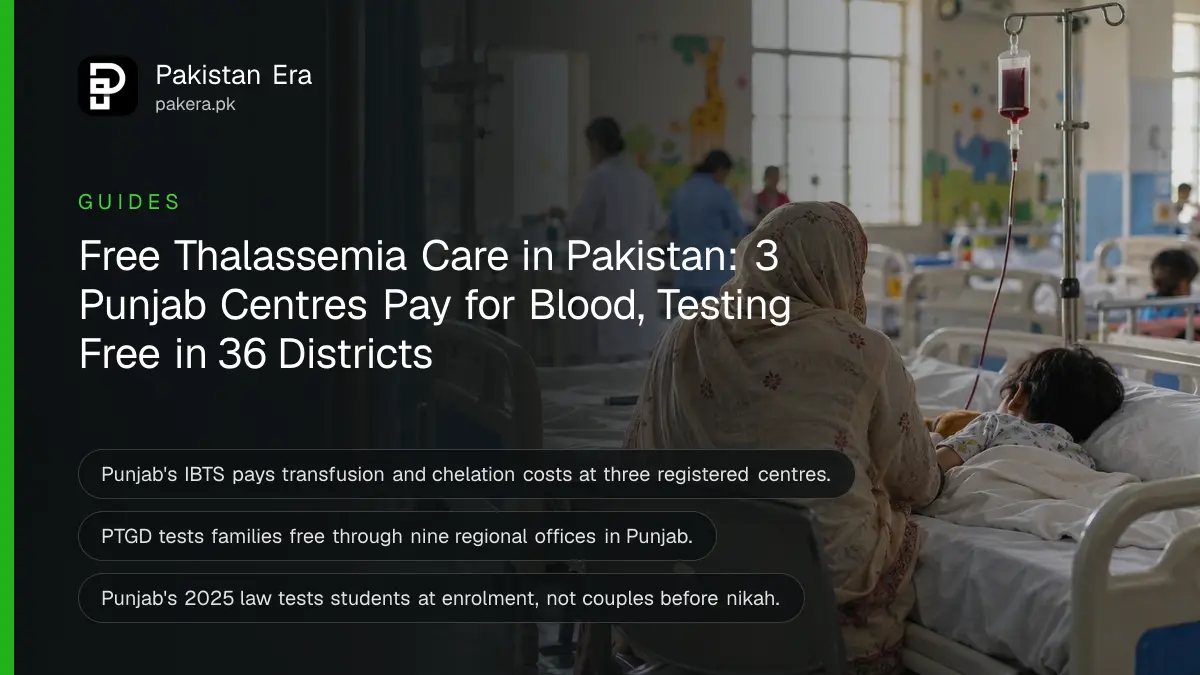
Free thalassemia treatment in Pakistan comes mainly from provincial government centres and registered charities. In Punjab, three government centres give free blood transfusions and iron chelation, and the PTGD institute tests families free in all 36 districts (042-99202644-46). In Khyber Pakhtunkhwa, Hayatabad Medical Complex in Peshawar treats registered children free.
A child with thalassemia major needs blood every few weeks for life. So the real question is where a family can register once and keep coming back.
We read the Punjab, Sindh and Balochistan thalassemia Acts on the provincial law portals, and the Punjab programme pages, on 7 October 2026. One finding stands out. Punjab's 2025 law tests students, not couples. Nothing in it stops a nikah.
Where children get free transfusions and chelation
Free care is strongest in Punjab, where the Institute of Blood Transfusion Service runs three registered thalassemia centres and pays for transfusions and chelation itself. In other provinces, a large teaching hospital or a charity centre usually carries the load, so families should register at the nearest one.
Chelation means medicine that removes the iron that builds up from repeated transfusions. Without it, iron damages the heart and liver.
| Province | Free centre | What its own page says |
|---|---|---|
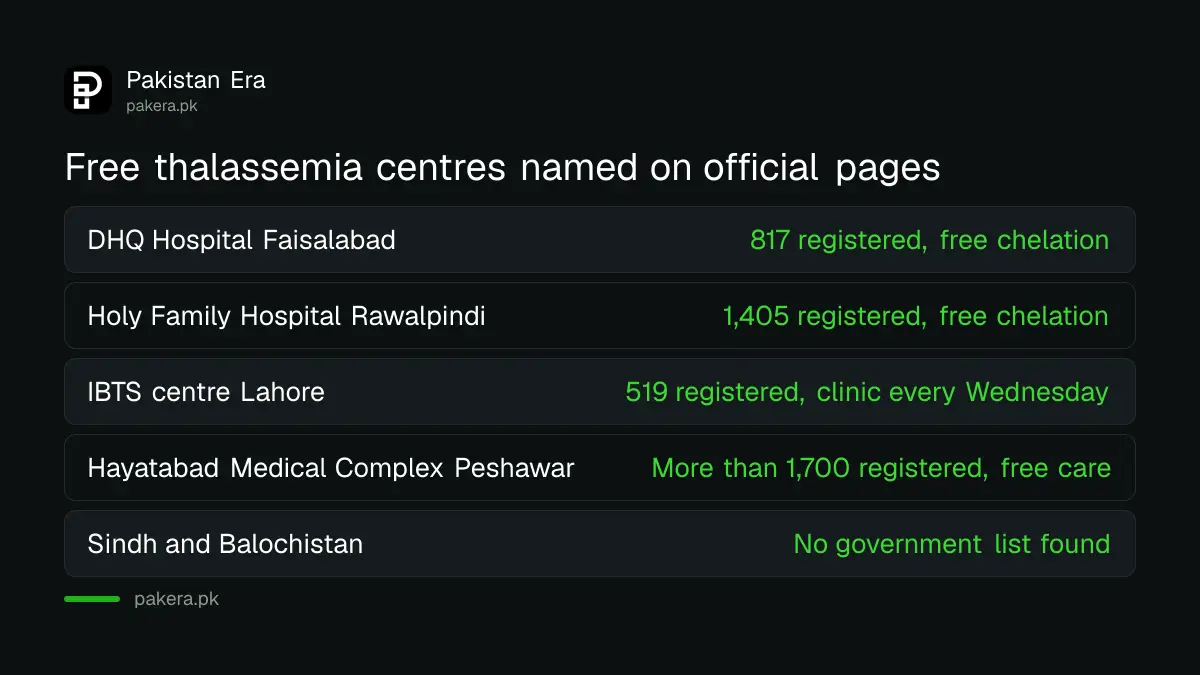
| Punjab | DHQ Hospital Faisalabad | 817 registered patients, 459 on regular transfusion, free deferasirox and deferiprone |
| Punjab | Holy Family Hospital Rawalpindi | 1,405 registered patients, regular transfusion, free chelation |
| Punjab | IBTS centre, Lahore | 519 registered patients, follow-up clinic every Wednesday, linked to Services Hospital |
| Khyber Pakhtunkhwa | Hayatabad Medical Complex, Peshawar | Tests, medicine, transfusion and minor surgery free; more than 1,700 registered |
| Sindh and others | Licensed charity centres | No government list found; check the blood bank's licence first |
The Punjab directorate says plainly that it "bears all expenses of safe transfusion and chelation therapy for registered thalassemia patients". The word "registered" matters.
Charities fill the gap elsewhere. Sundas Foundation, for example, lists 12 centres on its own site, in Lahore, Islamabad, Karachi, Faisalabad, Hafizabad, Wazirabad, Gujranwala, Sargodha, Gujrat, Sialkot, Daska and Peshawar, and says it charges nothing. Whoever you use, the blood must be screened, and in Punjab you can check a blood bank is licensed before the first transfusion.
How to register a child for free treatment
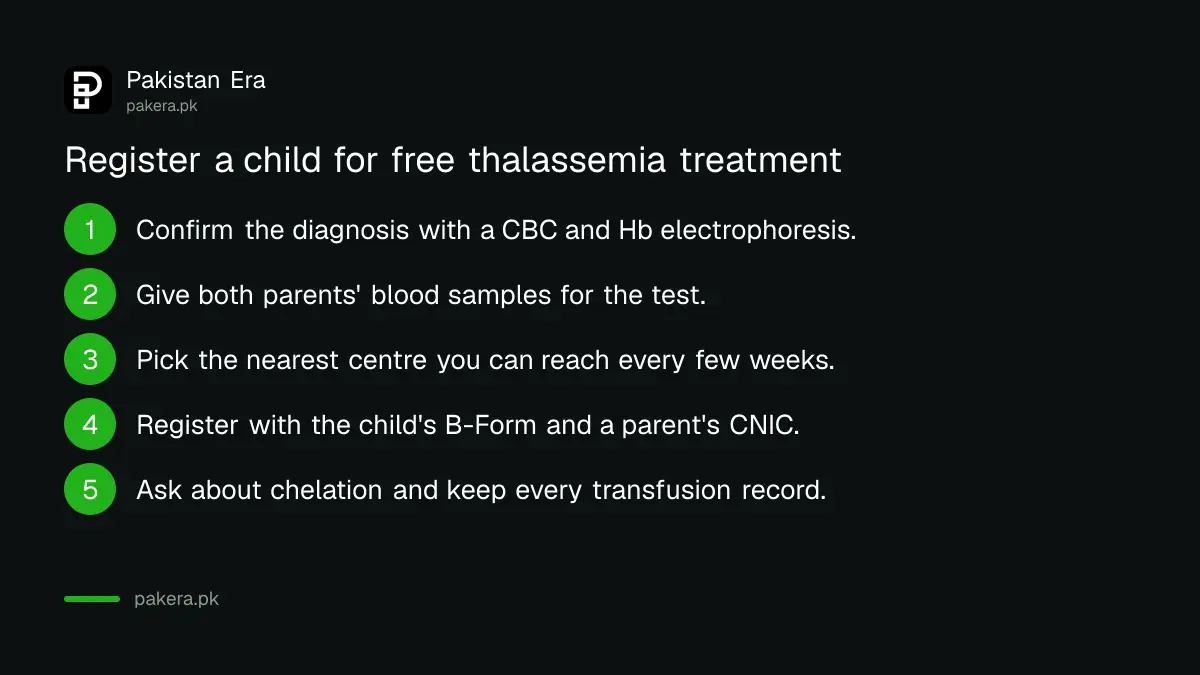
Get the diagnosis confirmed, register with one centre, and keep the same card for every visit. Most centres need the child's B-Form, a parent's CNIC and the test report. PTGD can confirm the diagnosis free, and it tests both parents too.
- Confirm the diagnosis. PTGD says a CBC and Hb electrophoresis can be done 12 months after birth, or earlier if the child is severely anaemic. Both parents' samples are needed.
- Wait out the gap if the child is already on blood. PTGD advises a gap of 2 to 3 months after a transfusion before taking a diagnosis sample, unless the case is urgent.
- Pick the nearest centre you can reach every few weeks. Distance matters more than reputation when the visits never stop.
- Register with the child's B-Form and a parent's CNIC. Ask for the patient card and the follow-up day.
- Ask about chelation on the first visit. Do not wait for the doctor to raise it.
Punjab's programme company says on its own FAQ page, which we read in August 2026, that empanelled private hospitals treat thalassemia at full cost under the Sehat Card. That is set out in what the Sehat Card now covers. Pakistan Bait-ul-Mal also runs a Pakistan Thalassaemia Centre with its own application form, alongside its wider medical help from Pakistan Bait-ul-Mal.
Free carrier testing for families and couples
A carrier test is a simple blood test that shows whether you carry one thalassemia gene. In Punjab, PTGD does it free at nine regional offices and through field officers in district hospitals. Testing the whole family of an affected child finds the most carriers.
PTGD puts the scale plainly: about 6 per cent of Pakistanis carry the beta thalassemia gene, which it estimates at around 13.2 million people. A carrier is healthy and needs no treatment. The risk comes when two carriers marry, because each child then has a one in four chance of thalassemia major.
PTGD's regional offices are at Sir Ganga Ram Hospital Lahore, Nishtar Hospital Multan, Victoria Hospital Bahawalpur, Holy Family Hospital Rawalpindi, Government General Hospital Ghulam Muhammadabad Faisalabad, Government Teaching Hospital DG Khan, Sahiwal Medical College, and DHQ Teaching Hospitals in Sargodha and Gujranwala. It also offers prenatal testing, called CVS, between the 10th and 14th week of pregnancy. The report takes 7 to 10 working days, and the father's blood sample is needed too.
PTGD also says plainly that being a carrier does not mean a person cannot marry.
The screening laws differ by province
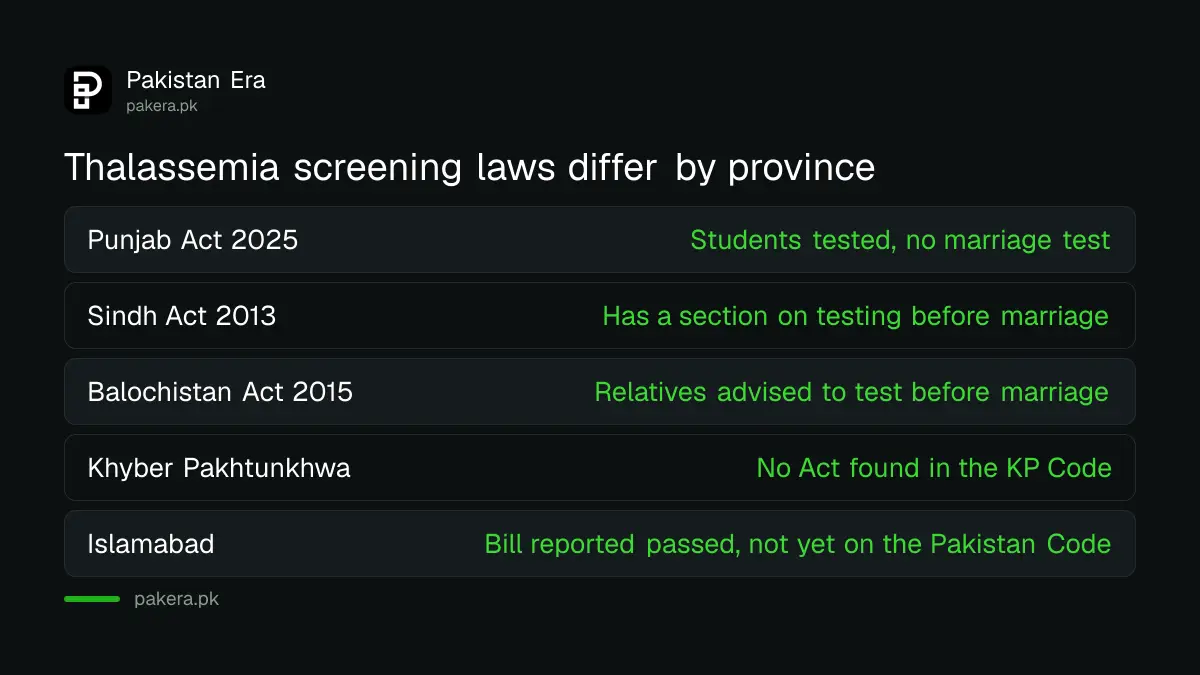
Health is a provincial subject, so the laws differ. Sindh and Balochistan have Acts with a section on testing before marriage. Punjab's 2025 Act tests students instead. We found no thalassemia Act in Khyber Pakhtunkhwa's code.
| Area | Law | What it actually requires |
|---|---|---|
| Punjab | Punjab Thalassemia Prevention Act 2025 | Students give a sample at enrolment or board registration; no marriage test |
| Sindh | Sindh Prevention and Control of Thalassemia Act 2013 | Sections on a blood test before marriage and a compulsory test; official text is in Urdu |
| Balochistan | Balochistan Prevention and Control of Thalassemia Act 2015 | Patients' relatives screened; those marrying advised to test; Rs 100,000 penalty on a failing facility |
| Khyber Pakhtunkhwa | None found in the KP Code | No provincial thalassemia Act listed as of 7 October 2026 |
| Islamabad | Bill reported passed by the National Assembly in March 2026 | Not on the Pakistan Code as an Act when we checked |
Balochistan's Act, which we read in the gazette copy on the Balochistan Code, is gentler than its reputation. Relatives of patients "shall be advised and counseled" to test before marriage. Testing without consent is barred and punishable under section 337E of the Pakistan Penal Code. A health facility that fails to carry out screening faces a penalty of Rs 100,000.
Punjab's 2025 law tests students, not couples
The Punjab Thalassemia Prevention Act 2025 came into force on 2 May 2025. It makes school and college heads ensure each student has given a sample to a notified lab, and boards must see the receipt before registering a student. It says nothing about nikah registrars.
A notified lab must finish the test within 10 days and send the result to the Punjab Information Technology Board within 5 days after that. Carriers must be offered counselling. Fees are set through the Punjab Healthcare Commission, and the Act lets the government make testing free.
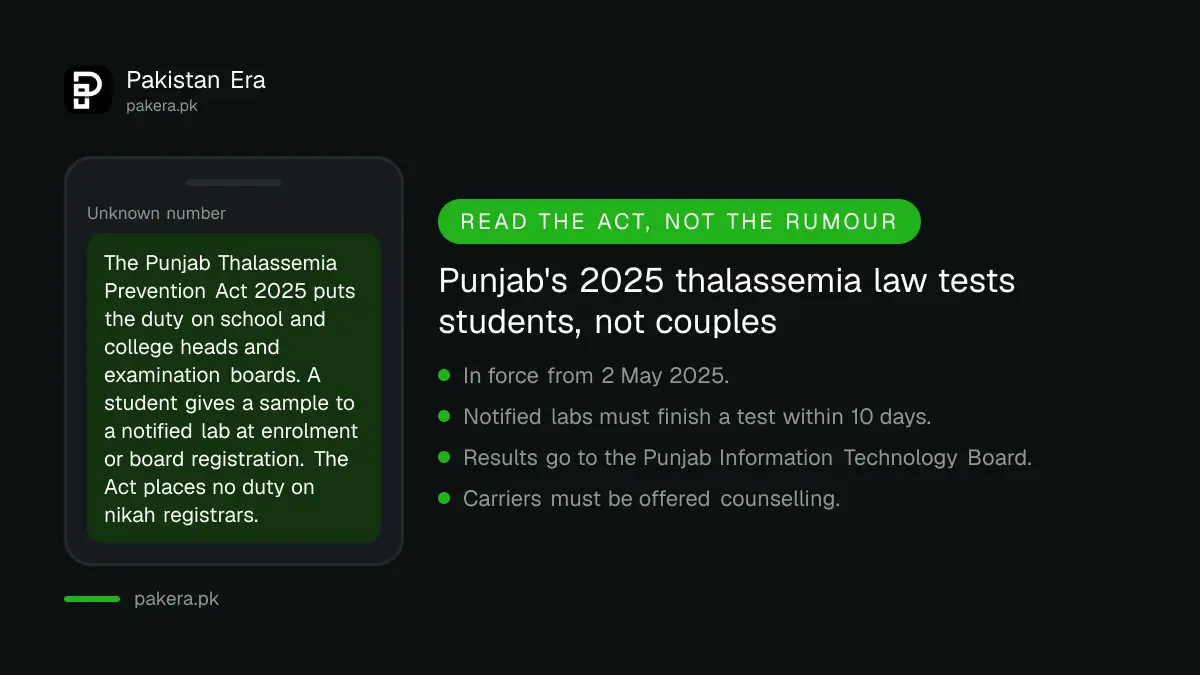
So a thalassemia certificate is not a requirement of this Act for a nikah in Punjab, though testing before marriage is still wise. The steps that the law does require are set out in how to register a nikah in Pakistan.
Common questions
Is thalassemia treatment free in government hospitals?
At registered centres, yes. Punjab's IBTS pays all transfusion and chelation costs for registered patients at its three centres, and Hayatabad Medical Complex in Peshawar says it treats thalassemia patients free.
Is a thalassemia test compulsory before marriage in Pakistan?
Not nationally. Sindh and Balochistan have Acts that cover testing before marriage. Punjab's 2025 law tests students instead. Islamabad's bill was not on the Pakistan Code as an Act on 7 October 2026.
Where can I get a free thalassemia carrier test in Punjab?
At any of PTGD's nine regional offices, or through its field officers at district headquarters hospitals. Call 042-99202644-46 to find the nearest one.
Can two thalassemia carriers marry?
Yes. The law does not stop them. But each child has a one in four chance of thalassemia major, so PTGD offers counselling and prenatal testing.
When can a baby be tested for thalassemia?
PTGD says from 12 months of age with a CBC and Hb electrophoresis, or earlier if the child becomes severely anaemic. A DNA test works at any age.
Does the Sehat Card cover thalassemia?
In Punjab, yes. The programme company's FAQ, which we read in August 2026, says empanelled private hospitals treat thalassemia at full cost under the card.
How we verified this
What we checked, where we read it, and what we could not confirm.
Last checked on 7 October 2026. We read the Punjab Thalassemia Prevention Act 2025 on the Punjab Code, the Sindh Act on the Sindh Code, and the Balochistan Act in its gazette copy on the Balochistan Code. We read the thalassemia centre page of IBTS Punjab and the services, regional office and FAQ pages of PTGD, and Hayatabad Medical Complex's own post. We could not find a government list of free thalassemia centres in Sindh or Balochistan, so none is given. Centre figures change as patients register.
About the author
Public Services and Education Journalist
Fajr Riaz is a journalist and content writer at Pakistan Era, based in Lahore. She covers the questions people meet in everyday life in Pakistan: how a public service works, what a change in the rules means, and where to find a reliable answer.