How to Check a Blood Bank Is Licensed in Punjab
Only licensed places may collect or issue blood. We counted 114 on the published lists, and both carry a date of 6 May 2018.
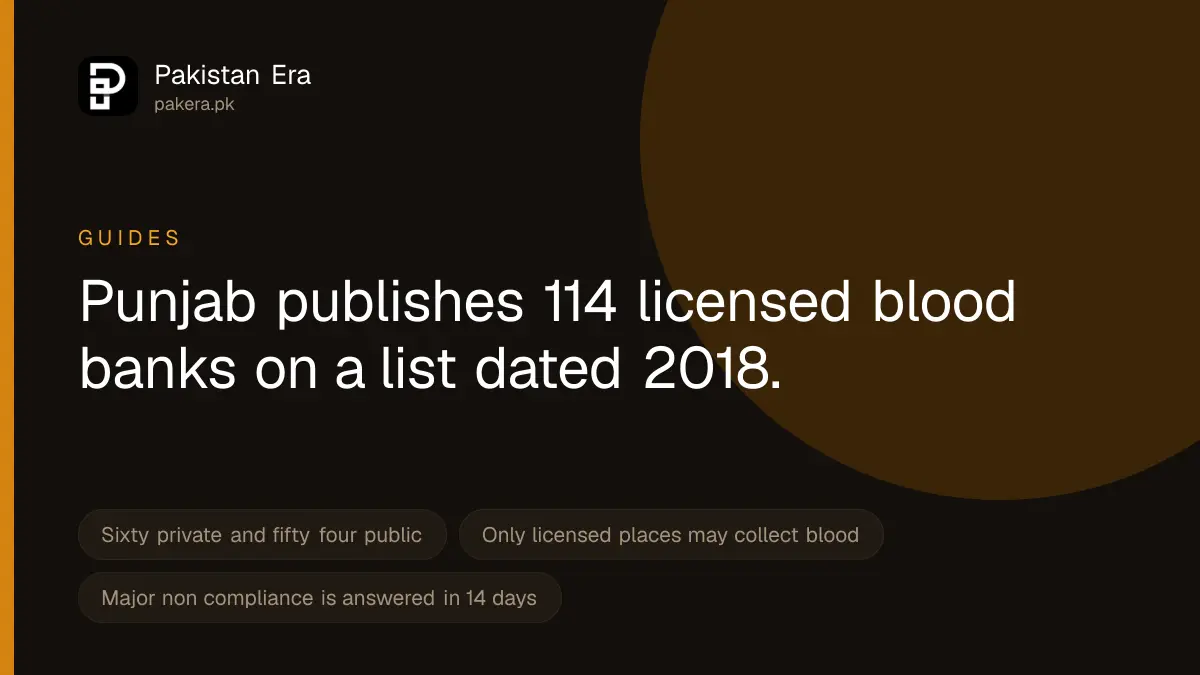
Only a licensed blood bank may collect, process, test, store or issue blood in Punjab. The authority publishes the list of licensed ones, and we counted 114 on it. The list carries a date of 6 May 2018.
That date is the reason this article exists. The list is still the right place to start, and it is not enough on its own.
We read the Punjab Blood Transfusion Authority site at pbta.punjab.gov.pk on 8 September 2026 and counted the published lists ourselves.
What the published list contains
| Measure | What we counted |
|---|---|
| Licensed private blood banks | 60 |
| Licensed public blood banks | 54 |
| Total on the published lists | 114 |
| Date on both lists | 6 May 2018 |
| Fields per record | Name, address, licence number, public or private |
The two lists are published together on the same page, one headed private and one headed public, and both carry the same date.
The rule the list exists to enforce
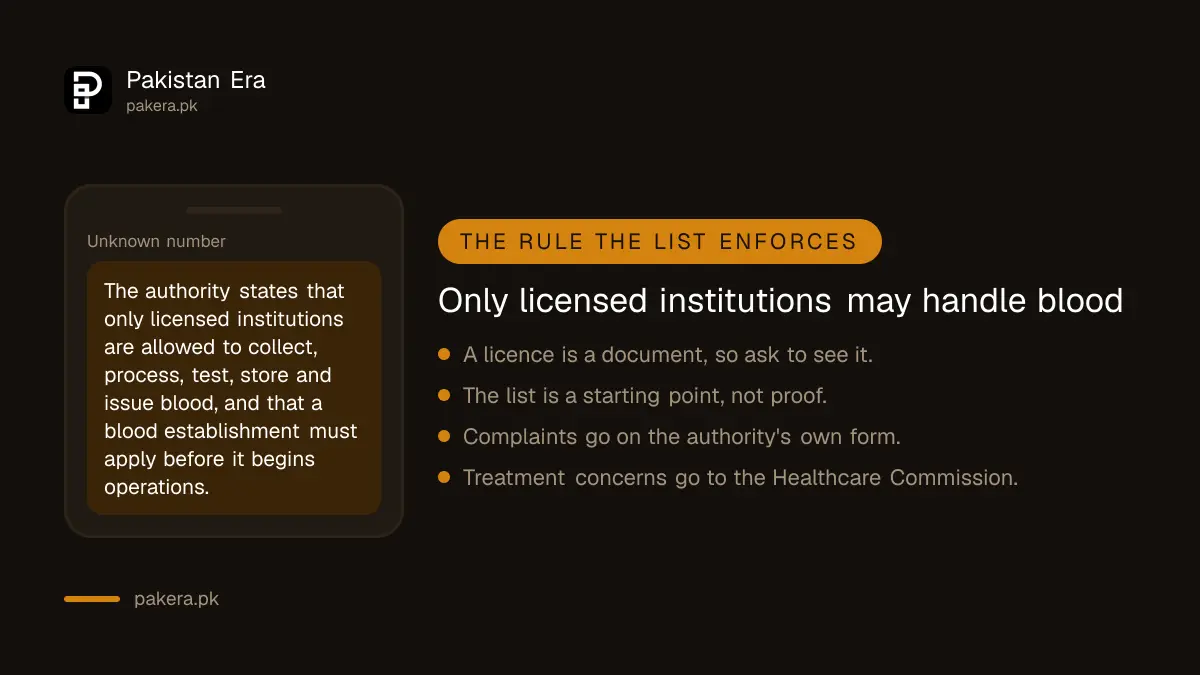
The authority states the position plainly. Only licensed institutions are allowed to collect, process, test, store and issue blood.
A blood establishment has to submit the application form with the mandatory documents before it begins operations, and licences may be issued only to establishments which comply with the law, rules and regulations in force.
So an unlicensed blood bank is not a lesser blood bank. It is one operating outside the permission the law requires.
The authority also publishes what happens after an inspection finds problems. For major non compliances the blood establishment must respond within 14 days. For other significant non compliances, within 30 days.
Why the date on the list matters
Eight years is a long time in a licensing register. Licences lapse, get renewed, get suspended, and new establishments open.
We are not going to guess what has changed since. What we can say is what a family checking today actually has in front of them, which is a list dated 2018 with 114 names on it.
Read it the way you would read any dated document. A blood bank on the list was licensed as at that date. A blood bank not on the list may have been licensed since. Neither answer is final.
That makes the list a starting point and puts the weight on the second check, which is asking the blood bank itself.
What to ask at the blood bank
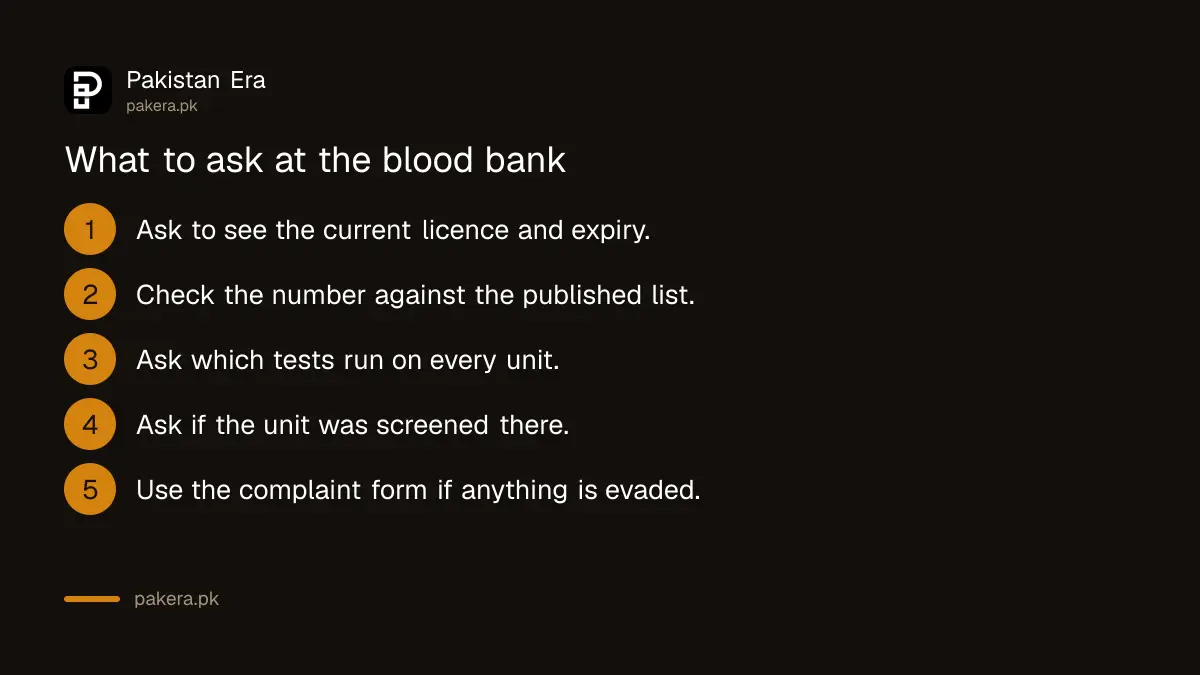
- Ask to see the current licence, and note the licence number and the expiry.
- Check that number against the published list, remembering the list is dated.
- Ask which tests are run on every unit before it is issued.
- Ask whether the unit being issued to you was screened at that blood bank or brought in.
- If anything is refused or evaded, use the authority's complaint form rather than arguing at the counter.
A licence is a document, and a licensed establishment has no reason not to show it. The request itself is normal and does not need explaining.
Where the authority takes a complaint
The Punjab Blood Transfusion Authority publishes a complaint form on its own site, alongside sections on registration and licensing, standards and guidelines, and haemovigilance, which is the monitoring of adverse events after transfusion.
Use the complaint form rather than a phone call where you can, because a written complaint creates a record with a date on it.
If the concern is about the treatment rather than the blood, that is a different route. Our guide to complaining against a hospital or doctor in Punjab sets out the sixty day deadline and the affidavit the Healthcare Commission requires.
In an emergency, our guide to what Rescue 1122 does covers the ambulance route, and our guide to free health programmes in Punjab beyond the Sehat Card covers treatment you do not have to pay for.
When blood is needed at short notice
Most people meet this subject in a hurry, with a relative in a ward and a requirement written on a slip.
Two things help. Ask the treating hospital whether it has its own licensed blood bank, because a hospital based bank removes a transport step and a question about handling. And ask whether the requirement is for whole blood or a component such as platelets or plasma, because that changes where you can go.
Our guide to when a dengue patient must be admitted in Punjab is relevant in season, since dengue is the reason many families first hear about platelet counts at all. The admission criteria published there use platelet levels and trends, not transfusion, so a low count on its own is not automatically a transfusion decision. That is for the treating doctor.
What we could not establish
The authority's licensing page states that a licence is mandatory and describes the application, but the page we read did not state the licence validity period, the fee, or the penalty for operating without a licence.
We are not going to supply figures we did not read. If those matter to you, the authority publishes contact details and a complaint form, and the question is a fair one to put to it directly.
We also did not verify the current status of any individual blood bank, and we have deliberately not reproduced any name or address from the lists. The authority's own page is the current version, and a list copied onto a blog goes stale in exactly the way this one shows.
Common questions
How do I check a blood bank is licensed in Punjab?
Search the licensed blood banks list published by the Punjab Blood Transfusion Authority, then ask the blood bank to show its current licence.
How many licensed blood banks are there?
We counted 114 on the published lists, 60 private and 54 public, on 8 September 2026.
How current is that list?
Both lists carry a date of 6 May 2018, so treat them as a starting point rather than proof of current status.
Is a licence actually required?
Yes. The authority states that only licensed institutions may collect, process, test, store and issue blood.
What happens if an inspection finds problems?
The establishment must respond within 14 days for major non compliances and 30 days for other significant ones.
Where do I complain?
The authority publishes a complaint form on its site. For treatment concerns, the Punjab Healthcare Commission is the separate route.
How we verified this
What we checked, where we read it, and what we could not confirm.
Last checked 8 September 2026. We opened the Punjab Blood Transfusion Authority site at pbta.punjab.gov.pk on that date and read its licensed blood banks page and its registration and licensing page. The counts of 60 private and 54 public licensed blood banks, giving 114 in total, are our own, taken by counting the rows of the two tables published on the licensed blood banks page. Both tables are headed with the date 6 May 2018, one as the list of licensed blood banks (private) and one as the list of licensed blood banks (public), and each record carries the name of the blood bank, the address, the licence number and whether it is public or private. The statement that only licensed institutions are allowed to collect, process, test, store and issue blood, the requirement to submit the application form with mandatory documents before beginning operations, the statement that licences may be issued only to establishments which comply with the law, rules and regulations in force, and the response times of 14 days for major non compliances and 30 days for other significant non compliances, are taken from the authority's registration and licensing page. The page we read did not state the licence validity period, the fee, or any penalty for operating without a licence, and this article therefore states none. We did not verify the current licensing status of any individual blood bank and have not reproduced any name, address or licence number from the lists, because the authority's own page is the current version. Confirm the position with the authority and with the blood bank itself before relying on it. Nothing here is medical advice, and decisions about transfusion are for the treating doctor.
About the author

Public Services and Education Journalist
Fajr Riaz is a journalist and content writer at Pakistan Era, based in Lahore. She covers the questions people meet in everyday life in Pakistan: how a public service works, what a change in the rules means, and where to find a reliable answer.