Punjab Runs Six Free Health Programmes. Most People Know One.
Dialysis, transplants, children's heart surgery and cancer care, all free and separate from the Sehat Card. The numbers, read at source.
Almost everyone in Punjab has heard of the Sehat Card. Very few people know that the same government company runs five other free health programmes alongside it.
Update, 11 October 2026: Punjab also offers free child heart surgery. See how to apply.
Dialysis. Organ transplants. Children's heart surgery. Adult cardiac surgery. Cancer treatment.
We read the figures off the Punjab Health Initiative Management Company's own site on 11 August 2026. The dialysis programme alone has treated patients over two million times.
The six programmes, by patients treated
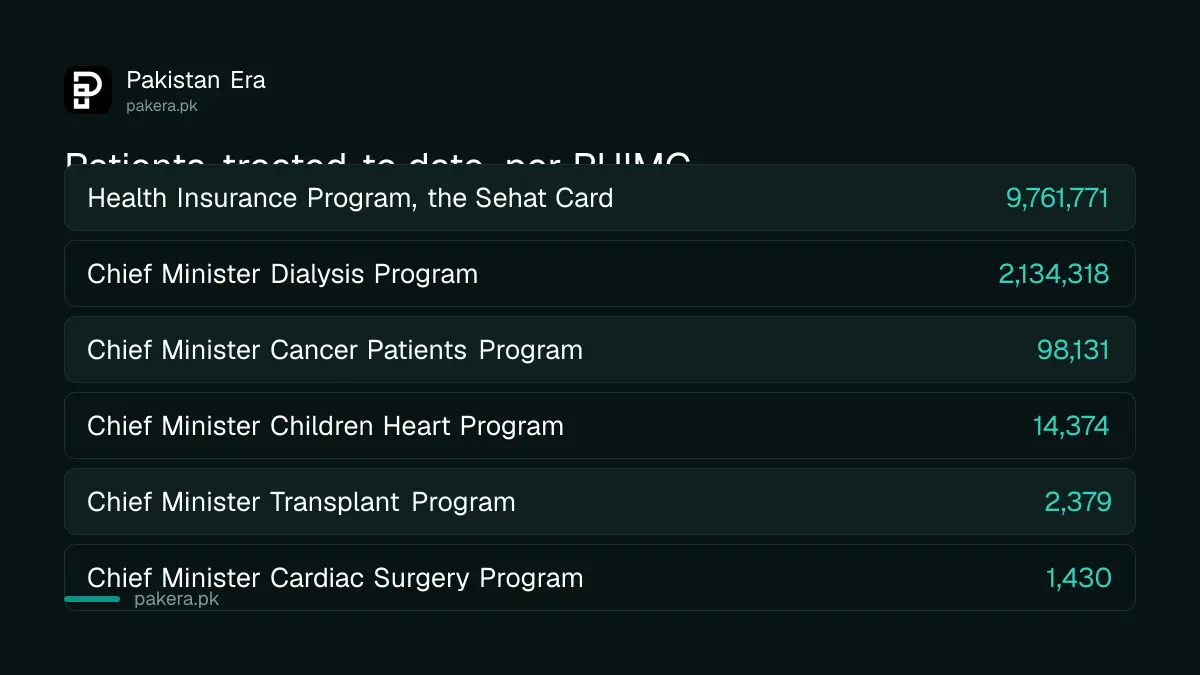
These are the counts the company displays as patients treated to date.
| Programme | Patients treated to date |
|---|---|
| Health Insurance Program, the Sehat Card | 9,761,771 |
| Chief Minister Dialysis Program | 2,134,318 |
| Chief Minister Cancer Patients Program | 98,131 |
| Chief Minister Children Heart Program | 14,374 |
| Chief Minister Transplant Program | 2,379 |
| Chief Minister Cardiac Surgery Program | 1,430 |
Read those numbers carefully
Before anyone repeats them, they need one piece of context, and it is the reason we are giving it rather than letting a big figure do unearned work.
These are cumulative treatment counts, not annual figures, and not counts of separate people.
That matters most for dialysis. A person with kidney failure does not have dialysis once. They have it repeatedly, often several times a week, for years. So 2,134,318 is a count of treatments delivered, not two million individuals helped, and comparing it directly against 1,430 cardiac surgeries is comparing two different things.
What the dialysis number does tell you honestly is scale of demand. Chronic kidney disease is common in Pakistan, dialysis is relentless, and privately it is ruinous. A programme absorbing that many sessions is doing something substantial.
The small numbers deserve the opposite reading. Only 2,379 transplants and 1,430 cardiac surgeries sounds modest until you consider what one of those costs a family privately. A low count on an expensive procedure is not a small programme.
These are separate from the Sehat Card
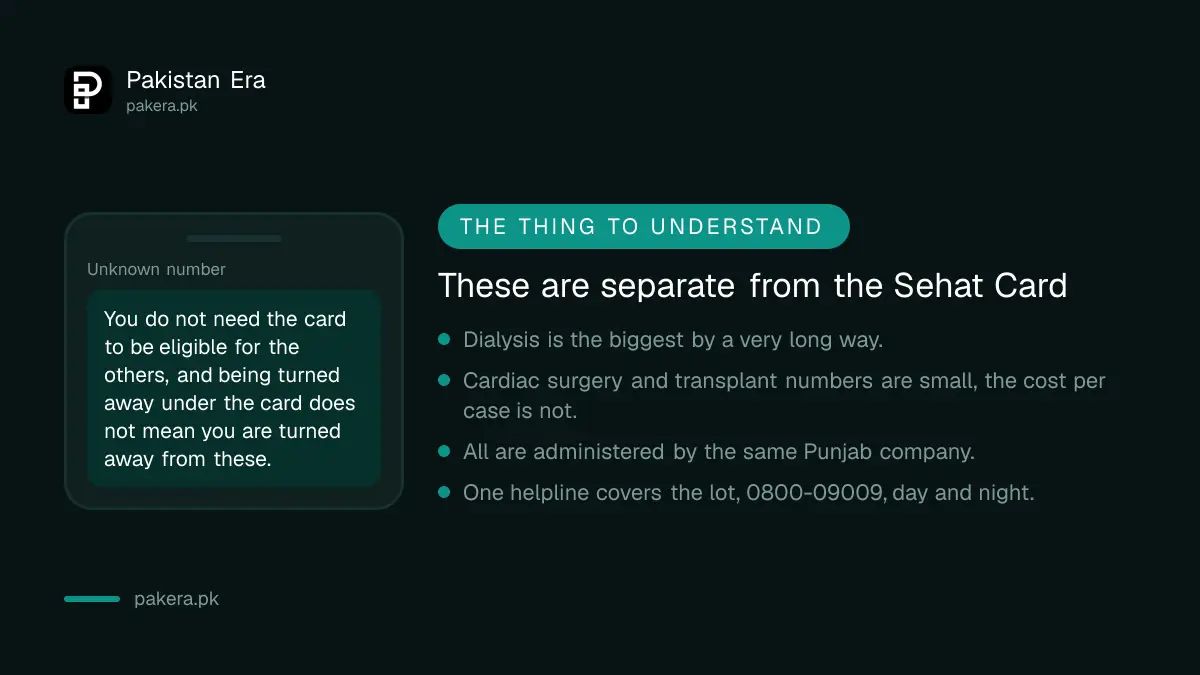
This is the practical point, and it is why the piece exists.
The Sehat Card is listed as the Health Insurance Program, one of six. The other five are their own programmes with their own arrangements.
So if you have been told you are not eligible for the card, or that the card no longer applies at your hospital, that does not automatically mean the dialysis, transplant, heart or cancer programmes are closed to you. They are a different question and worth asking separately.
What changed about the card itself this year, including the fact that it now covers half the cost of many treatments, is set out in what the Sehat Card covers now. Whether you are eligible for the card at all is in checking your Sehat Card eligibility.
What we are not telling you, and why
We are not printing eligibility rules, income limits, application steps or hospital lists for the five non-card programmes.
The reason is simple. Those details were not on the page we read, and we did not verify them anywhere else. It would have been easy to fill this section with plausible-sounding criteria, and on a question about whether a family can get free cancer treatment, plausible and wrong is worse than absent.
What we can give you is the verified way to find out, which is the next section.
How to find out if one applies to you
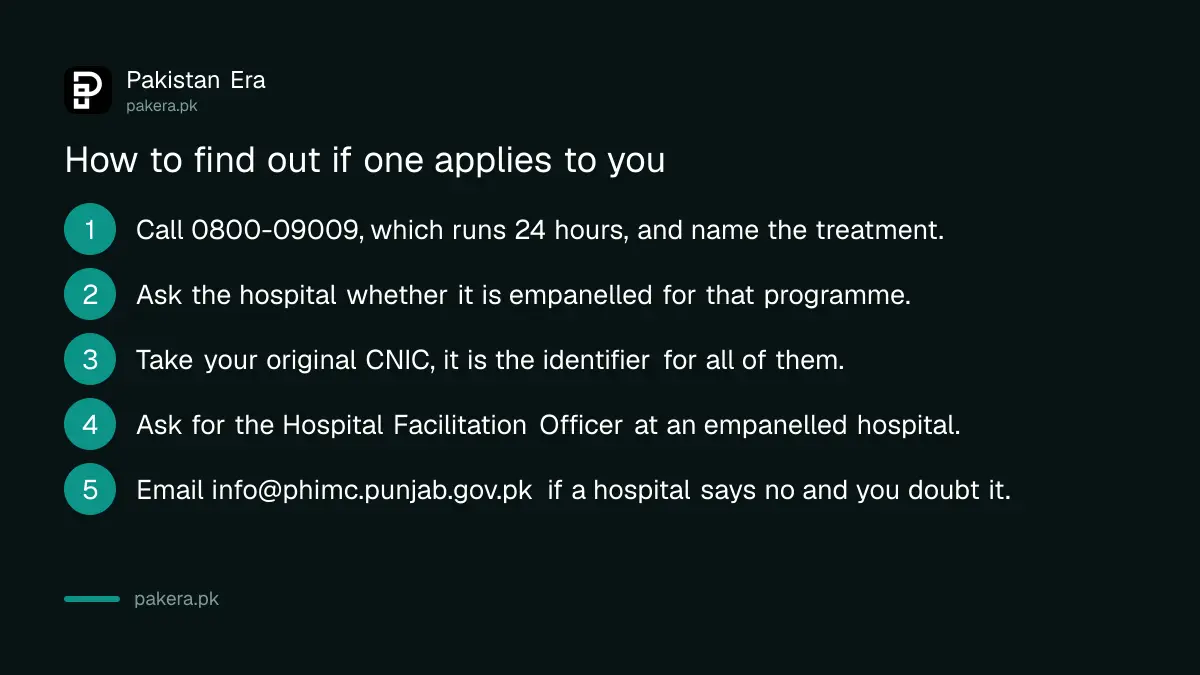
- Call 0800-07542. It runs 24 hours. Name the treatment you need rather than asking about "the card", because the programmes are separate.
- Ask the hospital directly whether it is empanelled for that specific programme. Empanelment is per programme, not blanket.
- Take your original CNIC. It is the identifier across these schemes and there is nothing physical to collect.
- Ask for the Hospital Facilitation Officer at an empanelled hospital. That role exists to walk patients through admission.
- Email info@phimc.punjab.gov.pk if a hospital tells you no and you have reason to doubt it.
The numbers we read on the company's own site, and would use ourselves:
| For | Contact |
|---|---|
| Helpline, 24 hours | 0800-07542 |
| Mobile, Mon to Sat, 8am to 11pm | 0333-6756390 |
| Landline, same hours | 042-99066000, 042-99066001 |
| info@phimc.punjab.gov.pk |
These sit alongside the other numbers we have read off institutions' own pages rather than copied from lists, in government helplines checked at source.
Two programmes are actively recruiting hospitals
One detail on the same page is worth noting because it answers the obvious question of whether these are live or historical.
The company is running expressions of interest and empanelment forms for the Chief Minister's Special Initiative for Cancer Patients and the Chief Minister's Cardiac Surgery Program.
A programme actively signing up hospitals is a programme that intends to treat more people. That is a better indicator of whether something is running than a press release.
Why nobody talks about these
Partly branding. The Sehat Card has a name people recognise and a simple promise. "Chief Minister Transplant Program" is not a phrase anyone searches for.
Partly relevance. Most people never need a transplant, so the information never reaches them until the week they do, which is the worst week to start researching.
And partly because the information sits on a company website that most people have never heard of, at an address they would not guess. The address people are usually given for anything Sehat related, sehatsahulat.gov.pk, does not resolve at all. The working one is phimc.punjab.gov.pk, which is a pattern we have found repeatedly across Pakistani government websites.
Questions readers are asking
Is dialysis free in Punjab?
Punjab runs a Chief Minister Dialysis Program through the Punjab Health Initiative Management Company, which reports over 2.1 million treatments to date. Call 0800-07542 to ask about eligibility and which hospitals are empanelled.
Do I need a Sehat Card for these programmes?
They are listed as separate programmes from the Health Insurance Program, which is the Sehat Card. Being ineligible for the card does not automatically mean you are ineligible for the others, so ask separately.
Is free cancer treatment available in Punjab?
There is a Chief Minister Cancer Patients Program reporting 98,131 patients treated, and the company is currently seeking hospital empanelment for a Special Initiative for Cancer Patients. Eligibility rules were not published on the page we read, so confirm by phone.
What is the helpline for these programmes?
0800-07542, which runs 24 hours. There is also 0333-6756390 and 042-99066000 or 042-99066001, Monday to Saturday, 8am to 11pm.
Does 2.1 million mean two million people had dialysis?
No. These are cumulative treatment counts, not counts of individuals. A dialysis patient is treated repeatedly, often for years, so the figure counts sessions delivered rather than people helped.
Are these programmes still running?
The company was advertising hospital empanelment for the cancer and cardiac surgery initiatives when we checked on 11 August 2026, which indicates they are active.
Which website is the right one?
phimc.punjab.gov.pk. The commonly shared sehatsahulat.gov.pk did not resolve when we tested it.
About the author

Tax, Bills and Technology Writer
Ali Akhtar is a young and curious voice here at Pakistan Era. He is currently pursuing his A-Levels and has a growing interest in Pakistan’s changing industrial landscape and educational trends. Ali likes to write in a way that helps him explain and explore the world around him. His writing reflects the perspective of the new generation navigating the evolving trends of Pakistan where technology, youth innovation, and shifting opportunities are reshaping the country’s future.