Talk to CM Punjab Portal: Send Your Idea to Maryam Nawaz's Office and Track It
Use the Talk to CM portal to send ideas to the Punjab Chief Minister's office, get a tracking ID and find the right channel for complaints, jobs or money help.
Talk to CM is the Punjab government's portal for sending ideas and suggestions straight to Chief Minister Maryam Nawaz's office. Open talk2cm.punjab.gov.pk, pick your age group, write your idea and save the tracking ID it gives you. It is for ideas on governance only. Complaints, money help, jobs, scholarships and laptops each have their own channel, listed below.
The portal was launched on 12 February 2026 as part of the government's "Year of Youth". It is open to every Punjab resident, including students, professionals and business owners, and to overseas Pakistanis from Punjab. Here is how to use it, what to send, and where to go when your problem is not an idea.
How to send an idea on Talk to CM
The portal takes your name, some brief personal details and your idea, then issues a unique tracking ID. You use that ID on the same portal to see the status of your submission. There is no fee and no agent in between.
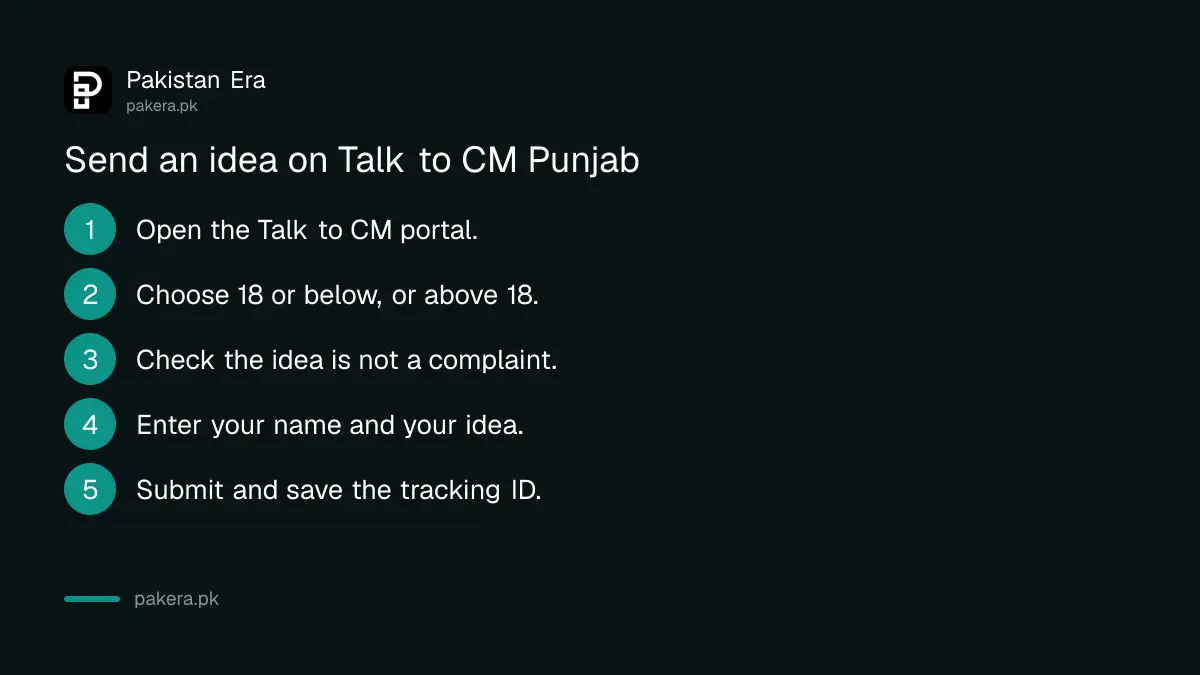
- Open talk2cm.punjab.gov.pk on your phone or computer.
- Choose your age group: 18 or below, or above 18. Each has its own section.
- Read the notice that lists the other channels. If your issue is a complaint or a request for money, use the right channel instead.
- Enter your name and the brief personal details the form asks for.
- Write your idea, suggestion or feedback clearly.
- Submit and note down the tracking ID.
- Use the tracking feature on the portal to follow its progress.
The launch release mentioned a separate interface for people aged 20 and above. The live portal splits users at 18 instead. Choose the button that fits your age on the day you apply.
Talk to CM is for ideas, not complaints
The portal says plainly that the forum is "exclusively meant for ideas related to improvement in governance". Use it to suggest a policy, a better way to run a service, or feedback on a government programme. A personal complaint sent here goes to the wrong desk.
The portal's own topic tags show the kind of ideas it wants: campus Wi-Fi, public transport, scholarships, a greener Punjab, freelance hubs, sports complexes and a tech city. A good idea names the place, the problem and a specific fix. "Add evening buses on the Multan to Shujabad route because students finish at 6 pm" is more useful than "improve transport".
Use these channels for other problems
Before you write, the portal shows a list of the right place for each kind of request. Complaints go to the CM Complaint Cell, money help to Maryam ko Batayn, jobs to the Punjab Job Portal, and scholarships and laptops to their own portals.
| Your need | Where to go |
|---|---|
| Idea or suggestion for the government | Talk to CM, talk2cm.punjab.gov.pk |
| Complaint about a department or service | CM Complaint Cell (CMCC), crm.punjab.gov.pk |
| Financial help or assistance | Maryam ko Batayn, helpline 1000 |
| Government jobs | Punjab Job Portal, jobs.punjab.gov.pk |
| Scholarship | Honhaar Scholarship portal |
| Laptop scheme | CM Punjab Laptop Programme portal |
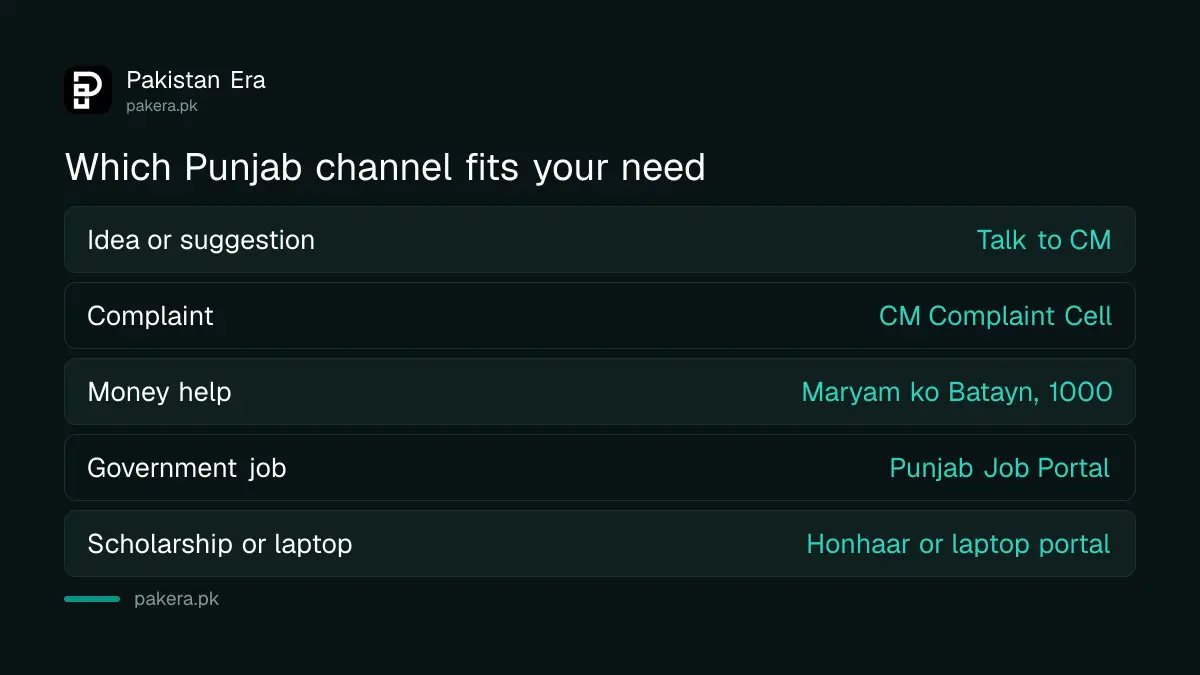
For money help, Maryam ko Batayn on 1000 explains who qualifies. For a laptop, checking your CM Punjab laptop status is the quicker route. Scholarship rules are in the Honhaar Scholarship guide.
Who can use the portal
The portal is open to all Punjab residents. The government names students, professionals, business owners and Punjab-origin overseas Pakistanis. It especially invites young people, in line with 2026 being declared the Year of Youth in Punjab.
You do not need a government job, a party link or a recommendation. The government's description stresses that ideas reach the Chief Minister's Office "without the need for intermediaries". So be wary of anyone who offers to "forward" your idea for a fee. Submit it yourself and keep your own tracking ID.
Write an idea that gets read
Short, specific ideas with a clear benefit are easiest for an office to act on. State the problem, the place, who is affected, and the change you propose. Add a number where you have one, such as how many students or shops are affected.
- One idea per submission. Several ideas in one message are harder to route to a department.
- Name the place. District, tehsil or the exact road, school or hospital.
- Say who benefits. Students, farmers, women workers, shopkeepers.
- Keep it polite and factual. No personal attacks or party slogans.
- Save the tracking ID. Without it you cannot follow the submission.
If you are not sure a link is genuine, compare it with the government's list of official Punjab apps and portals first.
Common questions
What is the Talk to CM portal?
It is a Punjab government portal, launched in February 2026, for sending ideas and feedback directly to the Chief Minister's Office.
Can I file a complaint on Talk to CM?
No. The portal is for governance ideas only. Complaints go to the CM Complaint Cell at crm.punjab.gov.pk.
Can overseas Pakistanis use it?
Yes. The government says Punjab-origin overseas Pakistanis can submit ideas.
How do I check what happened to my idea?
Use the unique tracking ID you receive after submitting, on the portal's tracking feature.
Is there a fee?
No. The portal is free, and there is no agent or intermediary.
Is there a minimum age?
No minimum is stated. The portal has one section for users aged 18 or below and one for those above 18.
How we verified this
What we checked and where we read it.
Last checked 15 November 2026. We read the Talk to CM portal at talk2cm.punjab.gov.pk, including its age selection and the notice that lists the other channels, the Punjab government's flagship page on punjab.gov.pk (talk2cm), and its news release of 12 February 2026 on the launch. The launch release mentions an interface for ages 20 and above; the live portal uses 18 as the split, and we report what the portal shows.
About the author

Public Services and Education Journalist
Fajr Riaz is a journalist and content writer at Pakistan Era, based in Lahore. She covers the questions people meet in everyday life in Pakistan: how a public service works, what a change in the rules means, and where to find a reliable answer.