PM2.5 and PM10 Safe Limit in Punjab: 35 and 150 a Day, and How to Check Your Area's Reading
Punjab's PM2.5 limit is 35 micrograms per cubic metre a day and PM10 is 150, under the 2016 ambient air standards. Every pollutant limit and how to compare.
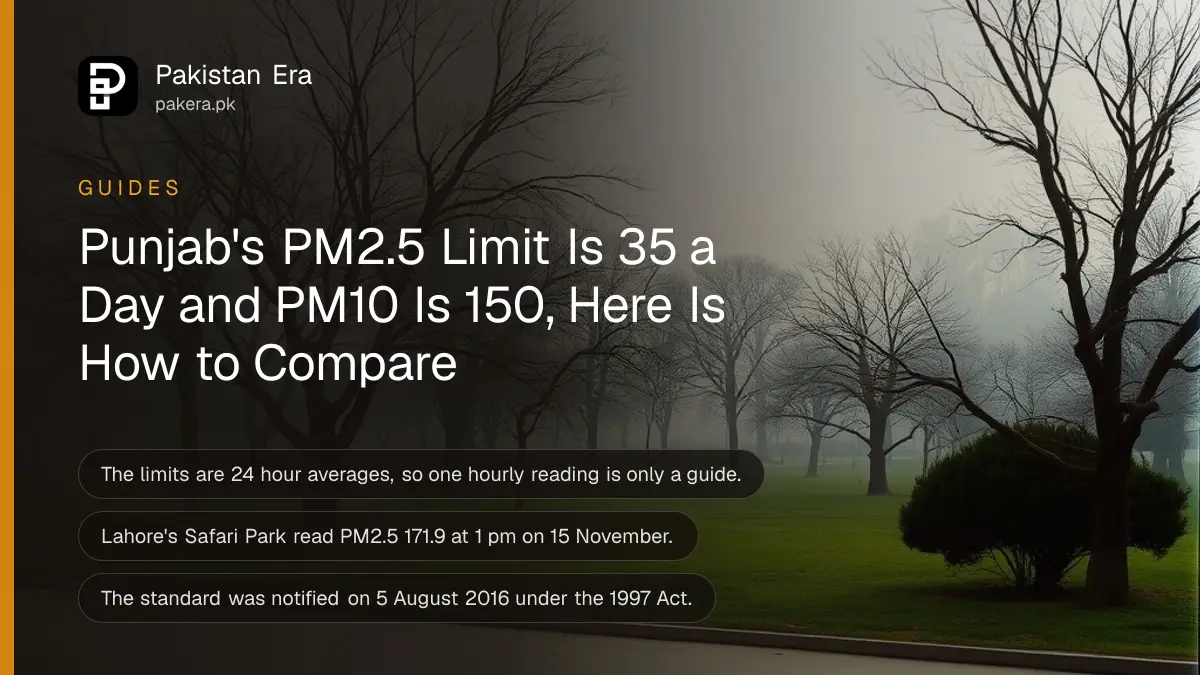
Short answer: Punjab's legal limit for PM2.5 is 35 micrograms per cubic metre as a 24 hour average and 15 as a yearly average. For PM10 it is 150 over 24 hours and 120 a year. Both are set by the Punjab Environmental Quality Standards for Ambient Air, notified in August 2016.
Those two numbers are what to hold any Punjab EPA reading against. At 1 pm on 15 November 2026, Lahore's Safari Park station showed PM2.5 at 171.9. That single hour was almost five times the daily limit.
Below are the full limits for every pollutant in the standard, how to read PM2.5 and PM10 on the dashboard, and the mistakes people make when comparing them.
Punjab's PM2.5 limit is 35 a day and PM10 is 150 a day
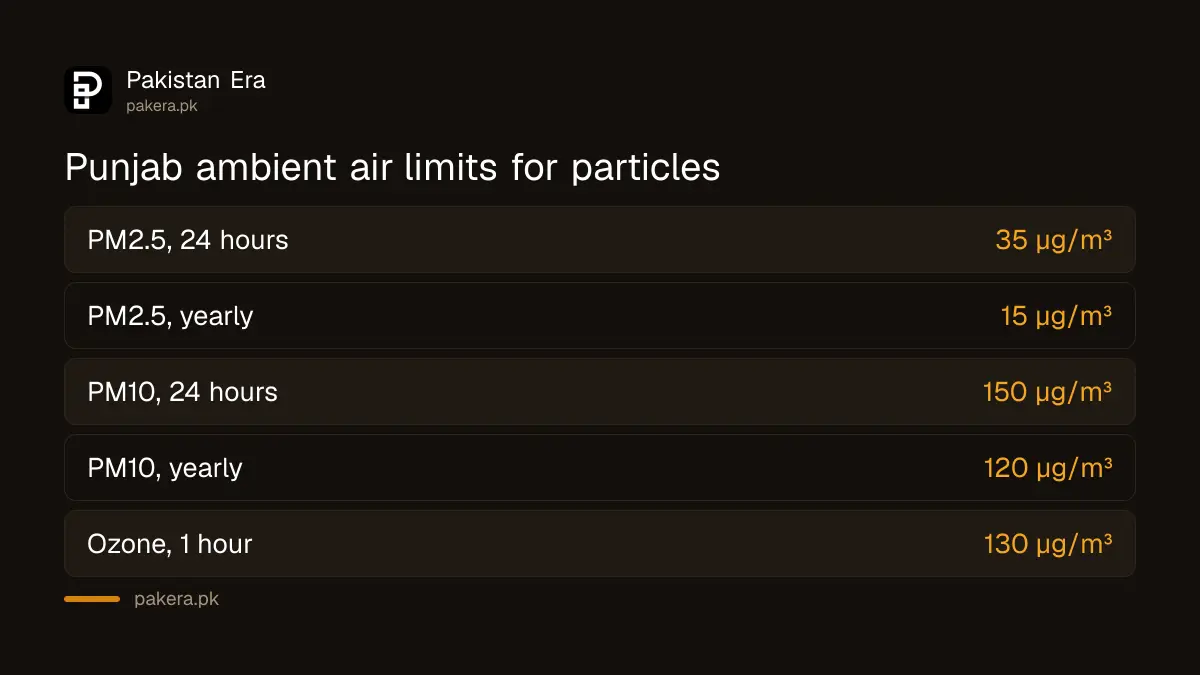
Under the Punjab Environmental Quality Standards for Ambient Air, PM2.5 must not pass 35 micrograms per cubic metre averaged over 24 hours, or 15 averaged over a year. PM10 must stay under 150 over 24 hours and 120 over a year.
PM2.5 means particles 2.5 micrometres across or smaller. They come mostly from burning: vehicles, factories, brick kilns and crop stubble. PM10 covers larger dust up to 10 micrometres, from roads, construction and bare ground. Both are measured in micrograms in each cubic metre of air.
The Environment Protection Department notified the standard on 5 August 2016 under the Punjab Environmental Protection Act, 1997. It was published in the Punjab Gazette on 15 August 2016.
Every pollutant limit in Punjab's ambient air standard
The standard sets limits for nine pollutants. Most have a yearly and a 24 hour figure. Ozone and carbon monoxide have shorter windows because their harm comes in peaks.
| Pollutant | Yearly average | 24 hour average | Shorter limit |
|---|---|---|---|
| PM2.5 (fine particles) | 15 µg/m³ | 35 µg/m³ | None |
| PM10 (coarse particles) | 120 µg/m³ | 150 µg/m³ | None |
| Suspended particulate matter | 360 µg/m³ | 500 µg/m³ | None |
| Sulphur dioxide (SO2) | 80 µg/m³ | 120 µg/m³ | None |
| Nitrogen dioxide (NO2) | 40 µg/m³ | 80 µg/m³ | None |
| Nitric oxide (NO) | 40 µg/m³ | 40 µg/m³ | None |
| Ozone (O3) | None | None | 130 µg/m³ over 1 hour |
| Lead | 1 µg/m³ | 1.5 µg/m³ | None |
| Carbon monoxide (CO) | None | None | 5 mg/m³ over 8 hours, 10 mg/m³ over 1 hour |
Carbon monoxide is in milligrams, not micrograms, so its numbers look small but are 1,000 times larger in the same unit. The standard also says the 24 hour and 8 hour limits should be met on 98 per cent of days in a year. They may be exceeded on the other 2 per cent, but never on two days in a row.
How to check PM2.5 and PM10 for your area
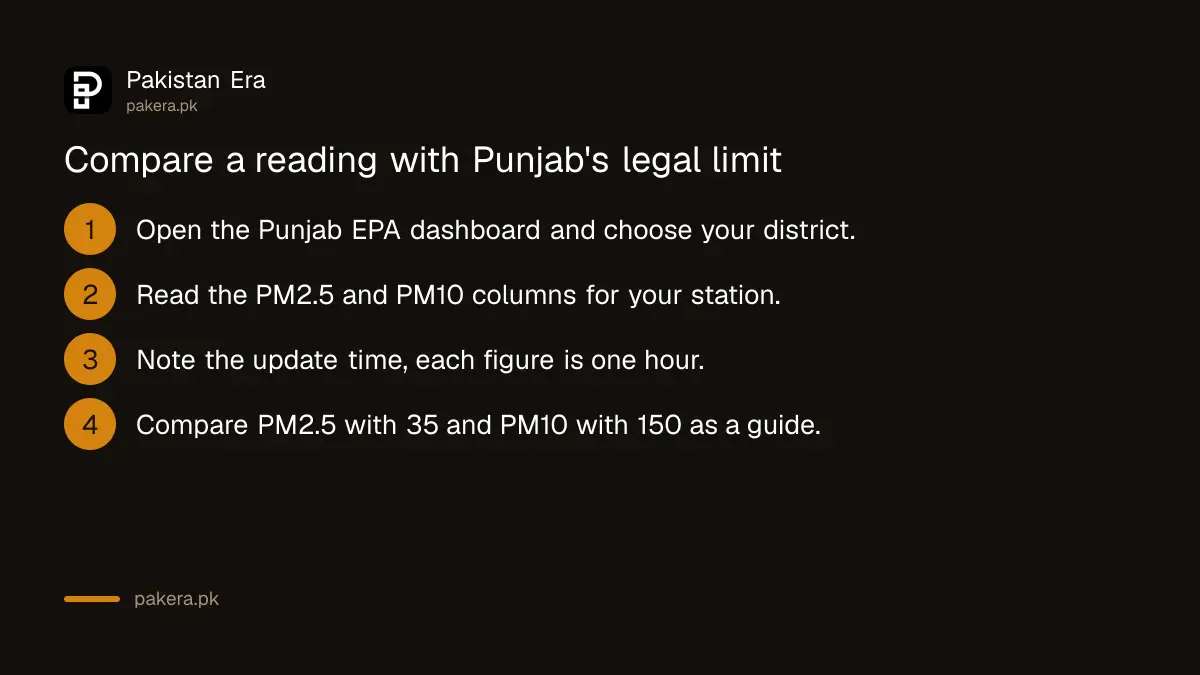
Punjab EPA's dashboard shows PM2.5 and PM10 for each station, not just the AQI. You can read them in a few taps.
- Open aqi.punjab.gov.pk on your phone or computer.
- Scroll to "Town-wise Ranking" and choose your district.
- Read the PM2.5 and PM10 columns beside each station. Both are in micrograms per cubic metre.
- Note the "Updated" time. Each figure is for one hour, not a full day.
- Compare PM2.5 with 35 and PM10 with 150 as a rough guide, keeping in mind the limits are daily averages.
The AQI number itself is a separate scale from 0 to 500. What each AQI band means for your day is set out in Punjab's seven AQI bands explained.
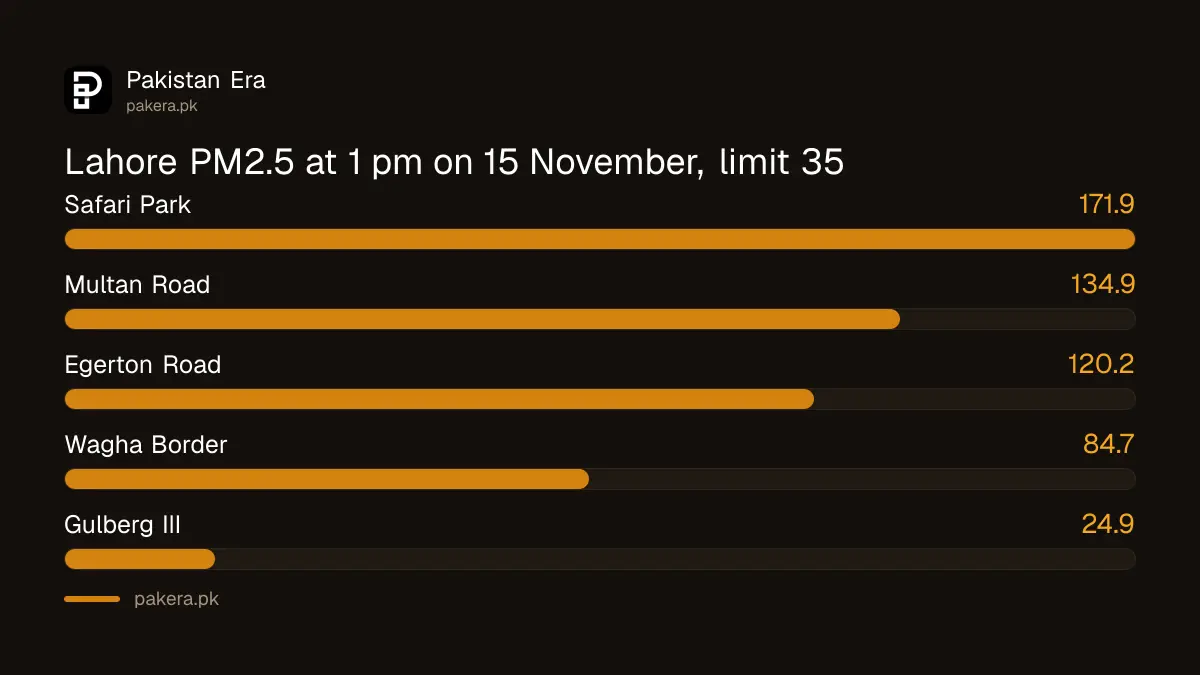
What Lahore's stations showed against the limits on 15 November
At 1 pm on 15 November 2026, ten of Lahore's 11 stations had PM2.5 above 35. Safari Park was highest at 171.9. Gulberg III was the only one under the line, at 24.9.
PM10 told a different story. Gulberg III had the highest PM10 in Lahore, 279.3, almost twice the 150 limit. So its AQI of 165 came from dust, not smoke. Only two Lahore stations had PM10 under 150: Wagha Border at 114.6 and DHA Phase 6 at 147.3. A station-by-station guide to the city is in Lahore AQI by area.
Three mistakes people make when comparing readings
The most common mistake is to treat one hour as a full day. The legal limit is a 24 hour average. A city can show 150 at 2 am and 40 at 2 pm and still meet the limit over the whole day, or break it.
- Mixing AQI and PM2.5. An AQI of 150 does not mean PM2.5 of 150. They are different scales.
- Using the wrong unit for carbon monoxide. The CO limits are in milligrams, the rest in micrograms.
- Judging dust as smoke. A high PM10 with low PM2.5, as at Gulberg III on Sunday, points to dust from roads or building work.
If you see smoke from a factory, kiln or burning field, report it on the Green Punjab app or Punjab EPA's helpline, 1373. How the complaint works is set out in the Green Punjab app smog complaint guide.
Common questions
What is the safe limit of PM2.5 in Punjab?
35 micrograms per cubic metre averaged over 24 hours, and 15 averaged over a year, under the Punjab Environmental Quality Standards for Ambient Air.
What is the PM10 limit in Punjab?
150 micrograms per cubic metre over 24 hours and 120 over a year.
Is PM2.5 the same as AQI?
No. PM2.5 is a measured amount in micrograms. AQI is a 0 to 500 index built from several pollutants.
When were Punjab's air quality standards notified?
The Environment Protection Department notified them on 5 August 2016, and they were published in the Punjab Gazette on 15 August 2016.
Can the limit be exceeded on some days?
The standard allows the 24 hour limit to be exceeded on 2 per cent of days a year, but not on two days in a row.
How we verified this
What we checked and where we read it.
We read the Punjab Environmental Quality Standards for Ambient Air, Notification No. SO(G)/EPD/7-26/2013, in the Punjab Gazette (Extraordinary) of 15 August 2016, pages 1198 to 1199, on 15 November 2026. The PDF is linked as "Ambient Air" from the Environment Protection Department's standards page. One row at the top of page 1199 lists a 1 hour figure of 15 without naming its pollutant, so we left it out of the table. Lahore station figures are from Punjab EPA's air quality dashboard at 1 pm on 15 November 2026.
About the author

Global Affairs & Political Economy Writer
Muhammad Hatim is a book lover who started writing because he enjoys it. At Pakistan Era he writes about international relations, geopolitics and the global economy, with a particular interest in South Asia and the forces behind current events.