AQI Levels in Punjab: What 100, 200, 300 and 500 Mean on Punjab EPA's 7-Band Scale
AQI levels explained for Punjab: see EPA's 7 bands, what AQI 100, 200, 300 and 500 mean, the advice for each and why apps use stricter names. Check it free.
Short answer: Punjab EPA uses seven AQI bands. Up to 100 is fine for most people, 101 to 150 is Moderate, 151 to 200 is Unhealthy for sensitive groups, 201 to 300 is Unhealthy, 301 to 400 is Very Unhealthy and 401 to 500 is Hazardous. So AQI 200 means mask up if you are vulnerable, and 300 means limit going out.
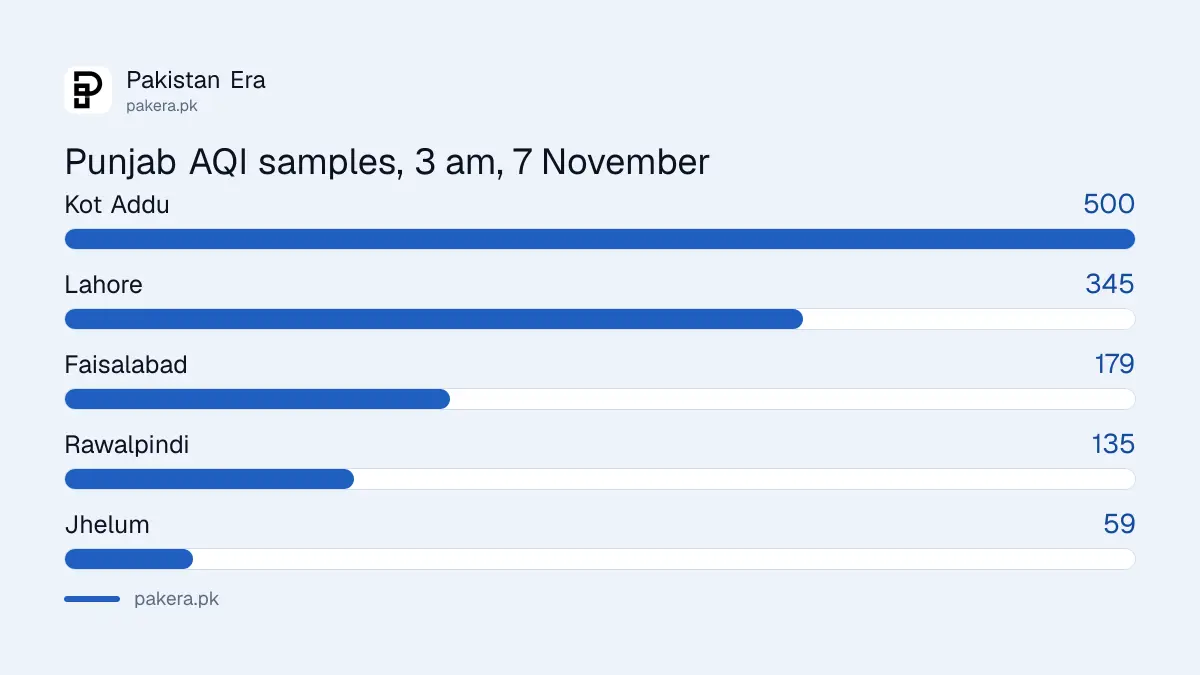
AQI, or Air Quality Index, is one number that sums up how dirty the air is. Higher is worse. Many Punjab families now check it on winter mornings, but the number alone does not tell them what to do. At 3 am on 7 November 2026, Lahore read 345 and Kasur read 411. This page puts each level in plain words, using Punjab EPA's health advisory, which we read on 7 November.
Punjab EPA splits AQI into seven bands from 0 to 500
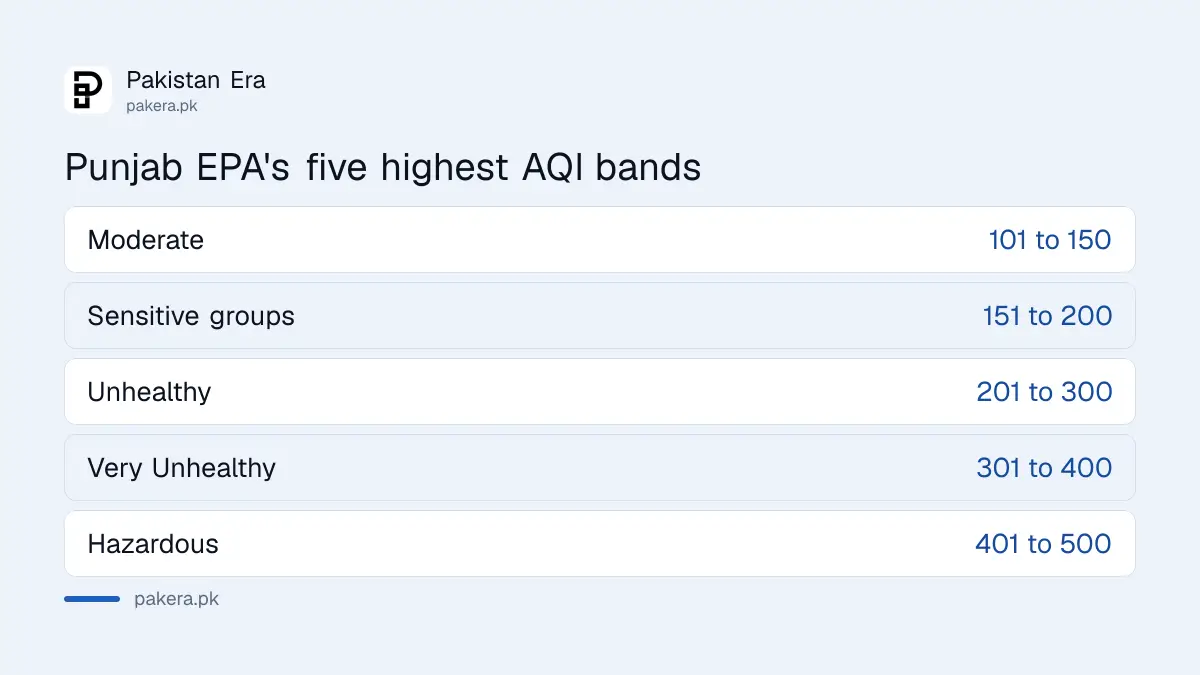
Punjab EPA's scale runs from Good at 0 to 50 up to Hazardous at 401 to 500. For each band, it gives one set of advice for the general public and another for vulnerable groups. The table below shortens that advice into plain language.
| AQI | Punjab EPA band | General public | Vulnerable groups |
|---|---|---|---|
| 0 to 50 | Good | No limits, ideal for outdoor activity | Make good use of clean air |
| 51 to 100 | Satisfactory | No special care needed | Go ahead with outdoor plans |
| 101 to 150 | Moderate | Check AQI when you plan outdoor activity | Limit time outdoors, keep a nebuliser ready, see a doctor for breathing trouble |
| 151 to 200 | Unhealthy for sensitive groups | Cut long or heavy outdoor effort | Wear a mask, keep children and older people indoors, close doors and windows |
| 201 to 300 | Unhealthy | Wear a mask outdoors, avoid heavy effort | Stay indoors as much as possible, use an N95 mask if you must go out |
| 301 to 400 | Very Unhealthy | Limit outdoor activity, exercise indoors | Stay indoors, use an N95 mask and protective glasses if you must go out |
| 401 to 500 | Hazardous | Stay indoors, use an N95 mask and protective glasses if you must go out | Stay at home, use an air purifier, check health vitals |
Vulnerable groups include children, older people, pregnant women and anyone with asthma, lung or heart disease. Punjab EPA also tells people with COPD, a long-term lung disease, or heart disease to ask a doctor about the right mask. Advice for two of these groups is set out in protecting children and older parents from smog.
AQI 100, 200, 300 and 500 each mean something different
These four numbers mark useful turning points. AQI 100 is the top of Satisfactory, 200 is the top of the sensitive band, 300 is the top of Unhealthy, and 500 is the top of the printed scale. Each one is a step up in what you should do.
AQI 100
This is the last number in Punjab's Satisfactory band. Healthy people need no special care, and vulnerable people can carry on with their plans. One point higher, at 101, Punjab EPA starts advising vulnerable people to limit time outdoors.
AQI 200
This is still the "sensitive groups" band. A healthy adult should only cut long or heavy outdoor effort. A child, an older parent or someone with asthma should wear a mask and keep indoors where possible. At 201 the advice to wear a mask reaches everyone.
AQI 300
This is the top of the Unhealthy band. Everyone should wear a mask outdoors and avoid heavy effort. Vulnerable people should stay indoors as much as they can, and an N95 or KN95 mask is the type to use if they must go out.
AQI 500
This is the highest number on Punjab EPA's printed scale. GT Road in Lahore showed exactly 500 at 3 am on 7 November. Punjab's Hazardous band ends here, so read 500 as "at the top of the scale". Do not read it as an exact measure of how bad the air is. Everyone is told to stay indoors.
Other AQI apps use a stricter set of band names
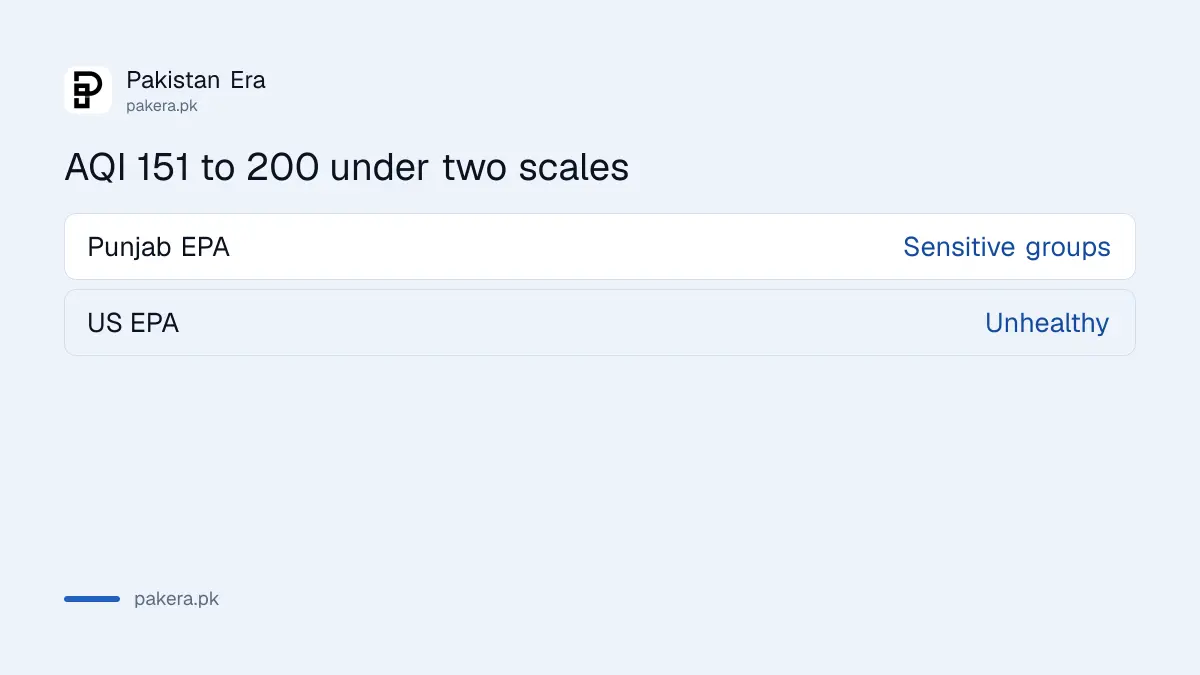
The same number can have a different name elsewhere. Many apps and devices follow the US scale, where 151 is already "Unhealthy" and 301 is already "Hazardous". In Punjab, those numbers are "sensitive groups" and "Very Unhealthy". So the label alone can mislead you.
| AQI | Punjab EPA | US EPA |
|---|---|---|
| 0 to 50 | Good | Good |
| 51 to 100 | Satisfactory | Moderate |
| 101 to 150 | Moderate | Unhealthy for sensitive groups |
| 151 to 200 | Unhealthy for sensitive groups | Unhealthy |
| 201 to 300 | Unhealthy | Very Unhealthy |
| 301 to 400 | Very Unhealthy | Hazardous |
| 401 to 500 | Hazardous | Hazardous |
The US column comes from the US government's AQI page, which lists Hazardous as 301 and higher. Our view is that if you have asthma, a heart condition or a small child, follow the stricter name of the two. It costs little, and it errs on the safe side.
Readings can also differ, not just names. Devices sit in different places, and an hourly government station will not match a sensor on someone's roof. In Punjab, the official number for orders and advice is the one on the provincial dashboard.
Read the number in four steps before you go out
A single figure can mislead if it is old, or from the other side of town. Check when it was measured, which area it covers and which band it falls in. Then match it to the people in your home, and act on the highest risk among them.
- Open the Punjab EPA dashboard and read the "Last updated" time. An old reading is not today's air.
- Find your city in the ranking. In Lahore, use the nearest of the 11 stations by area.
- Match the number to a band in the table above.
- Follow the vulnerable column if anyone in your home is a child, older, pregnant, or has asthma, lung or heart disease.
Night and early morning are often far worse than the afternoon. On 6 November, Lahore went from 373 at 3 am to 153 at 2 pm. That is two bands apart on the same day. Errands and outdoor exercise are better placed once you have checked the afternoon number.
PM2.5 and PM10 explain what is behind the number
The dashboard shows two kinds of dust alongside the AQI. PM2.5 is very fine dust that can reach deep into the lungs. PM10 is coarser, and comes from roads, building work and soil. The higher reading of the two usually pushes the AQI up.
Both are measured in micrograms per cubic metre of air. They are not the same as the AQI number. At GT Road in Lahore on 7 November, the AQI read 500 with PM2.5 at 407.1 and PM10 at 651.3. Do not compare a PM2.5 figure directly with an AQI figure, because they are different scales.
Common questions
What is a good AQI level in Pakistan?
Punjab EPA calls 0 to 50 Good and 51 to 100 Satisfactory. Up to 100 needs no special care on its scale.
Is AQI 150 safe?
For most healthy adults, Punjab EPA only says to plan outdoor activity with the number in mind. Vulnerable people should limit time outdoors and watch their health.
Is AQI 300 dangerous?
It is the top of Punjab's Unhealthy band. Everyone should wear a mask outdoors and avoid heavy effort. Vulnerable people should stay indoors as much as possible.
What does AQI 500 mean?
It is the top of Punjab EPA's Hazardous band, so read it as the ceiling of the scale. Everyone is told to stay indoors.
Why does my app show a different AQI?
It may use a different scale, sensor or location. Punjab EPA's dashboard gives the official provincial reading, so use it to compare.
Do schools close at a set AQI number?
We have not found a published number that closes schools automatically. Closure needs a written order, and smog school closure orders appear on two official pages.
How we verified this
What we checked, where we read it, and what we could not confirm.
Last checked on 7 November 2026. Bands and advice come from Punjab EPA's health advisory page, paraphrased. Sample readings come from its dashboard at 3 am on 7 November, and the 6 November afternoon figure comes from our reading that day. The US bands come from the US government's AQI basics page. This is general information, not medical advice.
About the author

Public Services and Education Journalist
Fajr Riaz is a journalist and content writer at Pakistan Era, based in Lahore. She covers the questions people meet in everyday life in Pakistan: how a public service works, what a change in the rules means, and where to find a reliable answer.