How to Get a Child Visitation Schedule From the Family Court in Punjab
Get a child visitation schedule from a Punjab Family Court: where to file, the section 12 interim meeting order, what to propose, and what to do if broken.
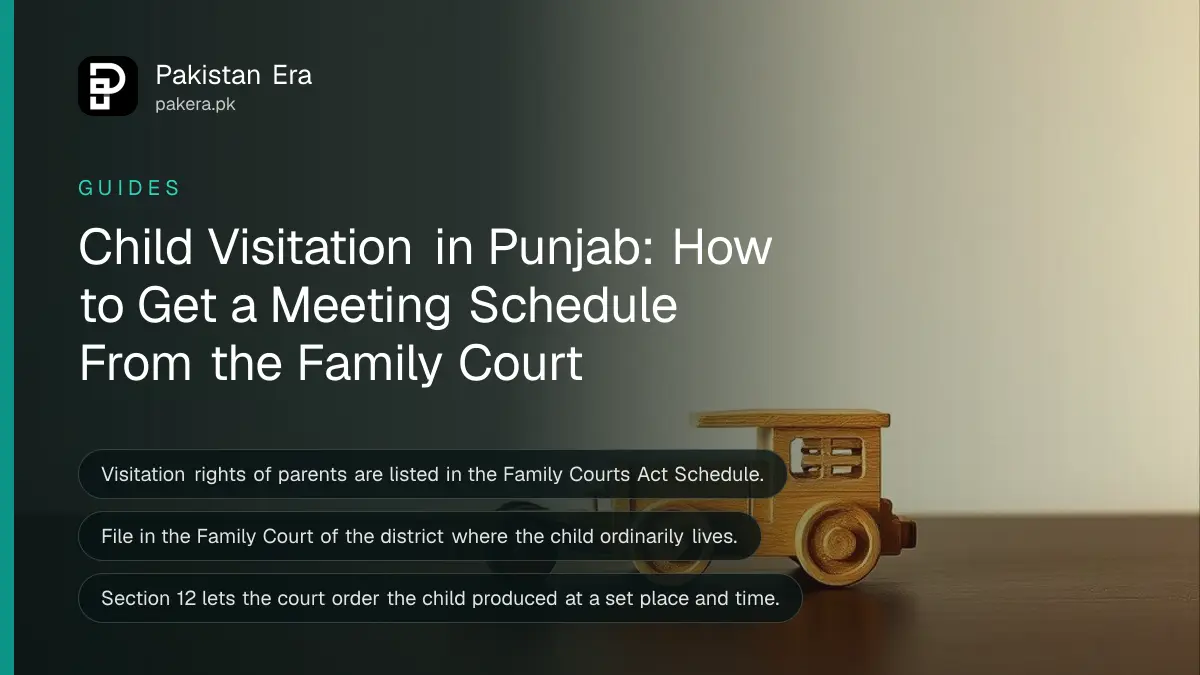
A parent who does not live with the child can ask the Family Court in Punjab for a visitation schedule, a written order of when and where they will meet the child. File in the court of the district where the child ordinarily lives, and ask for an interim meeting schedule at the first hearing under section 12 of the Guardians and Wards Act 1890.
Since 2002, the Schedule of the Family Courts Act 1964 has listed "custody of children, and the visitation rights of parents to meet them" as a matter only the Family Court can decide. So a father or mother kept away from a child does not have to wait for the whole custody case to end. The court can fix meetings while it runs.
This page explains the process and what to ask for. It is not legal advice. Every schedule depends on the child's age and welfare, so speak to a family lawyer about your own case.
File in the Family Court where the child ordinarily lives
Section 25 of the Family Courts Act treats the Family Court as the District Court under the Guardians and Wards Act. Section 9 of that Act sends an application about a child's person to the court where the child ordinarily lives. That court hears visitation too.
You can ask for visitation in two ways. If a custody or guardianship case is already running, apply in that case. If you only want to meet the child and are not asking for custody, file a petition for visitation on its own, as the Schedule lists it as a separate matter.
| Law | What it does for visitation |
|---|---|
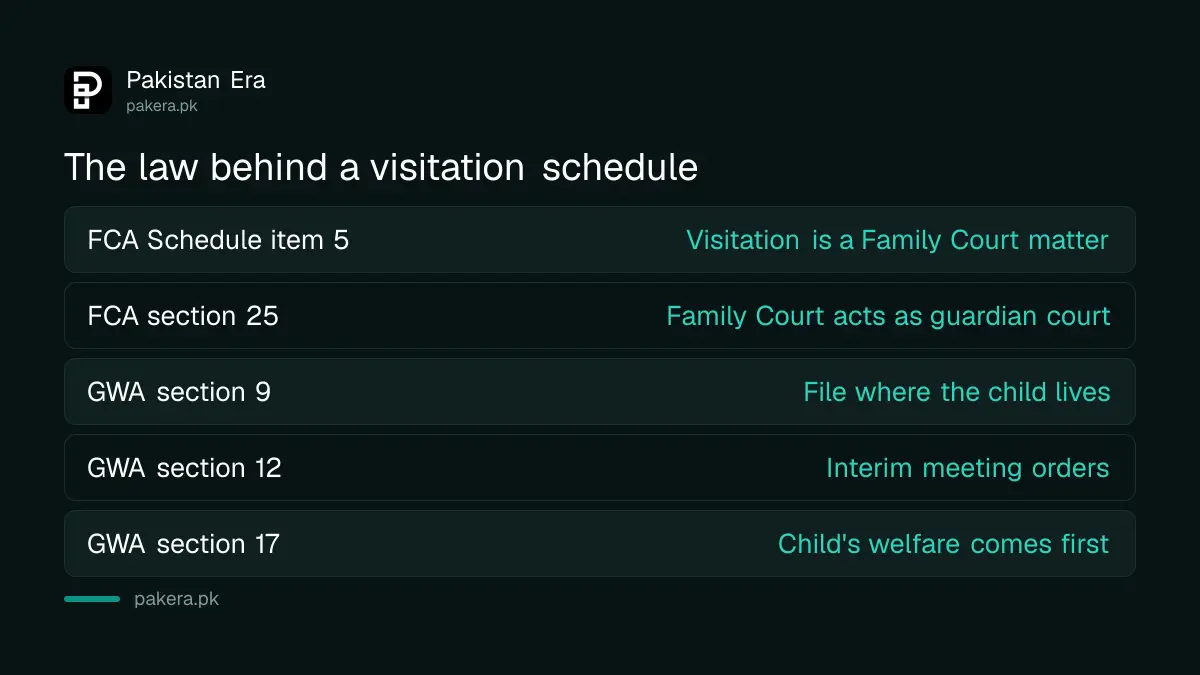
| Family Courts Act 1964, Schedule Part I item 5 | Custody and the visitation rights of parents are Family Court matters |
| Family Courts Act, section 25 | Family Court acts as the District Court under the Guardians and Wards Act |
| Guardians and Wards Act, section 9 | File where the child ordinarily lives |
| Guardians and Wards Act, section 12 | Court can order the child produced at a set place and time, and make interim orders |
| Guardians and Wards Act, section 17 | The child's welfare guides the court, and an older child's wish may be considered |
The wider picture of custody, guardianship and visitation is set out in the page on child custody in the Family Court.
Ask for an interim meeting schedule at the first hearing
Section 12 lets the court direct the parent who has the child to produce the child "at such place and time" as it sets. Use it to ask for an interim schedule at the start, so meetings begin while the main case goes on.
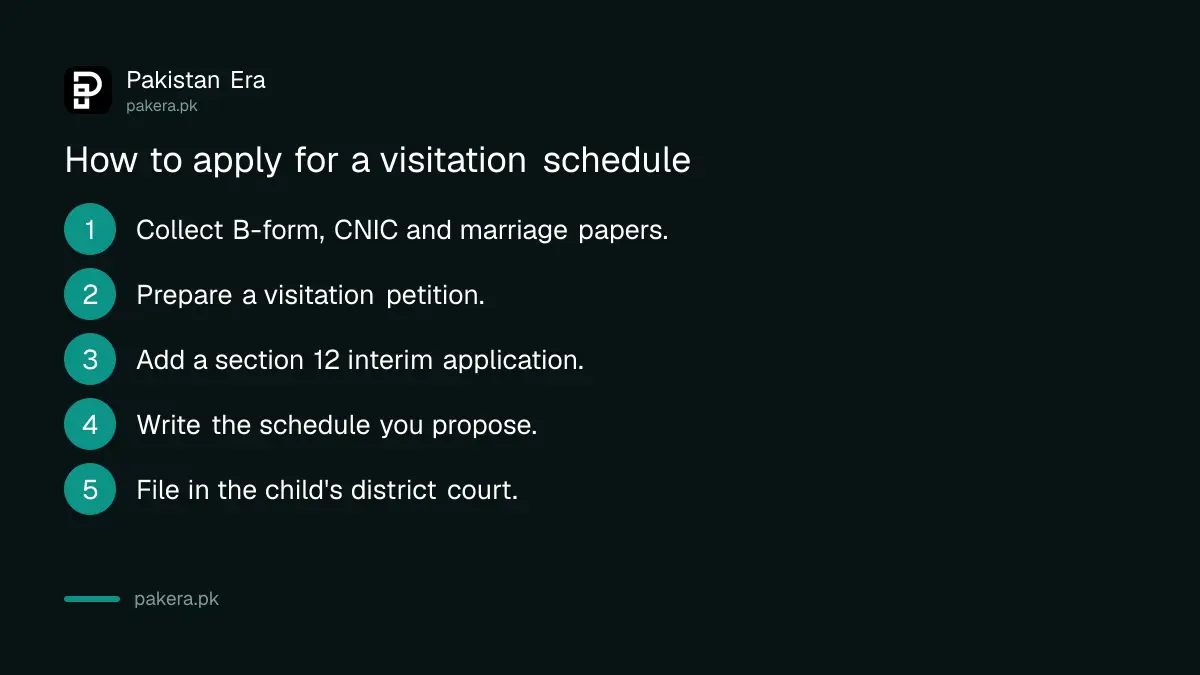
- Collect the child's B-form or birth certificate, your CNIC, the nikah nama or divorce papers, and the other parent's current address.
- Prepare a petition for visitation, or an application in the running custody case, with a short history of when you last met the child.
- Add a separate application under section 12 for an interim meeting schedule.
- Write down the schedule you propose: day, hours, place and holidays.
- File it in the Family Court of the district where the child lives and pay the court fee.
- At the first hearing, ask the court to fix interim meetings and to direct the other parent to bring the child.
- Get a certified copy of the order, so the date, time and place are in writing.
Under section 14(3) of the Family Courts Act, no appeal or revision lies against an interim order. If the interim schedule does not work, ask the same court to change it.
Propose a schedule the court can actually order
A court is more likely to accept a clear, practical plan that puts the child first. Name the day, the hours, the place and the handover. Ask for holidays and phone or video calls in so many words, because an order only covers what it says.
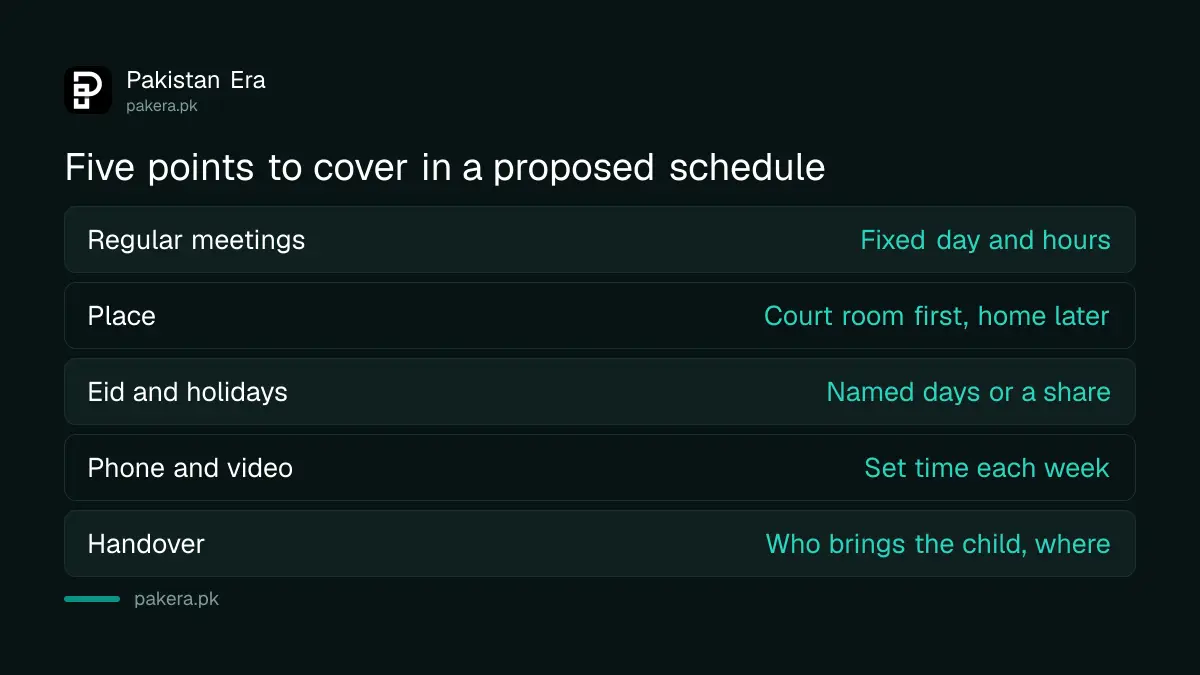
| Point to cover | What to propose |
|---|---|
| Regular meetings | A fixed day and hours, for example every second Saturday afternoon |
| Place | A meeting room in the court premises at first, a home or public place later if things go well |
| Eid and school holidays | Named days or a share of the winter and summer breaks |
| Phone and video calls | A set time each week |
| Handover | Who brings the child, where, and who else may be present |
Think about the child's age, school hours and travel. A schedule that a young child can manage is more likely to be ordered, and kept, than one that asks for every weekend.
If the other parent does not bring the child
Tell the court at once, with dates. Section 12 is a court direction, so missed meetings go on the record. The court can direct production again, change the schedule, and consider the conduct of both parents when it decides custody.
- Keep a record. Note each date, whether the child came, and any message from the other side. Attend every meeting yourself, on time.
- File an application. Ask the court to enforce the interim order and fix make-up meetings.
- Child taken away from the custodian. Section 25 of the Guardians and Wards Act lets the court order a child returned to the guardian, and if needed have the child brought to the guardian.
- Child taken out of Pakistan. The Hague Convention route through the Ministry of Law may apply, depending on the country, as set out in seeking a child's return under the Hague Convention.
- Case in the wrong district. A party can ask for transfer, as set out in moving a family case to another district in Punjab.
The schedule can be changed later
An interim schedule is not permanent. Either parent can ask the court to change it when the child grows, changes school, moves city or when meetings have gone well. The final custody decision usually settles visitation for the longer term.
If you need a lawyer but cannot pay, the district legal empowerment committee can assign one, as set out in getting a free lawyer in Punjab.
Common questions
Can a father get visitation without asking for custody?
Yes. The Schedule of the Family Courts Act lists visitation rights of parents as a separate matter, so a parent can apply for meetings alone.
Which court do I go to if the child lives in another city?
The Family Court in the district where the child ordinarily lives, under section 9 of the Guardians and Wards Act.
Can I appeal an interim meeting order?
No. Section 14(3) of the Family Courts Act bars appeal and revision against interim orders. Ask the same court to change it.
Does the child's own wish matter?
Section 17(3) of the Guardians and Wards Act lets the court consider the preference of a child old enough to form one. The child's welfare comes first.
Can grandparents ask for visitation?
The Schedule speaks of the visitation rights of parents. Grandparents should take legal advice on whether and how they can apply.
Can the mother stop the meetings if maintenance is unpaid?
Meetings and maintenance are separate orders. Raise unpaid maintenance in the maintenance case, and keep to the visitation order unless the court changes it.
How we verified this
What we checked and where we read it.
Last checked 24 November 2026. We read sections 14, 25 and Part I of the Schedule of the Family Courts Act 1964 as amended in Punjab, and sections 9, 12, 17 and 25 of the Guardians and Wards Act 1890 in the copy published by the Ministry of Religious Affairs. Neither law sets a standard visitation timetable, so the schedule points above are proposals for the court, and meeting room arrangements differ by district.
Free on WhatsApp
Get last dates and rule changes on WhatsApp
We post new last dates, fee changes and fixes for common problems, a few short posts a day.
Follow Pakera on WhatsAppOther followers cannot see your number.
Pakera Solves It
Which online process wasted your time this week?
A portal that will not load, a form nobody explains, a complaint that went nowhere. Tell us. Every week we pick one, solve it step by step and publish the answer.
About the author

Global Affairs & Political Economy Writer
Muhammad Hatim is a book lover who started writing because he enjoys it. At Pakistan Era he writes about international relations, geopolitics and the global economy, with a particular interest in South Asia and the forces behind current events.