Child Custody and Guardianship in a Punjab Family Court
Custody is who the child lives with. Guardianship is legal authority. Visitation is its own entry. Filing the wrong one costs months.
Custody, visitation and guardianship are three different things, and a family court handles all three. Filing for the wrong one wastes months.
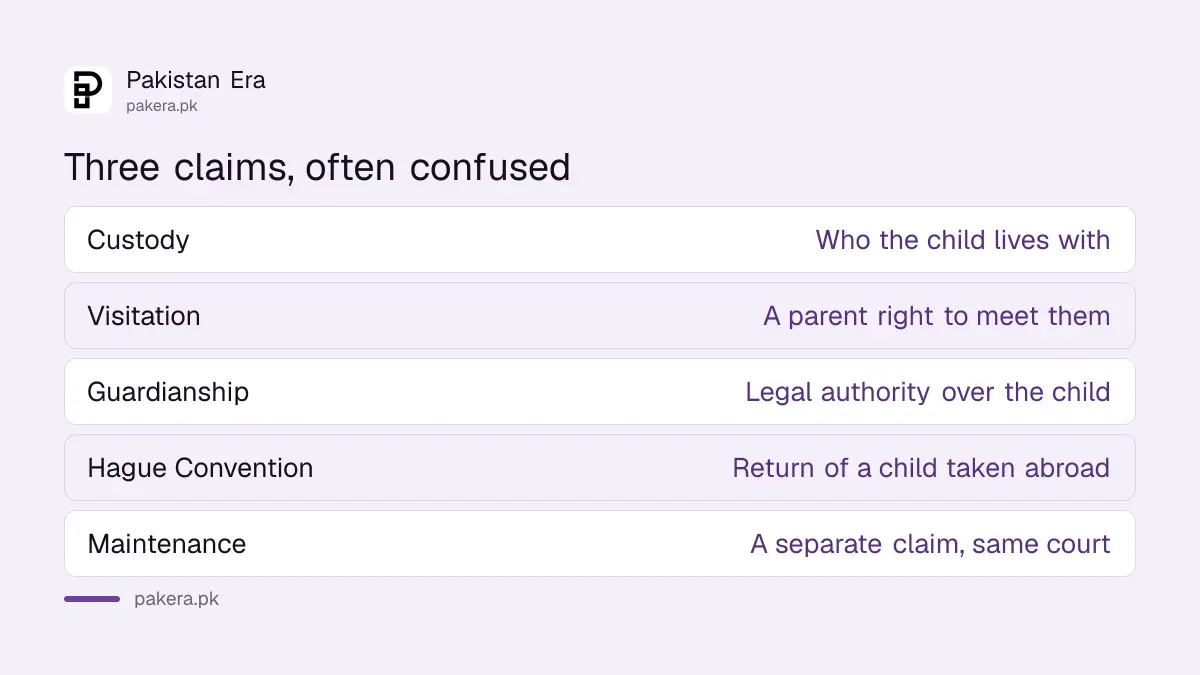
Custody is about who the child lives with. Visitation is the other parent's right to meet them. Guardianship is legal authority over the child's affairs and property. They are listed separately in the law for that reason.
We read the Family Courts Act, 1964 on 31 August 2026, in the text published by the Law and Parliamentary Affairs Department of the Government of the Punjab.
What a family court can decide
Part I of the Schedule to the Act lists what these courts handle. Three entries concern children.
| Entry | What it covers |
|---|---|
| Custody of children | Who the child lives with |
| Visitation rights of parents | The right of a parent to meet the child |
| Guardianship | Legal authority over the child and their affairs |
| Return of a child | Under the Hague Convention on International Child Abduction, 1980 |
| Personal property | Of a wife and of a child living with his mother |
Visitation is written into the Schedule as its own item. So a parent seeking contact is not asking for a favour attached to somebody else's custody case. It is a matter the court is there to decide.
The same court, wearing two hats
Section 25 does something people find confusing, and it is worth understanding before you are told your case is in the wrong place.
It says a Family Court shall be deemed to be a District Court for the purposes of the Guardians and Wards Act, 1890, and that in dealing with matters specified in that Act it shall follow the procedure prescribed in that Act.
In plain terms, guardianship still lives under an old and separate law from 1890, but you do not go to a different building for it. The family court hears it, using that Act's procedure.
That is why guardianship applications can feel procedurally different from a custody case heard by the same judge. They are running on different rules by design.
Cases can be moved
Section 25-A allows the High Court, either on a party's application or on its own accord, to transfer a suit or proceeding from one family court to another in the same district, or from a family court in one district to another district. It can also transfer appeals between district courts.
That matters where a parent has moved cities, or where travelling to the original court is genuinely impractical. It is an application to make with proper reasons, not an automatic right, but it exists.
What to prepare
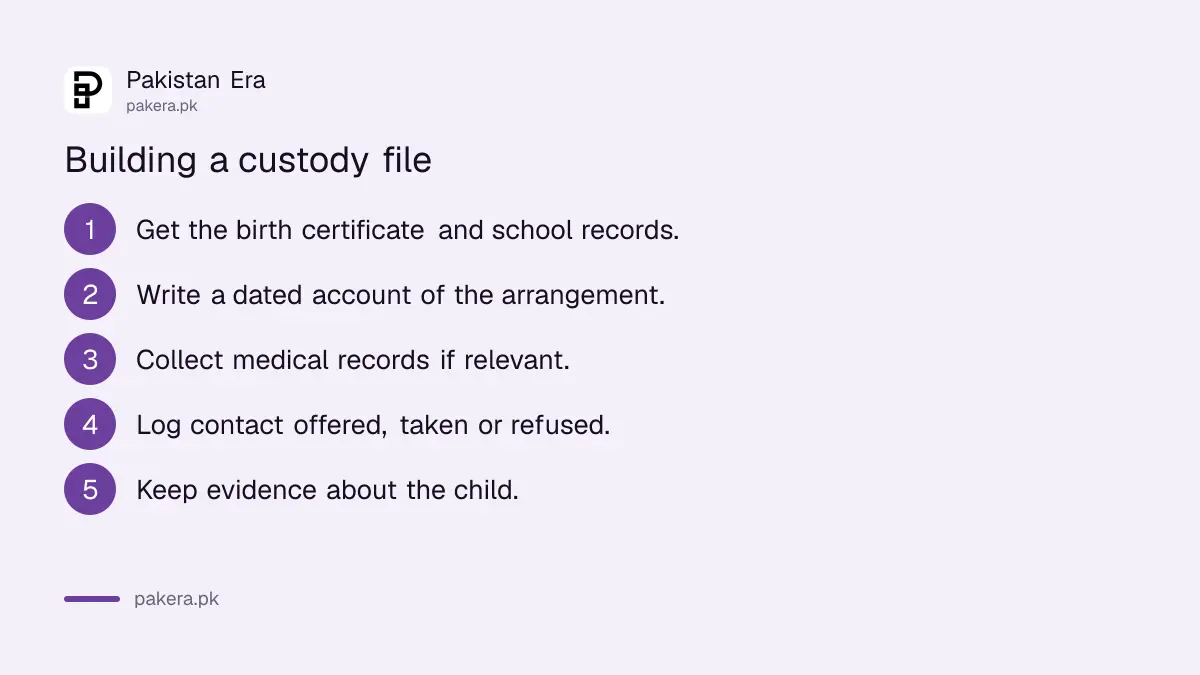
Custody cases turn on the welfare of the child, and what you can evidence about it.
- Gather the child's birth certificate or B Form and school records.
- Write a dated account of the current living arrangement and who does what.
- Collect medical records if health needs are part of the picture.
- Keep a factual record of contact offered, taken or refused, with dates.
- Keep your evidence about the child, not about the other parent.
That last point is the practical one. A file that is mostly complaints about the other adult is weaker than a file that shows the child's routine, schooling, health and needs. The question before the court is the child's welfare.
Maintenance is a separate claim
Money for the child is its own item in the same Schedule, and it moves faster than most people expect.
Interim maintenance is fixed at the defendant's first appearance, and a payment missed past the fourteenth of the month has serious consequences for the defence. Our guide to claiming maintenance in a Punjab family court sets that out in full.
Bring the custody and maintenance questions to the same court rather than treating them as separate errands.
If the marriage is also ending
Dissolution, including khula, and dower and dowry are all in the same Schedule. Our guides to the khula procedure and nikah registration cover those, and the nikahnama is worth re-reading because the Schedule includes any matter arising out of it.
Where a child has been taken abroad, the Schedule includes matters concerning return of a child under the Hague Convention on the Civil Aspects of International Child Abduction, 1980. That is a specialist area and needs a lawyer experienced in it.
This is the Punjab statute
The Act we read states that it extends to the whole of the Punjab. Family law is administered provincially, and other provinces have their own family courts legislation with their own amendments and numbering.
The shape is broadly similar across the country. Do not quote a section number outside Punjab without checking the version that applies there. Nothing on this page is legal advice, and a custody case is a matter for a family lawyer.
Common questions
What is the difference between custody and guardianship?
Custody concerns who the child lives with. Guardianship is legal authority over the child and their affairs, and it runs under the Guardians and Wards Act, 1890.
Which court hears guardianship?
The family court, which section 25 deems to be a District Court for the purposes of that Act, following that Act's procedure.
Can I ask for visitation on its own?
Visitation rights of parents to meet their children are listed as their own entry in the Schedule.
Can my case be moved to another city?
Section 25-A allows the High Court to transfer proceedings between family courts, including between districts.
What matters most in a custody case?
Evidence about the child's welfare, routine, schooling and health, rather than material about the other parent.
Does this apply outside Punjab?
The Act we read extends to the Punjab. Other provinces have their own legislation.
How we verified this
What we checked, where we read it, and what we could not confirm.
Last checked 31 August 2026. We read the Family Courts Act, 1964, Act XXXV of 1964, in the text published by the Law and Parliamentary Affairs Department, Government of the Punjab, on the Punjab Code portal, and downloaded the department's own PDF of the Act. The Part I Schedule entries covering custody of children, the visitation rights of parents to meet them, guardianship, matters pertaining to return of a child under the Hague Convention on the Civil Aspects of International Child Abduction, 1980, and the personal property and belongings of a wife and a child living with his mother, section 25 deeming a Family Court to be a District Court for the purposes of the Guardians and Wards Act, 1890 and requiring that Act's procedure to be followed, and section 25-A permitting the High Court to transfer suits, proceedings and appeals between family courts and districts, are all taken from that text. The Act states that it extends to the whole of the Punjab. We did not read the Guardians and Wards Act, 1890 itself, so no provision of it is quoted here. This is a summary of what the statute says and not legal advice.
About the author

Tax, Bills and Technology Writer
Ali Akhtar is a young and curious voice here at Pakistan Era. He is currently pursuing his A-Levels and has a growing interest in Pakistan’s changing industrial landscape and educational trends. Ali likes to write in a way that helps him explain and explore the world around him. His writing reflects the perspective of the new generation navigating the evolving trends of Pakistan where technology, youth innovation, and shifting opportunities are reshaping the country’s future.