How to Apply for a House Building or Motor Car Advance From AGPR
Apply for a federal house building, motor car or motorcycle advance from AGPR. Limits by basic pay, the proforma, papers, the FAC queue and hardship cases.
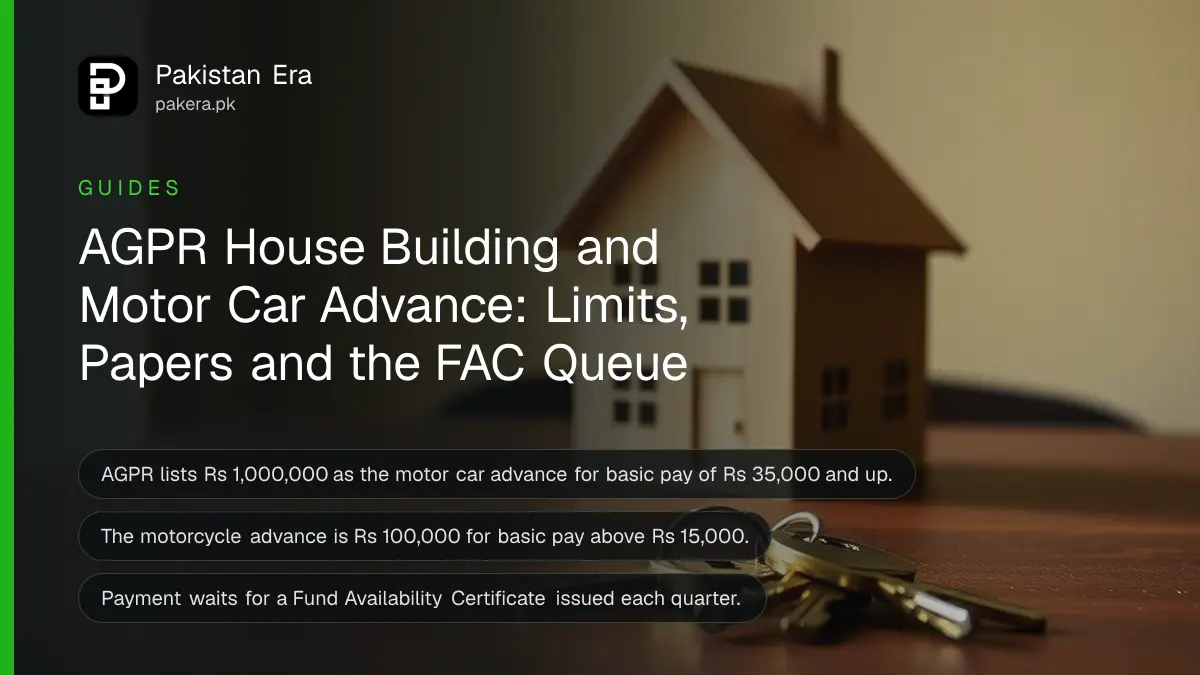
Federal employees apply for a house building advance, motor car advance or motorcycle advance on AGPR's long term advances application proforma, signed by the applicant and the DDO. AGPR's limits: motor car Rs 1,000,000 for basic pay of Rs 35,000 and above, motorcycle Rs 100,000 for basic pay above Rs 15,000, and house building up to 36 months' basic pay. Payment depends on a Fund Availability Certificate issued each quarter.
These advances are loans from the government, not from your GP Fund. They come with a mark-up and a queue. The queue is the part most applicants do not understand, and it decides when the money actually arrives.
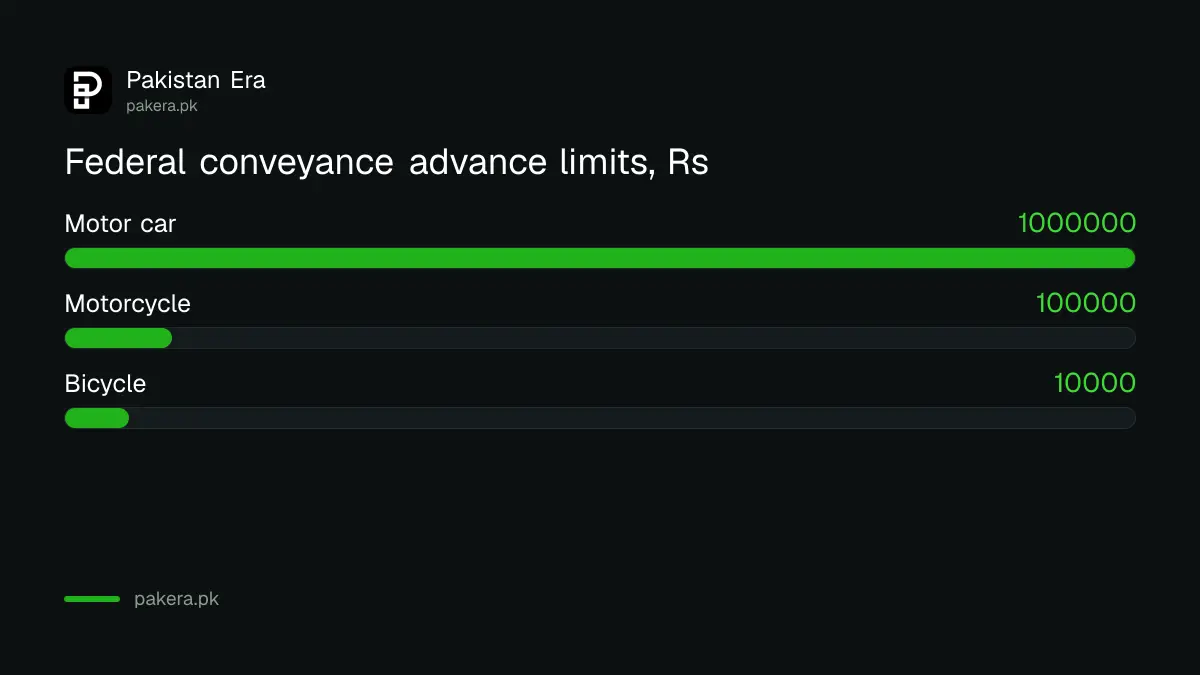
| Advance | Who qualifies | Amount (AGPR) |
|---|---|---|
| Motor car | Basic pay Rs 35,000 and above | Rs 1,000,000 |
| Motorcycle | Basic pay Rs 15,001 and above | Rs 100,000 |
| Bicycle | Basic pay up to Rs 15,000 | Rs 10,000 |
| House building, gazetted | FPSC-recruited permanent employees, no minimum service | 36 months' basic pay |
| House building, non-gazetted | 10 years' regular service or permanent; Class-IV after probation | 36 months' basic pay |
AGPR's Budget Section handles house and conveyance advances
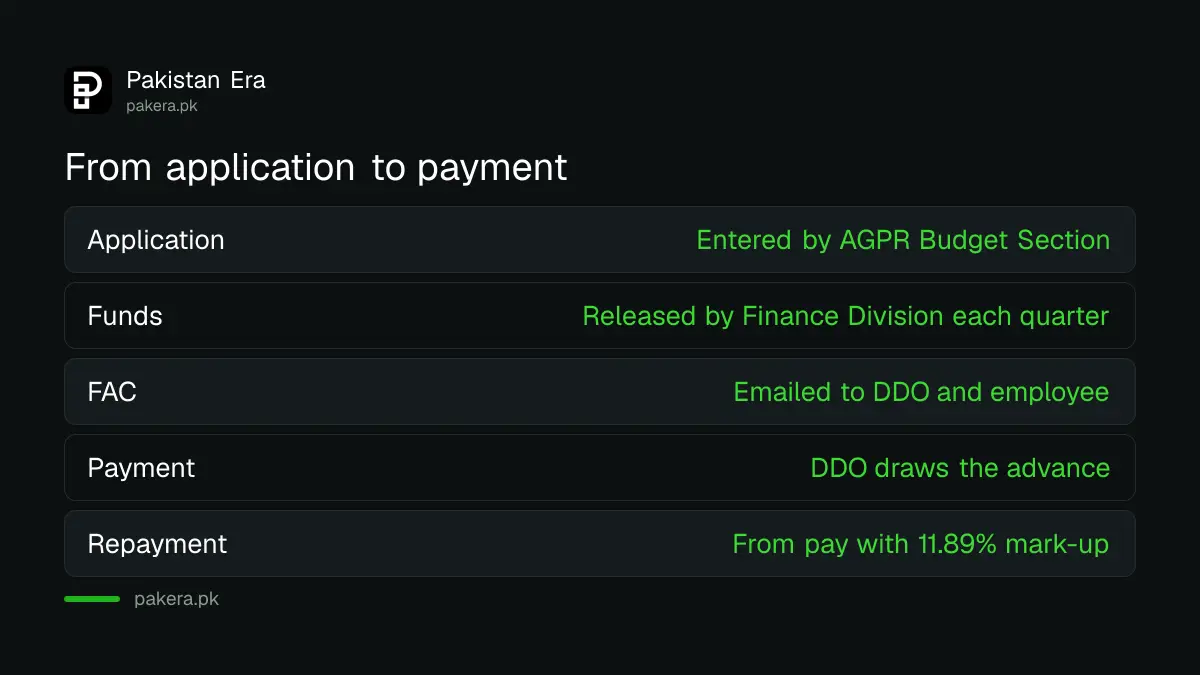
The Budget Section of AGPR Islamabad deals with long term advances to federal employees. The Finance Division releases money for them each quarter of the financial year. AGPR then issues a Fund Availability Certificate (FAC) to applicants in turn, and only an FAC lets the advance be paid.
House building advances are split by pay group: BPS 1 to 9, BPS 10 to 15 and BPS 16 to 22. Each group is split again into General and Priority. A priority case needs a priority letter, and the application form asks for its number, date and the officer who granted it.
Conveyance advances come in three kinds: motor car, motorcycle and bicycle. The application form allows a first or second car advance, and a first, second or third house building advance. You also list any earlier advance, the date drawn and the amount still outstanding.
Fill the long term advance proforma without a single blank
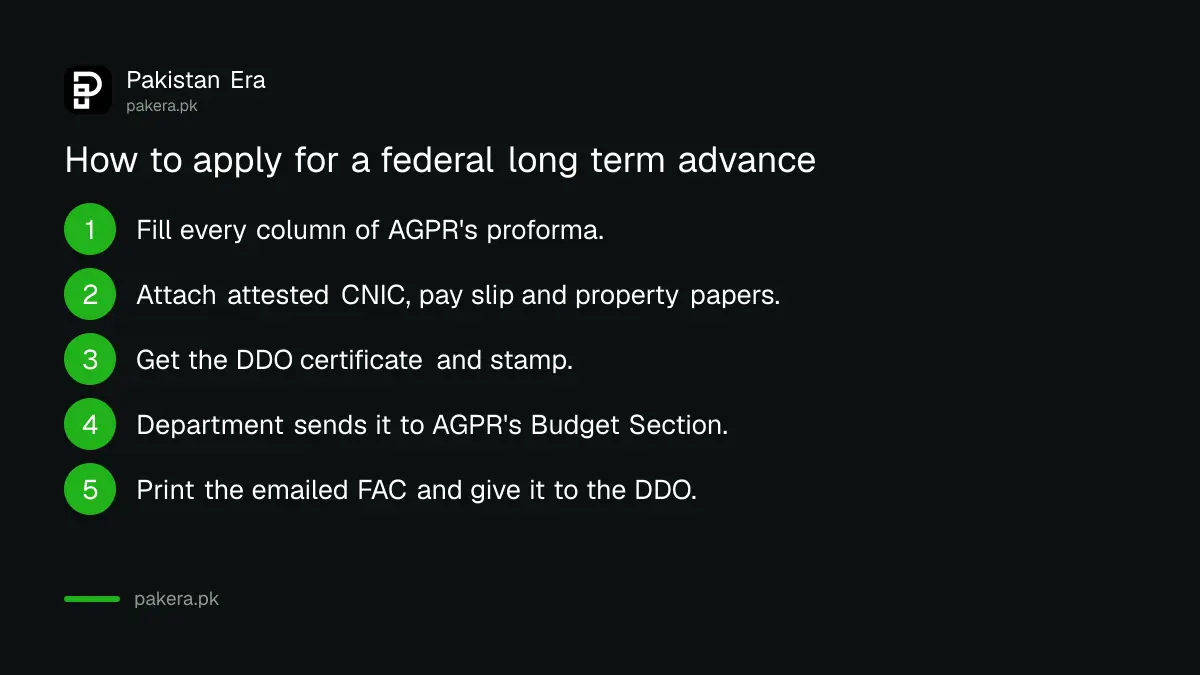
AGPR's application proforma says an incomplete form will be rejected. Fill every column, write dates as day, month and year in full, and get every photocopy attested by a gazetted officer. Email address and mobile number are compulsory, because AGPR emails the FAC.
- Download the long term advances proforma from AGPR's forms page.
- Fill your department, appointment date, BPS, basic pay, date of birth, retirement date and personnel number.
- Tick the advance type and whether it is your first, second or third.
- Write the amount you want and any earlier advance still outstanding.
- For a house, fill the plot or house details, owner and location.
- Attach the documents listed below, attested.
- Sign it, then get the DDO's certificate and stamp.
- Your department sends it to AGPR's Budget Section with a covering letter.
For a house building advance, the DDO certifies that the plot or house documents have been examined and are valid under para 253-A of the General Financial Rules, and that the sanctioning authority has approved the case. If anything in your application changes after AGPR enters it, tell the Budget Section, or the FAC may be issued with wrong details.
The documents differ for a house and a vehicle
A vehicle advance needs only three papers: an attested CNIC copy, an attested latest pay slip and a covering letter from your department. A house building advance needs the same three plus proof of the property, the agreement with the seller and proof that the seller owns it.
| Document | House building | Car, motorcycle, bicycle |
|---|---|---|
| Proforma signed by applicant and DDO | Yes | Yes |
| Attested CNIC copy | Yes | Yes |
| Attested latest pay slip | Yes | Yes |
| Covering letter from department | Yes | Yes |
| Plot or house particulars, attested | Yes | No |
| Valid agreement deed with the owner | Yes | No |
| Seller's proof of ownership | Yes | No |
Check the seller's papers before you sign the agreement. A house advance is tied to that property, and a rejected title means starting the file again. If you also plan a bank home loan, the charges and papers in HBFC home loan documents are a useful comparison.
Watch for your Fund Availability Certificate by email
Once funds are released for your turn, AGPR's Budget Section issues the FAC. Since 15 May 2024, AGPR emails FACs to DDOs and to employees, and they are valid for payment without a signature. Print the emailed FAC and give it to your DDO to draw the advance.
AGPR also posts lists of FACs issued each quarter on its loans and advances page, split into house building, motor car and motorcycle. If your name is on a list and you did not get the email, contact the Budget Section. The proforma gives its number as 051-9260372, extension 126.
The advance is repaid from your pay with a mark-up. For 2025-26, the Finance Division set 11.89 per cent a year on house building and conveyance advances, listed with the GP Fund profit and advance mark-up rates.
Hardship cases go through an officer your ministry names
AGPR receives many requests to move an advance up the queue on hardship grounds. Its circular of 12 September 2019 says these cases must be routed through an officer designated by the administrative head of your ministry, division or department. A direct request to AGPR will not be taken up.
If you need money faster than the advance queue allows, a GP Fund advance from your own balance is usually quicker, because it does not wait for a quarterly budget release. It is capped at three months' pay or half your balance, whichever is less.
Common questions
How much motor car advance can a federal employee get?
AGPR lists Rs 1,000,000 for employees whose basic pay is Rs 35,000 or more.
Who can get a motorcycle advance?
Employees with basic pay of Rs 15,001 and above, up to Rs 100,000. Those on basic pay up to Rs 15,000 can get a Rs 10,000 bicycle advance.
How much house building advance is allowed?
AGPR's table lists an amount equal to 36 months' basic pay, for gazetted and non-gazetted employees who meet the service condition.
Why has my advance not been paid after approval?
Payment waits for a Fund Availability Certificate, which AGPR issues only when the Finance Division releases quarterly funds for your turn.
Is there a mark-up on house and car advances?
Yes. The Finance Division set 11.89 per cent a year for 2025-26.
Can a contract employee apply?
The form has a box for contract employees, but the house building rules on AGPR's page require permanent or regular service. Ask your DDO before you apply.
How we verified this
What we checked and where we read it.
Last checked 24 November 2026. We read the loans and advances page of AGPR, with its eligibility table, document lists and FAC notices, the long term advances application proforma, and AGPR's circular of 12 September 2019 on hardship cases. The 11.89 per cent mark-up is from the Finance Division letter of 23 July 2026. The amounts are AGPR's published figures for employees whose accounts it keeps; employees paid by a provincial Accountant General follow that office's rules.
Free on WhatsApp
Get last dates and rule changes on WhatsApp
We post new last dates, fee changes and fixes for common problems, a few short posts a day.
Follow Pakera on WhatsAppOther followers cannot see your number.
Pakera Solves It
Which online process wasted your time this week?
A portal that will not load, a form nobody explains, a complaint that went nowhere. Tell us. Every week we pick one, solve it step by step and publish the answer.
About the author

Tax, Bills and Technology Writer
Ali Akhtar is a young and curious voice here at Pakistan Era. He is currently pursuing his A-Levels and has a growing interest in Pakistan’s changing industrial landscape and educational trends. Ali likes to write in a way that helps him explain and explore the world around him. His writing reflects the perspective of the new generation navigating the evolving trends of Pakistan where technology, youth innovation, and shifting opportunities are reshaping the country’s future.