How to Get a Free Lawyer in Punjab
The Punjab Legal Aid Agency covers criminal accused, women in family disputes and property complaints. Apply with an affidavit.

Punjab has a government agency that pays for your lawyer if you cannot afford one. It covers people accused of an offence, women in family disputes, and since 2025, people who have reported their property being grabbed.
Update, 10 October 2026: The Supreme Court has started a 1818 call centre for free legal advice. Callers can also ask for a free lawyer through it. Read the update.
The Punjab Legal Aid Agency runs a panel of accredited advocates in each district. You apply, you swear an affidavit, and if you are refused you have seven days to appeal.
We read the Punjab Legal Aid Act 2018 on 6 September 2026 in the text published by the Law and Parliamentary Affairs Department, Government of the Punjab, carrying the 2025 and 2026 amendments.
Who qualifies
| Category | What the Act says |
|---|---|
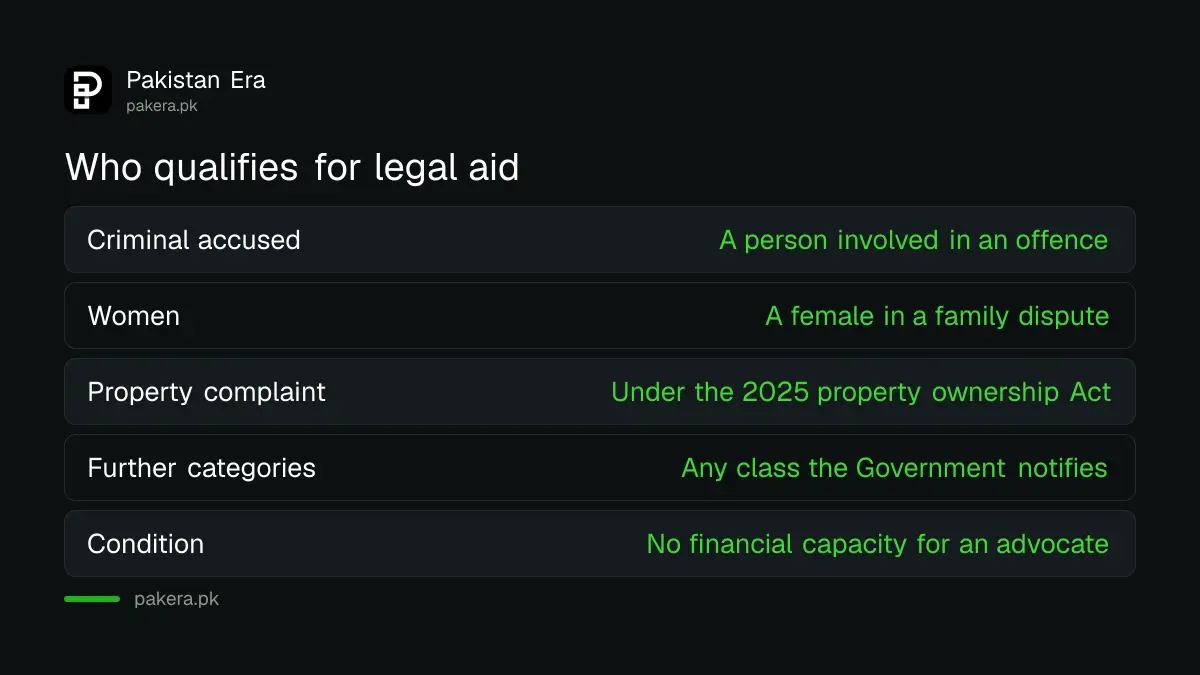
| Criminal accused | A person involved in the commission of an offence |
| Women in family cases | A female involved in a family dispute |
| Property complaint | A person who filed a complaint under section 7 of the Punjab Protection of Ownership of Immovable Property Act 2025 |
| Further categories | Any class the Government notifies in the official Gazette |
| Common condition | Not having the financial capacity to engage an advocate |
The financial condition applies across all of them. The Act calls a qualifying person an indigent person, and eligibility is determined in the manner prescribed by the rules.
What a family dispute means here
The Act does not leave this open. A family dispute means a dispute involving a female indigent person relating to divorce, maintenance, dowry, dower or custody of children.
Those five subjects are the ones women most often face without representation, and they are the ones the definition names.
Our guide to claiming maintenance in the family court covers one of them, and our guide to child custody covers another. Legal aid does not replace those processes. It pays for the advocate who takes you through them.
The category added for property grabbing
The most recent widening is worth noticing, because it covers a situation where people usually assume they are on their own.
The definition of indigent person now includes any person who filed a complaint under section 7 of the Punjab Protection of Ownership of Immovable Property Act 2025. That is the route for somebody whose immovable property has been taken from them.
An amendment in May 2026 also lets the Government declare further categories of persons, classes of cases or proceedings by notification, and the same procedure then applies to them. So the list is designed to grow.
Our guide to checking a housing scheme before buying a plot and our guide to getting a fard online in Punjab cover the checks that reduce the chance of ending up in that position.
How to apply
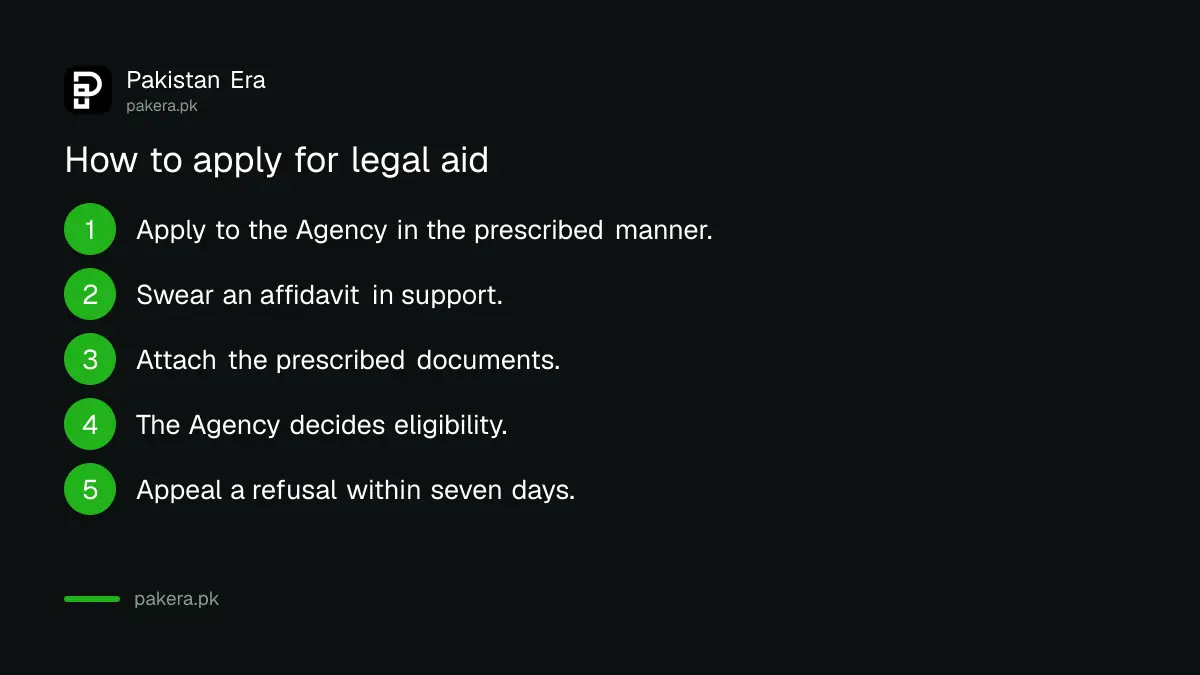
- Apply to the Punjab Legal Aid Agency in the prescribed manner.
- Support the application with an affidavit sworn by you.
- Attach the other documents the rules prescribe.
- The Agency decides whether you are an indigent person and meet the requirements.
- If it is satisfied, it provides legal aid. If not, it rejects the application.
If your application is rejected, you may appeal within seven days from the date the order was communicated to you, to the authority prescribed by the rules. Seven days is short, so note the date the order reached you.
The Agency may also recall legal aid at any stage of a case, after a hearing, for misstatement, misrepresentation or fraud.
Who the lawyer will be
Section 10 sets up the panel. The Agency accredits a panel of advocates for each financial year in every district, and in a tehsil where necessary, and starts the accreditation process for the next year by the first week of April.
If a new panel has not been notified when the year ends, the outgoing panel continues to serve, so there is no gap.
The Agency may classify accredited advocates for different classes of persons or courts. It caps how many legal aid cases one advocate may hold at a time. It monitors and evaluates the quality of the aid each advocate provides. And each accredited advocate must keep proper records of the cases entrusted to them and report to the Agency.
The Government may prescribe a code of conduct for accredited advocates, and the Agency may suspend or cancel an accreditation after a hearing.
The duty to tell you this exists
Section 14 places an obligation on officials rather than on you. On coming to know that an indigent person remains undefended by an advocate, the officer shall inform that person that they may apply to the Agency for legal aid.
That is the provision to point at if you are in a proceeding without a lawyer and nobody has mentioned legal aid.
Section 16 is the balance on your side of it. A person who intentionally makes a false declaration or swears a false affidavit in support of a legal aid application is punishable with imprisonment of not less than seven days and up to six months. The offence is not cognizable, and a court can only take it up on a written complaint by the Director General or somebody authorised by him.
Our guide to checking a court case online is useful once your case is moving.
Common questions
Can I get a free lawyer in Punjab?
Yes, if you are an indigent person under the Act and apply to the Punjab Legal Aid Agency.
Who counts as an indigent person?
A person involved in the commission of an offence, a female involved in a family dispute, or a person who filed a complaint under section 7 of the Punjab Protection of Ownership of Immovable Property Act 2025, who cannot afford an advocate.
What is a family dispute here?
A dispute involving a female indigent person relating to divorce, maintenance, dowry, dower or custody of children.
What do I need to apply?
An application in the prescribed manner, supported by your own affidavit and the prescribed documents.
What if I am refused?
Appeal within seven days of the order being communicated to you.
Can legal aid be taken away?
Yes, at any stage after a hearing, for misstatement, misrepresentation or fraud.
How we verified this
What we checked, where we read it, and what we could not confirm.
Last checked 6 September 2026. We downloaded the Punjab Legal Aid Act 2018 from the Punjab Code portal at punjablaws.punjab.gov.pk, in the text published by the Law and Parliamentary Affairs Department, Government of the Punjab, and read it. The Act was published on 24 May 2018. The definition of an indigent person as a person involved in the commission of an offence or a female involved in a family dispute who does not have the financial capacity to engage an advocate, and the definition of a family dispute as one involving a female indigent person relating to divorce, maintenance, dowry, dower or custody of children, are taken from section 2. The extension of indigent person to any person who filed a complaint under section 7 of the Punjab Protection of Ownership of Immovable Property Act 2025 appears in the same definition as an inserted amendment. Section 8 on the duty to arrange legal aid, and its added subsections allowing the Government to declare further categories of persons, classes of cases or proceedings by notification with the same procedure applying, were added by the Punjab Legal Aid (Amendment) Act 2026 published in the Punjab Gazette (Extraordinary) dated 14 May 2026. Section 9 requiring an application in the prescribed manner supported by an affidavit, determination of eligibility in the prescribed manner, provision or rejection by the Agency, a seven day appeal against rejection, and recall of legal aid for misstatement, misrepresentation or fraud; section 10 on the district panel of advocates, the April accreditation timetable, continuation of the outgoing panel, classification, the cap on allocated cases, monitoring of quality and record keeping; section 11 on the code of conduct; section 14 requiring an officer to inform an undefended indigent person of legal aid; section 16 setting imprisonment of not less than seven days and up to six months for a false declaration or affidavit; and section 17 making the offence non cognizable and triable only on a written complaint by the Director General or an authorised person, are all taken from that text. Eligibility rules, forms and the appellate authority are set by rules rather than by the Act, so confirm the current requirements with the Agency. Nothing here is legal advice.
About the author

Senior Writer, Public Services and Technology
Shahid joined us in 2024 as an author. He is a senior contributor to Pakistan's leading technology websites. He writes detailed articles, mostly covering his expertise in the latest tech, mobiles, apps, gadgets, and step-by-step guides. His ideology is to help people understand the latest trends and explain complex methods through very easy-to-understand guides.