Pay FBR Sales Tax on Captive Power Steel Units: Rs 35 a Unit Through a Special PSID by the 5th (STGO 31)
FBR STGO 31 of 2026: steel units on captive power pay Rs 35 per electricity unit through a special PSID by the 5th, then show it in STR-7 rows 23c and 1a.
Steel melters and composite units that run on captive power or their own generation must now pay the FBR's additional sales tax of Rs 35 per unit of electricity through a special PSID challan, by the 5th of the following month. For units used in October 2026, that is 5 November 2026. The procedure is in Sales Tax General Order (STGO) No. 31 of 2026, dated 29 October 2026.
A PSID is the payment slip ID that the Federal Board of Revenue (FBR) system creates for each tax payment. Steel units on the grid already pay this tax through their electricity bill. Units on captive power have no DISCO bill to carry it, so the FBR has given them their own challan. We read the order, its challan form and the notification it is based on, S.R.O. 1245(I)/2026, on 4 November 2026. Below are the rate, the steps, the two return rows you must fill, and the rule that blocks the adjustment if you skip the challan.
The rate is Rs 35 per unit for steel on captive power
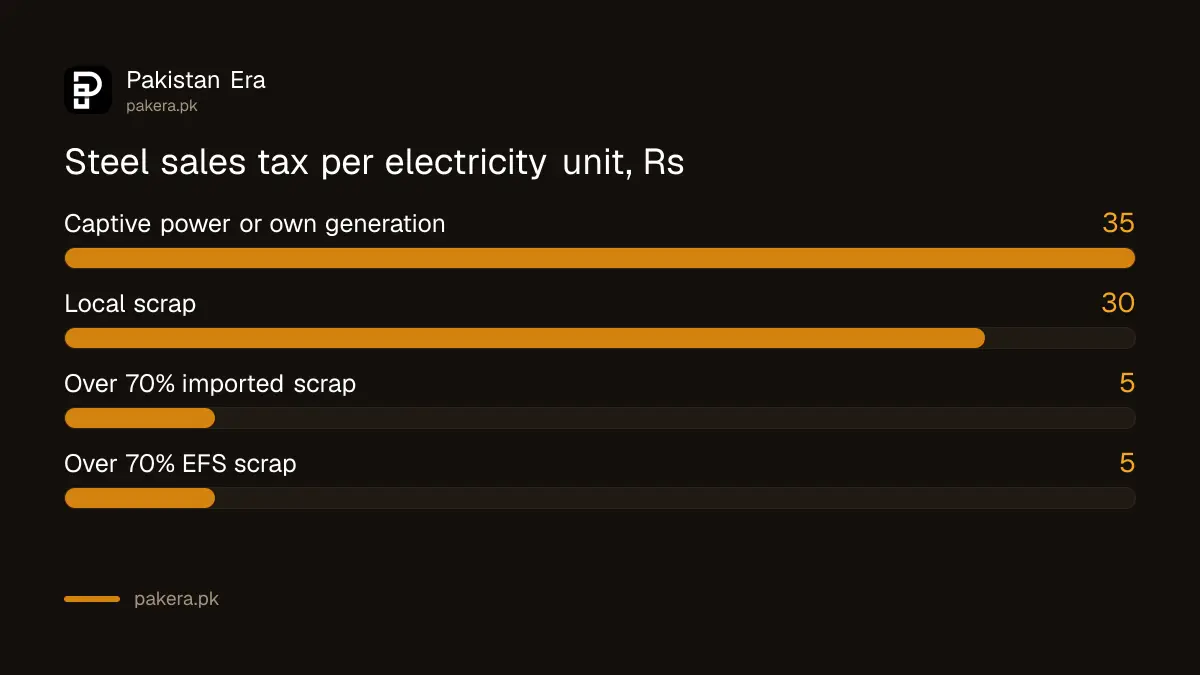
S.R.O. 1245(I)/2026, dated 31 July 2026 and in force from 1 July 2026, sets sales tax per unit of electricity used by steel melters and composite units. This is on top of normal sales tax on their sales. Units on captive power or self-generation pay the highest rate, Rs 35 a unit.
| Type of steel unit | Sales tax per electricity unit |
|---|---|
| Using local scrap | Rs 30 |
| Over 70% imported scrap in the last 12 months | Rs 5 |
| Over 70% scrap from an EFS licensee in the last 12 months | Rs 5 |
| Captive power or self-generation | Rs 35 |
The same notification sorts units by size. A maker using 500,000 units a month or more on a single meter counts as a steel melter or composite unit. Below that, it counts as a re-roller. The full rate rules, including who qualifies for Rs 5, are in the steel melter and re-roller rates.
Pay through the special PSID challan by the 5th
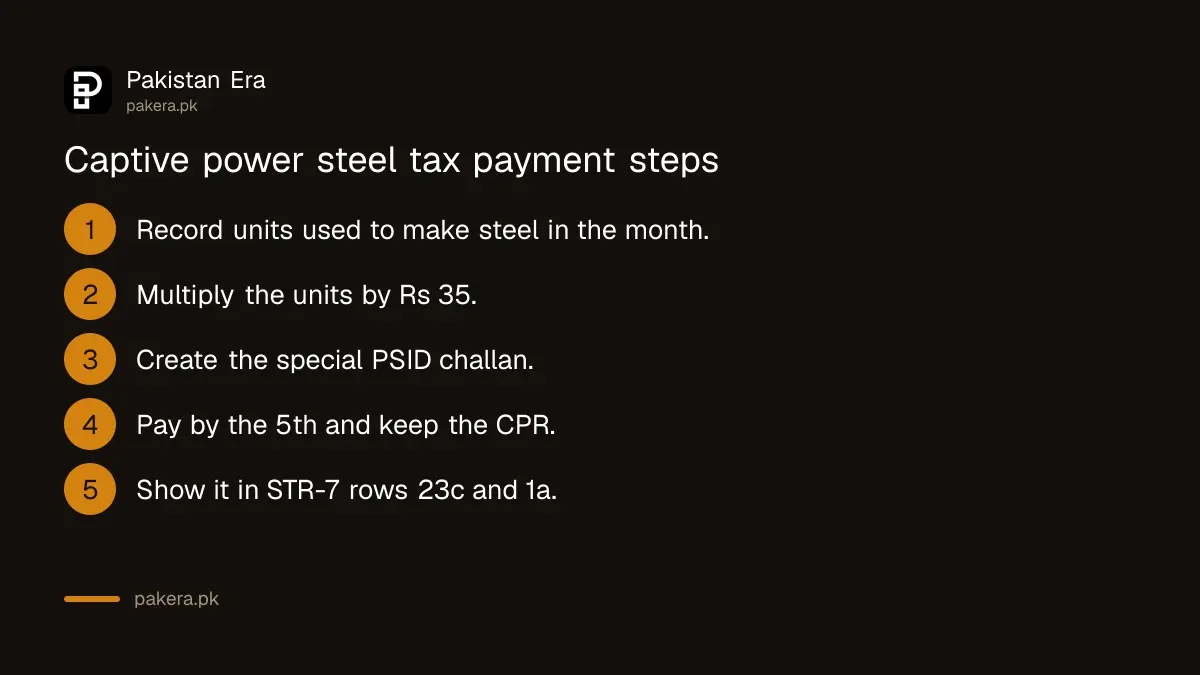
STGO 31 says a captive power steel unit must create a special PSID challan for each tax period. It is made only for this group. The tax is worked out on the units used to make steel that month, and it is paid by the 5th day of the next month. No invoice is issued for it.
- Work out the electricity units used for making steel in the month, from your own generation and consumption records.
- Multiply the units by Rs 35 to get the additional sales tax.
- Create the special PSID challan for additional sales tax on captive power steel, for that tax period.
- Pay it by the 5th of the next month. For 1-Bill payment through a bank, add the prefix 999999 before the PSID, as the challan form says.
- Keep the computerised payment receipt (CPR) the bank gives you. The CPR is your proof of payment.
- Show the paid amount in your sales tax return, in the two rows explained below.
The challan form in Annex A asks for the collectorate, NTN, name, address, year, month and tax period. It then asks for the number of electricity units in kWh, the additional sales tax rate and the amount, with a reference to S.R.O. 1245(I)/2026. The head of account printed on it is B-02341, Additional Sales Tax. The form notes that the bank should not sign or stamp the challan, but should issue a CPR after payment. How PSID payments work in general is in paying with a PSID through 1-Bill.
A worked example for October 2026
Say a captive power steel melter used 800,000 units of electricity to make steel in October 2026. The sum is simple:
| Item | Figure |
|---|---|
| Units used for steel in October 2026 | 800,000 kWh |
| Rate under S.R.O. 1245 | Rs 35 a unit |
| Additional sales tax | Rs 28,000,000 |
| Pay by | 5 November 2026 |
| Show in return for | October 2026 tax period |
The amount goes in the return for the month the units were used, not the month you paid. So October units go in the October return even though you pay on 5 November.
Two rows in the STR-7 return: 23c and 1a
Once the amount is paid and the CPR is verified, the order says it goes in the sales tax return form STR-7 twice, for the tax period the units relate to:
- Row 23c, "Additional Sales Tax on electricity supplied to Steel Melters and Re-Rollers": the amount you paid.
- Row 1a, "Input from Additional Sales Tax on electricity supplied to Steel Melters and Re-Rollers": the same amount, as input tax.
Row 1a is what lets you adjust the tax against your output sales tax. S.R.O. 1245 also says steel units may adjust this tax against output tax. So in effect the tax is collected early and then credited, as long as the paperwork is right.
The order is strict on one point. No amount may be shown in Row 23c, and no adjustment allowed through Row 1a, unless the tax was paid through the special PSID challan and verified through its CPR. Paying through an ordinary challan, or not paying, means no adjustment. Steel units on the grid have a different route for their units, set out in declaring electricity units in Annex-K.
Keep generation records ready for your Commissioner
The order requires each unit to keep proper records of electricity generated and electricity used for making steel. It must declare the units used in its sales tax return. The Commissioner Inland Revenue will check the units against these records and against the conditions of the Thirteenth Schedule to the Sales Tax Act.
Any default, short payment or wrong declaration of units is to be dealt with under the Sales Tax Act. Penalties and default surcharge for late payment are explained in late sales tax penalties and default surcharge.
The order takes effect from 1 July 2026, the same date as S.R.O. 1245. It does not say how a unit should handle tax for July to September 2026, which has already passed. If you have not paid for those months through this challan, ask your Commissioner in writing how to do it.
Common questions
What is STGO 31 of 2026?
It is the FBR's Sales Tax General Order No. 31 of 2026, dated 29 October 2026. It sets how steel units on captive power pay and adjust additional sales tax on electricity.
How much sales tax do captive power steel units pay per unit?
Rs 35 per unit of electricity used to make steel, under S.R.O. 1245(I)/2026. This is in addition to normal sales tax.
When is the payment due?
By the 5th day of the month after the units were used. For October 2026 units, the due date is 5 November 2026.
Which return rows does this tax go in?
The paid amount goes in STR-7 Row 23c, and the same amount in Row 1a as input tax, for the month the units were used.
Can I adjust the tax if I paid with a normal challan?
No. The order allows Row 23c and the Row 1a adjustment only for tax paid through the special PSID challan and verified through its CPR.
How we verified this
What we checked, where we read it, and what we could not confirm.
Last checked 4 November 2026. We read the FBR home page, which lists the order, the order itself, Sales Tax General Order No. 31 of 2026 (C.No. 1(216) ST-L&P/2026/123070-R, 29 October 2026) with its Annex A challan and CPR forms, and S.R.O. 1245(I)/2026 of 31 July 2026. The worked example is ours, with an assumed figure of 800,000 units. We did not generate a live PSID, so we have not seen the exact screen for choosing this challan type.
About the author

Global Affairs & Political Economy Writer
Muhammad Hatim is a book lover who started writing because he enjoys it. At Pakistan Era he writes about international relations, geopolitics and the global economy, with a particular interest in South Asia and the forces behind current events.