FBR Sales Tax on Steel Melters and Re-Rollers Per Unit of Electricity: Find Your Rate
FBR now taxes steel melters and re-rollers per unit of electricity, from Rs 5 to Rs 35, with changes on 29 September. Find your rate and how to adjust it.
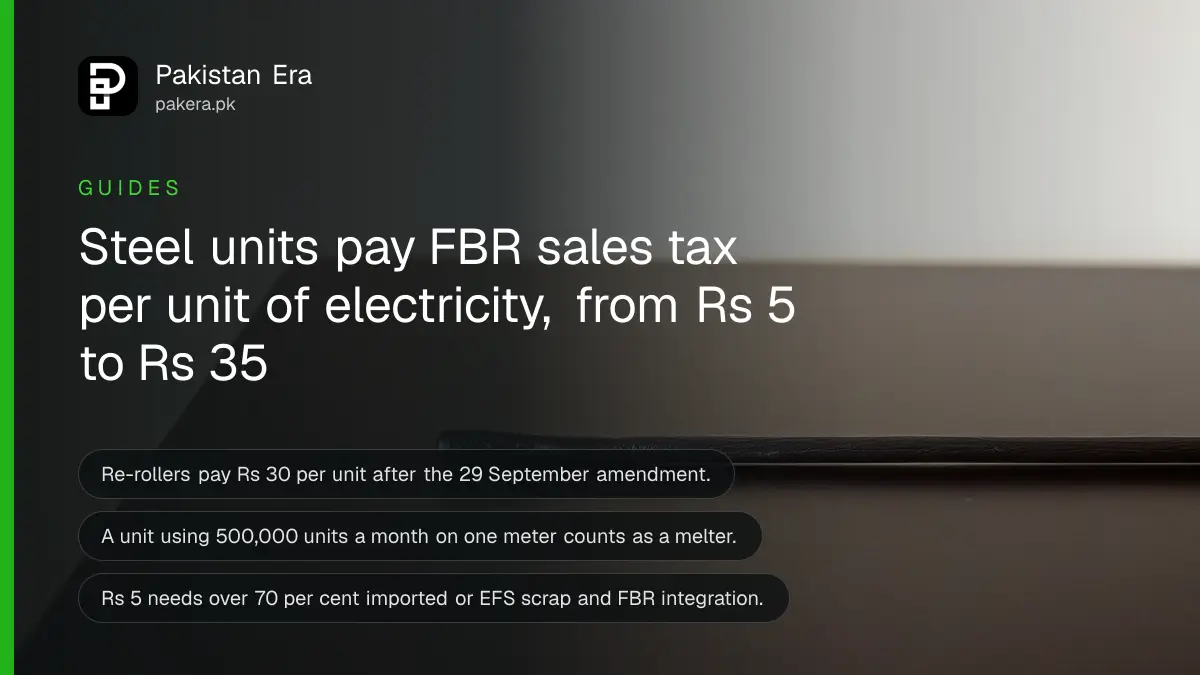
Short answer: Under S.R.O. 1245(I)/2026, as amended by S.R.O. 1664(I)/2026 on 29 September, steel melters, re-rollers and composite units pay sales tax on each unit of electricity they use: Rs 30 for local scrap melters and all re-rollers, Rs 35 for captive power, Rs 20 in erstwhile FATA and PATA, and Rs 5 if more than 70 per cent of raw material is imported or bought directly from Export Facilitation Scheme (EFS) licensees.
Update, 11 October 2026: Units can also declare electricity units in Annex-K when the DISCO has not filed.
For a steel unit, the electricity bill is now also a tax bill. The FBR collects the sales tax through the power distribution company, and it does so from the date of the first notification, 1 July 2026. We read both notifications on the FBR website.
Your rate depends on the scrap you use and the power you run on
Melters and composite units (units that melt and roll) pay by the type of raw material and power source. Re-rollers, which roll billets into bars, pay a flat rate after the September amendment. A single meter's monthly use decides which group you are in.
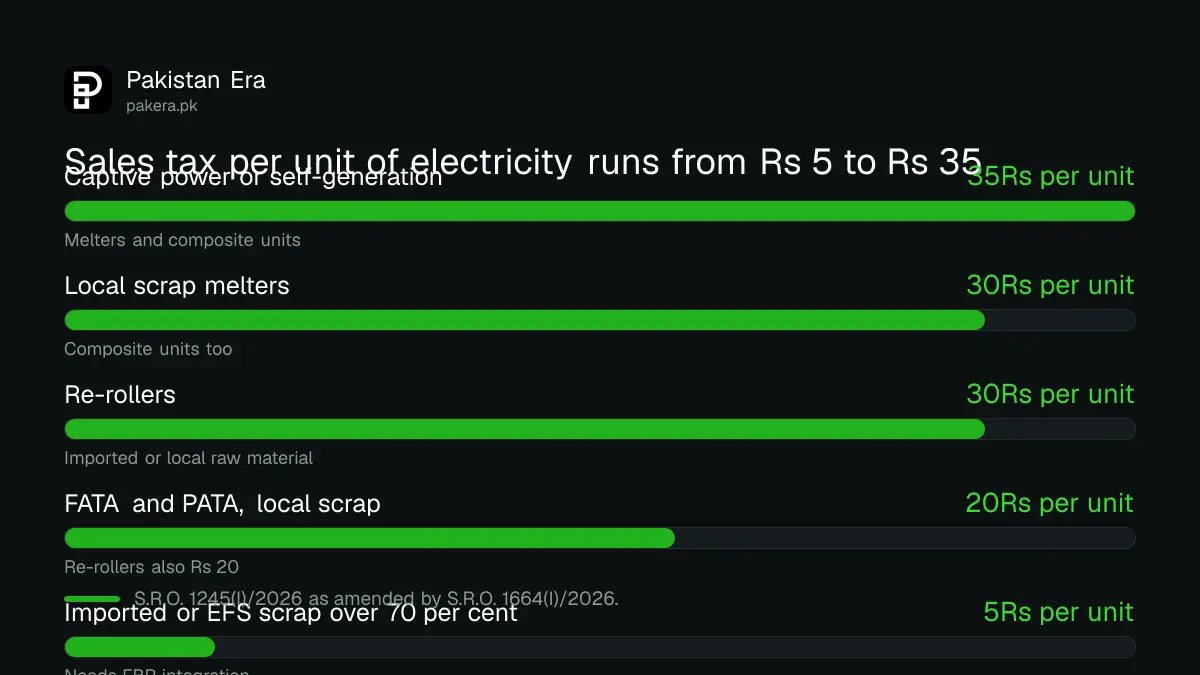
| Who pays | Rate per unit of electricity |
|---|---|
| Melters and composite units using local scrap | Rs 30 |
| Melters and composite units using over 70 per cent imported scrap in the last 12 months | Rs 5 |
| Melters and composite units buying over 70 per cent of scrap directly from EFS licensees | Rs 5 |
| Steel makers on captive power or self-generation | Rs 35 |
| Re-rollers, imported or local raw material | Rs 30 |
| Melters and composite units in erstwhile FATA and PATA using local scrap | Rs 20 |
| Re-rollers in erstwhile FATA and PATA | Rs 20 |
Monthly electricity use sorts you into melter or re-roller
A steel manufacturer using 500,000 units or more a month on a single meter is treated as a melter or composite unit. Anyone below that is a re-roller. The September amendment adds that the category stands unless the FBR's production monitoring system proves otherwise.
The amendment also says that an electricity connection linked to a steel business keeps its category even if ownership changes or the business is leased. Taking over a plant therefore does not reset its classification.
The Rs 5 rate needs integration with the FBR
The first notification gives the Rs 5 rate to melters and composite units that are integrated with the FBR's computerised system for real time reporting of sales and of scrap consumption, and whose imported scrap exceeds 70 per cent of raw material in the previous twelve months. New or restarted units are judged on quarterly imports or purchases, under the amendment.
Units that qualify under the Rs 5 rate for imported scrap or EFS scrap will be named in a sales tax general order, with their NTN, electricity reference number and distribution company. The list is to be reviewed every three months.
The tax is collected on the electricity bill and is adjustable
The tax is added through the electricity bill by the distribution companies (DISCOs). The September amendment says tax collected this way is "advance in nature". Units may adjust it against the output sales tax they charge on sales.
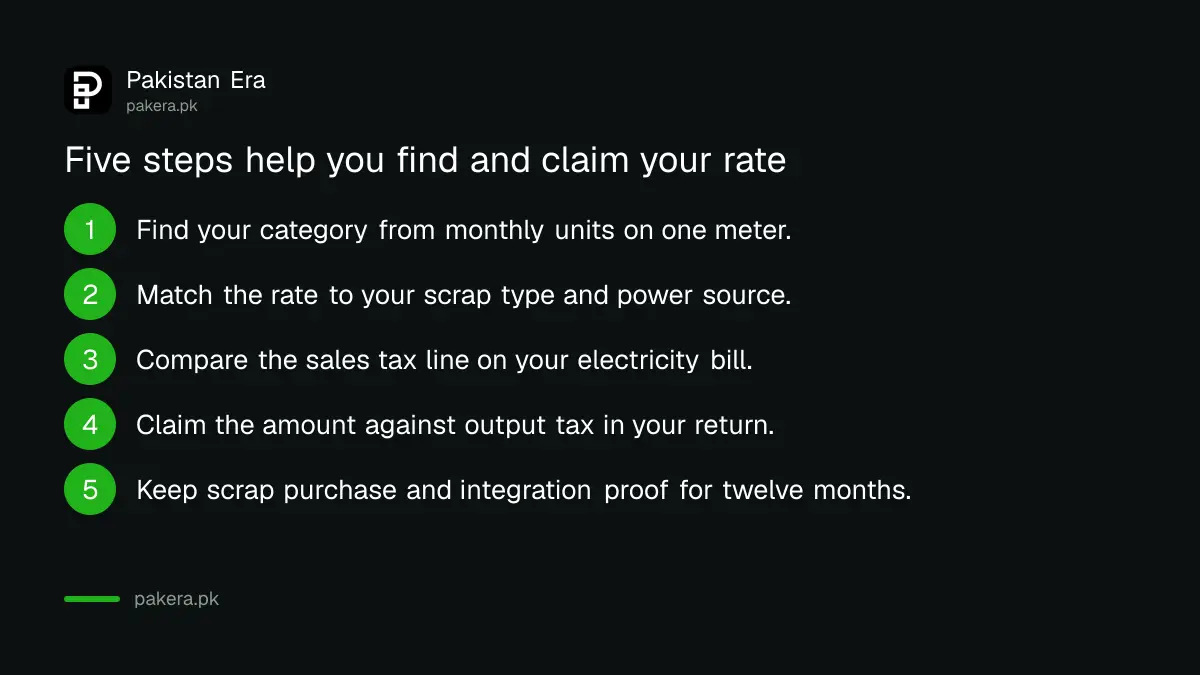
- Find your category from your meter's monthly units and the type of scrap or raw material.
- Check the rate that matches it, and whether you qualify for Rs 5 or the FATA and PATA rate.
- Look at your electricity bill for the sales tax per unit and compare it with the table.
- Claim the amount against output tax in your monthly sales tax return.
- Keep your scrap purchase records and integration proof for each twelve month test.
Non-payment can lead to disconnection
If a melter or composite unit does not pay the sales tax by the due date on its electricity bill, the distribution company shall disconnect the connection, besides other legal action by the FBR field office. The first notification also told the companies to apply the per unit rate from 1 July 2026 to all melters, re-rollers and composite units.
The effect is simple. A late tax payment is treated like a late electricity bill. Paying the sales tax on time and claiming the adjustment protects cash flow.
Registration comes first for any unit that is not registered. The documents are listed in sales tax registration with the FBR.
What changed on 29 September
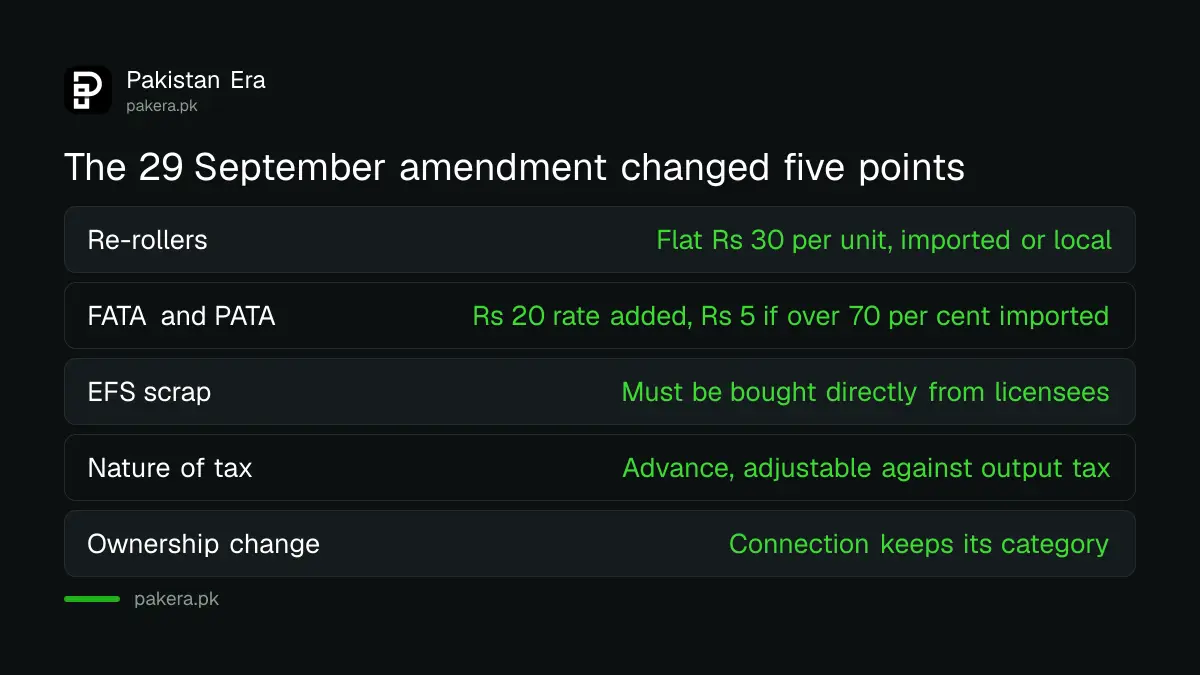
The amendment did four things: it set a flat Rs 30 for re-rollers, added FATA and PATA rates, tied the Rs 5 rate for EFS scrap to buying directly from licensees, and made the tax advance in nature. It also removed the words "in addition to sales tax chargeable under section 3", so the exact link to normal sales tax is worded differently now.
Common questions
What is the sales tax rate per unit for a re-roller?
It is Rs 30 per unit of electricity consumed, whether the raw material is imported or local, after S.R.O. 1664(I)/2026.
How do I qualify for the Rs 5 rate?
A melter or composite unit must use more than 70 per cent imported scrap, or buy more than 70 per cent directly from EFS licensees, over the last twelve months, and integrate with the FBR system.
Can I adjust this tax against my sales tax?
Yes. The September amendment says the tax is advance in nature and can be adjusted against output sales tax.
What if I use my own generator or captive power?
The first notification sets Rs 35 per unit consumed for steel makers on captive power or self-generation.
Who is a melter and who is a re-roller?
A unit using 500,000 units or more a month on one meter is a melter or composite unit. Below that it is a re-roller, unless the FBR's monitoring system shows otherwise.
Since when does the tax apply?
The first notification, dated 31 July 2026, takes effect from 1 July 2026.
How we verified this
What we checked, where we read it, and what we could not confirm.
Last checked on Sunday 11 October 2026. We read S.R.O. 1245(I)/2026 of 31 July and S.R.O. 1664(I)/2026 of 29 September on the FBR sales tax SRO page. We did not read the sales tax general order that lists the units on the Rs 5 rate. Later orders may change the details, so check the FBR page before you rely on a rate.
About the author

Senior Writer, Public Services and Technology
Shahid joined us in 2024 as an author. He is a senior contributor to Pakistan's leading technology websites. He writes detailed articles, mostly covering his expertise in the latest tech, mobiles, apps, gadgets, and step-by-step guides. His ideology is to help people understand the latest trends and explain complex methods through very easy-to-understand guides.