Smog Outside, Gas Heater Inside: How to Ventilate a Room Safely in Punjab This Winter
NIH says close windows in smog. SSGC says keep them open where gas burns. Six steps to heat a room safely in Punjab, switch off before sleep and air the house.
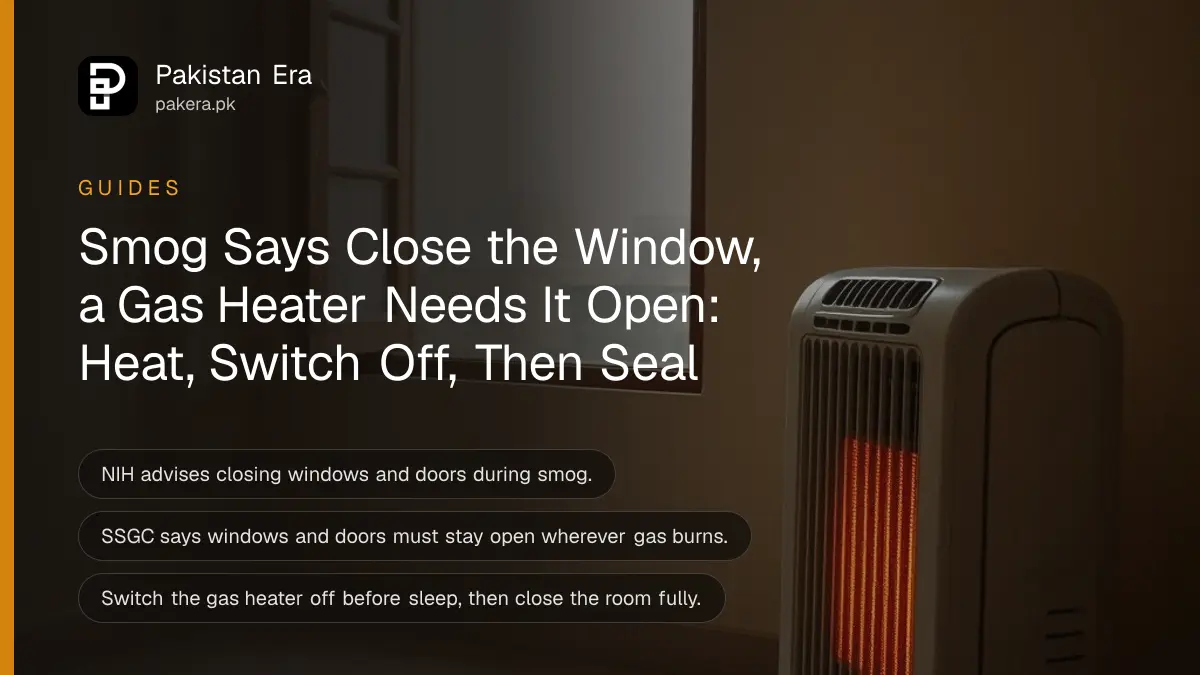
Short answer: in smog season in Punjab, never seal a room while a gas heater is burning. NIH says to close windows and doors against smog. SSGC says windows and doors must stay open wherever gas burns. Do both by running the gas heater only while you are awake with a window slightly open, then switching it off and shutting the room.
That clash catches many homes in Lahore, Kasur, Faisalabad and Islamabad every winter. At 5 am on 17 November 2026, Punjab EPA's dashboard put Lahore's AQI at 243, Unhealthy, and Kasur's at 351. That is exactly when families close every window and light the heater.
Both rules are right. Smog harms the lungs over hours and days. A gas heater in a sealed room can kill in one night, because it uses up oxygen and can fill the room with carbon monoxide, a gas with no colour and no smell. The steps below keep both risks low.
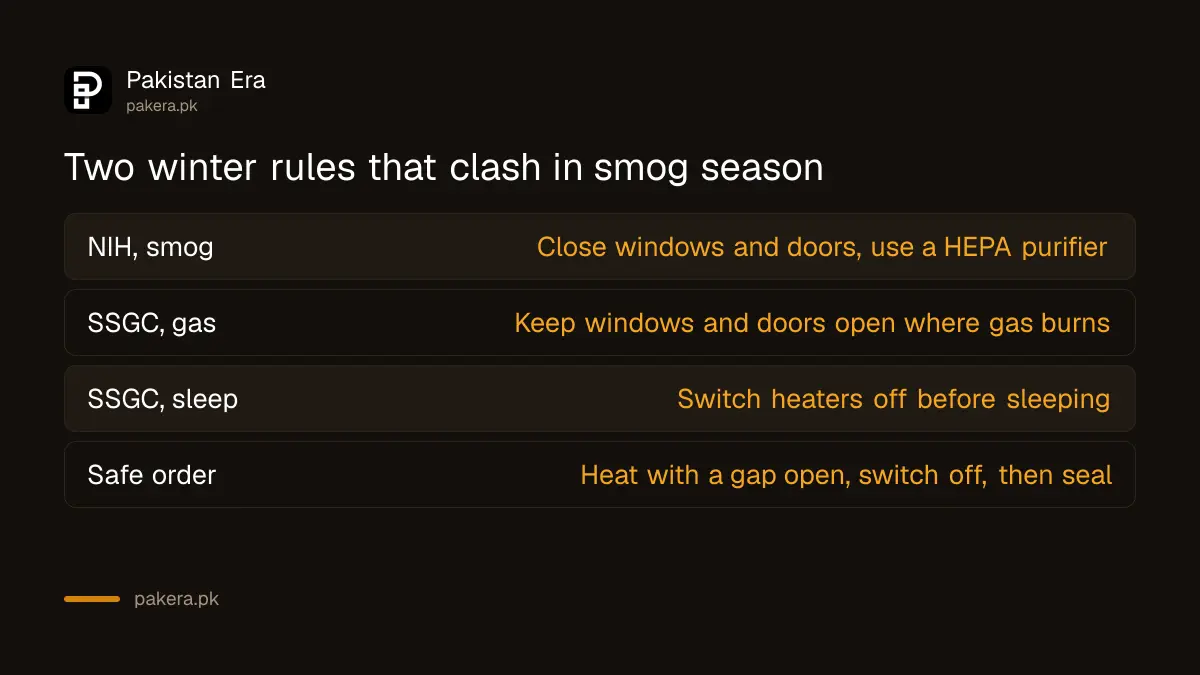
NIH says close windows in smog, SSGC says open them for gas
The National Institute of Health (NIH) tells people to "close windows and doors" and use HEPA air purifiers during smog. SSGC, the gas company, says "windows and doors must be kept open" wherever gas is used, to keep oxygen in the room.
NIH's smog advisory lists four steps for individuals: limit time outdoors, wear an N95 or KN95 mask, improve indoor air by closing windows and avoiding indoor pollution such as smoking, and drink plenty of water. It also names "solid fuel combustion for heating" as one of the causes of smog.
SSGC's customer safety notice is just as firm. It says ventilation is necessary wherever gas is burning, that leaving heaters on while you sleep "can be very hazardous", and that exhaust pipes must not leak because their gas is harmful. SNGPL, which supplies Punjab and Khyber Pakhtunkhwa, uses the same 1199 emergency line.
| Rule | Who says it | Why |
|---|---|---|
| Close windows and doors in smog | NIH smog advisory | Keeps fine smoke and dust out |
| Use a HEPA air purifier indoors | NIH smog advisory | Cleans the air inside a closed room |
| Keep windows and doors open where gas burns | SSGC safety notice | Keeps oxygen in the room |
| Switch heaters off before sleeping | SSGC safety notice | A burning heater overnight is very hazardous |
| Never use a rubber pipe, use a GI pipe | SSGC safety notice | Rubber pipes crack and leak |
A gas heater in a sealed room is the bigger danger
Smog damages health slowly. A gas heater burning in a closed room can use up oxygen and build carbon monoxide fast enough to kill sleeping people in one night. So when the two rules clash, the gas rule must win.
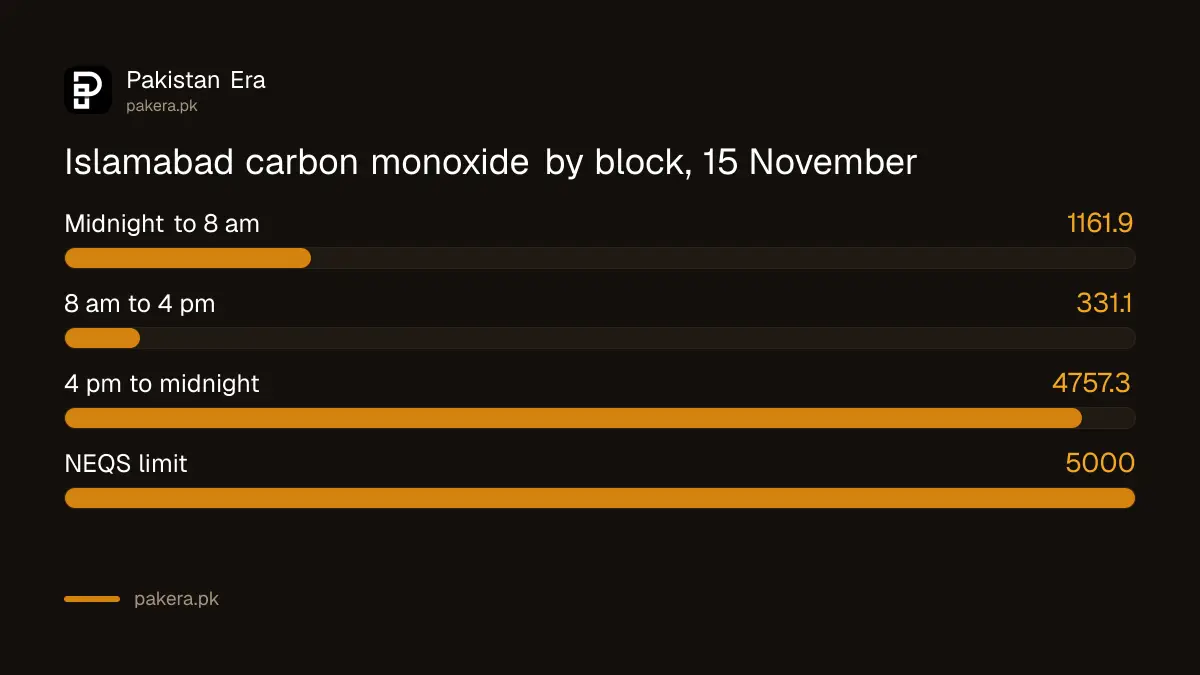
Carbon monoxide comes from fuel that does not burn fully. Outdoor readings already rise in the evening. Pak-EPA's table for Islamabad on 15 November showed carbon monoxide at 331 micrograms per cubic metre from 8 am to 4 pm and 4,757 from 4 pm to midnight, close to the national limit of 5,000. A heater indoors adds to that.
NIH's smog advisory also names carbon monoxide among the gases in smog that "irritate the lungs and aggravate pre-existing conditions". People with asthma, COPD or heart disease feel both risks first. The fuller list of gas heater rules is in how to use a gas heater or geyser safely.
Six steps to heat a room safely on a smog night
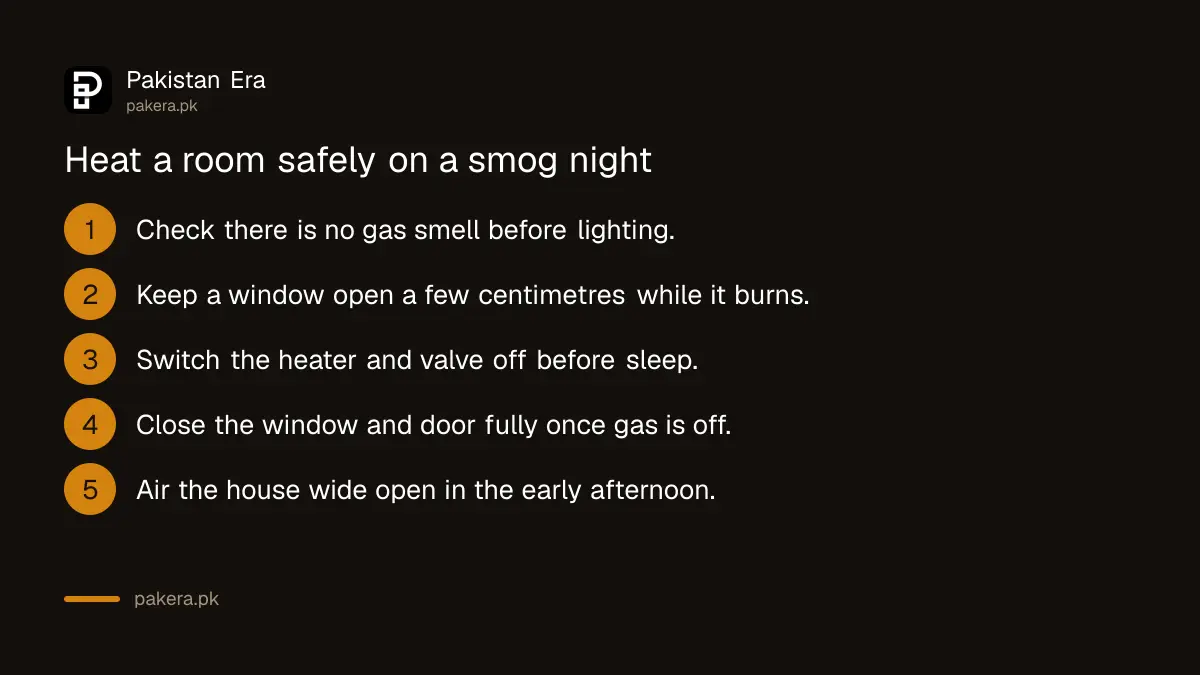
Heat the room while awake, keep a small gap open while gas burns, switch the heater off before sleep, then close the room fully. Air the house in the cleanest part of the day, and use electric heat or a purifier in a sealed bedroom.
- Check the room first. Before lighting the heater, make sure there is no smell of gas. If there is, SSGC says open the windows and doors, do not light a match or touch switches, and call 1199.
- Keep a gap open while it burns. Leave a window open a few centimetres, or the door to a hallway. A small gap lets in far less smog than a wide one, but it keeps oxygen coming in.
- Heat, then switch off. Warm the room for a set time while you are awake. Switch the heater off and close the main valve before you sleep, as SSGC says.
- Then seal the room for the night. Once the gas is off, close the window and door fully. This is the moment to follow NIH's smog advice.
- Air the house in the clean hours. Open windows wide in the early afternoon. On 15 November Islamabad's PM2.5 was lowest from 8 am to 4 pm. Check your city on Punjab EPA's dashboard before you open up.
- Use electric heat in a sealed bedroom. An electric heater burns no fuel and makes no carbon monoxide, so it is the safer choice for a closed room. A HEPA purifier can run beside it.
Running costs for electric heaters are set out in which electric heater uses the least electricity. Purifier prices are in Westpoint air purifier prices.
Check the heater and pipe before the coldest nights
SSGC names three checks: a GI pipe instead of rubber, an exhaust that does not leak, and a PSQCA approved appliance. Do all three before the coldest weeks.
- Pipe. SSGC says never use a rubber pipe with a gas appliance. A galvanised iron (GI) pipe does not crack with heat or age.
- Exhaust. A vented heater must have a flue pipe that is whole and leads outside. A cracked or loose pipe sends fumes back into the room.
- Approval. SSGC tells customers to use only PSQCA approved appliances. PSQCA is Pakistan's national standards body.
- Low pressure. If gas pressure drops, SSGC says turn off all valves and call 1199. Use gas again only once pressure is steady.
A heater cable or plug also needs a PSQCA mark, explained in how to check a PSQCA licence on a heater cable. Charcoal and wood fires indoors carry the same carbon monoxide risk as gas, and NIH lists solid fuel heating among the causes of smog.
Common questions
Should I close the windows when the AQI is high?
Yes, NIH advises closing windows and doors in smog. But never close them fully while a gas heater is burning. Switch the heater off first.
Can I sleep with a gas heater on if a window is open?
No. SSGC says leaving heaters on while you sleep can be very hazardous. Switch it off and close the valve before bed.
Is an electric heater safer in smog season?
Yes, for a closed room. It burns no fuel, so it uses no oxygen and makes no carbon monoxide. Check the cable for a PSQCA mark.
When is the best time to air the house in smog?
Usually the early afternoon. On 15 November Islamabad's PM2.5 was lowest from 8 am to 4 pm. Check the live reading for your city first.
What number do I call for a gas leak?
Call 1199, the emergency line for SSGC and SNGPL. For a fire or an unconscious person, call Rescue 1122.
Does an air purifier remove carbon monoxide?
No. A HEPA filter traps particles such as PM2.5. It does not remove carbon monoxide, so it is no substitute for fresh air while gas burns.
How we verified this
What we checked and where we read it.
We read NIH's "Advisory for Protection and Preventive Measures against Smog" (No. F.1-22/Advisory/CDC/2025, November 2025) on the NIH advisories page and SSGC's "Your safety is our priority" customer notice on ssgc.com.pk on 17 November 2026. SNGPL's 1199 line is from its home page and Rescue 1122 from rescue.gov.pk, read the same day. The Lahore and Kasur readings are from Punjab EPA's dashboard at 5 am on 17 November, and the Islamabad carbon monoxide and PM2.5 blocks from Pak-EPA's table for 15 November. SSGC's notice calls the exhaust gas carbon dioxide; the gas that builds up from poor burning in closed rooms is carbon monoxide, which NIH names among smog's harmful gases. The six steps put the two agencies' rules in order; neither agency publishes them as one list.
About the author

Senior Writer, Public Services and Technology
Shahid joined us in 2024 as an author. He is a senior contributor to Pakistan's leading technology websites. He writes detailed articles, mostly covering his expertise in the latest tech, mobiles, apps, gadgets, and step-by-step guides. His ideology is to help people understand the latest trends and explain complex methods through very easy-to-understand guides.