Use a Gas Heater or Geyser Safely in Pakistan: SSGC's Winter Rules
Gas heater and geyser safety in Pakistan: SSGC's rules on ventilation, rubber pipes and sleeping, the soap leak test, carbon monoxide signs and helpline 1199.
To use a gas heater or geyser safely in Pakistan this winter: keep a window or door open while it burns, switch it off before you sleep, connect it with a GI pipe instead of a rubber hose, buy a PSQCA approved model, and check the lines with soapy water. SSGC says to call 1199 the moment you smell gas.
Those rules come from SSGC's own safety notices, which we read on ssgc.com.pk. SNGPL, the gas company for Punjab and Khyber Pakhtunkhwa, uses the same 1199 number. The advice is short, but every point on it answers a real way people get hurt in winter.
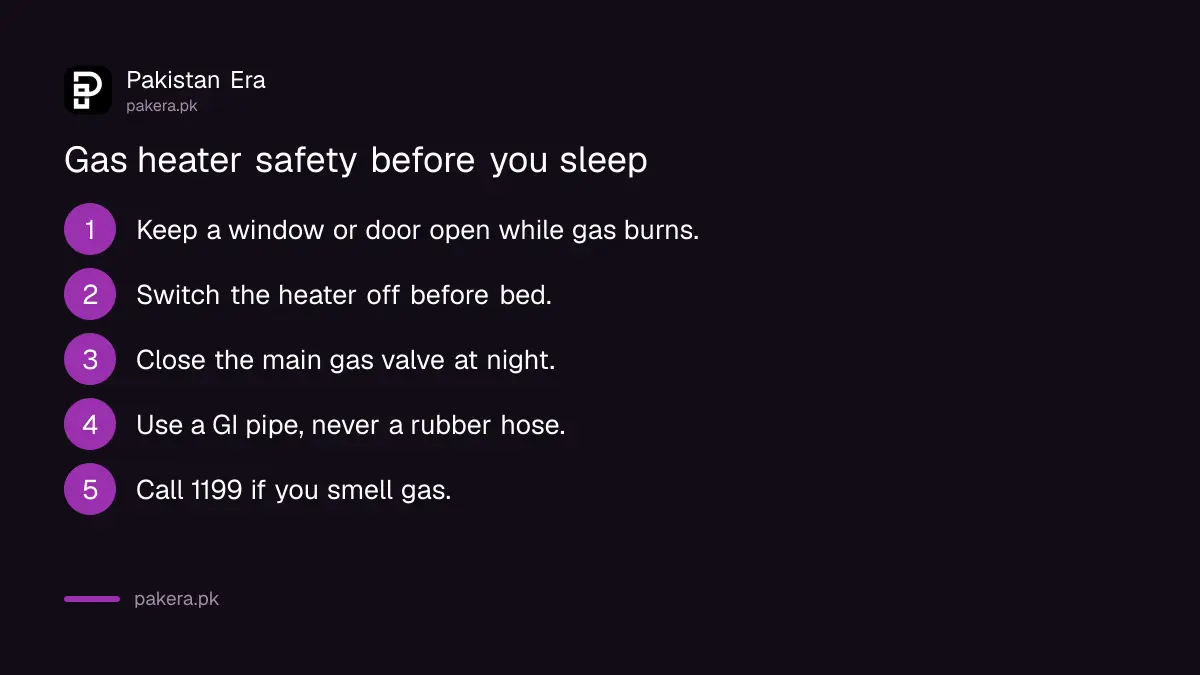
The five gas heater rules SSGC gives every customer
SSGC's safety notice lists clear rules. Keep rooms ventilated, switch heaters and stoves off when nobody is watching or before sleep, close all valves at night, never use a rubber pipe, and always use PSQCA approved gas appliances.
Here is the full list from SSGC's "Your safety is our priority" notice, in plain words:
- Ventilation. Windows and doors must stay open where gas is burning, so the room has oxygen.
- Never leave it on. Leaving heaters and stoves on while you are out or asleep "can be very hazardous". Switch off all valves before bed.
- Close the main valve when no gas is being used.
- No rubber pipe. SSGC says never use a rubber pipe with a gas appliance. Use a GI pipe, which is galvanised iron.
- Check exhaust pipes for leaks, because the fumes are poisonous.
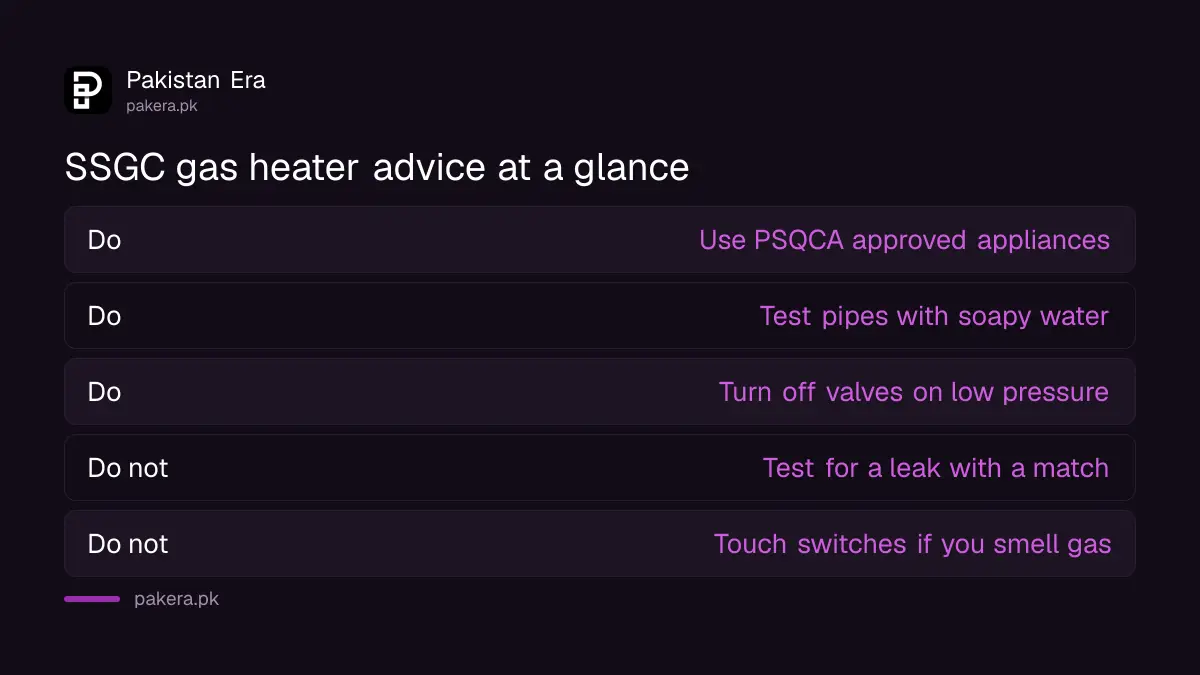
- Use PSQCA approved appliances. PSQCA is the national standards body.
Honestly, the rubber pipe rule is the one most homes break. A soft hose cracks with heat and age, and it slips off a nozzle easily. A fixed metal line costs more once and then stops being a worry.
Carbon monoxide is the danger you cannot smell
A heater or geyser that burns gas badly in a closed room makes carbon monoxide. The gas has no colour and no smell. It causes headache, dizziness, weakness, vomiting and confusion, and people who are asleep can die before they feel anything.
SSGC's notice calls the exhaust gas poisonous and names it carbon dioxide. The gas that kills in closed rooms is carbon monoxide, which is what the US Centers for Disease Control and Prevention describes. Its list of symptoms is headache, dizziness, weakness, upset stomach, vomiting, chest pain and confusion. It also warns that people who are sleeping can die before they have symptoms.
That is the real reason behind "switch it off before you sleep". A gas leak can often be smelt. Carbon monoxide cannot.
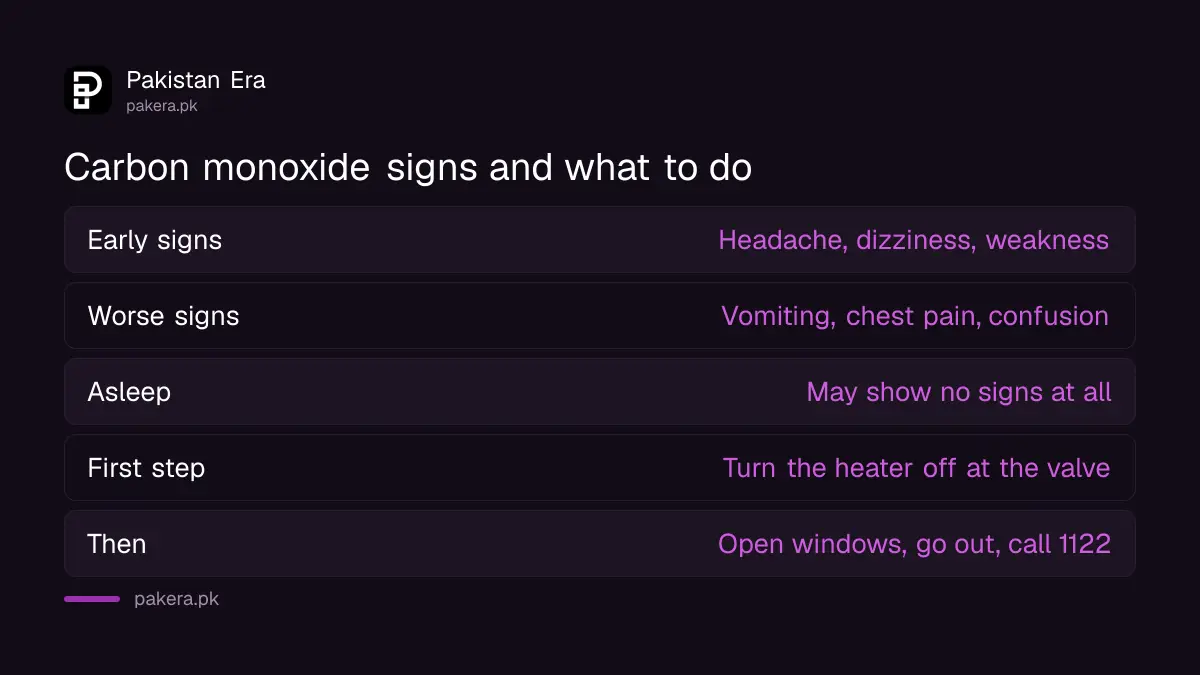
If someone in a heated room feels these signs, act at once:
- Turn the heater off at the valve.
- Open every door and window.
- Take everyone out into fresh air.
- Call Rescue 1122 if anyone is drowsy, confused or will not wake properly.
Rescue 1122 runs the ambulance service in Punjab and other provinces, and what Rescue 1122 does includes medical emergencies like this one.
Geyser safety: where it goes and what to watch
SSGC's ventilation rule applies to a geyser as much as a heater: gas should only burn where air can move. Use a PSQCA approved model on a metal GI connection, check its exhaust pipe for leaks, and switch it off at night.
Gas water heaters have their own Pakistan Standard, PS 4858, and are on PSQCA's compulsory list. So are gas room heaters, both the unvented kind (PS 3656) and the vented kind with a flue pipe (PS 4859).
| Appliance | Pakistan Standard | Main risk in winter |
|---|---|---|
| Gas water heater (geyser) | PS 4858 | Fumes in a closed bathroom |
| Unvented or semi vented room heater | PS 3656 | Burns room air, fumes stay inside |
| Vented room heater | PS 4859 | Blocked or leaking flue pipe |
| Gas stove | PS 1560 | Used to heat a closed kitchen |
One warning from our own check. When we searched PSQCA's online licence tool on 2 October 2026, every gas geyser, heater and stove licence it listed showed as expired. So ask the shop for the current licence before you buy, and search the licence number on PSQCA's website at icq.psqca.com.pk.
Check your gas line for leaks with soap and the meter
SSGC gives two simple leak tests. Brush soapy water on every gas pipe and joint and watch for bubbles. Or switch off every appliance at night, note the meter, and read it again in the morning. Any change means a leak.
SSGC's "Check your gas lines for leakages" notice adds one caution: never test for a leak with a match. It also warns against opening a heater or stove valve and then searching for a match box, because gas keeps flowing while you look.
Before lighting a heater, SSGC says to check that the house has no gas smell. If it does, open windows and doors, do not light a match, and do not switch any electric switch on or off. The spark can light the gas.
If a pipe is leaking inside the house, SSGC says to call an SSGC approved technician to fix it. The full steps for each company are in SNGPL and SSGC gas complaints, and a meter that seems to run on its own is covered under getting a gas meter checked.
Low gas pressure is a reason to switch off
When pressure drops, flames can go out while gas keeps flowing. SSGC says to turn off all gas valves straight away and call 1199. Use gas again only once the pressure is steady. Never leave a heater burning on low pressure overnight.
This happens most on cold mornings and evenings, when demand is highest. A flame that dies at 3 am in a closed room is exactly the case SSGC's rules are written for. If you use cylinder gas instead, the separate LPG cylinder checks apply.
Before you buy a heater or geyser, check its PSQCA licence.
Common questions
Is it safe to sleep with a gas heater on?
No. SSGC says leaving heaters on while sleeping can be very hazardous and tells customers to switch off all valves before bed.
What is the gas leak helpline in Pakistan?
1199. SSGC lists it for leaks, complaints and technical help, and SNGPL's website lists the same number.
Can I use a rubber pipe for my gas heater?
SSGC says never use a rubber pipe with a gas appliance. It tells customers to use a GI pipe instead.
How do I check for a gas leak at home?
Apply soapy water to the pipes and look for bubbles, or compare the meter reading at night and in the morning with everything off. Never use a match.
What are the signs of carbon monoxide poisoning?
Headache, dizziness, weakness, upset stomach, vomiting, chest pain and confusion. Sleeping people may show no signs at all. Get fresh air and call 1122.
Does a gas geyser need PSQCA approval?
Yes. Gas water heaters are on PSQCA's compulsory list under PS 4858. SSGC also tells customers to use only PSQCA approved appliances.
How we verified this
What we checked, where we read it, and what we could not confirm.
Last checked at about 4:40 am PKT on 2 October 2026. We read SSGC's Safety Education notice and its Check Gas Line for Leakages notice on ssgc.com.pk (both are images, which we read in full), SSGC's header listing 1199, SNGPL's homepage listing 1199, and PSQCA's compulsory items list for the standard numbers. The carbon monoxide symptoms are from the US Centers for Disease Control and Prevention. We searched PSQCA's licence tool ourselves on 2 October 2026. SNGPL's own geyser timer leaflet link returned an error page, so this article quotes SSGC's advice, not SNGPL's.
About the author

Tax, Bills and Technology Writer
Ali Akhtar is a young and curious voice here at Pakistan Era. He is currently pursuing his A-Levels and has a growing interest in Pakistan’s changing industrial landscape and educational trends. Ali likes to write in a way that helps him explain and explore the world around him. His writing reflects the perspective of the new generation navigating the evolving trends of Pakistan where technology, youth innovation, and shifting opportunities are reshaping the country’s future.