Federal Jobs Quota in Pakistan: Punjab 50%, Sindh 19%, KP 11.5% and Every Other Province's Share
Federal jobs quota in Pakistan: merit 7.5%, Punjab 50%, Sindh 19%, KP 11.5%, Balochistan 6%, ex-FATA 3%, AJK 2%, GB 1%, plus the 10% women and 5% minority rule.
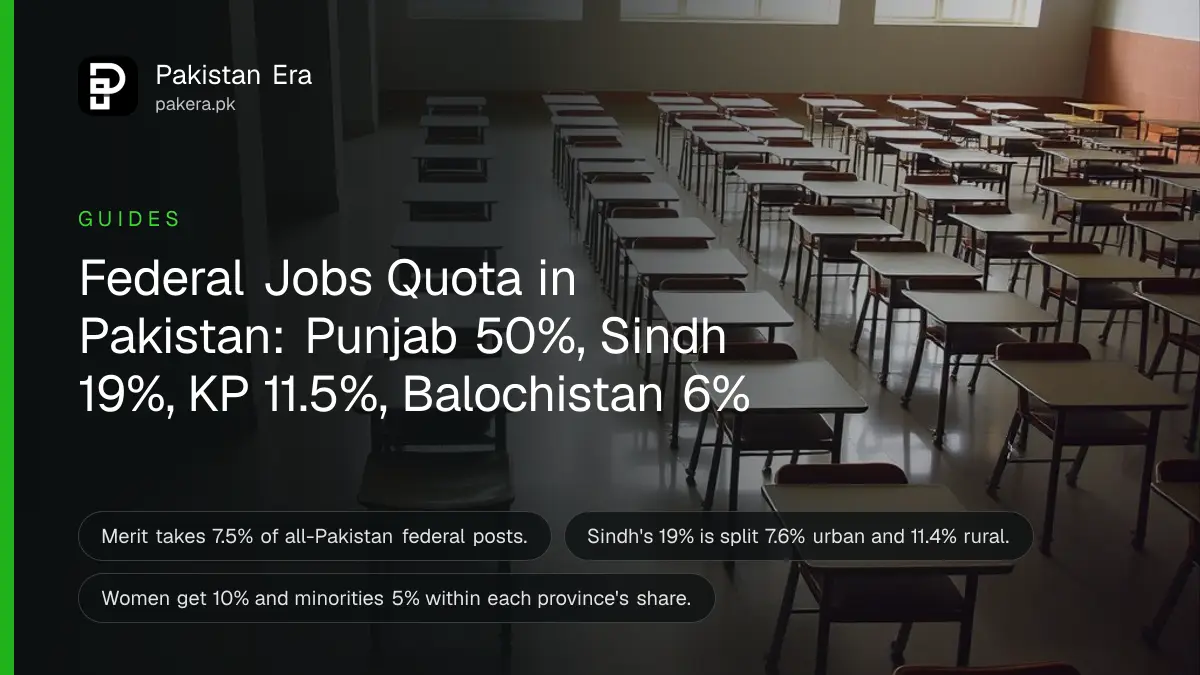
Short answer: Federal government jobs in Pakistan that are filled on an all-Pakistan basis are split by quota: Merit 7.5%, Punjab (including Islamabad) 50%, Sindh 19%, Khyber Pakhtunkhwa 11.5%, Balochistan 6%, the former FATA districts 3%, Azad Kashmir 2% and Gilgit-Baltistan 1%. Sindh's 19% is shared 40% urban and 60% rural.
Update (10 November 2026): the Senate devolution sub-committee said Balochistan is more than 30,000 federal jobs short of its share and Sindh more than 80,000, and asked for grade 18 to 22 data in 15 days. Details in the Senate panel on the federal jobs shortfall.
These shares are set by the Establishment Division and printed in its official handbook, the ESTACODE, which is published on the Ministry of Law's Pakistan Code website. We read the 2021 edition, Chapter 3, on 10 November 2026. The same day, a Senate sub-committee on devolution is due to hear the Establishment Division's report on whether every province is getting its share. Below is every quota, how it is worked out, and the separate rules for women, minorities and Islamabad offices.
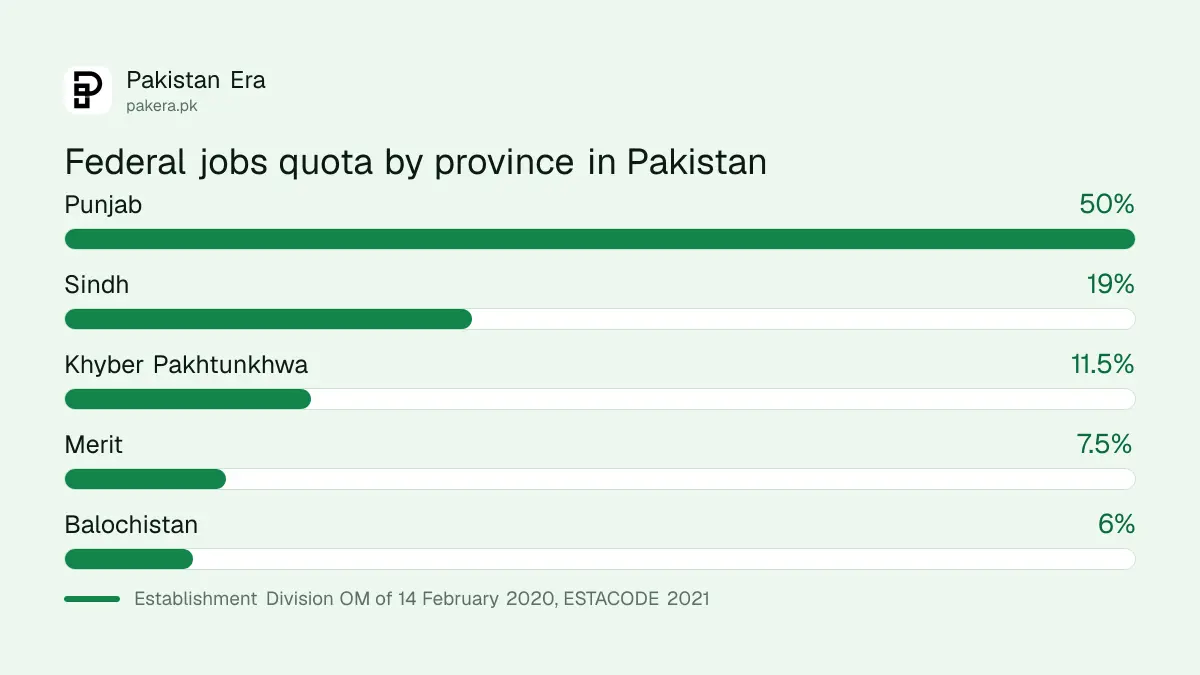
The quota for every province and region
The current shares come from Establishment Division Office Memorandum No. 4/10/2006-R-2 of 14 February 2020. That memo split the old 4% combined quota for Gilgit-Baltistan and FATA into separate shares. It applies to "direct recruitment to posts under the Federal Government which are filled on All-Pakistan basis".
| Quota | Share |
|---|---|
| Merit (open to all) | 7.5% |
| Punjab, including the Federal Area of Islamabad | 50% |
| Sindh, urban: Karachi, Hyderabad and Sukkur (40% of 19%) | 7.6% |
| Sindh, rural: rest of Sindh (60% of 19%) | 11.4% |
| Khyber Pakhtunkhwa | 11.5% |
| Balochistan | 6% |
| Newly merged districts of Khyber Pakhtunkhwa (ex-FATA) | 3% |
| Azad Kashmir | 2% |
| Gilgit-Baltistan | 1% |
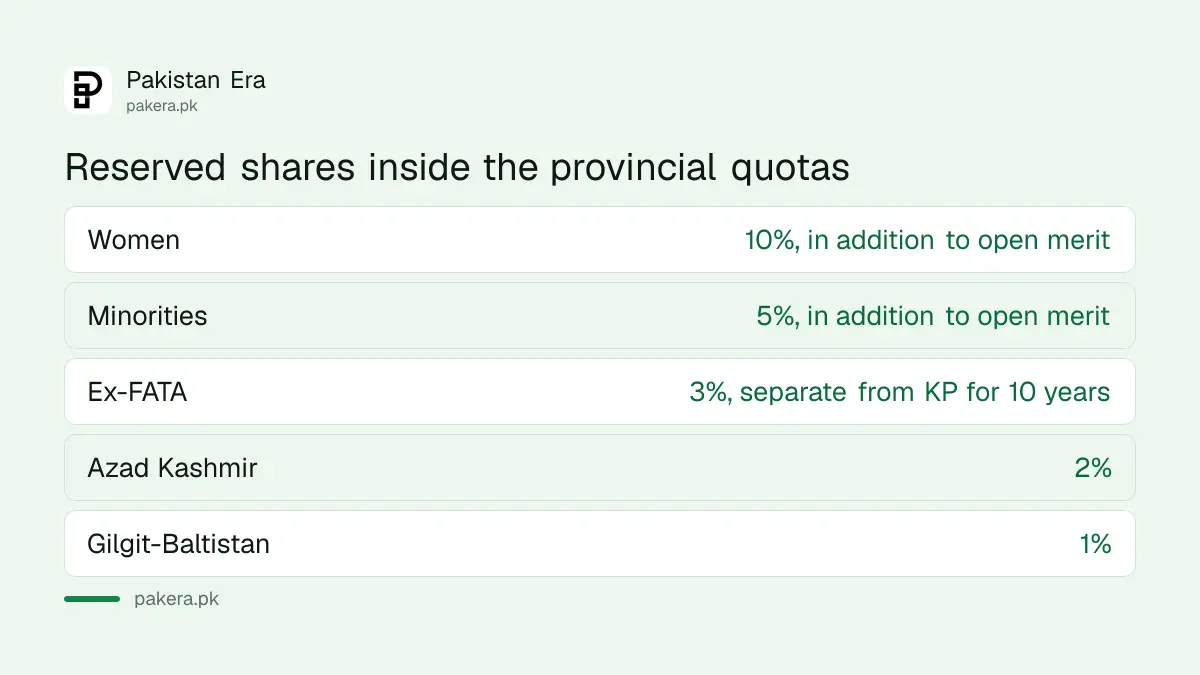
The ex-FATA 3% is kept separate from Khyber Pakhtunkhwa's share. The memo says it will be observed independently "for next 10 years", alongside the ten-year development plan for the merged districts. A 2020 clarification adds that the split applies only to recruitment started on or after 14 February 2020.
Your domicile decides which quota you compete in
A candidate competes for the quota of the province or region on their domicile certificate. Merit seats are open to everyone, whatever the domicile. So a candidate from Balochistan competes for the 7.5% merit seats and for the 6% Balochistan seats.
The FPSC accepts only a candidate's own domicile certificate for quota posts, not a father's or husband's. Our guide on checking your domicile for FPSC quota posts covers that rule and the Sindh urban definition. If you need one, see how to get an Islamabad domicile certificate. Islamabad residents fall in the Punjab share for all-Pakistan posts.
Women get 10% and minorities 5% within the provincial share
Two more reservations sit inside the provincial quotas, not on top of them. Both come from Establishment Division memos printed in the same chapter.
- Women, 10%: reserved across the board in federal services, including CSS, "in addition to their participation in the open merit". It counts against the quota of the woman's province of origin.
- Minorities (non-Muslims), 5%: reserved on the same terms, and counted against the province of origin of the candidate.
Neither applies to merit seats, to promotion or transfer, to vacancies expected to last less than six months, or to isolated posts that fall vacant only now and then. Unfilled reserved posts are carried forward and filled by women, or by minority candidates, later. Both rules also cover autonomous bodies and corporations run by the federal government. Separate rules govern the disability quota; see our page on the disabled persons job quota.
Islamabad offices use a different quota
Offices of the Islamabad Capital Territory administration whose work is limited to Islamabad follow their own split. It was set by Establishment Division memo No. 4/3/93-R-II of 26 January 2016, after an Islamabad High Court judgment in Writ Petition No. 1648 of 2015.
| Quota for ICT-only offices | Share |
|---|---|
| Merit | 6% |
| Punjab | 40% |
| Islamabad Capital Territory | 20% |
| Sindh urban | 6% |
| Sindh rural | 9% |
| Khyber Pakhtunkhwa | 9% |
| Balochistan | 5% |
| Gilgit-Baltistan and FATA | 3% |
| Azad Kashmir | 2% |
How a quota is worked out when posts are few
A ministry with 3 vacancies cannot give 0.18 of a post to Balochistan. The ESTACODE solves this with a running tally. Shares are worked out to one thousandth of a post. The province with the largest fraction gets the vacancy, and the others carry their fractions forward to the next year.
- Multiply the number of vacancies by each quota percentage.
- Add any fraction carried forward from last year.
- Give each whole post to the province or region it belongs to.
- Give a remaining post to the one with the largest fraction.
- Carry every other fraction forward, and send the updated statement with the summary for any grade 17 and above appointment.
The rules also apply to contract appointments, which the Establishment Division treats as initial appointments under the Civil Servants Act, 1973. For a live example, our list of FPSC jobs by domicile counts seats by province in a recent advertisement.
Why the Senate is checking the quota now
The sub-committee of the Senate Functional Committee on Devolution meets on 10 November 2026 at 11:00 am. First on its agenda is an Establishment Division compliance report on provinces' shares in federal appointments, in grades 1 to 15 through ministries, 16 and 17 through the FPSC, and 18 to 22 by promotion or transfer. The notice cites Article 38(g) of the Constitution. Read our report on the Senate committee meetings of 10 November.
We read the 2021 edition of the ESTACODE, the latest on Pakistan Code. If the Establishment Division has issued a newer memo since, it would override these figures; check the recruitment advertisement, which usually lists the quota for each post.
Common questions
What is Punjab's quota in federal jobs?
50%, including the Federal Area of Islamabad, for posts filled on an all-Pakistan basis. It is the largest share under the Establishment Division memo of 14 February 2020.
What is the Sindh urban and rural quota?
Sindh has 19% in total. Urban areas, Karachi, Hyderabad and Sukkur, get 40% of it, or 7.6%. The rest of Sindh gets 60%, or 11.4%.
What is the merit quota in federal jobs?
7.5% of all-Pakistan posts are filled on open merit, open to candidates from every province and region, whatever their domicile.
Is there a separate quota for ex-FATA?
Yes, 3%, kept separate from Khyber Pakhtunkhwa's 11.5% for ten years under the 2020 memo, alongside the development plan for the merged districts.
Do women have a quota in federal jobs?
Yes. 10% of posts are reserved for women, in addition to open merit. The reservation is counted within the quota of the woman's province of origin.
Which quota applies to an Islamabad resident?
For all-Pakistan posts, the Punjab share, which includes the Federal Area of Islamabad. For Islamabad-only ICT offices, there is a separate 20% Islamabad quota.
About the author

Global Affairs & Political Economy Writer
Muhammad Hatim is a book lover who started writing because he enjoys it. At Pakistan Era he writes about international relations, geopolitics and the global economy, with a particular interest in South Asia and the forces behind current events.