The Disabled Persons Employment Quota in Pakistan
Three per cent of staff in establishments of a hundred or more must be disabled persons, and an unfilled place costs the salary monthly.
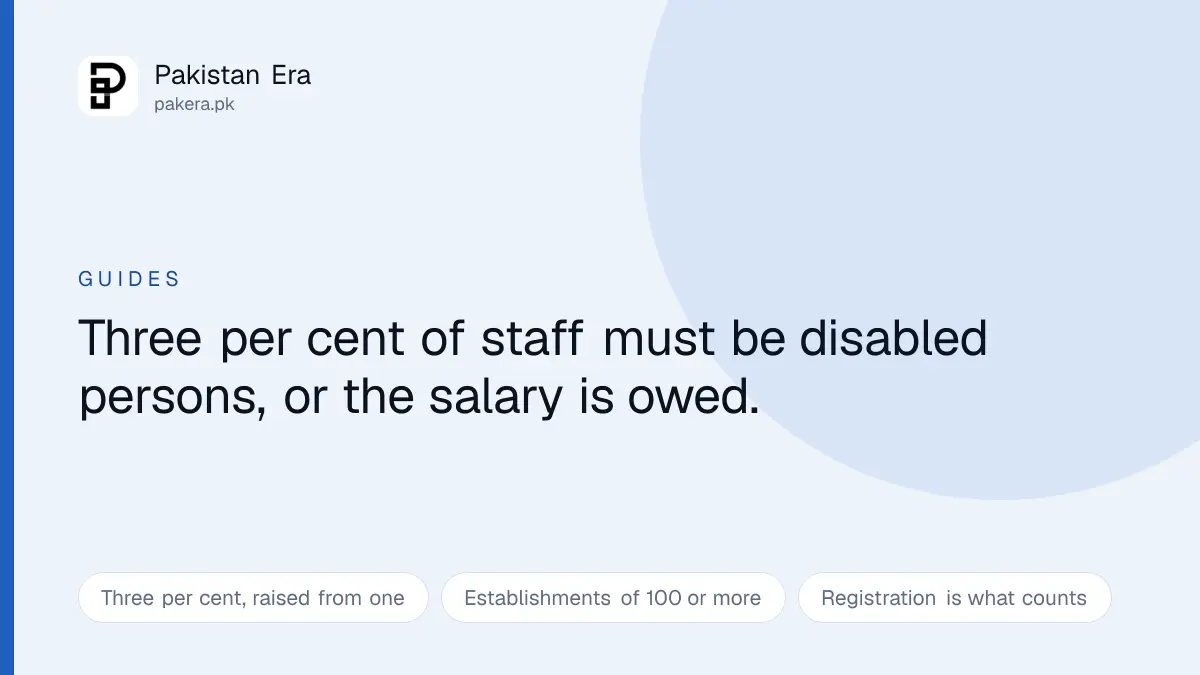
Three per cent of the workforce in any establishment with a hundred or more workers must be disabled persons. An employer who does not fill those places pays the salary into a fund instead, every month.
That second part is what gives the quota teeth, and almost nobody on either side of the hiring desk knows it is there.
We read the Disabled Persons (Employment and Rehabilitation) Ordinance, 1981 on 6 September 2026, in the text published by the Law and Parliamentary Affairs Department, Government of the Punjab.
Who the quota applies to
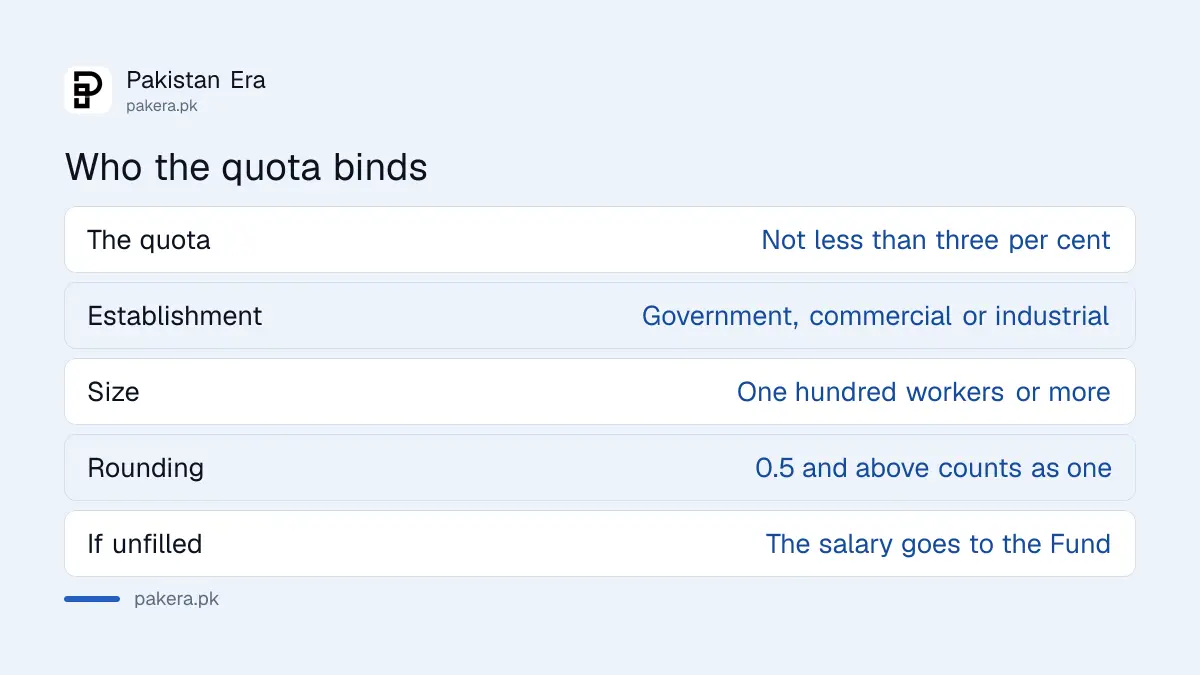
| Point | What the Ordinance says |
|---|---|
| The quota | Not less than three per cent |
| Establishment | Government, commercial or industrial |
| Size threshold | Not less than one hundred workers at any time in a year |
| Rounding | A fraction of 0.5 or above counts as a whole number |
| If unfilled | The salary is paid monthly into the Fund |
The three per cent is not the original figure. The Ordinance set one per cent, and the Punjab Amendment Act of 2015 substituted three, with effect from 14 April 2015.
The size threshold is the first thing to check. Below one hundred workers at any time during a year, the establishment is outside the definition.
The condition attached to the quota
Section 10 does not simply say three per cent of employees must be disabled. It says three per cent shall be disabled persons whose names have been registered with the Employment Exchange of the area in which the establishment is located, and against whose names an endorsement exists that they are fit to work.
So registration is what connects a person to the quota. Somebody with a disability who has never registered does not count towards it, however qualified they are and however long they have worked there.
That makes registration the practical first step, and it is covered below.
Equal terms, not lesser ones
Section 10(2) is short and worth quoting to anyone who treats a quota place as a lesser one.
Disabled persons employed against any post under the quota are entitled to terms and conditions which are not less favourable than those of other persons employed by the establishment against similar posts.
The same post means the same terms. A quota place is not a separate category of employment with its own pay scale.
What it costs an employer to ignore
Section 11 is the enforcement mechanism, and it is unusually direct.
An establishment which does not employ a disabled person as required by section 10 shall pay into the Fund each month the sum of money it would have paid as salary or wages to a disabled person had that person been employed.
Read that carefully. The cost of not hiring is the salary of the person not hired, paid monthly to the Rehabilitation of Disabled Persons Fund established under section 17. It is not a token penalty, and it does not stop until the place is filled.
How to register
Section 12 sets out the route, and it runs through the Employment Exchange rather than through employers.
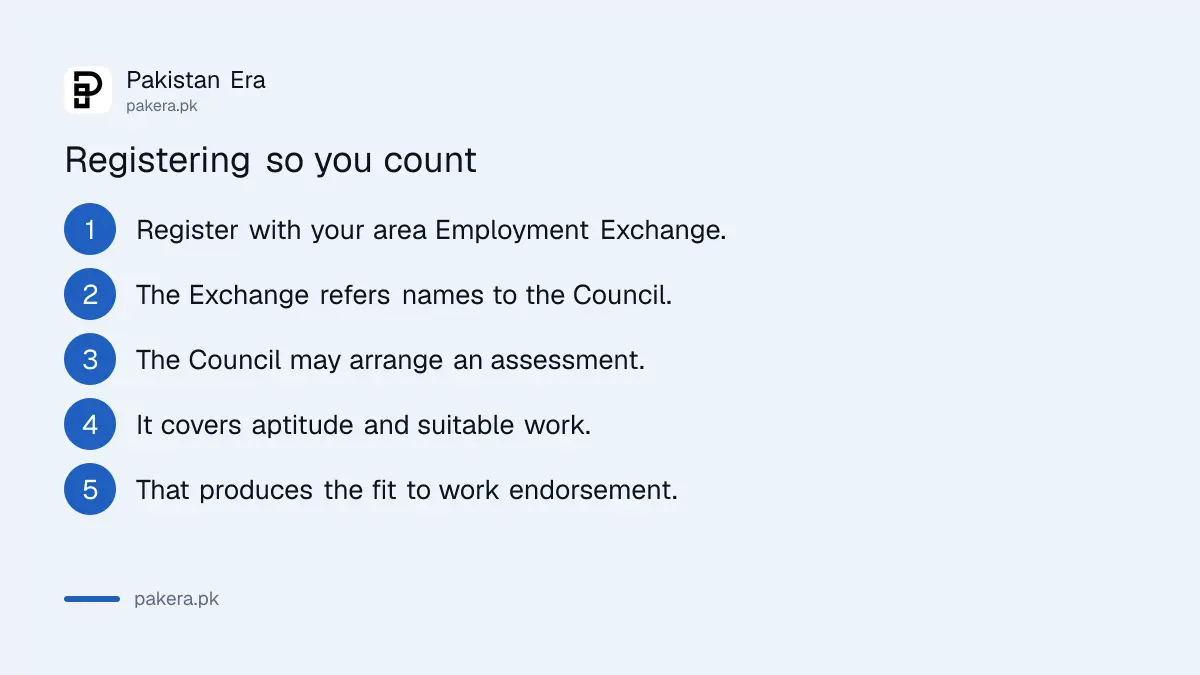
- Register your name with the Employment Exchange for your area.
- The Exchange refers all registered names to the Provincial Council.
- The Council may arrange an assessment of your functional disability.
- That assessment also covers your aptitude and the work you are fit to do.
- It is done by a medical officer or an assessing board it appoints.
The assessment is not only about what you cannot do. The Ordinance describes it as covering aptitude and the nature of the work the person is fit to do, which is what produces the fit-to-work endorsement the quota depends on.
You will usually need the disability documentation first. Our guide to getting a disability certificate and Special CNIC covers those two documents and the order they come in.
Who runs the system
The Ordinance establishes a National Council and Provincial Councils, each with its own functions, and a Rehabilitation of Disabled Persons Fund under section 17.
The Provincial Council is the body the Employment Exchange refers names to, and the one that arranges assessment. In the Punjab text, Government means the Government of the Punjab, and a 2012 amendment removed the National Council from parts of the machinery.
What this does not settle
The Ordinance is about employment and rehabilitation. It does not deal with tax concessions, travel arrangements or welfare payments, which sit in other legislation and other schemes.
Our guide to medical help from Bait-ul-Mal covers a programme providing assistance and wheelchairs to disabled people, and our guide to Punjab welfare institutions covers provincial bodies.
Labour is a provincial subject and the text we read is the Punjab one, carrying Punjab amendments of 2012 and 2015. Check the version that applies where you live before quoting a percentage, because the figure has moved once already.
Common questions
What is the disabled persons employment quota in Pakistan?
Not less than three per cent of the total number of persons employed, in the Punjab text following the 2015 amendment.
Which employers does it apply to?
Government, commercial and industrial establishments with not less than one hundred workers at any time during a year.
Do I have to register to count towards it?
Yes. Section 10 refers to persons registered with the Employment Exchange with an endorsement that they are fit to work.
Are quota jobs paid less?
No. Terms and conditions must be not less favourable than those of others employed against similar posts.
What happens if an employer does not comply?
It pays into the Fund each month the salary or wages it would have paid to the person had they been employed.
How is the percentage rounded?
A fraction of 0.5 and above counts as a whole number.
How we verified this
What we checked, where we read it, and what we could not confirm.
Last checked 6 September 2026. We downloaded the Disabled Persons (Employment and Rehabilitation) Ordinance, 1981 from the Punjab Code portal at punjablaws.punjab.gov.pk, in the text published by the Law and Parliamentary Affairs Department, Government of the Punjab, and read it. Section 10 requiring not less than three per cent of the total number of persons employed by an establishment at any time to be disabled persons registered with the Employment Exchange of the area with an endorsement that they are fit to work, the entitlement to terms and conditions not less favourable than those of others employed against similar posts, and the rounding of a fraction of 0.5 and above as a whole number; section 11 requiring an establishment which does not employ a disabled person as required to pay into the Fund each month the sum it would have paid as salary or wages had that person been employed; section 12 on registration with an Employment Exchange, referral of registered names to the Provincial Council, and assessment of functional disability, aptitude and the nature of work the person is fit to do by a medical officer or an assessing board; the definition of establishment as a Government, commercial or industrial establishment with not less than one hundred workers employed at any time during a year; the definition of employee as a regular or whole-time employee including an apprentice; and the Rehabilitation of Disabled Persons Fund under section 17, are all taken from that text. The three per cent figure was substituted for one per cent by the Punjab Disabled Persons (Employment and Rehabilitation) (Amendment) Act 2015 with effect from 14 April 2015, and a 2012 amendment made other changes. Labour is a provincial subject and this is the Punjab text, so confirm the version applying where you live. Nothing here is legal advice.
About the author

Public Services and Education Journalist
Fajr Riaz is a journalist and content writer at Pakistan Era, based in Lahore. She covers the questions people meet in everyday life in Pakistan: how a public service works, what a change in the rules means, and where to find a reliable answer.