LESCO Load Shedding Schedule 2026: Check Your Feeder in LESCO's List, Where 9 in 10 Show No Cuts
LESCO's current schedule lists 2,094 feeders with NIL load shedding and about 190 with one-hour cuts, mostly at night. Find your feeder code in five steps.
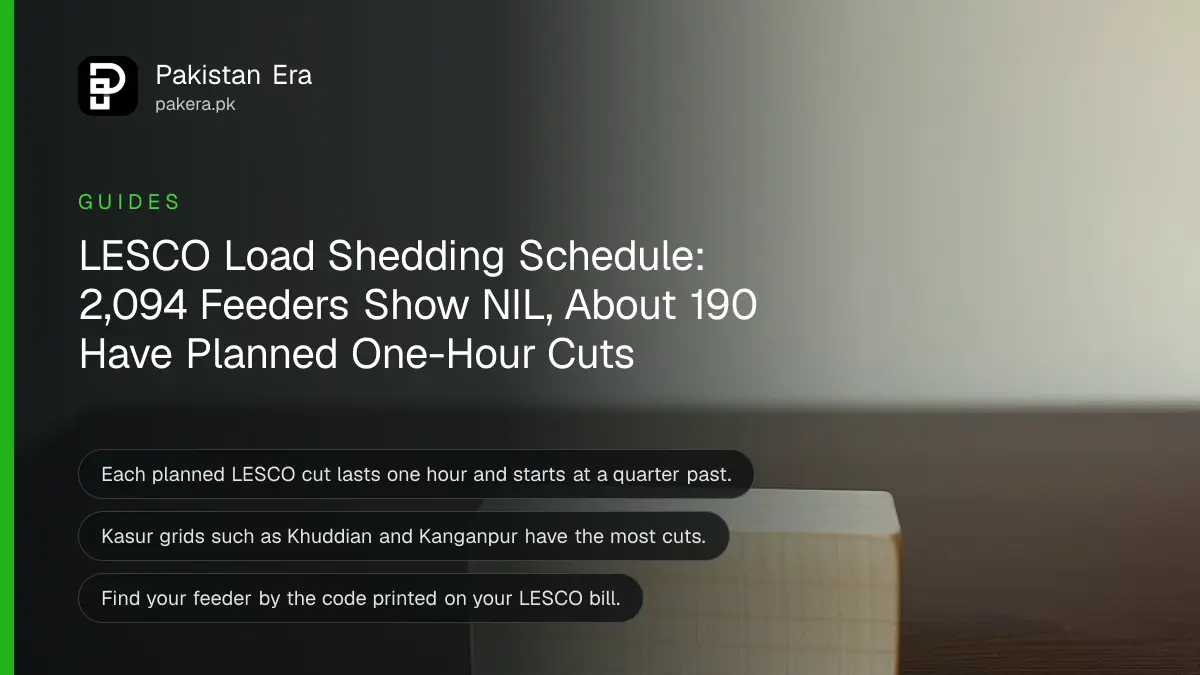
LESCO's current load management schedule lists more than 2,200 feeders, and about nine in ten show "NIL", meaning no scheduled load shedding. Around 190 feeders do have planned cuts, mostly one hour at a time and mostly at night. They are concentrated in Kasur district, on the Khuddian, Kanganpur and Kasur grids, and in parts of Lahore such as Bata Pur, Shahdara and Momenpura. You can find your feeder in LESCO's file in about two minutes.
We downloaded the "Current Load Management Program" that LESCO links on its load shedding page and read all 46 pages on 5 November 2026. Below: how to find your feeder, what the timings look like, the areas with the most cuts, and why your power can still go off on a NIL feeder.
Most LESCO feeders show NIL load shedding
The file has one row per 11 kV feeder. Each row gives the sub division, grid station, feeder name, feeder code, a category from I to VI, and the load management timing. The timing column is headed "09/26", which points to a schedule set in September 2026. LESCO still links it as the current schedule on 5 November.
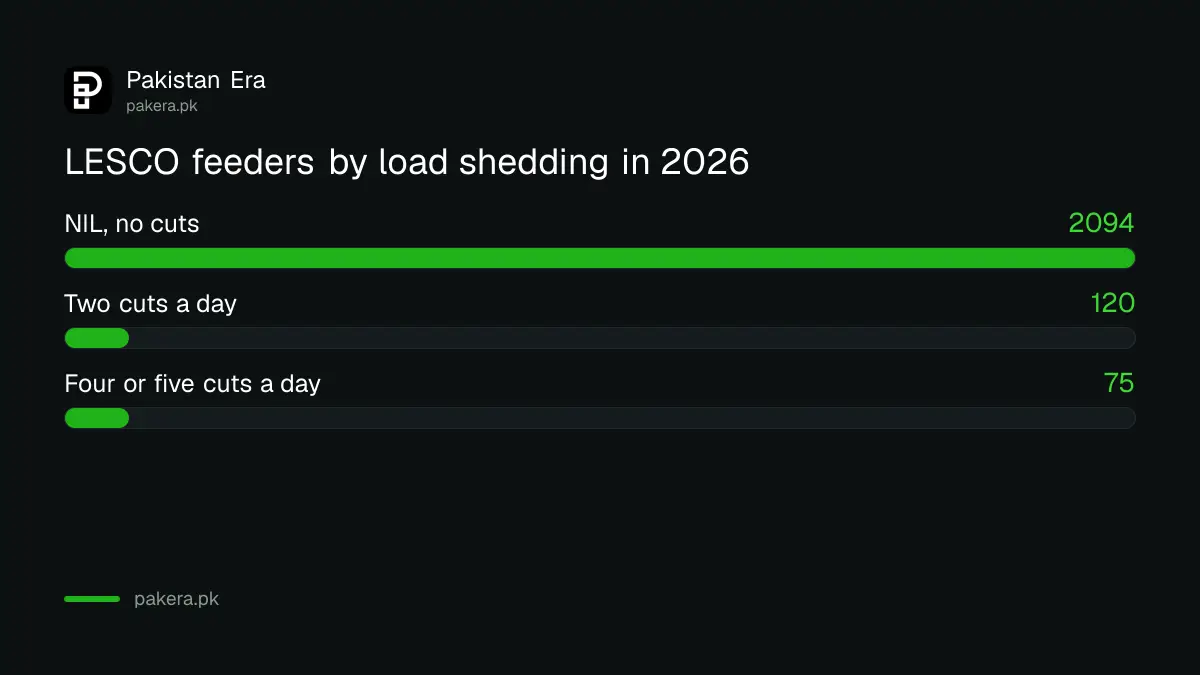
| What the schedule shows | Count in LESCO's file |
|---|---|
| Feeder rows with a grid station | About 2,280 |
| Rows marked NIL | 2,094 |
| Rows with planned cut times | About 190 |
| Feeders with 2 cuts a day | About 120 |
| Feeders with 4 or 5 cuts a day | About 75 |
Our counts come from reading the PDF as text, where some rows wrap onto two lines. Treat them as close, not exact. The NIL count is exact, because the word appears once per row.
Find your feeder in LESCO's file in five steps
The feeder name and code are on your LESCO bill. With them, the search is quick.
- Note the feeder name and feeder code from your latest LESCO bill.
- Open lesco.gov.pk and go to "Load Shedding/Shutdown Schedule".
- Click "Load Management Schedule" to open the PDF, which is about 1.6 MB.
- Use Find in the PDF viewer and type your feeder code. Codes are more reliable than names, which are often shortened.
- Read the timing at the end of the row. NIL means no scheduled cut; a list of times means a one-hour cut at each.
If you cannot find your feeder, the same LESCO page has a box that asks for your reference number to show your schedule. Our guide to the load shedding schedule by reference number explains that route.
Cuts are one hour each and mostly at night
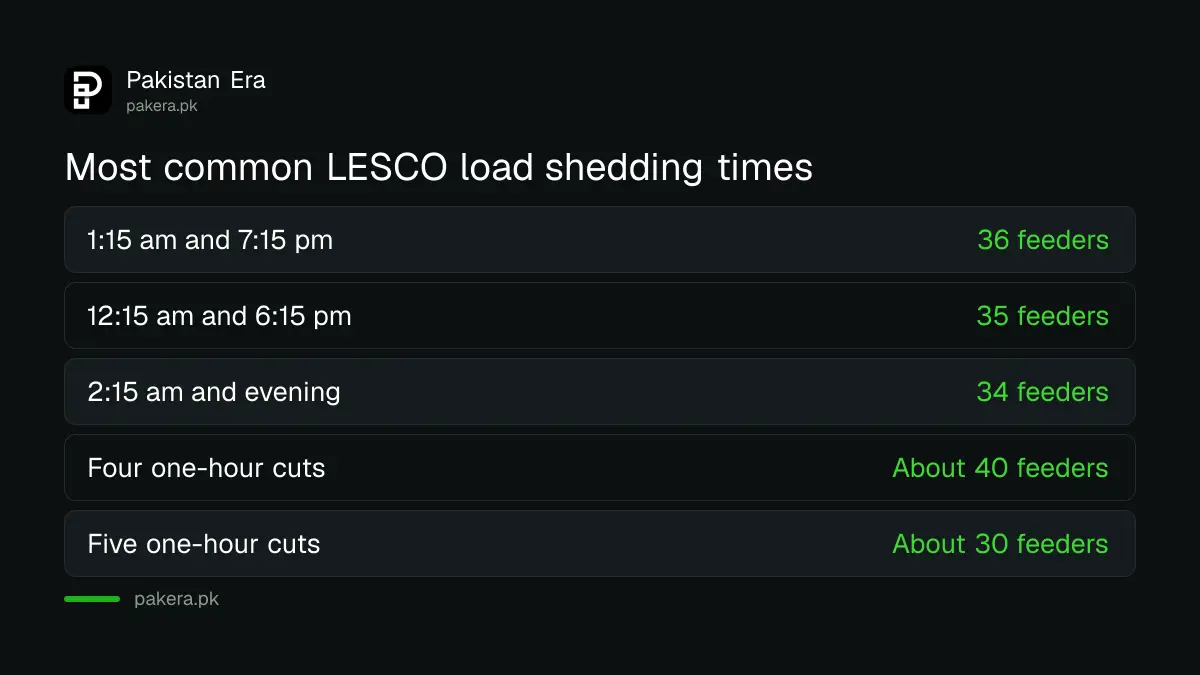
Where a feeder has cuts, each one lasts one hour and starts at a quarter past the hour. The most common patterns are two cuts a day: one after midnight and one in the evening.
| Pattern in the file | What it means | Feeders |
|---|---|---|
| 0115-0215, 1915-2015 | 1:15 to 2:15 am and 7:15 to 8:15 pm | 36 |
| 0015-0115, 1815-1915 | 12:15 to 1:15 am and 6:15 to 7:15 pm | 35 |
| 0215-0315, 2015-0215 | 2:15 to 3:15 am and an evening slot | 34 |
| Four cuts, such as 0015, 0615, 1815, 2015 | Night, early morning and two evening hours | About 40 |
| Five cuts a day | Night, morning and evening hours | About 30 |
The third pattern is printed as "2015-0215", which would be six hours. Every other cut in the file is one hour, so this looks like a typing slip for 8:15 to 9:15 pm. Ask your SDO if your feeder shows it.
Kasur grids and parts of Lahore have the most cuts
The feeders with cuts cluster on a small number of grid stations. Counting rows with timings, these grids lead:
- Kasur district: Khuddian (11), Kanganpur (10), Kasur New (8), Kasur (7), Bhai Pheru (7), Chunian and Ellahabad.
- Lahore: Bata Pur (8), Momenpura (6), Ghazi New (6), Shahdara Scarp and Shahdara New (4 each), Rustam (4), DHA Rahber (3) and X-Air Avenue (3).
- Sheikhupura: Sharaqpur (6), Sheikhupura (3) and Kala Shah Kaku (3). The Shamkey grid has 5 more.
Most feeders in central Lahore show NIL. Even so, a few feeders on the Johar Town and Defence grids have cuts in the file, while their neighbours on the same grid do not. So check your own feeder code, not your area.
Your power can still go off on a NIL feeder
NIL covers only scheduled load management. Three other things can still cut your supply.
- Planned maintenance shutdowns: LESCO posts a separate list each day, usually 9 am to 2 pm. See our report on the LESCO shutdown schedule for 5 November.
- Faults: a tripped feeder or burnt transformer. Report it on 118; our page on LESCO complaint numbers lists the others.
- Emergency load shedding: when the national grid is short, cuts can be added at short notice.
Common questions
What does NIL mean in the LESCO schedule?
No scheduled load shedding on that feeder. Maintenance shutdowns and faults can still cut power.
How many hours of load shedding does LESCO have?
Most feeders have none. Feeders with cuts have two, four or five one-hour cuts a day, mostly at night and in the evening.
Where is the LESCO load shedding schedule?
On lesco.gov.pk, under Load Shedding/Shutdown Schedule, as the "Load Management Schedule" PDF.
How do I find my feeder code?
It is printed on your LESCO bill with the feeder name. Search the PDF for the code.
Is the LESCO schedule up to date?
Its timing column is headed 09/26, and LESCO still linked it as current on 5 November 2026.
Which areas have the most LESCO load shedding?
Kasur district grids such as Khuddian and Kanganpur, and Lahore grids such as Bata Pur, Momenpura and Shahdara.
How we verified this
What we checked, where we read it, and what we could not confirm.
Last checked 5 November 2026. We read the "Current Load Management Program" PDF linked from the LESCO load shedding and shutdown page, 46 pages, as text. NIL and timing counts are our own, and because some rows wrap, the timed counts are approximate. LESCO does not explain the I to VI category column in the file, so we have not interpreted it. The schedule can change without a new date on the file.
About the author

Tax, Bills and Technology Writer
Ali Akhtar is a young and curious voice here at Pakistan Era. He is currently pursuing his A-Levels and has a growing interest in Pakistan’s changing industrial landscape and educational trends. Ali likes to write in a way that helps him explain and explore the world around him. His writing reflects the perspective of the new generation navigating the evolving trends of Pakistan where technology, youth innovation, and shifting opportunities are reshaping the country’s future.