Loan App Charges Capped at 90% in Pakistan: How to Work Out What an App Can Charge You
SECP Circular 26 of 2026 caps loan app charges at 90% a year for new borrowers and 70% for repeat ones. Work out the most an app can charge you, and complain.
Short answer: Under SECP Circular 26 of 2026, a licensed loan app in Pakistan can now charge at most 90 per cent a year on a digital nano loan to a new borrower, and 70 per cent to a repeat borrower. That cap covers everything: markup, processing fee and platform fee. In daily terms it is about Rs 24.66 a day on Rs 10,000 for a new borrower, or Rs 740 for a 30 day loan. Before, the limit was 274 per cent.
| Rule | Before | Now, Circular 26 of 2026 |
|---|---|---|
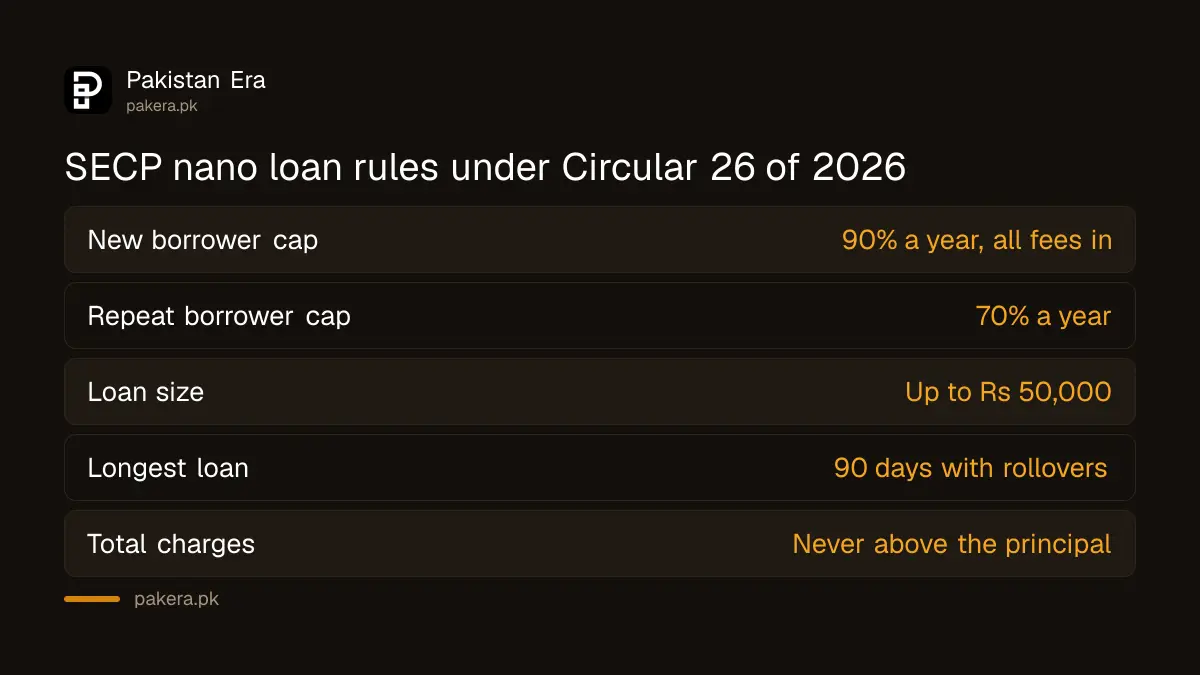
| Maximum yearly cost, new borrower | 274% | 90% (about 0.2466% a day) |
| Maximum yearly cost, repeat borrower | 274% | 70% (about 0.1918% a day) |
| Loan size covered | Up to Rs 50,000 | |
| Longest loan, with any rollover | 90 days | |
| Total charges and penalties | Never more than the amount borrowed | |
A nano loan is the small, short cash loan that apps give in minutes, usually Rs 5,000 to Rs 50,000 for a few weeks. The Securities and Exchange Commission of Pakistan (SECP) licenses the non-bank companies behind these apps. It issued Circular 26 of 2026 on 17 November 2026 and announced it the next day. It amends Circular 12 of 2024, the earlier rulebook for digital lending.
The cap is 90 per cent a year for new borrowers and 70 per cent for repeat borrowers
A licensed app may charge a first time borrower no more than 90 per cent a year, all costs included. A repeat borrower pays no more than 70 per cent. The lower rate must apply on its own; you do not have to ask for it.
The annual rate is called the APR, or annual percentage rate. It is the total cost of the loan stated as a yearly percentage. Because nano loans last days or weeks, the yearly figure looks high, but the rupee cost is what matters. SECP says the APR includes markup, processing fees, platform fees and every other charge, so an app cannot keep the rate low and move the cost into a fee.
You count as a repeat borrower when you paid your last loan from the same lender in full, inside its original repayment period. A loan you paid late, or rolled over, does not earn you the 70 per cent rate on the next one.
How to work out the most a loan app can charge you
You need three numbers: the amount you borrow, the number of days, and whether you are new or repeat. Multiply them by the daily cap. The result is the highest total charge the app may take, fees included.
- Take the loan amount, for example Rs 10,000.
- Multiply by the daily cap: 0.002466 for a new borrower, or 0.001918 for a repeat borrower.
- Multiply by the number of days of the loan, for example 30.
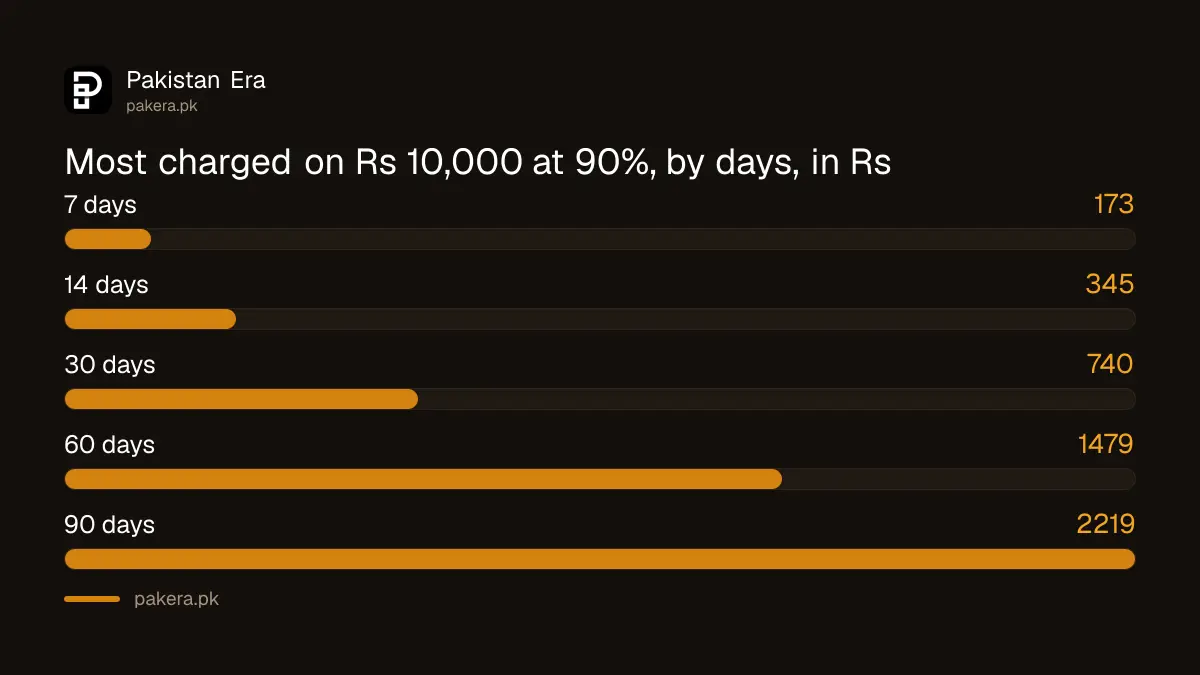
- The answer is the maximum total charge: Rs 10,000 x 0.002466 x 30 = about Rs 740.
- Compare it with the "total amount payable" in the app's Key Fact Statement, the summary sheet every licensed lender must show before you accept. If the charges are higher, the app is over the cap.
We worked out the table below from the two caps. It shows the highest total charge, not the repayment. Add the loan amount to get what you repay.
| Loan | Days | Most a new borrower pays in charges (90%) | Most a repeat borrower pays (70%) | Old cap (274%) |
|---|---|---|---|---|
| Rs 5,000 | 30 | Rs 370 | Rs 288 | Rs 1,126 |
| Rs 10,000 | 14 | Rs 345 | Rs 268 | Rs 1,051 |
| Rs 10,000 | 30 | Rs 740 | Rs 575 | Rs 2,252 |
| Rs 20,000 | 60 | Rs 2,959 | Rs 2,301 | Rs 9,008 |
| Rs 50,000 | 90 | Rs 11,096 | Rs 8,630 | Rs 33,781 |
Before you borrow at all, confirm the app is on SECP's whitelist, because the cap protects you only with a licensed lender. The steps are in how to check a lending app is SECP licensed.
Rollovers, late fees and early repayment have new limits too
The circular also bans compounding, bans automatic rollovers, gives a three day grace period after the due date, and lets you repay early and pay only for the days you used. All charges and penalties together can never exceed the amount you borrowed.
- No compounding. The app cannot charge markup on markup, or on late fees.
- No automatic rollover. A loan can be extended or restructured only if you ask, and only after the app shows a new statement with the extra cost in rupees and as an APR.
- Three day grace. No late charge for the first three days after the due date. After that, late charges apply only to the unpaid principal, and at no more than the daily cap.
- Early repayment. You may repay early and pay charges only for the days the loan was out.
- Total cap. Markup, fees and penalties combined can never be more than the principal. On Rs 10,000, the most you could ever repay is Rs 20,000.
- 90 days in all. The whole loan, including any rollover or extension, cannot run past 90 days.
Lenders were given 15 days to update their apps, websites, loan agreements and Key Fact Statements, and to tell existing borrowers about the new limits. SECP is also building a digital record of nano loan borrowers, so lenders can see your existing loans before giving another one.
What to do if an app charges more than the cap
Complain to the lender first, in writing, with screenshots of the Key Fact Statement and the amount it asked for. If it does not fix the charge, file a complaint with SECP. If the app threatens you or messages your contacts, report that to the National Cyber Crime Investigation Agency (NCCIA) on 1799.
| Problem | Where to go |
|---|---|
| Charges above 90% or 70%, or a fee hidden outside the APR | The lender first, then SECP through "Submit Your Complaint" on its website |
| Loan rolled over without your request | The lender first, then SECP |
| App is not on SECP's whitelist | SECP; do not repay to an unknown account until you check |
| Threats, calls to family, photos shared | NCCIA helpline 1799 or its online complaint form |
The full complaint routes, the evidence to save and the SECP toll free number are in how to report loan app harassment.
Common reasons your loan still looks expensive
Some loans that look over the cap are not, and some that look fine are. Check the loan date, the lender's licence and whether the charge is on principal or on the full balance before you complain.
- The loan was taken before the circular. Ask the lender in writing how the new limits apply to your outstanding loan, and keep the reply.
- The app is a bank or microfinance bank product. Banks answer to the State Bank, not SECP. Complain to the bank, then the Banking Mohtasib.
- The app is unlicensed. An illegal app ignores every cap. That is a matter for SECP and NCCIA, not a pricing dispute.
- The fee is taken from the loan up front. If you receive Rs 9,500 on a Rs 10,000 loan, the Rs 500 fee still counts inside the cap.
A loan at 90 per cent a year is still expensive borrowing. For larger or longer needs, interest free lenders and bank schemes cost far less; Akhuwat's interest free loan is one option.
Common questions
What is the new interest rate limit on loan apps in Pakistan?
90 per cent a year for new borrowers and 70 per cent for repeat borrowers, all fees included, under SECP Circular 26 of 2026.
How much can a loan app charge on Rs 10,000 for 30 days?
At most about Rs 740 for a new borrower and Rs 575 for a repeat borrower, including every fee.
Does the cap apply to loans above Rs 50,000?
No. The circular covers digital nano loans of up to Rs 50,000. Larger loans fall under other SECP rules.
Can a loan app roll over my loan automatically?
No. A rollover now needs your express request and a fresh cost statement, and the whole loan cannot pass 90 days.
Who counts as a repeat borrower?
Someone who repaid their latest loan from the same lender in full within the original repayment period.
Can I complain to the State Bank about a loan app?
No. Non-bank lenders answer to SECP. The State Bank handles complaints about banks.
How we verified this
What we checked and where we read it.
Last checked 25 November 2026. The rules on this page come from SECP Circular 26 of 2026, dated 17 November 2026, which amends Circular 12 of 2024, and from SECP's announcement of 18 November 2026. The cost table and the Rs 10,000 examples are our own arithmetic from the 90 and 70 per cent caps, using a 365 day year. Complaint routes are from the SECP website and the NCCIA complaint portal, as set out in our pages on licensed apps and harassment. Nothing here is legal advice.
About the author

Senior Writer, Public Services and Technology
Shahid joined us in 2024 as an author. He is a senior contributor to Pakistan's leading technology websites. He writes detailed articles, mostly covering his expertise in the latest tech, mobiles, apps, gadgets, and step-by-step guides. His ideology is to help people understand the latest trends and explain complex methods through very easy-to-understand guides.