Disability Rights in Islamabad: Free Education, a 1% Job Rule and Council Registration Under the 2020 Act
Islamabad's 2020 disability law gives free education and public health care and makes employers keep 1% disabled staff. See how to register with the Council.
In Islamabad, the ICT Rights of Persons with Disability Act, 2020 promises free education from pre-primary to higher level, free public health care, reserved transport seats and parking, and a rule that at least 1% of every establishment's staff be registered disabled persons. To use the job rule, register with the Council on Rights of Persons with Disabilities, which assesses you and records whether you are fit to work.
The 2020 Act replaced the 1981 Disabled Persons Ordinance for the Islamabad Capital Territory. It became law on 22 September 2020. We read it in full on the Pakistan Code on 20 October 2026, and the rights below are what it says, section by section.
The Act is long on promises and short on procedure, so the useful skill is knowing which section to quote, and to whom.
Registration with the Council is the starting point
Section 23 lets any person with disability who wants work or rehabilitation register with the Council or its designated office. The Council can have you assessed by an authorised medical officer or an assessing board, which records the nature of your disability and the work you can do.
The outcome goes into the register as an endorsement. If you are fit to work, the register notes the kind of work or training that suits you. If not, it notes that, and the Council must arrange rehabilitation. If the Council decides a person is not disabled, the name is struck off.
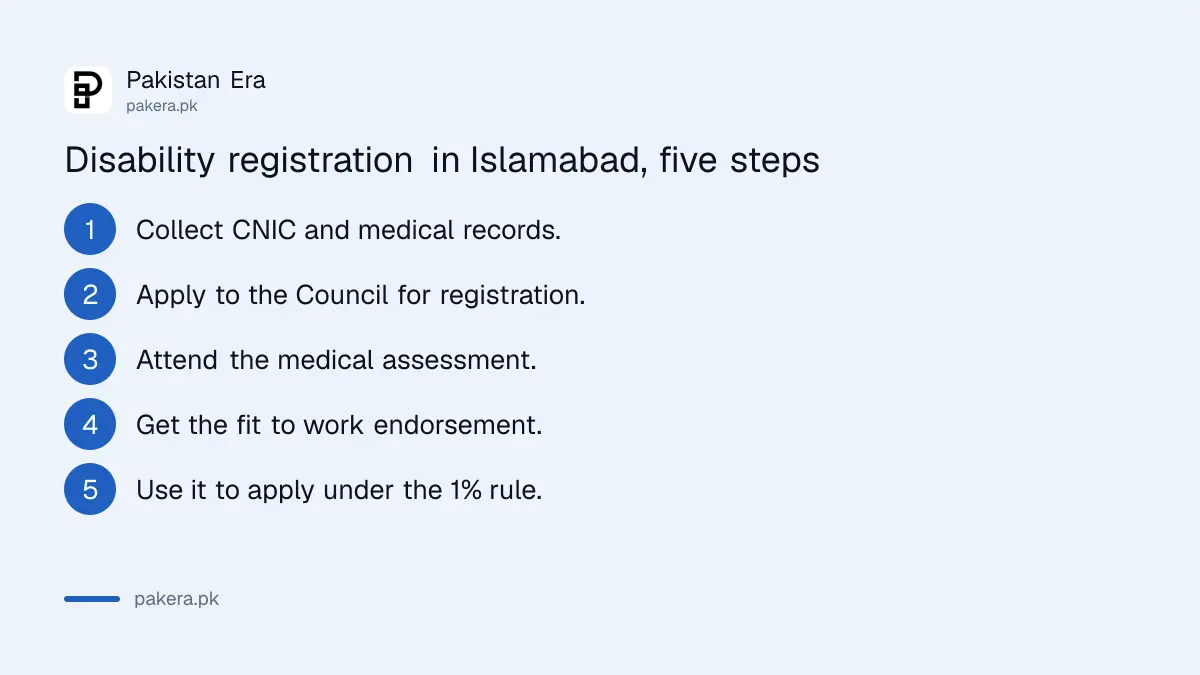
- Collect your CNIC, medical records and any existing disability certificate.
- Apply to the Council on Rights of Persons with Disabilities, or its designated office in Islamabad, to be entered in the register.
- Attend the assessment by the medical officer or assessing board.
- Ask for a copy of the endorsement against your name, especially "fit to work".
- Use that endorsement when you apply for jobs under the 1% rule.
- Get a special CNIC with the disability logo from NADRA for everyday concessions.
The Act does not set a form or fee for registration. Section 23 leaves the form and manner to the Council, so ask its office what it currently needs. If you are bed-ridden, NADRA's home visit for a CNIC can sort out the identity document first.
The 1% job rule covers every establishment
Section 24 says not less than 1% of the people an establishment employs at any time must be registered disabled persons endorsed as fit to work. A fraction of 0.5 or more counts as one. An establishment that falls short must pay the Fund every month what it would have paid that worker.
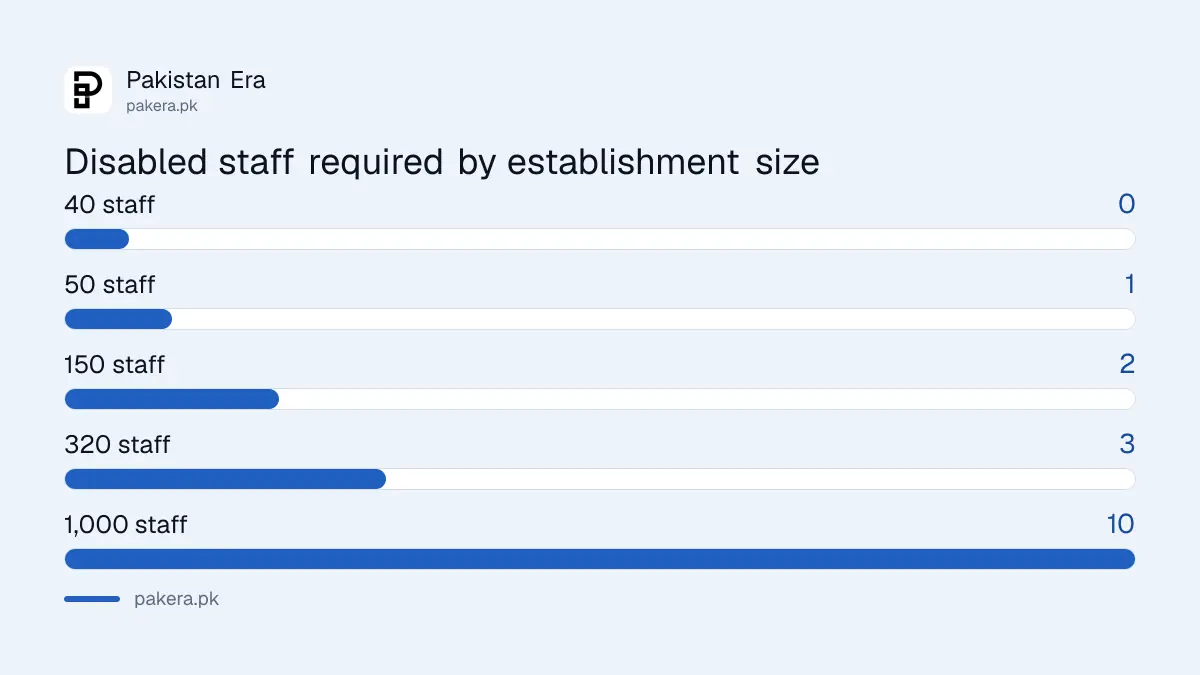
So an Islamabad office with 150 staff needs at least two registered disabled employees, because 1.5 rounds up to two. One with 40 staff needs none under the strict count, because 0.4 rounds down. These examples are our arithmetic on section 24(3). The Act does not define "establishment", so a small business may argue the rule does not reach it.
| Staff in the establishment | 1% of staff | Disabled employees required |
|---|---|---|
| 40 | 0.4 | 0 |
| 50 | 0.5 | 1 |
| 150 | 1.5 | 2 |
| 320 | 3.2 | 3 |
| 1,000 | 10 | 10 |
Government posts have a separate quota. Section 10(3) says the government shall reserve an employment quota as the federal government prescribes and reviews. The Act itself does not fix that percentage. Disabled employees under section 24 must get terms no less favourable than others in similar posts.
This is not the Punjab figure. Pages that quote a 3% quota describe Punjab's amended Ordinance, explained in our guide to the disabled persons employment quota. In Islamabad, the 1981 Ordinance was repealed by section 36 of the 2020 Act.
Education and health care are free under the Act
Section 9 says the government shall provide free education to persons with disabilities from pre-primary to higher education, and no institution, public or private, may refuse admission because of disability. Section 11 promises barrier free public health services at no cost to the person.
Section 9 also makes it illegal for an institution or its staff to discriminate against or abuse a disabled student, with both the institution and the person punishable. Schools and hostels must provide reasonable accommodation, meaning the practical changes a student needs to study on equal terms.
For exams, the federal board's rules on a writer and extra time for disabled candidates sit alongside these rights.
Everyday protections in transport, housing and safety
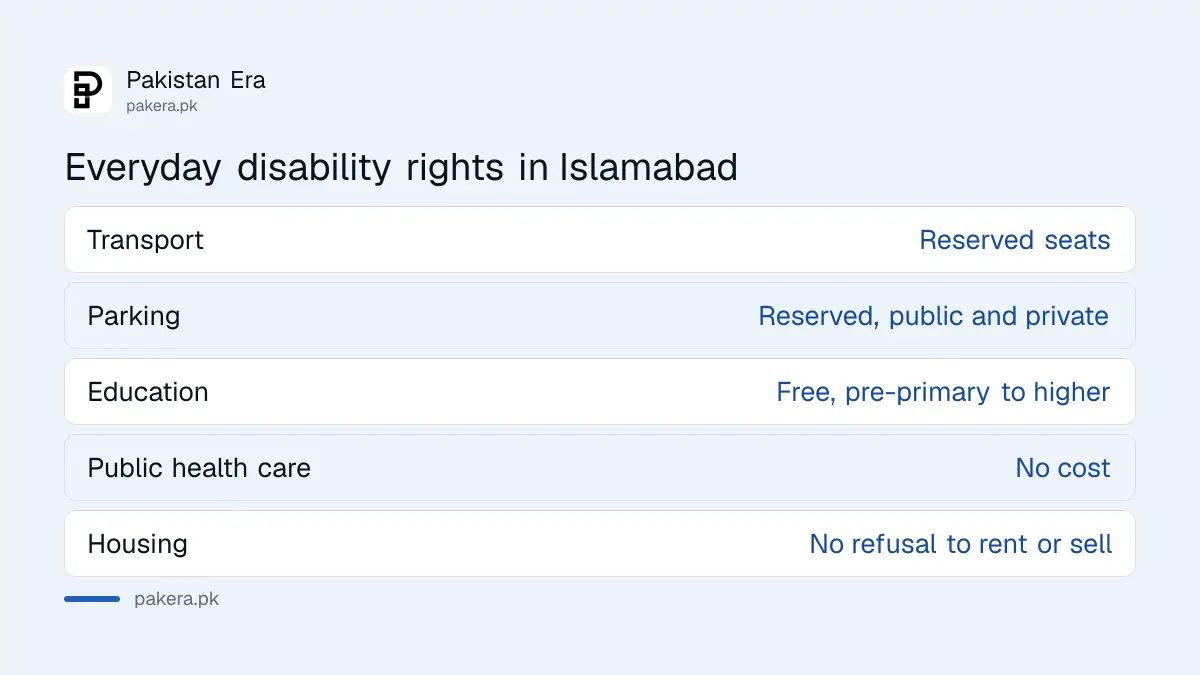
The Act reaches into daily life. It requires reserved seats on all transport and reserved parking at public and private places. It bans refusing to rent or sell a home to someone because of disability. And it treats even a minor injury to a disabled person as grievous hurt.
- Transport and parking: special seats in all means of transport and exclusive parking at public and private places, under section 7(5).
- Washrooms: the government must ensure accessible washrooms and toilets, under section 7(1).
- Violence: physical violence causing even a minor injury is deemed grievous hurt under section 335 of the Penal Code, under section 8(3).
- Legal aid: at public expense where needed, under section 8(4), and sign language interpreters for justice, under section 17.
- Housing: no one may refuse to rent or sell a home because of disability, under section 13(1).
- Voting: the Election Commission must make polling stations accessible, under section 16(2).
- Property: a disabled person cannot be denied the right to own, sell or inherit property, under section 18.
Banks have their own duties to disabled, blind and elderly customers, set out in our guide to bank access rights.
The Council also takes complaints
Section 22(10) gives the Council power to address individual and collective complaints about violations of the rights of persons with disabilities. Section 27 makes non-cooperation with the Council by a government official misconduct. Put your complaint in writing, cite the section, and keep a copy.
The Council is the old National Council for the Rehabilitation of Disabled Persons, reconstituted by section 21. It is chaired by the Minister-in-charge and includes members of the Senate and National Assembly. It also manages the ICT Disability Fund, which collects the payments from establishments that skip the 1% rule.
For speedy justice, section 32 lets the government designate special courts for cases involving persons with disabilities. We could not confirm whether any have been designated in Islamabad.
Common questions
What is the disability job quota in Islamabad?
At least 1% of every establishment's staff must be registered disabled persons fit to work, under section 24. Government posts follow a quota the federal government prescribes.
Is education free for disabled students in Islamabad?
Section 9(2) says the government shall provide free education to persons with disabilities from pre-primary to higher education.
Where do I register as a person with disability in Islamabad?
With the Council on Rights of Persons with Disabilities or its designated office, under section 23. It may assess you through a medical officer or board.
Does the 1981 Disabled Persons Ordinance still apply in Islamabad?
No. Section 36 of the 2020 Act repealed it for the Islamabad Capital Territory.
Can a landlord refuse to rent to a disabled person?
No. Section 13(1) says no one may refuse to rent or sell a place of living to a person because of disability.
What happens to an employer who ignores the 1% rule?
It must pay the Fund each month the salary it would have paid a disabled employee, under section 25.
How we verified this
What we checked, where we read it, and what we could not confirm.
We read the ICT Rights of Persons with Disability Act, 2020 (Act No. XXXV of 2020) in full on the Pakistan Code on 20 October 2026. We could not find rules under the Act, the government post quota the federal government has prescribed, the Council's current registration form or office address, or any designated special courts. Ask the Council's office before you apply.
About the author

Public Services and Education Journalist
Fajr Riaz is a journalist and content writer at Pakistan Era, based in Lahore. She covers the questions people meet in everyday life in Pakistan: how a public service works, what a change in the rules means, and where to find a reliable answer.