Banking Rights for Blind, Disabled and Senior Customers in Pakistan: SBP Rules
SBP says banks may not refuse a blind customer an individual account and must build ramps, stock Braille forms and put seniors first. Know your rights here.
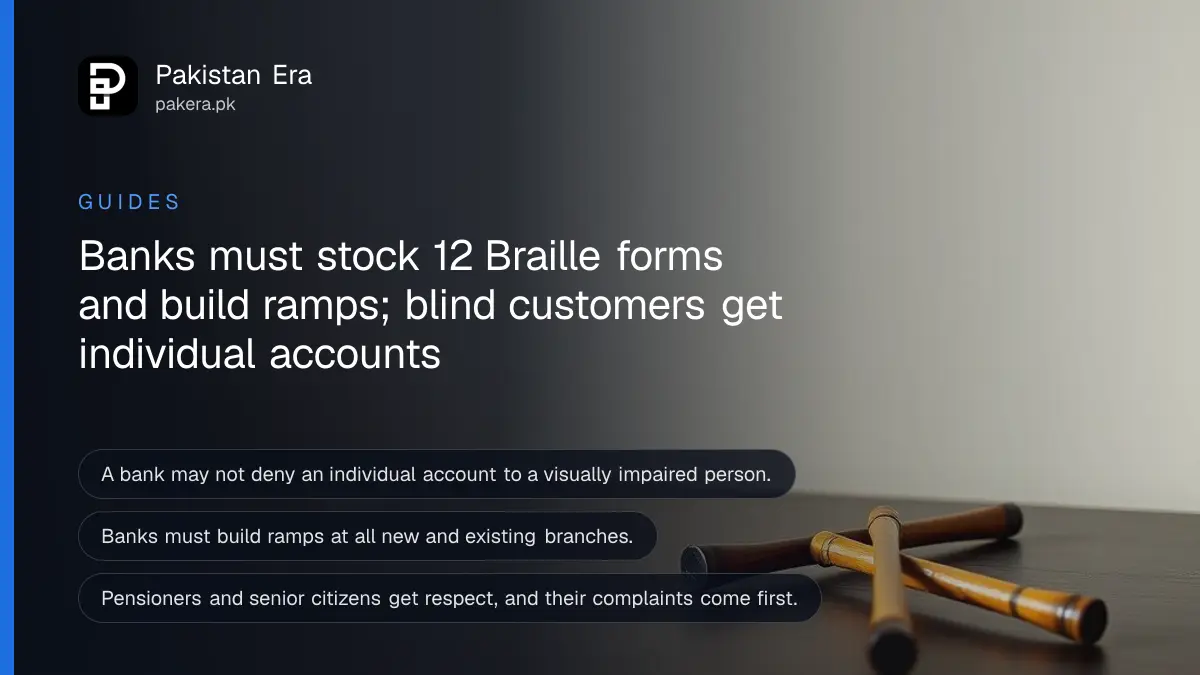
Short answer: SBP's framework says a bank in Pakistan may not refuse an individual account to a blind customer, must give priority and special assistance to people with disabilities, and must make branches reachable by ramp. It also tells banks to treat pensioners and senior citizens with respect and to resolve their complaints first.
Many blind customers in Pakistan have been told to open only a joint account with a sighted relative. Many wheelchair users have found a flight of steps at the branch door. The State Bank of Pakistan (SBP) has written rules against both, and most customers have never seen them.
We read SBP's Business Conduct and Fair Treatment of Consumers Regulatory Framework on 12 October 2026. It comes with BPRD Circular No. 04 of 2025, dated 17 October 2025. This guide uses sections 3.2.5, 3.3 and 5.1.1.6 and Annexures 3A and 3B. We did not visit branches, so we cannot say how any bank performs on these points.
A bank may not refuse an individual account to a blind customer
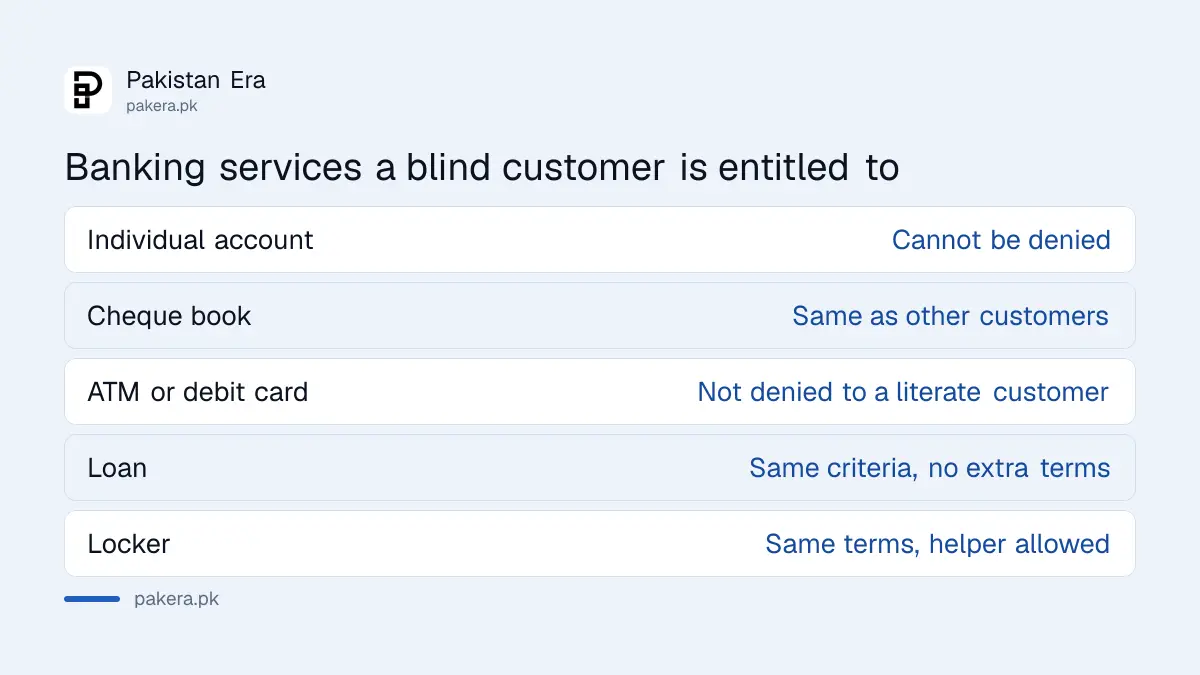
The framework says banks shall not deny opening an individual account to a visually impaired person. The customer must have a clear option to open it alone or jointly with another person. The same documents apply as for every other customer.
The bank must also explain all risks of each product before it starts the relationship, and may not treat a literate blind person as an illiterate customer. The account must be marked "Visually Impaired/Blind Person Account", and the bank must set up controls against financial exploitation.
If a form, deposit slip or cheque must be filled in, staff must read the questions out and write the answers on the customer's behalf. They do this in front of a witness whom the customer knows, if the customer wants that.
| Service | What SBP's guidelines say for a blind customer |
|---|---|
| Account | Individual account cannot be denied, alone or joint, as the customer chooses |
| Cheque book | Provided as to other customers, and third-party cheques honoured if in order |
| Cash withdrawal | Not limited to self-withdrawal, on a witnessed undertaking by a literate customer |
| ATM or debit card | Not denied to a literate customer on a witnessed undertaking |
| Credit card | Allowed on a witnessed request if otherwise eligible, after risks are explained |
| Loans | Same criteria as other applicants, with no extra terms |
| Locker | Same terms, and a registered helper of the customer's choice may assist |
Banks must provide ramps, Braille forms and sign language help
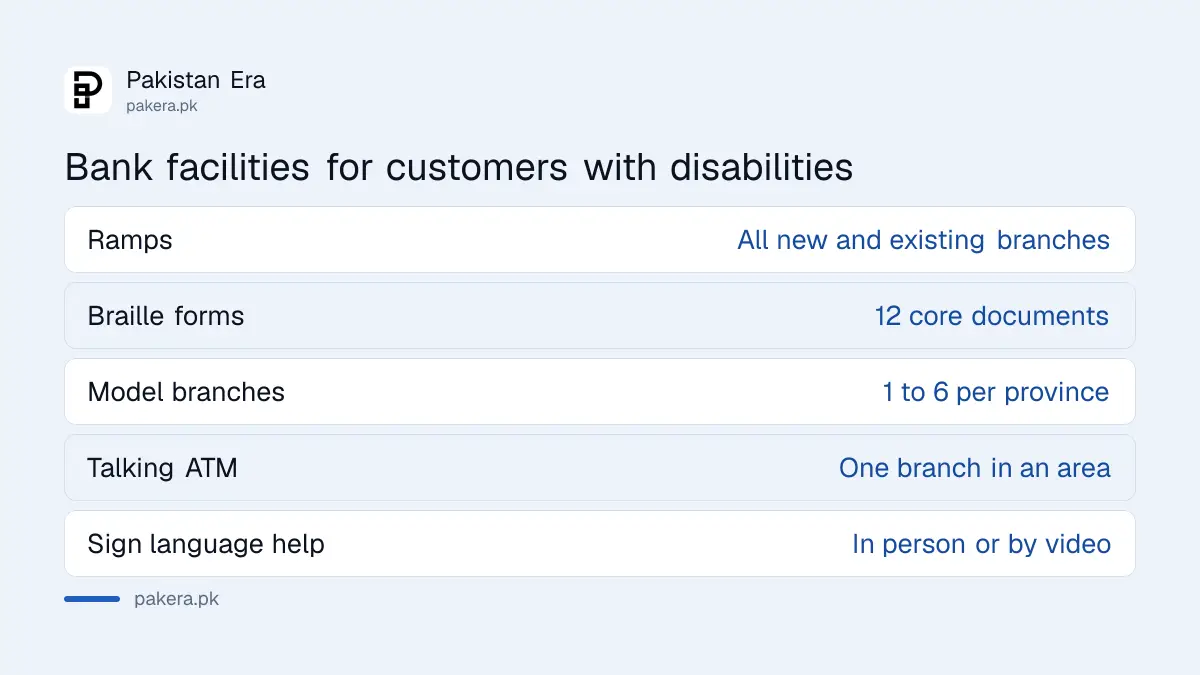
Banks must build ramps at the entrances of all new and existing branches, except mobile banking units, and list those branches on their websites. They must stock Braille versions of 12 core forms at controlling offices, and offer sign language help in person or by video.
The Braille list in Annexure 3A includes the account opening form and its terms and conditions, the deposit slip, the cheque book request slip, the locker application, the card application, the form to reactivate a dormant account, the term deposit application and the indemnity or undertaking.
SBP also wants banks' apps and websites to be usable with screen readers and voice navigation. It asks banks to set up alternative ways to verify a blind customer's identity in digital channels. It gives these as a strong encouragement for accessibility standards, so ask your bank what it offers.
Model branches must have height-adjusted counters and a talking ATM nearby
Each bank must designate model branches in every province, from 1 to 6 per province depending on its size. A model branch must have ramps, height-adjusted counters and ATMs, a separate token system, trained staff and Braille stationery. Banks should also make sure one branch in an area has a talking ATM.
The model branch rules also call for ATMs with voice command, light alerts for customers with hearing difficulty, dedicated counters and help desks, and a video call option with sign language help. Banks must publicise where their model branches are.
You can ask any branch which model branch serves your city. Our guide on the disability certificate and special CNIC explains the papers that may help you get other disability benefits. A guide on free wheelchairs and hearing aids in Punjab covers support equipment.
Pensioners and senior citizens get priority, respect and protection from mis-selling
The framework says banks must treat senior citizens and pensioners with respect and give pensioners special help with account opening. Government, semi-government and defence pensioners pay no service charges, and pension money must reach the account without delay. Their complaints are resolved on priority.
If a branch sells an investment or insurance product to a senior citizen, widow, illiterate or disabled person or a pensioner, senior approval is needed. The sale must be approved at least at regional head level, and the branch manager must sign that the terms were explained.
That is a protection against a hard sell. Our guide on cancelling a life insurance policy shows how to get a refund within the free look period. Our guide on pension proof of life explains the change away from bank biometric checks.
Banks must also provide shelter and drinking water for people who queue outside a branch, and the queue rule includes special care for BISP beneficiaries.
How to raise it when a branch says no
Ask the branch manager to put the refusal in writing with the reason. Then write to the bank's complaint unit and quote the framework. If that fails, complain to the Banking Mohtasib or on the SBP Sunwai portal.
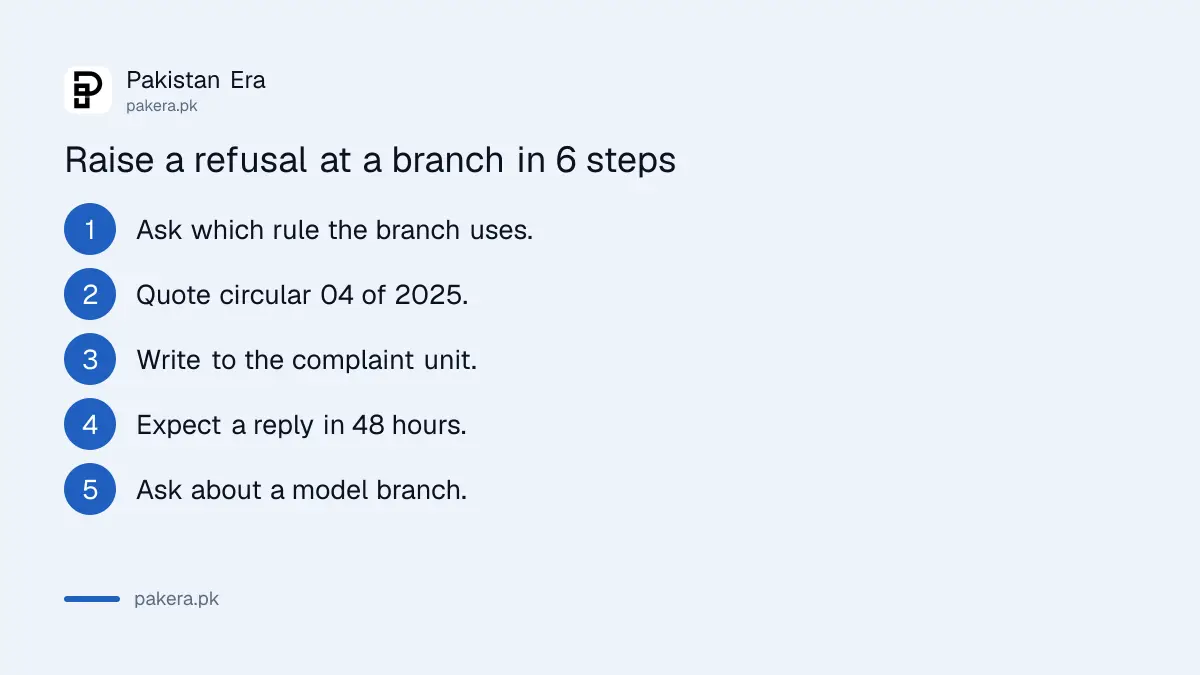
- Ask politely which rule the branch is relying on, and ask for the reason in writing.
- Quote "BPRD Circular No. 04 of 2025, section 3.3 and Annexure 3B".
- Write to the bank's complaint unit. Ask for the tracking number by SMS or email.
- Expect an acknowledgement within 48 hours and a reply in 3 to 7 working days for a simple matter.
- Ask the branch whether it has a model branch nearby and a ramp.
- If the bank does not fix it, file with the Banking Mohtasib or on the SBP Sunwai portal.
The framework has a separate complaint route for discrimination. Banks must set up a mechanism for fast handling of complaints about discrimination in the provision of financial services.
Common questions
Can a bank force a blind person to open a joint account?
No. The framework says the bank shall not deny an individual account, and the customer must be offered a clear option to open it alone or jointly.
Can a blind customer get an ATM or debit card?
Yes. Guidelines say a literate blind account holder may not be denied an ATM or debit card against a duly witnessed undertaking.
Can a blind customer get a loan or credit card?
Yes. A loan application must be judged by the same criteria as others, with no extra terms. A credit card is allowed on a witnessed request if the person is otherwise eligible.
Do banks have to build ramps?
Yes. The framework says banks shall construct ramps at all newly opened and existing places of business, except mobile banking units, and keep a list of those branches on their websites.
Do pensioners pay service charges?
Not if they are government, semi-government or defence pensioners. The framework exempts their accounts from service charges.
Is there a lower age limit for a senior citizen's rights?
The framework does not give an age. Provincial laws differ, with 60 in several of them, so ask your bank which age it applies. Our guide on the Senior Citizen Card lists the age used by each law.
How we verified this
What we checked, where we read it, and what we could not confirm.
We read BPRD Circular No. 04 of 2025 and the framework on 12 October 2026, including sections 3.2.5.2, 3.3, 3.3.1 and 5.1.1.6, and Annexures 3A and 3B. The special segments section does not apply to e-money institutions such as wallets. We did not visit any branch, and the framework can be amended.
About the author

Technology Journalist & Multimedia Producer
Ahmad Ali is a technology journalist and multimedia producer at Pakistan Era, joining the team in October 2026. He covers consumer technology and digital life for Pakistani readers, combining research with hands-on product testing.