Apply for a Free Wheelchair or Hearing Aid in Punjab: Papers, Rules and Helpline 1312
Punjab's ADWC programme gives free wheelchairs, hearing aids and limbs. See the 3 papers needed, the test for each device and how to apply online or call 1312.
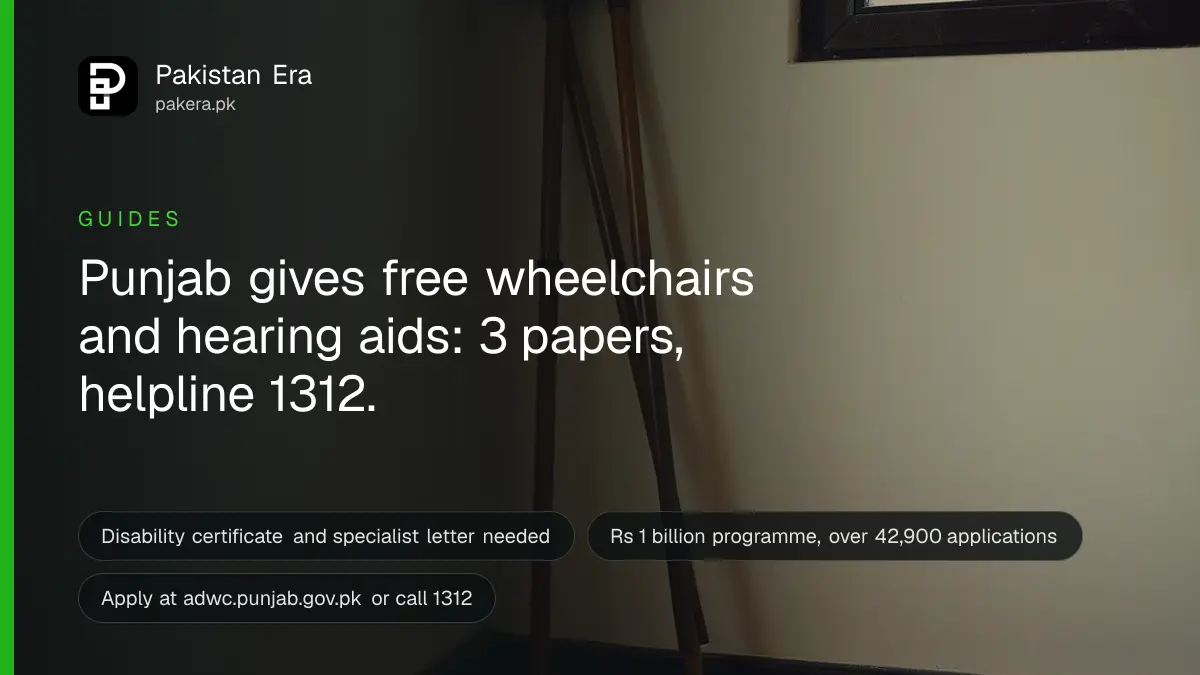
Punjab's Assistive Devices and Wheelchair Programme gives free wheelchairs, hearing aids, artificial limbs and walking aids to people with disabilities. You apply on adwc.punjab.gov.pk or at a Social Welfare office, with a disability certificate and a specialist's recommendation. Help line: 1312.
The government page on the programme says it has put Rs 1 billion behind these devices and has received over 42,900 applications. An application is only as good as its papers, so this guide is built around them.
We read the programme's portal and its FAQ pages and the Punjab government's own initiative page on 11 October 2026. We did not submit an application, so we cannot say how long approval takes. The programme says you will be told the date and place of distribution by SMS.

The programme gives free devices to people with disabilities
The Assistive Devices and Wheelchair Programme, shortened to ADWC, is a Punjab government initiative under the Social Welfare department. It provides manual and electric wheelchairs, digital hearing aids with batteries and moulds, artificial limbs, tricycles, walking frames, rollators and mobile toilet chairs.
The government page says the programme also introduced advanced bionic limbs, which move through signals from the user's own muscles. That is the first time this has been offered in Punjab, it says. A real-time dashboard tracks applications, payments and device distribution.
You need three papers before you apply
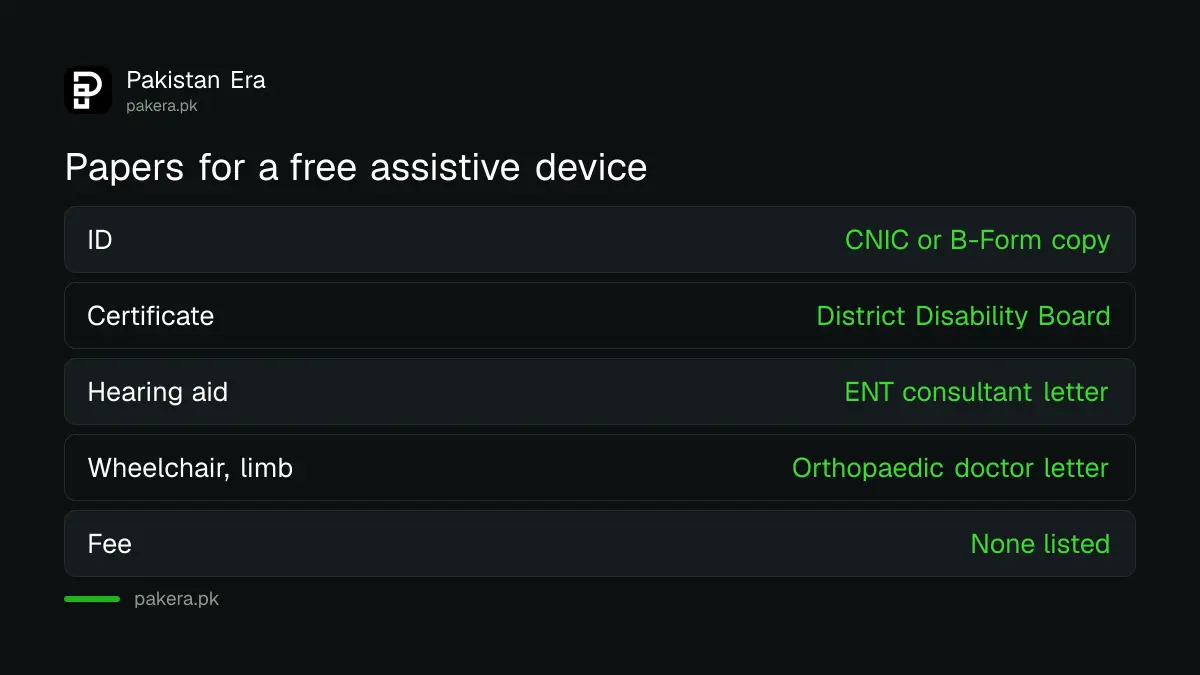
The FAQ lists the papers. You need a valid CNIC or B-Form (the guardian's CNIC for a child or for someone with an intellectual disability), a disability certificate from the District Disability Assessment Board, and a specialist's written recommendation for the device you want.
- A valid CNIC or B-Form, with a copy attached. For a minor or an intellectually impaired person, the guardian's CNIC.
- A disability assessment certificate from the District Disability Assessment Board, needed for wheelchairs, artificial limbs, braces and other devices.
- A needs assessment. For a hearing aid, a recommendation from an ENT consultant at a District Headquarters (DHQ) or teaching hospital. For a wheelchair, artificial limb or brace, a recommendation from an orthopaedic doctor at the same kind of hospital.
If you do not have the certificate yet, get it first. The online disability certificate from DPMIS is the first step, and nothing else moves without it.
Each device has its own medical test
The portal sets a separate rule for each device. A standard wheelchair is for people who still have upper limb power. An electric wheelchair is for people with weak or paralysed limbs. A hearing aid needs a measured loss of 50 to 80 decibels. A limb needs a disability of 40% or more.
| Device | Main condition on the portal |
|---|---|
| Standard wheelchair | Disability certificate, upper limb power above 3 out of 5, children and adults |
| Electric wheelchair | All four limbs paralysed or weak, upper limb power not 3 out of 5, proof of skilled or educational mobility |
| Hearing aid | Moderate to severe loss, 50 to 80 dB, ENT recommendation |
| Lower limb prosthetic | Valid certificate of 40% disability or more, at least 3 years of expected use, fitness checks |
| Upper limb bionic prosthetic | Age 15 to 45, specialist evaluation, enough muscle signal strength |
For older applicants, the limb rules add a heart and lung fitness check. If you are over 50, a cardiologist's clearance is required. The portal also says the doctors will rate each case, so the device you ask for may not be the one you are given.
There is a separate federal route too. Bait-ul-Mal help for wheelchairs and hearing aids has its own rules and is not the same as this Punjab programme.
Apply online, at a Social Welfare office, or by phone
The FAQ names three routes: the website adwc.punjab.gov.pk, the nearest Social Welfare and Bait-ul-Maal office, and the help line 1312 for guidance. The site asks first whether you are a registered person with disability, and there is also an Android app.
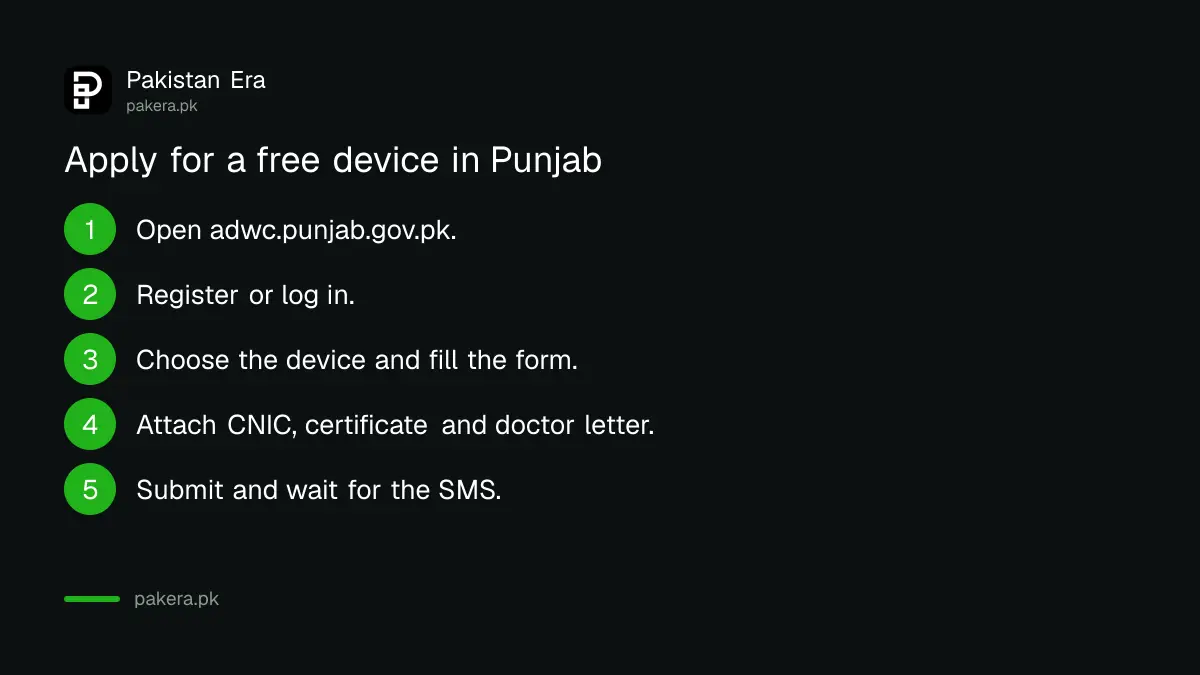
- Open adwc.punjab.gov.pk and choose "Apply for Assistive Device / Wheelchair".
- Say whether you are a registered person with disability, and log in or register.
- Pick the device and fill in the form.
- Attach the CNIC or B-Form copy, the disability certificate and the specialist's recommendation.
- Submit, then wait for the SMS with the date and place of distribution.
If you cannot use a computer, a family member can do the form for you, or you can go to the Social Welfare office. The programme's FAQ says you can edit your application only before it is marked for verification, so check every detail before you submit.
Check your status and make a complaint
After you apply, use the application status page on the portal. The Punjab government page also names the ADWC verification page on dpmis.punjab.gov.pk. For a complaint, the portal has a lodge-a-complaint link, and the FAQ says you can also go to the local Social Welfare office or use the provincial complaint system.
Keep your application number and a photo of your papers. If your device is delayed, ring 1312 and quote the number. And if you also want a monthly payment, the Himmat Card for disabled persons is a separate scheme with its own form.
Common questions
Is the wheelchair really free?
Yes. The Punjab government's page calls the programme free, and none of the portal pages we read mention a fee.
Who can apply?
A Punjab resident with a valid CNIC or B-Form and a disability certificate from the District Disability Assessment Board, plus a specialist's recommendation for the device.
Which doctor writes the recommendation?
An ENT consultant for hearing aids, and an orthopaedic doctor for wheelchairs, limbs and braces. Both must be from a DHQ or teaching hospital.
Can I apply without internet?
Yes. You can go to your nearest Social Welfare and Bait-ul-Maal office, or call 1312 for guidance.
Can I choose an electric wheelchair?
Only if all four limbs are paralysed or weak and you can show a skilled or educational mobility need with proof.
Can I change my form after submitting?
Only before it is marked for verification, according to the programme's FAQ.
How we verified this
What we checked, where we read it, and what we could not confirm.
We checked this on 11 October 2026. We read the programme portal adwc.punjab.gov.pk, its FAQ page and its pages for wheelchairs, hearing aids, limbs and other devices. We read the Punjab Directorate General of Public Relations page on the programme for the Rs 1 billion figure and the 42,900 applications. We did not apply, and we have not confirmed processing times or the current number of devices in stock.
About the author

Senior Writer, Public Services and Technology
Shahid joined us in 2024 as an author. He is a senior contributor to Pakistan's leading technology websites. He writes detailed articles, mostly covering his expertise in the latest tech, mobiles, apps, gadgets, and step-by-step guides. His ideology is to help people understand the latest trends and explain complex methods through very easy-to-understand guides.