How to Apply for a Disability Certificate Online in Punjab
Punjab now issues the disability certificate through its DPMIS portal, not a hospital counter. The registration fields, board choice, fees, and tracking.
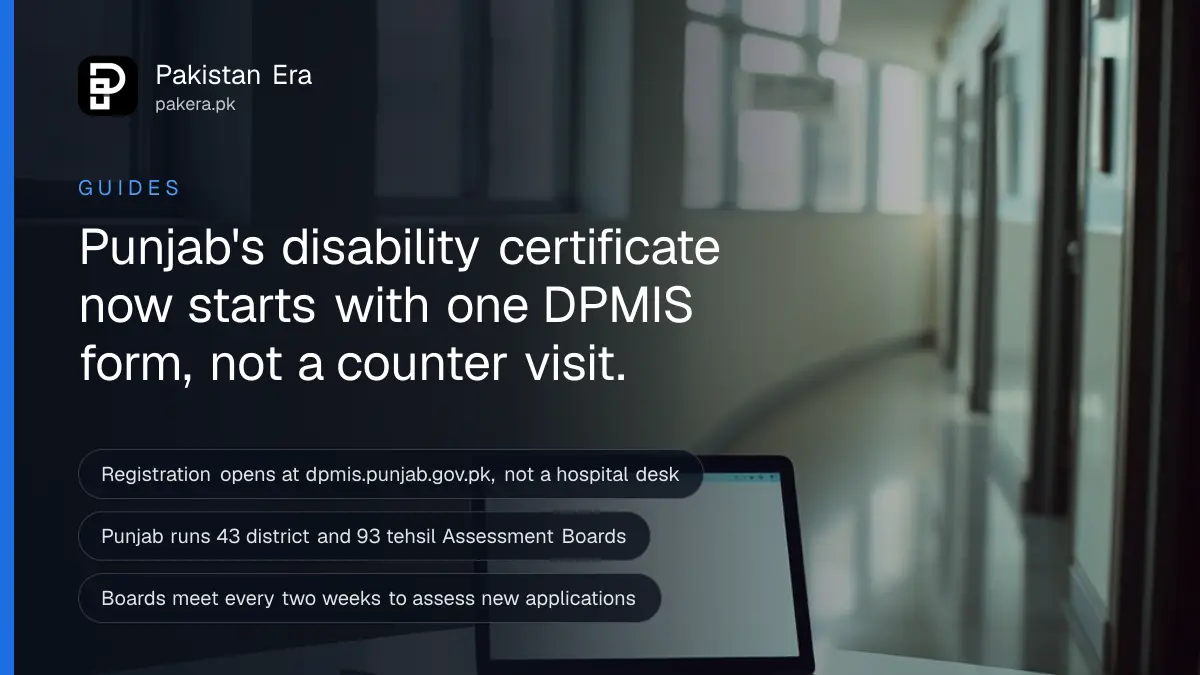
Punjab now starts the disability certificate online. Go to dpmis.punjab.gov.pk/register, pick CNIC or CRMS, choose a Medical Board near you, and the system books you into an Assessment Board. The certificate itself is still handed out in person, after that board sees you.
We checked the Punjab Social Welfare Department's own page on disability assessment and the DPMIS registration form directly on 4 October 2026. The department runs 43 District Assessment Boards and 93 Tehsil Assessment Boards across the province, and every one of them sits inside a DHQ or THQ hospital. That network is bigger than most people expect, and it is the reason the online form exists: too many applicants were showing up at the wrong counter.
Punjab's disability certificate now starts online, not at a hospital desk
You no longer walk into a Social Welfare office cold. You register first on the Disabled Persons Management Information System, known as DPMIS, and the system schedules your Assessment Board appointment from there. The certificate is only issued after that in-person visit.
This is a change from how the process used to run, and it is also the gap in a lot of guidance still floating around. Older advice skips the portal entirely and sends people straight to a Social Welfare counter, where staff now point them back to DPMIS anyway. Starting at dpmis.punjab.gov.pk/register saves that extra trip.
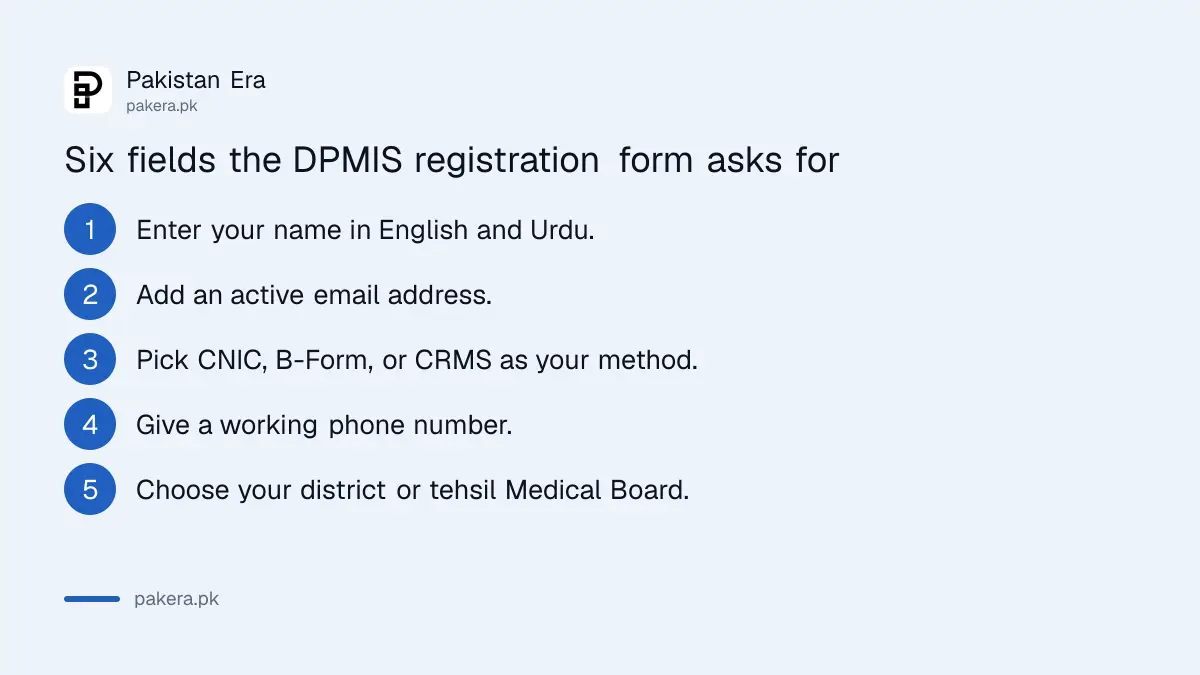
The DPMIS form asks for six things, and two of them shape everything after
Open the registration page and you will see a short form, not a long one. We read through it directly rather than guessing at the fields.
- Your name, entered in both English and Urdu.
- An active email address.
- Your registration method: CNIC or B-Form for most adults, or CRMS, which is your birth certificate number, for a child who has not yet got a CNIC or B-Form.
- A working phone number, since updates and the tracking link go there.
- Your Medical Board, chosen by province, division, district, and the specific board name.
- A password, confirmed, plus a CAPTCHA check before submission.
The method you pick in step three and the board you pick in step five are the two that matter most. Get the method wrong and the system cannot match your record later. Pick a board far from where you actually live, and you are the one who has to travel for the assessment.
Picking the right Medical Board decides how soon the Assessment Board sees you
Forty three District Boards and ninety three Tehsil Boards sounds like plenty of choice, and it mostly is. Pick the board attached to your own district's DHQ hospital, or your tehsil's THQ hospital, rather than a bigger one further away. Distance is the only thing you control here.
These boards meet on a fortnightly basis, so roughly every two weeks, according to the department's own page. That is not a fixed date the portal shows you in advance. It is the rhythm the boards work to, and it is the reason a registration submitted right after a board sitting can sit longer than one submitted just before the next one.
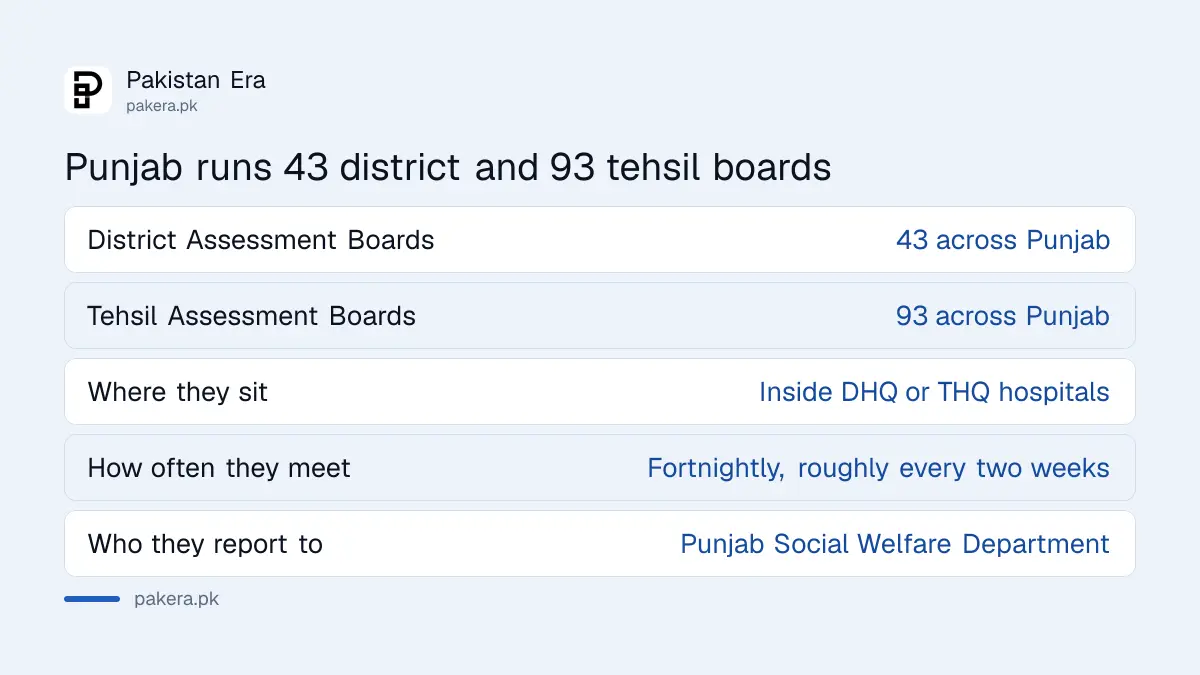
The Assessment Board visit, not the online form, actually issues the certificate
Registration gets you booked. It does not get you the certificate. That still comes from an in-person assessment at the board you chose, inside a DHQ or THQ hospital.
Bring your CNIC, B-Form, or the CRMS reference depending on which method you used to register, plus every medical document you already hold. Discharge slips, test reports, prescriptions, and any earlier assessment from a different hospital all help the board reach a decision in one sitting rather than sending you away for more paperwork.
The board's job is to confirm the type and extent of the disability, and in cases where it finds someone unable to work, it can mark that person as "Not Fit For Work," a classification the Social Welfare Department ties directly to eligibility for financial assistance. This whole structure runs under the Punjab Empowerment of Persons with Disabilities Act 2022, which is the current law the department cites for the Assessment Boards' authority. We could not find a published fee for registration or assessment on either the department's page or the portal itself, so if a district office quotes you one, ask for a receipt and the rule it is charged under.
Tracking your application on DPMIS replaces the old habit of repeat visits
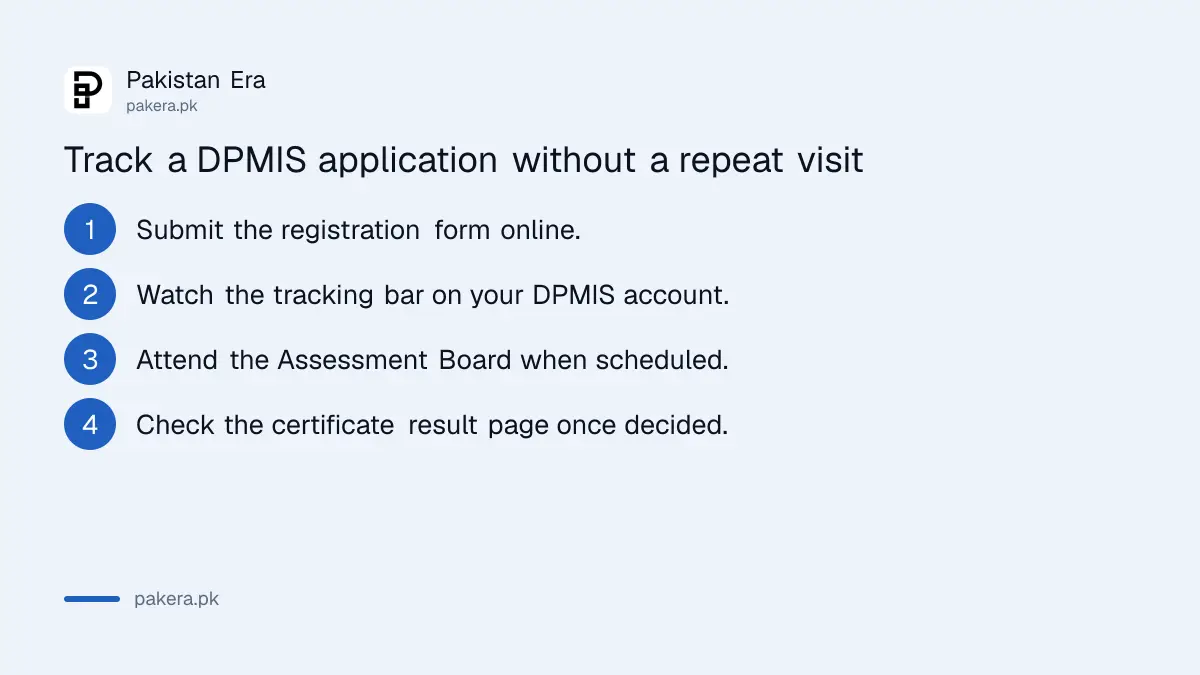
Once you submit, DPMIS shows a tracking bar against your application so you can see where it stands without a phone call or a trip to the office. The portal also has a separate certificate lookup page, so a result can be checked once the board has decided.
That tracking feature is arguably the biggest practical change here. Before DPMIS, confirming anything meant going back in person, often more than once, and often standing in the same queue as new applicants.
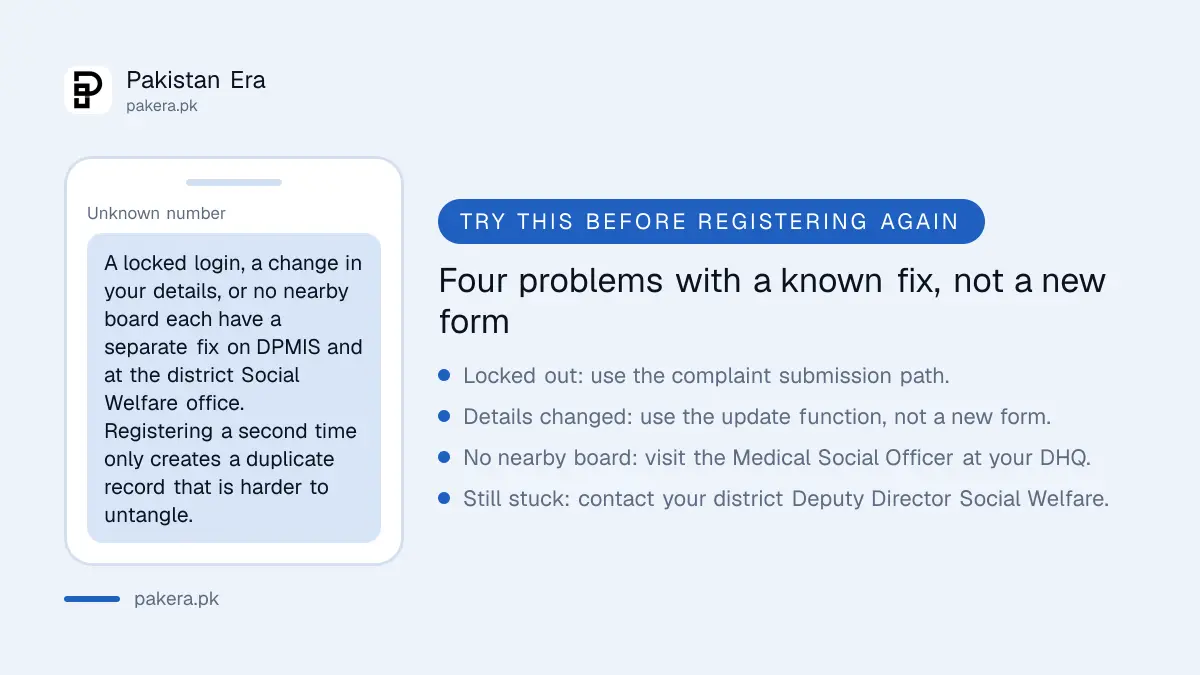
A few problems come up after registration, and each one has a known fix
If you cannot log back in, DPMIS has a complaint submission path built for exactly that, rather than forcing a fresh registration. Use it before you try registering a second time, since a duplicate record is harder to untangle than a login issue.
If your personal details change, your education finishes a stage, or you start a job, the portal has a separate update function for personal, medical, educational, and job information. Keep that current, because the Himmat Card and other benefits tied to your record pull from the same data.
If there is no board close enough to reach easily, the department's own advice is to visit the Medical Social Officer at your district's DHQ or THQ hospital, or contact the Deputy Director of Social Welfare for that district. That contact exists specifically for people the fortnightly schedule and the distance do not work for.
CNIC, B-Form, or CRMS: the registration method that fits you
| Registration method | Who it fits | What you enter |
|---|---|---|
| CNIC | Any adult who already holds one | 13-digit CNIC number |
| B-Form | A minor already registered with NADRA | B-Form number |
| CRMS | A child with only a birth certificate, no CNIC or B-Form yet | Birth certificate reference number |
Once the Punjab certificate is in hand, it is only the first of two documents if you also want a Special CNIC from NADRA. Our guide to getting the Disability Certificate and Special CNIC in order covers that second step, and the Himmat Card application many families apply for alongside it is covered separately in our guide to the Punjab Himmat Card.
The certificate also feeds into entitlements outside DPMIS itself, including the employment quota reserved for persons with disabilities in government and private jobs. None of that is processed on the portal, so treat the certificate as the key that opens those doors rather than the end of the paperwork.
Common questions about Punjab's disability certificate
Do I have to visit an office before registering on DPMIS?
No. Registration happens online first, at dpmis.punjab.gov.pk/register, and the system books your Assessment Board visit from there.
What is CRMS and who needs it instead of a CNIC?
CRMS is a registration route using your birth certificate number. It is for children who have not yet been issued a B-Form or CNIC by NADRA.
How often do Assessment Boards meet?
On a fortnightly basis, roughly every two weeks, according to the Social Welfare Department. The portal does not publish exact future dates in advance.
Is there a fee to register or get assessed?
We found no published fee on the department's page or the DPMIS portal itself. If an office asks you for payment, ask for a written receipt and the rule it is charged under.
What if there is no Assessment Board near where I live?
Visit the Medical Social Officer at your district's DHQ or THQ hospital, or contact the Deputy Director of Social Welfare for your district, which the department lists as the fallback route.
Does this certificate also give me the Special CNIC?
Not automatically. The Special CNIC is a separate document from NADRA, applied for after this certificate, not as part of the DPMIS registration.
How we verified this
What we checked, where we read it, and what we could not confirm.
Last checked on 4 October 2026. We read the Social Welfare Department's disability assessment page at swd.punjab.gov.pk directly, and the registration form at dpmis.punjab.gov.pk/register directly, rather than from search summaries or news reporting. The count of 43 District and 93 Tehsil Assessment Boards, the fortnightly meeting schedule, the "Not Fit For Work" classification, and the citation to the Punjab Empowerment of Persons with Disabilities Act 2022 all come from the department's own page. The registration field list, the tracking bar, the certificate lookup page, and the complaint and data update functions come from the portal itself. No fee is quoted anywhere in this article because none is published at either source. Confirm your own district's board location and any current fee with your Deputy Director of Social Welfare before you travel.
About the author

Tax, Bills and Technology Writer
Ali Akhtar is a young and curious voice here at Pakistan Era. He is currently pursuing his A-Levels and has a growing interest in Pakistan’s changing industrial landscape and educational trends. Ali likes to write in a way that helps him explain and explore the world around him. His writing reflects the perspective of the new generation navigating the evolving trends of Pakistan where technology, youth innovation, and shifting opportunities are reshaping the country’s future.