Get a Writer for a Blind or Disabled Student in FBISE Exams: 45 Extra Minutes and No Extra Fee
How a blind or disabled student gets a writer in FBISE SSC and HSSC exams: who qualifies, the government medical certificate, who may write and extra time.
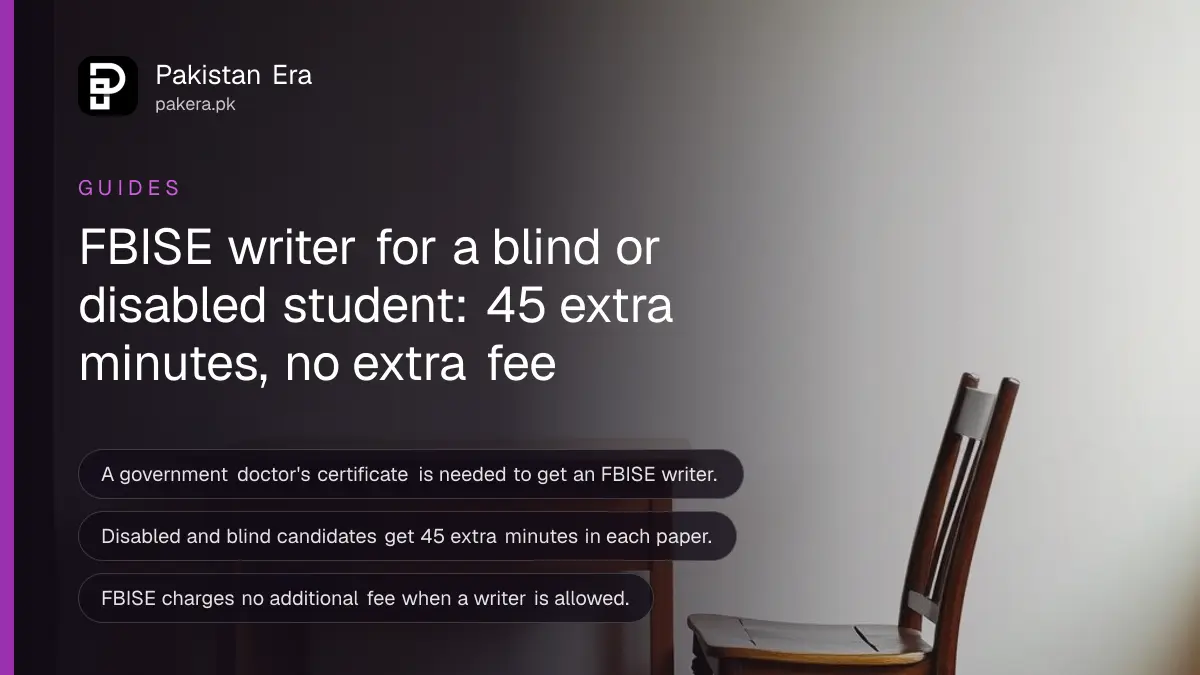
Short answer: A student who is blind, or cannot write with their own hand, can ask FBISE for a writer (amanuensis) in SSC and HSSC exams. The student applies on the board's form with a government medical certificate. The board gives 45 minutes extra, a separate room and charges no extra fee.
A mother in Islamabad has a son with a broken right wrist, three weeks before his matric papers. He knows every answer. He cannot hold a pen. Can someone else write for him? Under the Federal Board's rules, yes, and the rule is clear about who may write and what paper is needed.
We read rules 1.7, 1.8, 1.11 and 1.14 of the FBISE General Rules for Examination on 13 October 2026. This guide covers the Federal Board only. It is written for parents and for schools that prepare the file. It does not replace the board's own form.
Who can get a writer under FBISE rules
Rule 1.7 allows a writer for a blind candidate, and for a candidate who is permanently or temporarily unable to write with their own hand. A temporary injury, such as a broken arm, counts if a doctor certifies it.
The student, or the guardian, applies on the prescribed form. The Controller of Examinations concerned may permit the writer and informs the Superintendent of the exam centre, who arranges everything. Apply early. The board does not promise a decision on the day of the paper.
| Item | FBISE rule |
|---|---|
| Who qualifies | Blind, or unable to write, permanently or for a time |
| Who applies | The student or guardian, on the prescribed form |
| Proof | Medical certificate from a government civil surgeon or specialist |
| Extra time | 45 minutes |
| Extra fee | None |
| Room | Separate room with a special invigilator |
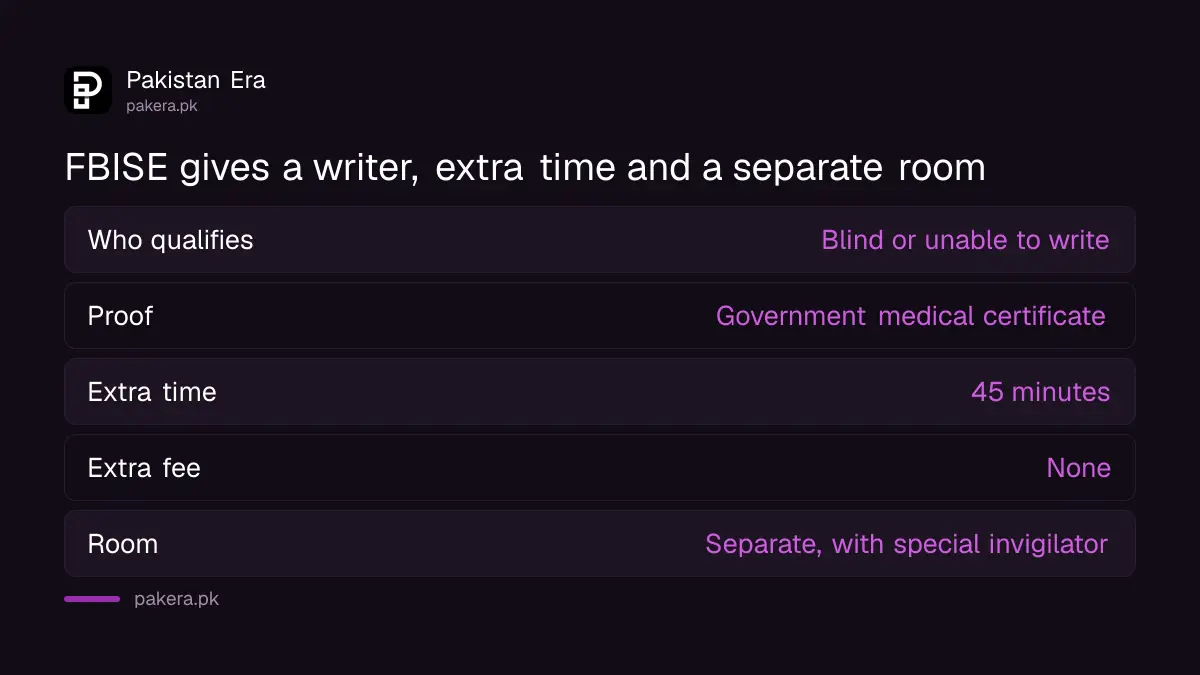
The medical certificate must come from a government source
The certificate must be issued by a civil surgeon or specialist of a government hospital, or by the head of an organisation set up by the government for disabled people. It must say the candidate is disabled, permanently or for a time, and cannot write.
A private clinic note is not what the rule asks for. Ask the doctor to write the diagnosis, the date and the expected recovery time for a temporary injury. Keep two photocopies. The school should attach one copy to the application and keep one in the file.
Choose the writer by the class of the exam
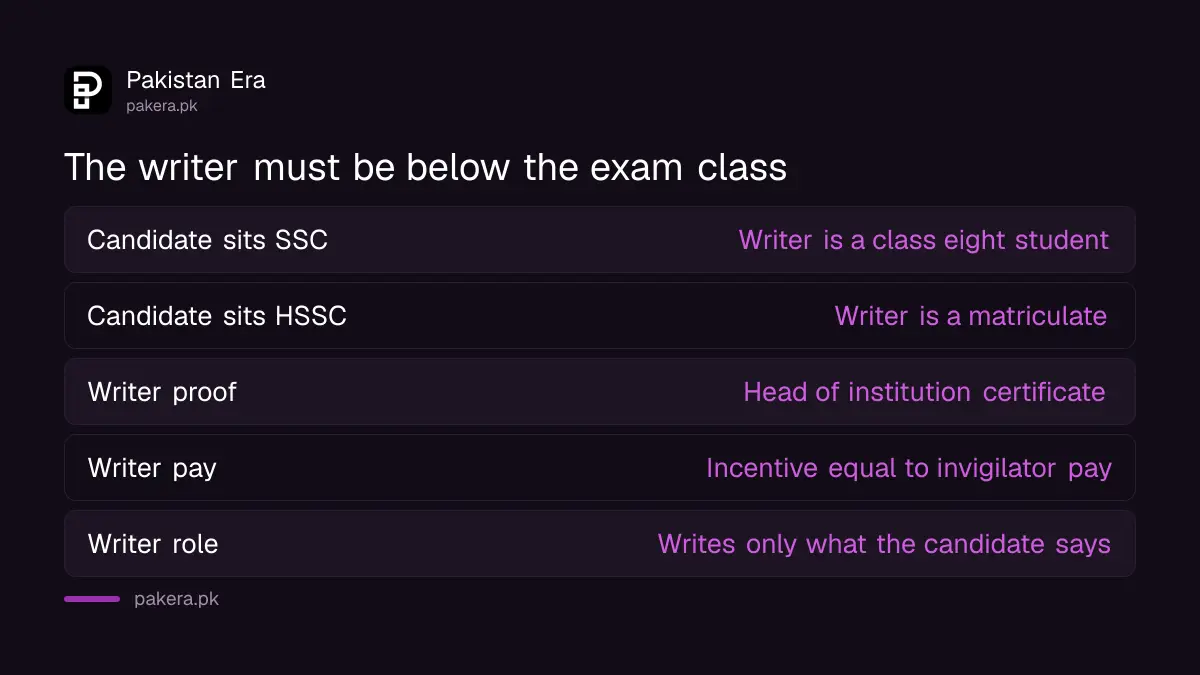
The writer must be a regular student of class eight when the candidate sits SSC, and a matriculate when the candidate sits HSSC. The writer brings a certificate from the head of an institution proving they are a bona fide student.
The rule is meant to keep the writer academically below the candidate, so the writer cannot add to the answers. Do not choose a relative who has passed the same subject at a higher level. The writer writes only what the candidate says.
- Get the government medical certificate.
- Collect the prescribed form from the board or the school.
- Choose a writer who meets the class rule, and get the school certificate.
- Submit the file to the Controller of Examinations well before the first paper.
- Confirm the centre has a separate room and an invigilator.
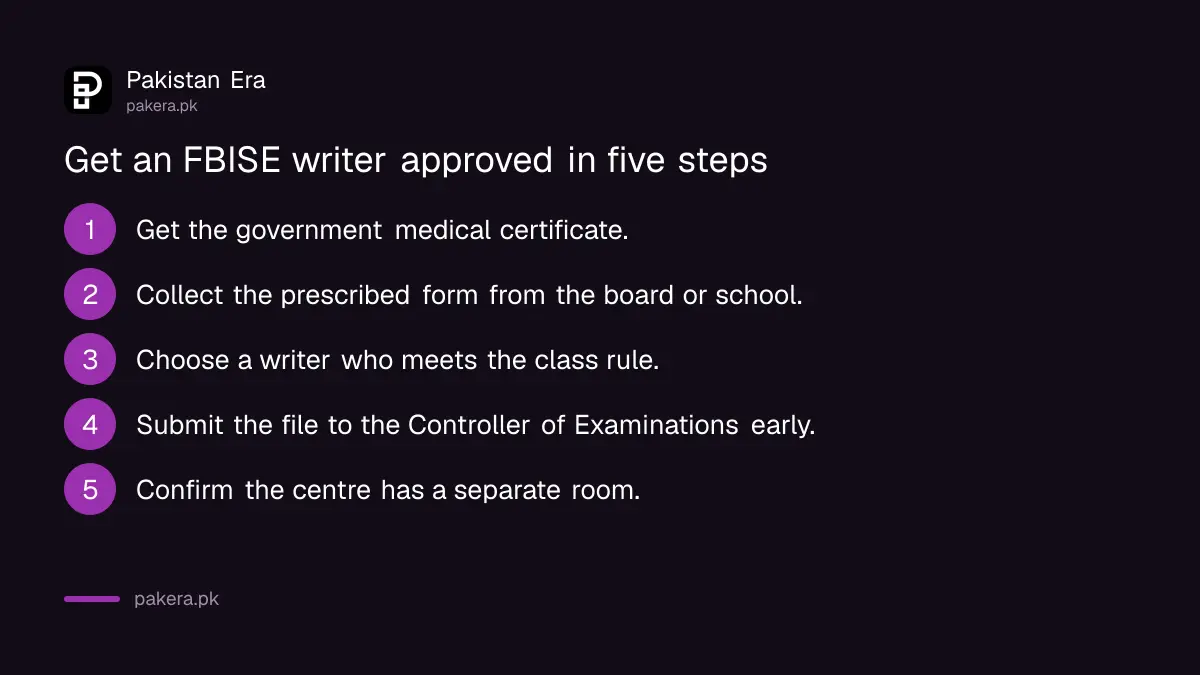
The exam day arrangements are fixed by the board
The centre superintendent arranges a separate room and appoints a special invigilator for the candidate. The candidate gets 45 minutes extra in each paper. No extra fee is charged because a writer was allowed.
The board does not pay the writer. It gives the writer an incentive per paper equal to the pay of an invigilator. The rule says both things in separate lines, so ask the board how the incentive is paid. The special invigilator is paid by the board.
A candidate who wants to change the exam centre has a separate rule. Rule 1.8 says a change is allowed only in special cases, such as a transfer of the father or guardian. The application must usually reach the board 30 days before the exam, and the fee is not refunded even if the change is refused. A change inside the same city or twin city is not allowed.
Deaf, mute and blind students have no limit on attempts and pay no fees
Rule 1.11 (e) says special children, meaning physically handicapped, deaf and mute, and blind students, can qualify without any limit on attempts. A medical certificate from a government specialist or civil surgeon is required. They are exempt from every fee payable to the board.
For a student with a temporary injury, the exemption is not described in the rule. Do not assume the fee is waived. Check with the board. For the dates and the forms, see the pages on the FBISE second annual exam and the FBISE class 11 registration.
Families looking for financial help for a student with a disability may also read the page on Bait-ul-Mal education stipends. If a student has a problem with the exam centre itself, see the board's notices in the guide to the matric second annual date sheet.
Common questions
Can a student with a broken arm get a writer?
Yes. Rule 1.7 covers a candidate who is temporarily disabled from writing. A government medical certificate is needed.
How much extra time does FBISE give?
It gives 45 extra minutes in each paper to disabled and blind candidates, and to those who use a writer.
Who can be the writer?
A regular class eight student for SSC papers, or a matriculate for HSSC papers, with a certificate from the head of an institution.
Is there an extra fee for a writer?
No. The rule says no additional fee is charged from a candidate who has been allowed a writer.
Which doctor can sign the certificate?
A civil surgeon or specialist of a government hospital, or the head of a government organisation for disabled people.
Do blind students pay exam fees?
No. The rules exempt special children from all fees payable to the board, and they have no limit on attempts.
How we verified this
What we checked, where we read it, and what we could not confirm.
Last checked on 13 October 2026, Pakistan time. We read rules 1.7, 1.8 and 1.11 in the FBISE General Rules for Examination. We did not see the prescribed writer form, so we have not stated its name or its fee, and we do not know the last date for applying in 2026. Contact the board before you file.
About the author

Tax, Bills and Technology Writer
Ali Akhtar is a young and curious voice here at Pakistan Era. He is currently pursuing his A-Levels and has a growing interest in Pakistan’s changing industrial landscape and educational trends. Ali likes to write in a way that helps him explain and explore the world around him. His writing reflects the perspective of the new generation navigating the evolving trends of Pakistan where technology, youth innovation, and shifting opportunities are reshaping the country’s future.