Bait-ul-Mal Education Stipend: Rs 100 at Primary, Up to Rs 30,000 a Year at College
Bait-ul-Mal policy lists Rs 100 a month at primary, Rs 200 at high school and up to Rs 30,000 a year after matric. Board notes raise the cap. See the table.
Short answer: Bait-ul-Mal's policy table pays Rs 100 a month at primary and Rs 200 at high school, and for post-matric study it pays the prescribed fee of a government institution, up to Rs 30,000 a year. Later board decisions in the same document raise the ceiling, so ask your district office which figure applies.
A family looks at a Bait-ul-Mal poster and sees the word "stipend". A father asks the obvious question: how much, and for whom. The website says only that fees are paid directly. The amounts sit in a policy PDF that most applicants never open.
We read the Pakistan Bait-ul-Mal Individual Financial Assistance (IFA) policy PDF on the PBM projects page on 12 October 2026. This article sets out the education table, the later board changes printed under it, and where the numbers do not agree. For documents and the fee-paid-directly rule, see our note on Bait-ul-Mal education stipends and orphan support.
The policy table gives small amounts for school and fees for college
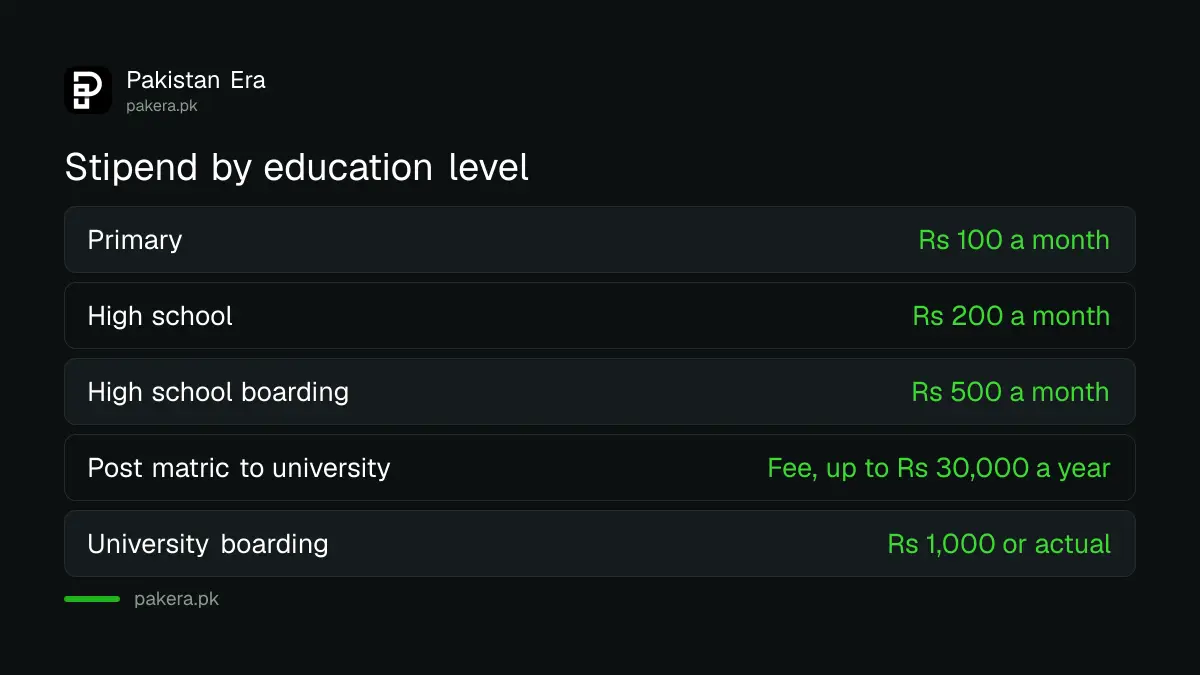
The education table lists a monthly stipend of Rs 100 for primary and Rs 200 for high school, plus boarding of Rs 500 a month at high school. From matric to university it pays the fee a government institution prescribes, with a stated maximum of Rs 30,000 a year including boarding.
| Level | Stipend per month | Boarding per month |
|---|---|---|
| Primary | Rs 100 | None listed |
| High school | Rs 200 | Rs 500 |
| Post matric to university | Prescribed government fee, up to Rs 30,000 a year | Rs 1,000 or actual, whichever is less |
At primary and high school the money goes to the parents and is meant for uniform, books, stationery and tuition fee. For post-matric students it goes to the institution and covers admission, tuition, examination, library and board or university registration fees.
Later board decisions printed under the table change the ceiling
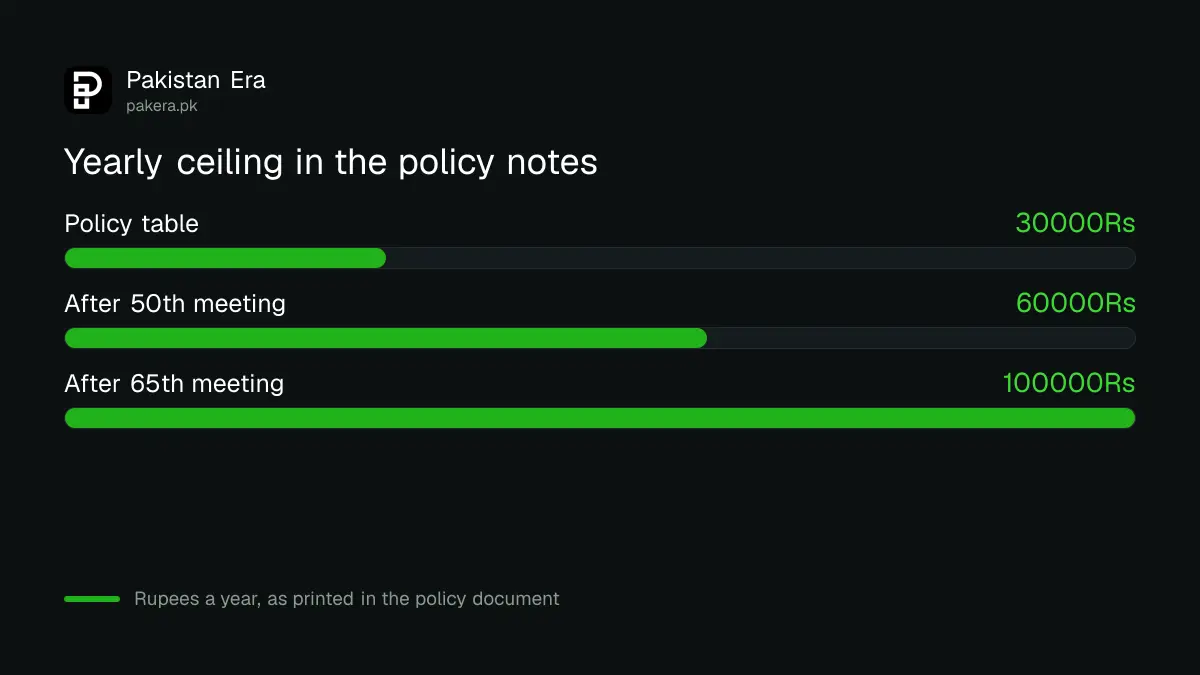
Under the table, the policy prints notes from board meetings. They raise the yearly ceiling in steps, and the last one reads "one lac per student". So the top figure in the same document runs from Rs 30,000 to Rs 100,000 depending on which line you read.
| Board meeting | Decision recorded |
|---|---|
| 49th, April 2008 | Boarding raised from Rs 1,000 to Rs 1,500 a month, transport and other charges allowed |
| 50th, August 2008 | Ceiling raised from Rs 30,000 to Rs 60,000 a year |
| 51st, January 2009 | M.Phil and PhD students included, up to Rs 100,000 |
| 52nd, January 2010 | Managing Director's power raised from Rs 60,000 to Rs 100,000 |
| 65th, September 2019 | Limit changed from one lac per family to one lac per student a year |
The body text still says M.Phil and PhD students are not eligible, while a footnote from 2009 says they are included. A policy that carries both lines has not been fully rewritten. We would treat the 2019 note as the latest, but we cannot say which number a district officer will use.
One payment a year, at the start of the session
The policy says deserving students are paid once a year when the new academic session starts, for both annual and semester systems. The amount in a year should not exceed the ceiling. An older line allowed two members of one family at a time, within the family cap.
The same note says the initial admission fee will be repaid to the student if the student already paid it. That is useful for a family that had to borrow to pay the first fee. Keep the fee receipt and the challan in a safe place.
Orphans may fit better under the Orphan and Widow Support Programme, which pays Rs 8,000 a month per orphan child on the PBM site. Payment under this stream is by crossed cheque. For the school levels it is in favour of the parents, and for post-matric it is in favour of the institution. Cheques can be handed to the student in person in exceptional cases, on a case-by-case basis.
Eligibility follows the same income and exclusion rules as other IFA streams
The education stream is for poor and deserving students in government institutions. The PBM website bars government employees and their families, and applicants who receive similar help from another government body. It adds that self-financed and private institute students are not eligible.
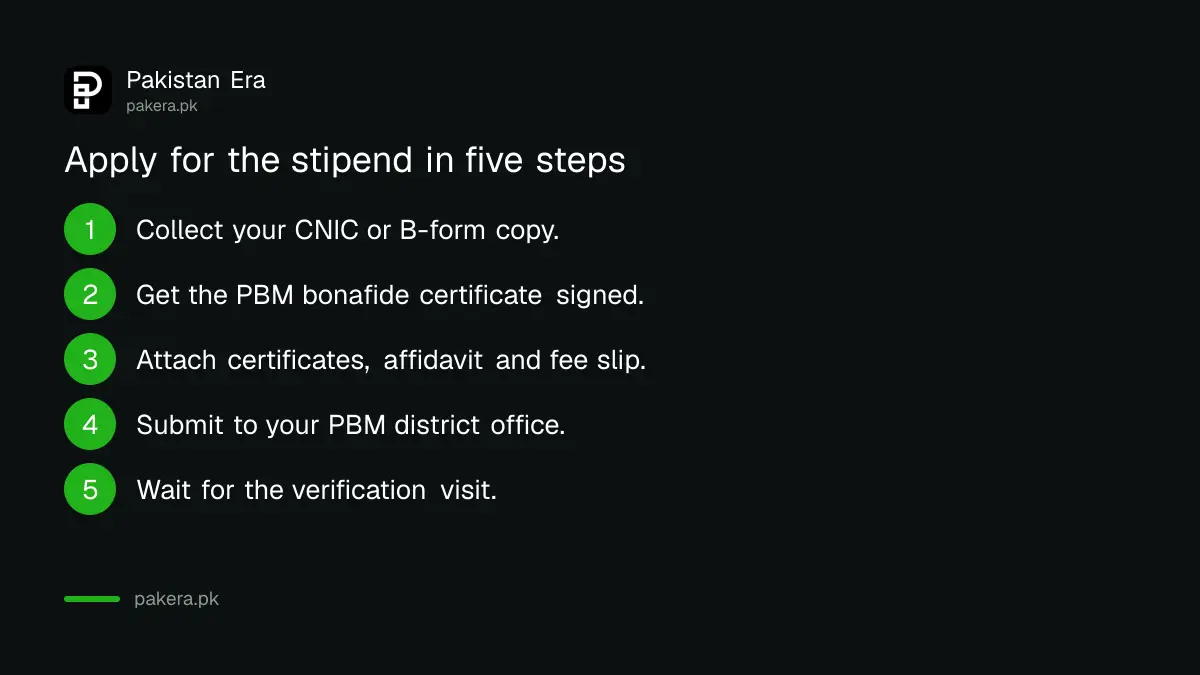
- Get an application with your address, thumb signature, and CNIC or B-form for under 18s.
- Get a bonafide certificate in PBM's format, signed by the head of your institution.
- Attach copies of your certificates and results.
- Attach an affidavit from your parents and the fee slip or fee structure.
- Submit to your PBM district office and wait for the verification visit.
The poverty line the policy gives for medical and education stipends is Rs 6,000 a month, later raised by board decisions to Rs 17,500. The PBM website says Rs 74,000. We cannot reconcile the two, and the website is the newer source.
Ask the district office three questions before you apply
Because the policy and the website disagree, three questions save a wasted trip. Ask what the current yearly ceiling is for your level, whether the payment is made to you or to the institution, and what the current monthly income limit is.
Ask for the answers in writing, or write them down with the officer's name and the date. If the office quotes the old Rs 100 and Rs 200 stipends for school levels, ask whether a newer decision has changed them.
The contact details on PBM's contact page are the helpline 0800-66666 and the email address info@pbm.gov.pk. Do not pay anybody to submit the form. The policy lists no fee, and the application can be received from any source.
Common questions
How much is the Bait-ul-Mal education stipend?
The policy table lists Rs 100 a month at primary and Rs 200 at high school, and up to Rs 30,000 a year for post-matric study, with later board decisions raising the ceiling.
Who receives the money?
Parents receive it for primary and high school expenses. For post-matric students it is paid to the institution.
Can an M.Phil or PhD student apply?
The policy contradicts itself. The body says no, and a 2009 board note says they are included up to Rs 100,000. Ask the office.
How often is it paid?
Once a year, at the start of the academic session.
Do private institute students qualify?
No. The PBM website says students of self-financed or private institutes are not eligible.
How we verified this
What we checked, where we read it, and what we could not confirm.
We read the Individual Financial Assistance policy PDF and the education programme text on the Pakistan Bait-ul-Mal projects page on 12 October 2026. The policy carries board notes between 2008 and 2020, and the website carries a different income limit. Confirm the current ceiling at your district office before you apply.
About the author

Public Services and Education Journalist
Fajr Riaz is a journalist and content writer at Pakistan Era, based in Lahore. She covers the questions people meet in everyday life in Pakistan: how a public service works, what a change in the rules means, and where to find a reliable answer.