Disability Rights in Balochistan: 5% Job Quota, 50% Fee Relaxation and Other Rights Under the 2017 Act
Balochistan's 2017 disability law sets a 5% government job quota, 5% admissions, 50% off higher education fees and private care. See how to claim each right.
Under the Balochistan Persons with Disabilities Act, 2017, the provincial government must reserve 5% of government jobs and 5% of seats in schools, colleges and universities for persons with disabilities. Private hospitals must charge disabled patients 50% less, higher education institutions must give a 50% fee relaxation, and housing schemes need a 5% quota at half price. These are rights in the law. Whether your office or college applies them yet is a separate question, and this guide shows how to ask.
Balochistan replaced the old federal Disabled Persons Ordinance of 1981 with its own law in June 2017. We read the full Act on the Balochistan Code on 20 October 2026. It is longer and more detailed than the 1981 rules it replaced, which set a one per cent job quota.
Below are the figures in the Act, who must provide them, and what to do when an office says no.
The Act sets five headline numbers
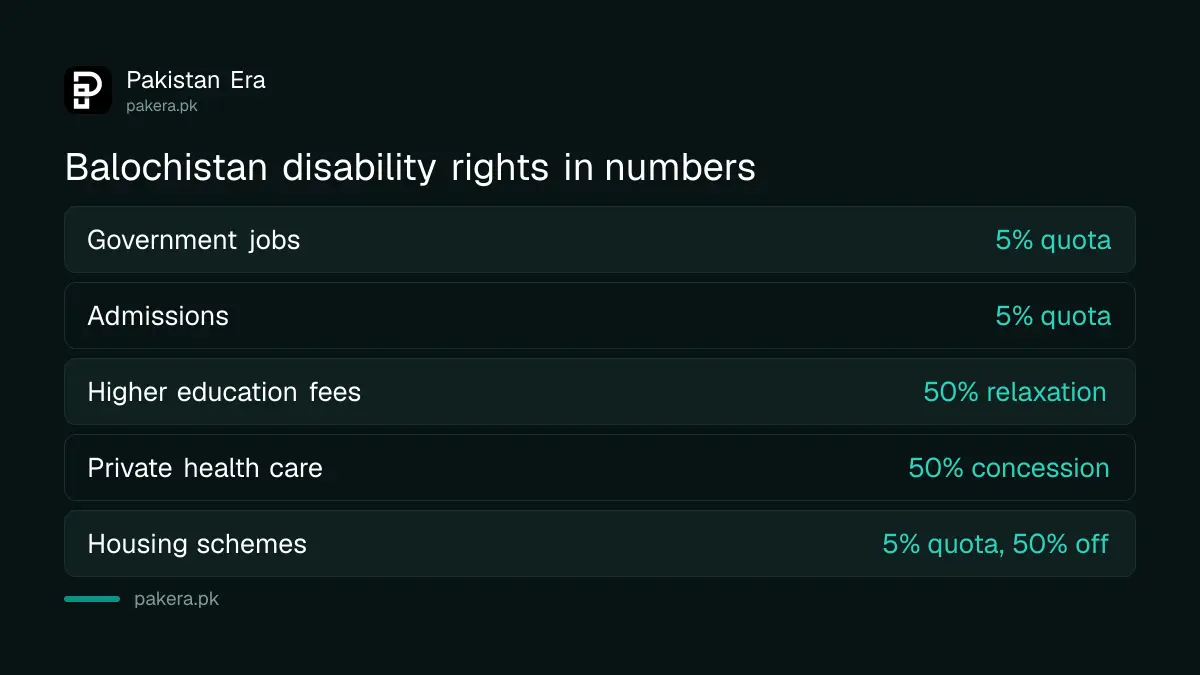
The 2017 Act puts figures on jobs, admissions, fees, private medical care and housing. These are the parts you can quote to an office in writing, with the section number, when you ask for your right.
| Right | What the Act says | Section |
|---|---|---|
| Government jobs | 5% quota at various levels in departments, institutions and government-owned companies | 10(3) |
| Admissions | 5% quota in all public and private educational institutions, with up to 5 years' age relaxation if needed | 9(5) |
| Higher education fees | 50% fee relaxation in public and private institutions | 9(2) |
| Private health care | Private providers to charge 50% concessional rates | 11(3) |
| Housing | Policy for a 5% quota with 50% concession on cost, on easy instalments, for those who own no property | 13(2) |
Free education comes first. Section 9(2) says the government shall provide free education under Article 25-A of the Constitution, which covers children aged 5 to 16. The 50% fee relaxation then applies to higher education, in public and private institutions alike.
Employers who skip the quota must pay double
Section 10(6) is the part with teeth. An establishment, public or private, that does not employ persons with disabilities as required must pay into the rehabilitation fund twice the salary or minimum wage it would have paid a disabled employee, every month.
The Act also bans discrimination in hiring, promotion and career growth. Section 10(5) says a disabled employee's terms cannot be less favourable than those of others in the same post. Section 10(2) makes the employer provide reasonable accommodation, meaning the aids and equipment you reasonably need to do the job.
Be careful with one detail. The double payment sentence refers to "section 4 (sub-section 4) of this section", which reads like a drafting slip. The 5% quota itself is clear only for government offices. For private employers, the Act asks the government to encourage hiring through incentives. So quote the quota to government offices, and quote the anti-discrimination rule to private ones.
For how quotas work in the other provinces, where the figures differ, see the disabled persons employment quota. The Punjab figure there is not the Balochistan figure.
Everyday rights in transport, parking and safety
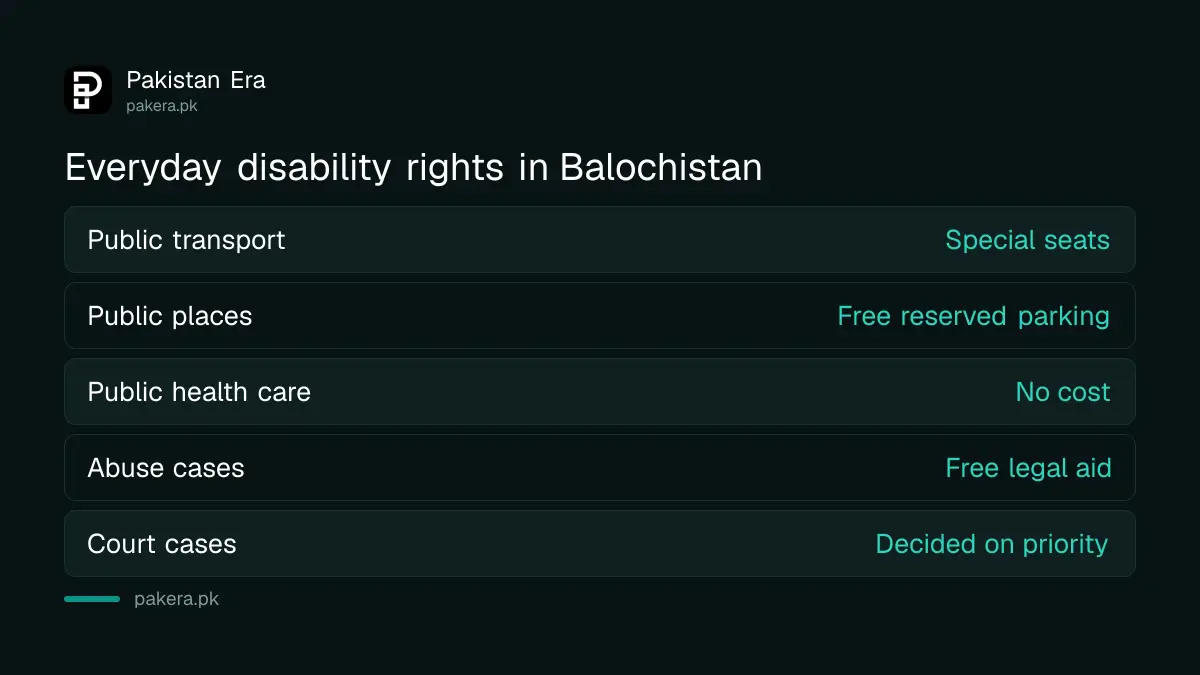
The Act is not only about jobs. Section 7 requires special seats on all public transport and free reserved parking nearest the entrance at public places. Section 8 treats violence against a disabled person as more serious and promises free legal aid when needed.
- Buildings and roads: old buildings and vehicles are to be modified and new ones built to accessibility standards, under section 7(1).
- Transport and parking: special seats in all means of transport, and parking reserved free of cost, under section 7(5).
- Safe place: no cost may be charged for lodging an abused disabled person in a safe place, under section 8(2).
- Health: barrier free public health services at no cost to the person, under section 11(1).
- Assistive devices: free or subsidised aids, and tax exemption on importing wheelchairs and adapted vehicles, under section 12.
- Courts: cases involving disabled persons to be decided on priority, under section 17(2), with special disability courts under section 28.
For a wheelchair or hearing aid when you cannot pay, the federal Bait-ul-Mal assistive device scheme covers Balochistan residents too.
How to claim a right under the Act
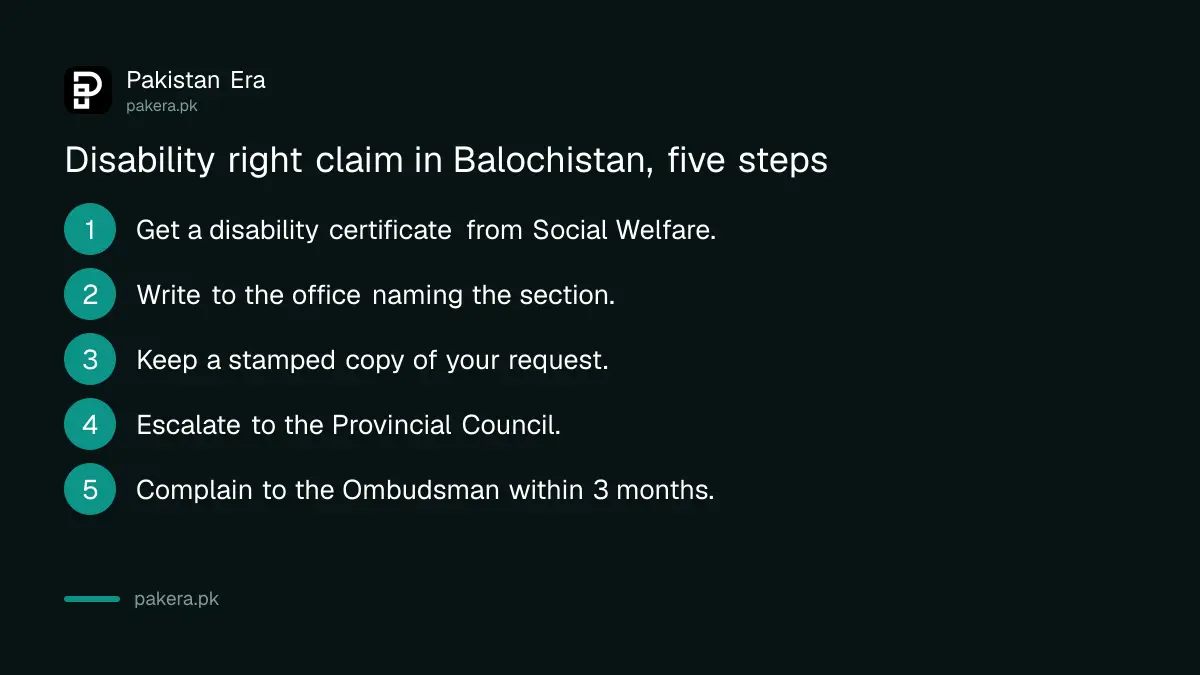
Start with proof of disability, then ask in writing and quote the section. Most offices refuse informally. A written request that cites the Act forces a written answer, and a written refusal is something you can take further.
- Get a disability certificate from your district Social Welfare office and, if you can, a special CNIC with the disability logo from NADRA.
- Write to the head of the office, college or hospital, naming the right and the section number.
- Attach copies of your certificate and CNIC, and keep a copy with the receipt stamp.
- If there is no answer or a refusal, write to the Provincial Council for the Rights of Persons with Disabilities through the Social Welfare Department.
- If a provincial office still refuses, complain to the Balochistan Ombudsman within three months.
- For violence or abuse, go to the police and ask for free legal aid under section 8(4).
The Council is the body the Act puts in charge. Section 21 renames the old provincial rehabilitation council as the Provincial Council for the Rights of Persons with Disabilities, chaired by the Social Welfare Minister. A provincial office that ignores you can be taken to the Balochistan Ombudsman.
What the Act does not tell you
The Act sets rights but leaves the details to rules and notifications. It does not set a fee for a disability certificate, name the medical board, or say how the housing quota will be run. We could not find published rules under section 29 on the Balochistan Code.
So expect gaps. A college may not have a 5% seat list ready. A housing scheme may say no policy exists yet. When that happens, ask the office to put its answer in writing. A written "we have no notification" helps the Council and the Ombudsman more than a verbal refusal.
The Act covers the whole province except the former tribal areas, as section 1(2) puts it. Federal benefits, such as BISP Kafaalat's higher cut-off for disabled persons, apply on top of these provincial rights.
Common questions
What is the government job quota for disabled persons in Balochistan?
Five per cent, at various levels in government departments, institutions and government-owned companies, under section 10(3) of the 2017 Act.
Do disabled students get a fee concession in Balochistan?
Yes. The Act gives a 50% fee relaxation in public and private higher education institutions, and a 5% admission quota with up to five years' age relaxation.
Do private hospitals have to give a discount?
Section 11(3) says private health service providers shall provide services to persons with disabilities at 50% concessional rates.
Does the old 1981 Ordinance still apply in Balochistan?
No. Section 31 repealed the Disabled Persons (Employment and Rehabilitation) Ordinance, 1981 for Balochistan. Cases already pending under it continue under the old law.
Who enforces the Act?
The Provincial Council for the Rights of Persons with Disabilities, chaired by the Social Welfare Minister, with special disability courts for speedy cases.
Where do I get a disability certificate in Balochistan?
From your district Social Welfare office. The Act does not set the process, so ask the office for its current form and medical board date.
How we verified this
What we checked, where we read it, and what we could not confirm.
We read the Balochistan Persons with Disabilities Act, 2017 (Balochistan Act II of 2017) in full on the Balochistan Code on 20 October 2026. The Act was passed on 20 May 2017 and published on 8 June 2017. We could not find rules or notifications under it, the certificate procedure, or any figures on how many quota posts have been filled. Ask your district Social Welfare office for the current process before you apply.
About the author
Public Services and Education Journalist
Fajr Riaz is a journalist and content writer at Pakistan Era, based in Lahore. She covers the questions people meet in everyday life in Pakistan: how a public service works, what a change in the rules means, and where to find a reliable answer.