Check the BISP Kafaalat Cut-Off Score: 32, or 37 With a Disabled Family Member
BISP decides Kafaalat eligibility with a 0 to 100 poverty score. The cut-off on its page is 32, and 37 with a disabled member. See how to check and fix yours.
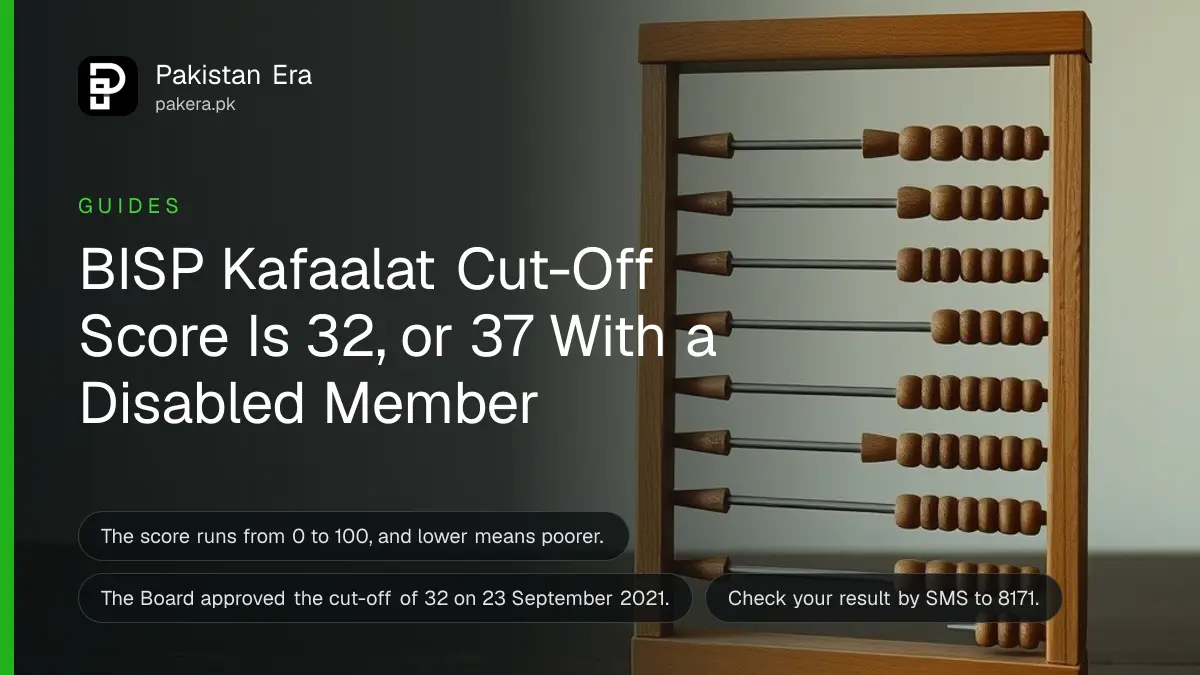
BISP decides Benazir Kafaalat eligibility with a Proxy Means Test score from 0 to 100. A household qualifies if its score falls at or under the cut-off. The cut-off on BISP's page is 32, and 37 for a household with a differently abled person. You cannot see your score yourself, but you can check the result on 8171.
Many families hear "your score is too high" and have no idea what the number means. We read BISP's own Benazir Kafaalat page on 14 October 2026 to set out what the score is, who decides the cut-off, and what you can do if you think your survey is wrong.
The Proxy Means Test scores a household from 0 to 100
The Proxy Means Test, or PMT, is a scoring method. It estimates how poor a household is from survey answers, not from income papers. BISP says welfare status runs on a scale from 0 to 100. A lower score means a poorer household.
The answers come from the National Socio-Economic Registry, called NSER. A surveyor visits, or you go to a Benazir registration desk, and your answers about the home, assets and members go into the registry. BISP then calculates the score from those answers.
The word "proxy" matters. BISP does not check your bank statement. It uses signs of poverty, such as what you own and how many people live in the house, to estimate your level.
The cut-off is 32, or 37 with a disabled member
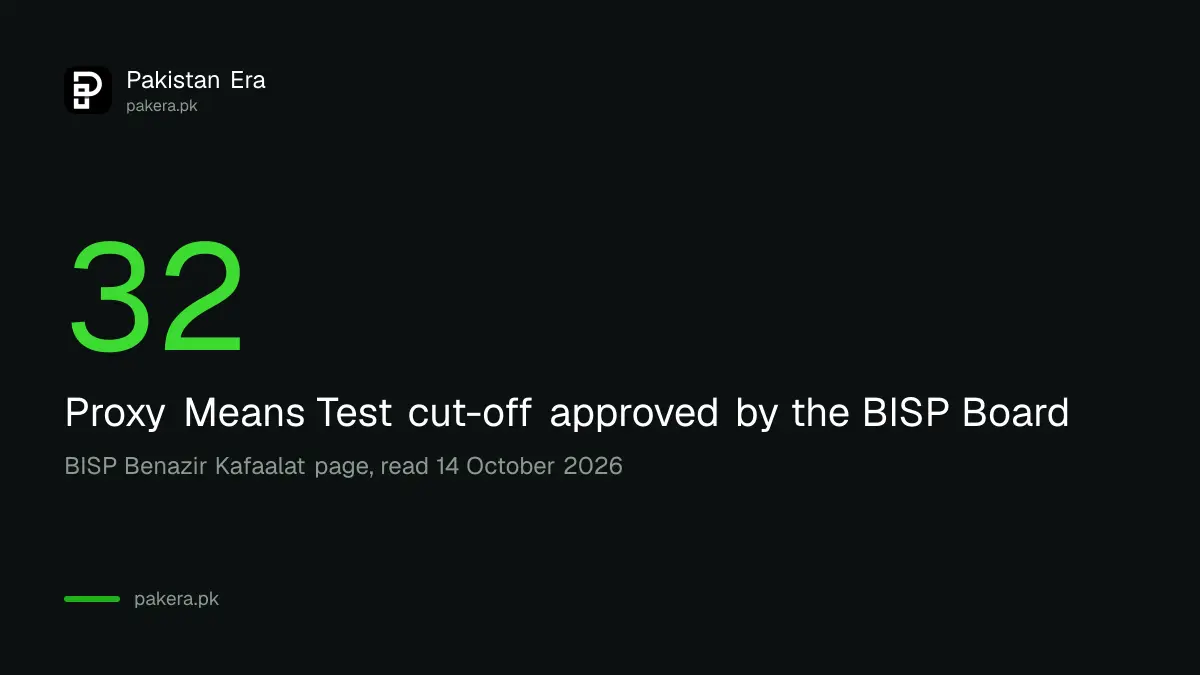
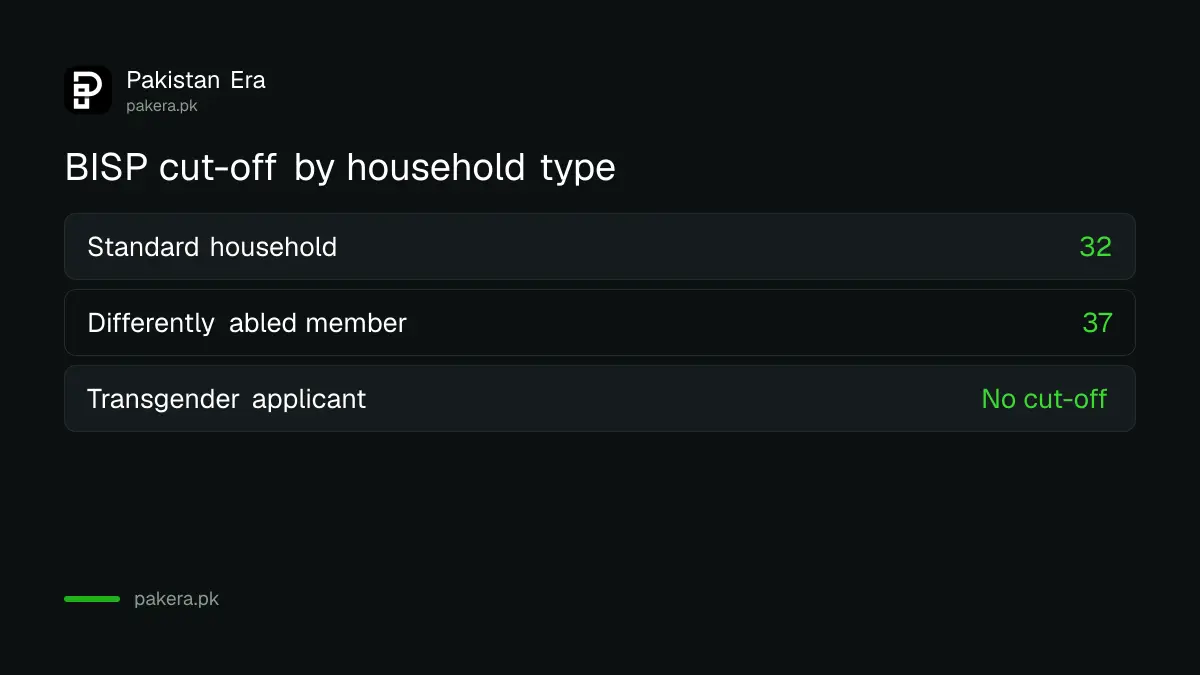
BISP's page says the current cut-off is 32, approved by the BISP Board on 23 September 2021 at its 52nd meeting. For families with a differently abled person, the cut-off is 37. A household at or under the number qualifies.
| Household type | PMT cut-off score |
|---|---|
| Standard household | 32 |
| Household with a differently abled person | 37 |
| Transgender person | No cut-off, survey must succeed |
Think of it like a school pass mark where lower is better. A household scoring 30 passes. A household scoring 34 fails, unless it has a disabled member, where 37 is the line. The page does not say whether the score must be "at or under" or "under" the number. It says households "falling within" the cut-off. We read that as at or under, but we could not confirm the edge case.
BISP's page dates the cut-off to 2021. The Board can change it, so ask 8171 or your tehsil office whether it is still current. This is a point where the page may lag the latest decision.
The Board sets the cut-off from available money
BISP says the Board decides the cut-off "on the basis of available fiscal space". In plain words, the cut-off depends on how much money the government has. A bigger budget can lift the number and let more families in. A smaller budget can lower it.
That is why your score can stay the same while your result changes. Your household did not change, but the line did. BISP does not publish a household's score, so families cannot tell which case they are in.
We have not found a notice of a new cut-off after the 2021 decision on BISP's pages. The payment amount is a separate question. For the figures in circulation, see how much the BISP Kafaalat payment is.
Check your result on 8171, then fix the survey if needed
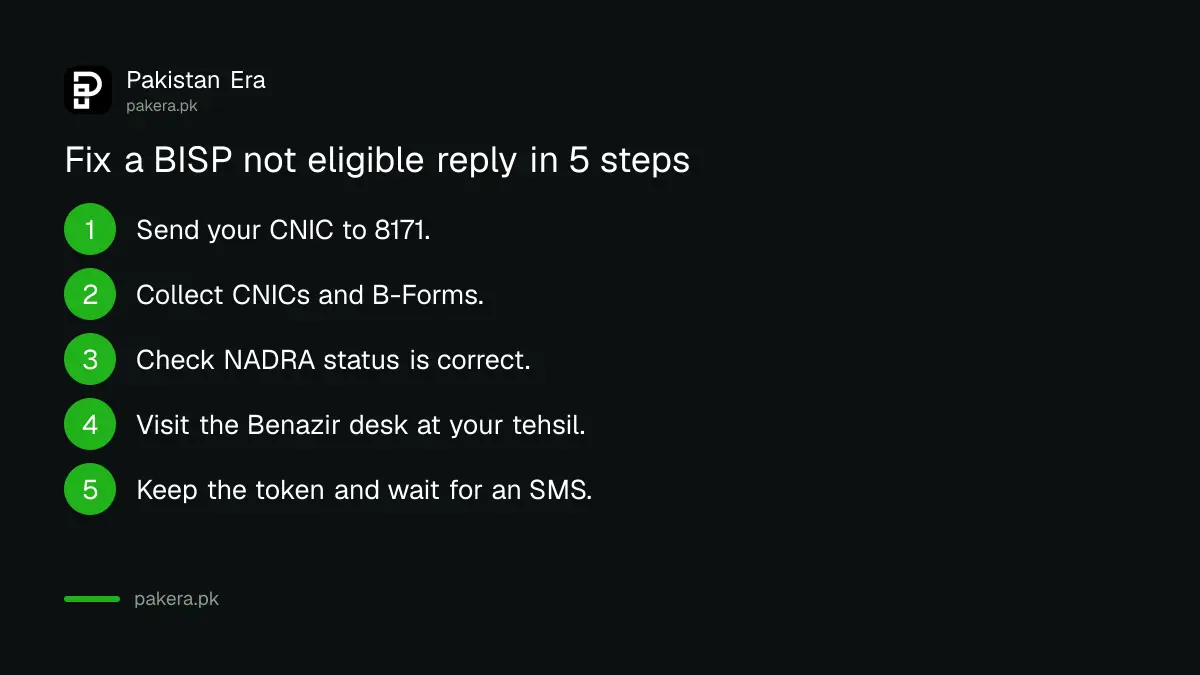
You check eligibility by sending your CNIC number as an SMS to 8171, or on the 8171 web portal. If the answer is not eligible, the survey may be old or wrong. Update it at the Benazir registration desk in your tehsil.
- Send your CNIC number to 8171 and read the reply.
- If the reply says not eligible, collect the CNICs of all adults and the B-Forms of all children.
- Make sure NADRA records show the right marital status, widow status or disability.
- Visit the Benazir registration desk at your BISP Tehsil Office and answer the survey truthfully.
- Keep the token receipt and wait for a confirmation SMS from 8171.
The full walk through is in our guide to updating your NSER survey, and the SMS and portal checks are covered in how to check your BISP payment and eligibility on 8171. If you add a disabled member to the survey, a NADRA special CNIC can help, as set out in how to get a disability certificate and special CNIC.
Common questions about the BISP cut-off score
What is the BISP cut-off score?
BISP's page gives a PMT cut-off of 32 for a standard household and 37 for a household with a differently abled person. The Board approved the figure of 32 on 23 September 2021.
Can I see my own PMT score?
BISP does not publish household scores on the pages we read. You can only see the result, eligible or not eligible, by SMS to 8171 or on the 8171 portal.
Why was my family eligible before and not now?
The Board can move the cut-off, and a new survey can change your score. BISP ties the cut-off to available government money. Ask your tehsil office whether a new survey or a new cut-off applies.
Does a disabled family member help my score?
Yes, on BISP's page. A household with a differently abled person qualifies at a score up to 37, not 32. Make sure the disability is recorded accurately in the survey and on NADRA records.
Does a transgender person need to meet the cut-off?
No. BISP's page says the cut-off is relaxed for transgender applicants whose survey is successful. They still need a CNIC that records transgender as the gender and a survey at a Benazir Registration Centre.
Who is paid in an eligible household?
BISP's leaflet says the payee is an ever-married woman with a valid CNIC who clears profiling. The household can be eligible while that step is still pending.
How we verified this
What we checked, where we read it, and what we could not confirm.
Last checked 14 October 2026. The score scale, both cut-offs, the Board date and the fiscal space rule come from the Benazir Kafaalat page on bisp.gov.pk. The payee rule and the SMS check come from BISP's Kafaalat registration leaflet. We could not confirm whether a newer cut-off has replaced the 2021 figure. We did not test the 8171 service.
About the author

Senior Writer, Public Services and Technology
Shahid joined us in 2024 as an author. He is a senior contributor to Pakistan's leading technology websites. He writes detailed articles, mostly covering his expertise in the latest tech, mobiles, apps, gadgets, and step-by-step guides. His ideology is to help people understand the latest trends and explain complex methods through very easy-to-understand guides.