BISP Ever-Married Condition Removed for Kafaalat: What Changes for Unmarried Women in Pakistan
BISP told the First Lady on 29 October 2026 it has removed the ever-married condition for Kafaalat. See who may gain, what is still missing and what to do now.
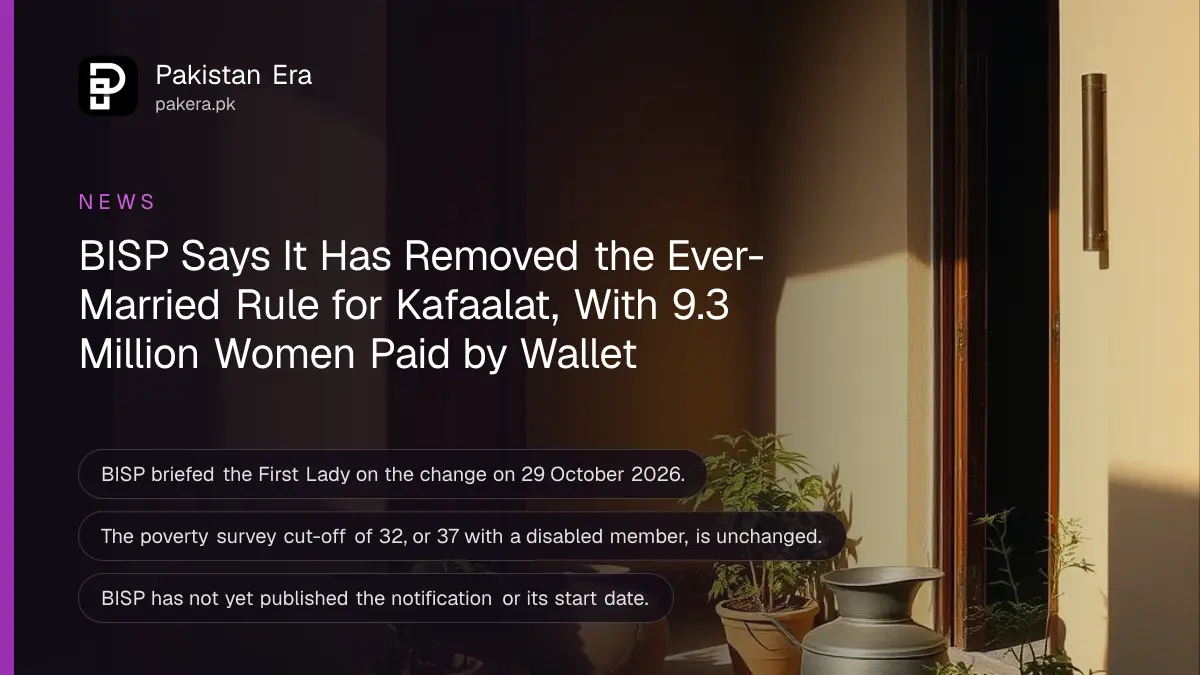
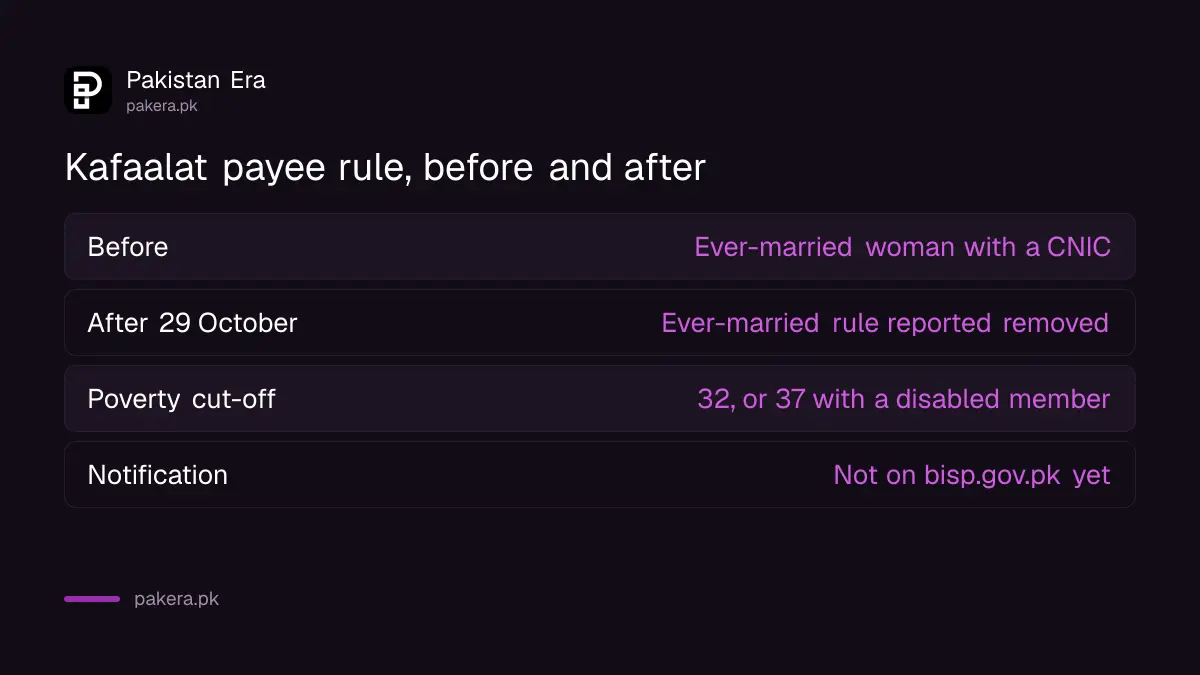
BISP told the First Lady on 29 October 2026 that it has removed the "ever-married" condition, the old rule that only a woman who is or has been married can be the Kafaalat payee. The same briefing said 9.7 million Benazir SIMs are active and 9.3 million beneficiaries have already been paid through digital wallets. BISP has not yet published the rule change itself, so read on for what is confirmed, what is not, and what an unmarried woman should do now.
The news came in a Press Information Department release dated 29 October 2026. First Lady Bibi Asifa Bhutto Zardari visited BISP headquarters in Islamabad and was briefed by Chairperson Senator Rubina Khalid and Secretary Amer Ali Ahmad. We read the release on 31 October 2026.
BISP says the ever-married condition for Kafaalat has been removed
The government release says the removal of the ever-married condition was highlighted as a step to reach women who were left out before. It does not give the date the change took effect, the new wording of the rule, or how existing families will be handled.
Until now, BISP's own leaflets said the payee in an eligible household had to be an ever-married woman with a valid CNIC. That shut out unmarried adult women who head a household, for example a daughter caring for old parents, or an orphaned elder sister. Several of our guides, including the one on how to update your NSER survey at a tehsil desk, still describe the old rule, and we have added a note to them.
We checked the Kafaalat page and the 2026 press release list on bisp.gov.pk on 31 October 2026. Neither carries the change yet. The newest press release on that list is dated 14 September 2026.
Unmarried women who head a household are the ones who may gain
The change matters most for an unmarried adult woman in a poor household with no married woman in it. If the rule is applied as described, she could be named the payee instead of the family being left out.
It does not change the poverty test. A household still needs a survey score at or below the cut-off, which is 32, or 37 where a family member has a disability, as set out in our explainer on the Kafaalat cut-off score. The survey still decides who is poor enough. The married status only decided who in that family receives the money.
| Question | Before | After the 29 October briefing |
|---|---|---|
| Who can be the payee | An ever-married woman with a valid CNIC | Reported to no longer need to be ever-married |
| Poverty test | PMT score of 32, or 37 with a disabled member | No change announced |
| Quarterly amount | Rs 14,500, as reported | No change announced in the release |
| Written notification | Leaflets and survey sheets | Not published on bisp.gov.pk by 31 October |
The Rs 14,500 figure is the quarterly Kafaalat payment as reported, covered in our page on how much BISP pays. It is reported rather than confirmed here because the Kafaalat page on bisp.gov.pk still shows an older Rs 8,500. The 29 October release did not mention the amount at all.
9.7 million Benazir SIMs are active and 9.3 million women have been paid by wallet
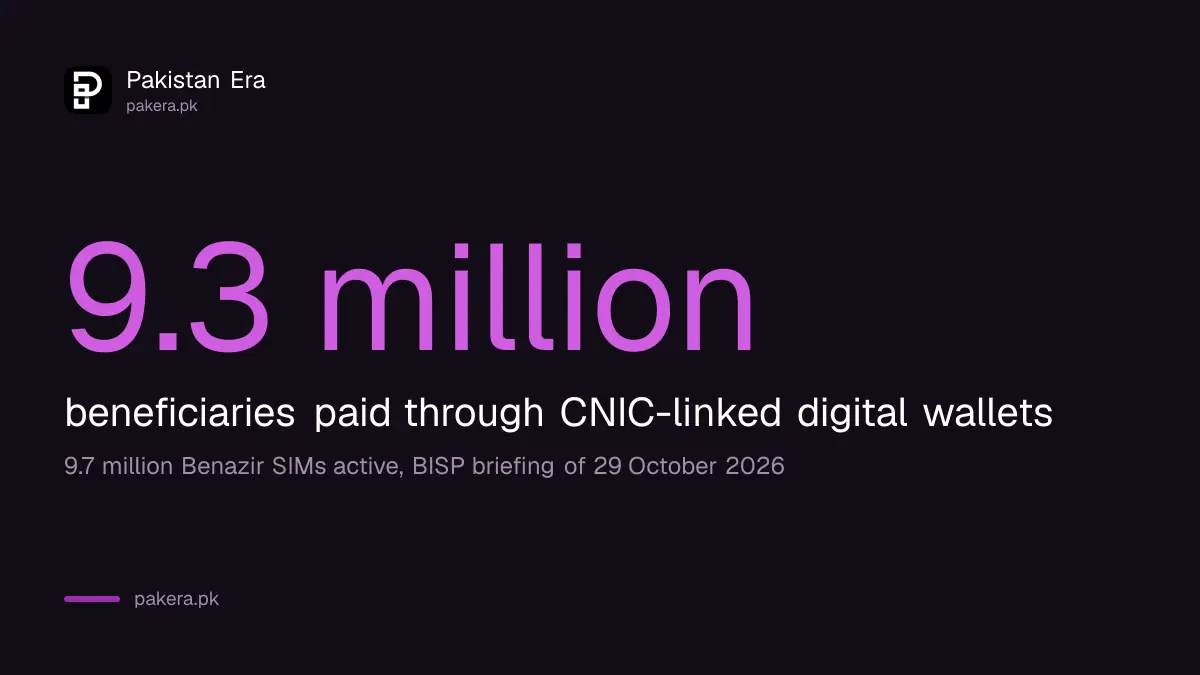
The Secretary told the meeting that 9.7 million SIMs have been activated under the Social Protection Wallet and 9.3 million beneficiaries have made transactions through wallets linked to their CNIC. Payments use a fingerprint check and a second verification step.
That leaves a gap of about 400,000 women. That is our own arithmetic: 9.7 million active SIMs minus 9.3 million who have transacted. Some may simply not have withdrawn yet. Others may have a SIM problem. If you are one of them, the steps in our guide to the BISP digital wallet and Benazir SIM cover how to withdraw and what to do when the wallet will not open.
The briefing also gave figures on skills training and jobs
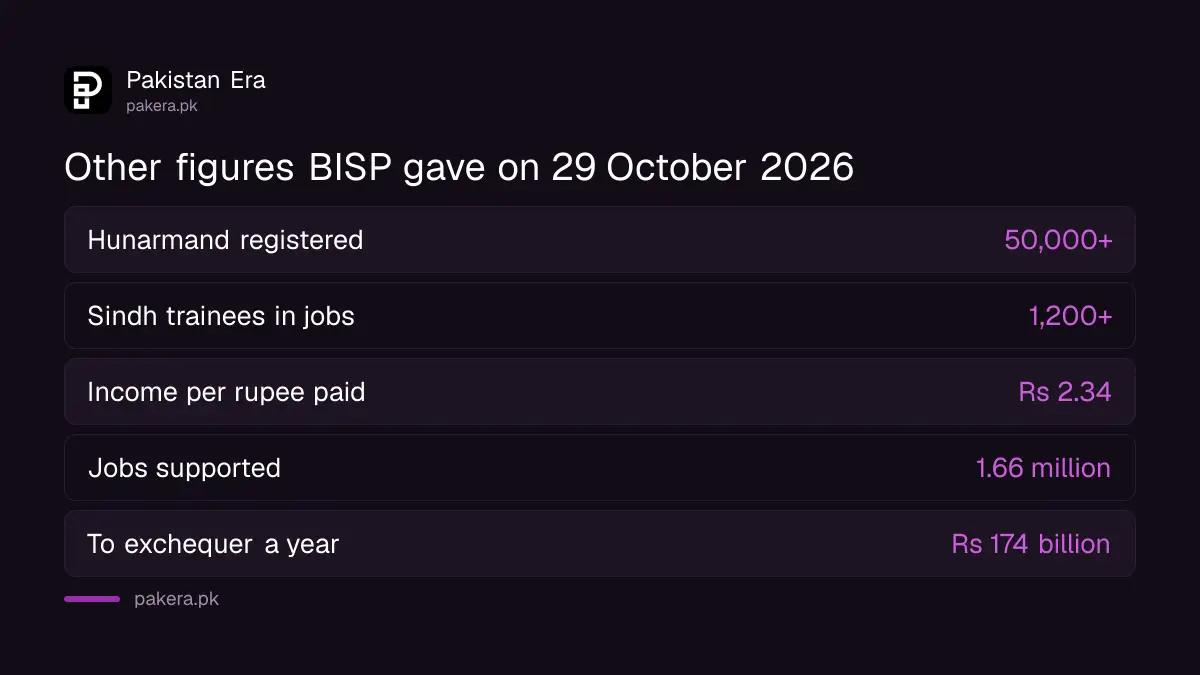
BISP said more than 50,000 people have registered for the Benazir Hunarmand Programme. In Sindh, more than 5,000 people were trained with the provincial government's help and over 1,200 found jobs. A World Bank study was cited for the economic effect.
- Benazir Hunarmand Programme: more than 50,000 registered for training in IT, healthcare, hospitality and construction.
- Sindh training with the Benazir Bhutto Shaheed Human Resource Research and Development Board: more than 5,000 trained, over 1,200 in jobs.
- World Bank study cited: each rupee paid out creates an estimated Rs 2.34 in real income.
- About 1.66 million full-time equivalent jobs supported, two thirds of them in rural areas.
- About Rs 174 billion a year estimated to reach the national exchequer through the economic activity.
If you want the free training, the registration steps are in our guide to the Benazir Hunarmand Programme. The First Lady also inspected a BISP mobile registration van, the kind used to survey families in remote areas.
An unmarried woman should not pay anyone to "register" her
Nothing has to be bought or paid for. BISP registration and surveys are free at the tehsil office. Wait for BISP's own instructions, and treat any agent or caller who asks for money or your PIN as a fraud.
- Check your household's status on the 8171 web portal at 8171.bisp.gov.pk, which asks for your CNIC, mobile number and a picture code, or by SMS to 8171.
- If the reply says not eligible, ask at your BISP tehsil office whether the survey can be updated.
- Take your own CNIC and the CNICs and B-Forms of everyone who lives in the house.
- Ask the officer directly whether an unmarried woman can now be recorded as the payee.
- Keep the token or slip you are given, and note the date and the officer's name.
If anyone demands a fee, use the routes in our guide on how to complain about a BISP payment problem. Messages from numbers other than 8171 that ask you to pay a "registration fee" are scams, whatever logo they carry.
BISP still has to publish the rule, its start date and the process
The release confirms the policy direction but not the details. Until BISP publishes the change, tehsil offices may still be working from the old survey forms, so expect some officers to say they have not received instructions yet.
Three things are still missing. First, the date the condition was removed. Second, whether unmarried women already in surveyed households will be added automatically or must visit an office. Third, whether the change applies only to Kafaalat or also to Taleemi Wazaif and Nashonuma, which are paid to the mother. We will add these when BISP publishes them.
Common questions
Has BISP removed the ever-married condition?
BISP said so in a briefing to the First Lady on 29 October 2026, reported in an official government release. BISP has not yet published the notification on its website.
Can an unmarried woman now get BISP Kafaalat?
If her household passes the poverty survey, the change suggests she can be the payee. The household still needs a PMT score of 32 or less, or 37 with a disabled member.
Has the BISP payment amount changed?
The 29 October release did not mention any change. The quarterly Kafaalat payment is reported at Rs 14,500.
How many women are paid through the Benazir SIM wallet?
BISP said 9.7 million SIMs are active and 9.3 million beneficiaries have transacted through CNIC-linked wallets.
Do I need to pay to register as an unmarried woman?
No. BISP surveys and registration are free at tehsil offices. Report anyone who asks for money to BISP.
Where can I confirm the new rule?
Watch the press release list on bisp.gov.pk and ask at your BISP tehsil office. The 8171 SMS service will show your household status.
How we verified this
What we checked, where we read it, and what we could not confirm.
Last checked 31 October 2026. We read the Press Information Department release of 29 October 2026 on the First Lady's visit to BISP headquarters, which is the source of the ever-married statement and every figure above. On 31 October 2026 we also read the BISP website, its Kafaalat page and its 2026 press release list, none of which yet carries the rule change, and opened the 8171 web portal, which was working. The 400,000 gap is our own arithmetic. We could not confirm the start date of the change, how existing households will be updated, or whether it covers BISP's other programmes, because BISP has not published that detail. We did not visit a tehsil office.
About the author
Public Services and Education Journalist
Fajr Riaz is a journalist and content writer at Pakistan Era, based in Lahore. She covers the questions people meet in everyday life in Pakistan: how a public service works, what a change in the rules means, and where to find a reliable answer.