BISP Adds Unmarried Women Aged 45 and Above to Benazir Kafaalat, Registration Free
Unmarried women aged 45 and above will join BISP's Benazir Kafaalat, the chairperson said on 17 November 2026. The poverty test stays. How to check, register.
یہ صفحہ اردو میں پڑھیں
Short answer: Unmarried women aged 45 and above will be included in the Benazir Kafaalat Programme under a new BISP policy, BISP Chairperson Senator Rubina Khalid said on Tuesday 17 November 2026. The usual eligibility rules still apply, so a woman's household must still pass the poverty survey. Registration and the survey are free.
She made the announcement during a visit to the BISP office and Dynamic Registration Centre in Pattoki, Kasur district. The same day, at a news conference in Lahore, she repeated that no one has to pay for BISP registration, surveys or any related service.
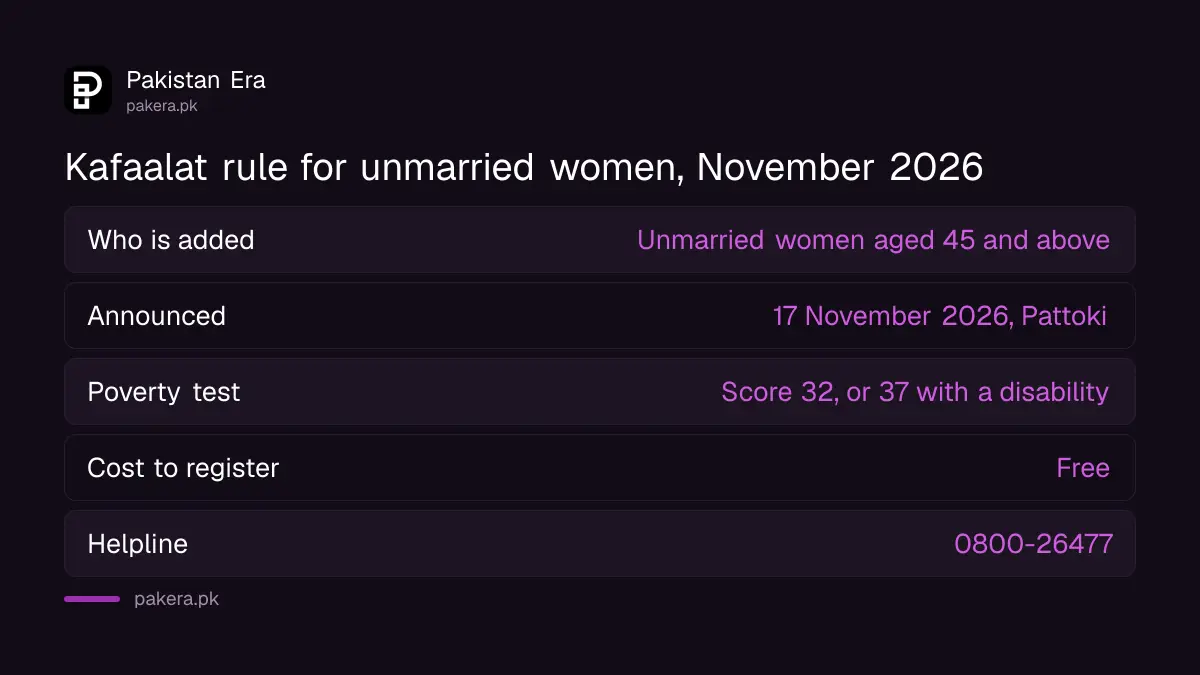
Unmarried women aged 45 and above are being added to Kafaalat
BISP says unmarried women aged 45 or older will now be covered by Benazir Kafaalat, its quarterly cash support for poor families. Until October 2026, the payee in a household had to be a woman who is or has been married. The change is subject to the programme's eligibility criteria.
Benazir Kafaalat is the main cash transfer run by the Benazir Income Support Programme (BISP). The money goes to a woman in each eligible household. In the past, BISP's leaflets said that woman had to be "ever-married", meaning married, widowed or divorced. That left out many single women who head a household, for example a daughter looking after old parents.
On 29 October 2026, BISP told the First Lady in a briefing that the ever-married condition had been removed. The age of 45 is the new detail from 17 November. In June 2026, an earlier briefing to a parliamentary committee was reported to mention unmarried women above 35, so reports on the age limit differ. The chairperson's figure on 17 November is 45.
| Point | What BISP has said |
|---|---|
| Who is added | Unmarried women aged 45 and above |
| Programme | Benazir Kafaalat, quarterly cash support |
| Conditions | Subject to the prescribed eligibility criteria |
| Poverty test | No change announced: survey score of 32, or 37 with a disabled member |
| Cost to register | Free |
| Who announced it | BISP Chairperson Senator Rubina Khalid, 17 November 2026 |
| Written policy on bisp.gov.pk | Not published yet |
The poverty survey still decides who gets paid
Age and marital status only decide who in a family can receive the money. A household still has to qualify through BISP's National Socio-Economic Registry (NSER) survey, which gives each family a poverty score. Families at or below the cut-off qualify.
The NSER is BISP's database of household information. BISP scores each household with a Proxy Means Test (PMT), a formula that uses 43 indicators such as family size, education, jobs, assets, land and health. A score of 32 or below qualifies for Kafaalat. The limit is 37 when a family member has a disability. The Kafaalat cut-off score of 32 or 37 is explained step by step.
BISP also checks the survey answers against other government records, including employment, pension, excise and tax records. So a woman who owns a car, draws a government pension or files a large tax return is unlikely to qualify, whatever her age.
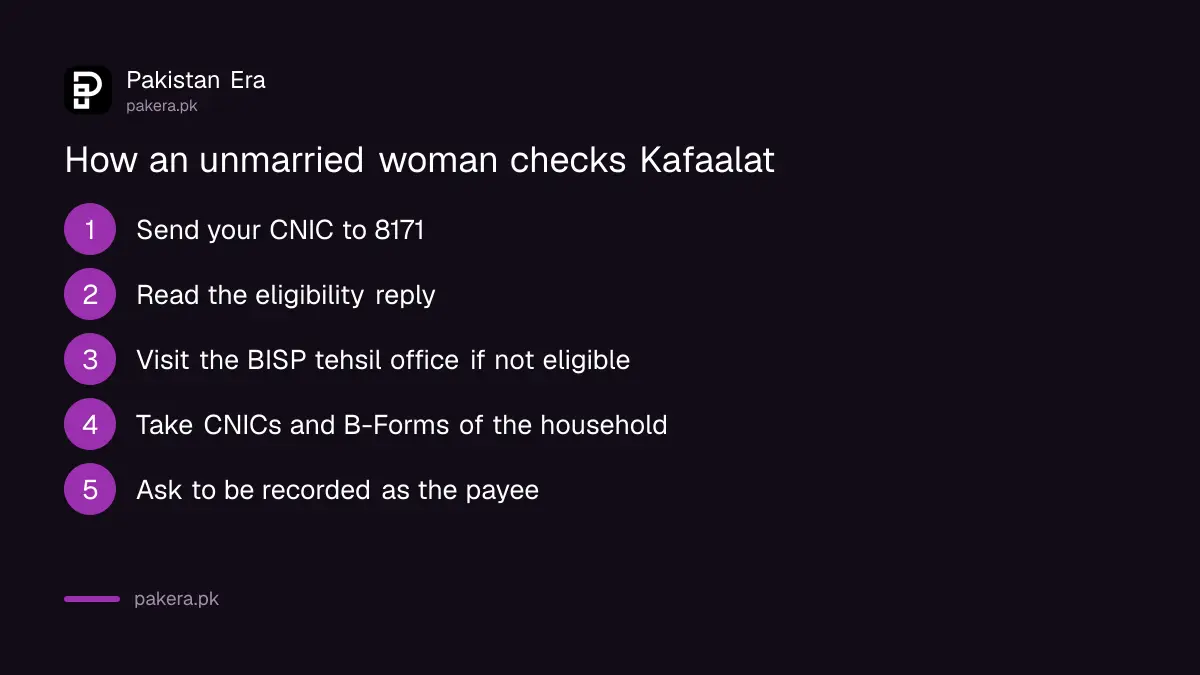
An unmarried woman aged 45 or above can check her status now
She can start by checking her household on the 8171 service with her own CNIC. If the reply says not eligible, or her family has never been surveyed, she should visit the BISP tehsil office or a Dynamic Registration Centre to register or update the survey, free of charge.
- Send your CNIC number by SMS to 8171, or enter it on the 8171 web portal with your mobile number.
- Read the reply. It says whether your household is eligible, not eligible, or not found in the survey.
- If your household is not found or not eligible, go to your BISP tehsil office or Dynamic Registration Centre.
- Take your original CNIC and the CNICs and B-Forms of everyone who lives with you.
- Tell the staff you are unmarried and aged 45 or above, and ask to be recorded as the payee.
- Keep the token or slip you receive, and note the date.
BISP has 647 Dynamic Registration Centres at tehsil level, and its mobile vans visit remote areas. The steps to update your NSER survey at a tehsil desk cover the visit in more detail. Because the written policy is not out yet, some offices may not have received instructions. If an officer says so, ask when the instructions are expected and go back.
BISP registration and surveys are free of charge
The chairperson said registration, surveys and all related BISP services cost nothing. Nobody is allowed to hold back a beneficiary's money. Anyone who asks for a fee, takes a cut from a payment or asks for your phone or Benazir SIM is breaking the rules.
She gave three warnings to beneficiaries in Pattoki:
- Do not hand your mobile phone or Benazir SIM to a retailer or anyone else.
- Keep the SMS your bank sends when money arrives in your wallet and when you withdraw it. These messages are your proof of payment.
- You do not have to withdraw the money at once. It stays in your wallet until you collect it.
Payments now go into digital wallets. She said more than 10 million wallets have been set up for women. They can withdraw seven days a week from authorised retailers of any of six partner institutions: HBL, Bank Alfalah, Bank of Punjab, Habib Microfinance Bank, Easypaisa and JazzCash. Withdrawing is explained in the steps for the BISP digital wallet and Benazir SIM.
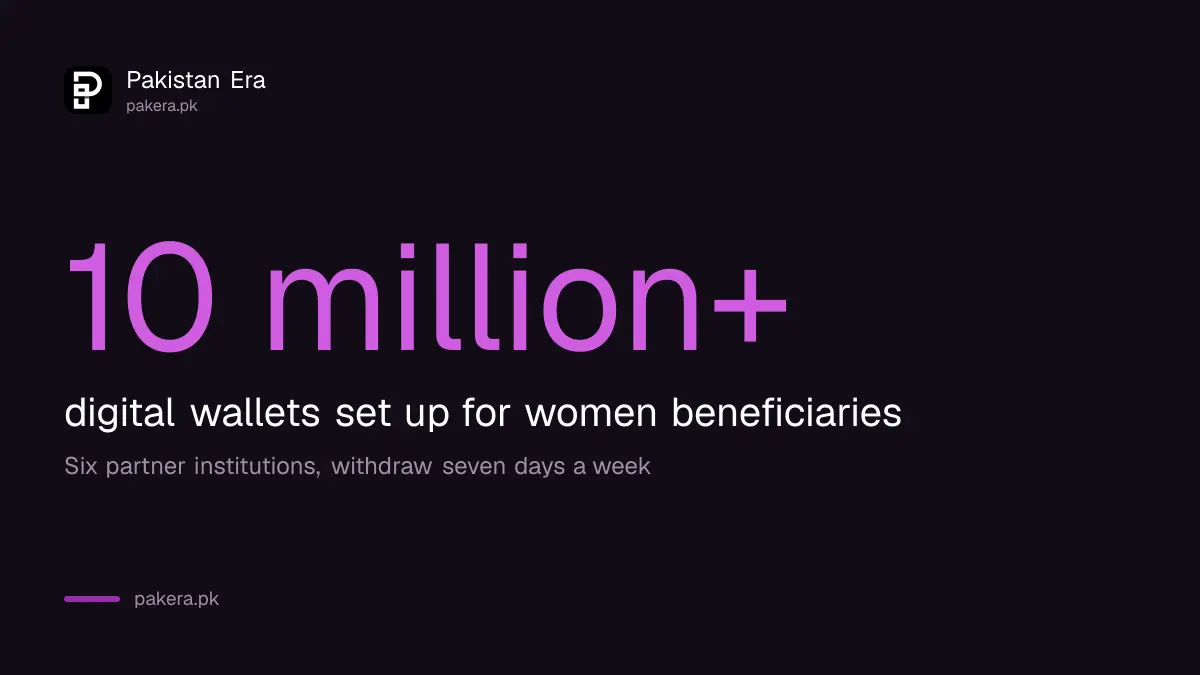
Complaints go to the free helpline 0800-26477
If a retailer cuts money from your payment, or anyone asks for a fee to register you, call the BISP toll-free helpline on 0800-26477. You can also complain in person at your tehsil office. Only messages from 8171 come from BISP.
Every route to complain about a BISP payment problem is listed separately. Fake messages asking for a "registration fee" are common, so learn how to spot BISP fake SMS and calls before you reply to any of them.
BISP still has to publish the written rule
The policy was announced by the chairperson but BISP has not yet published the written notification on its website. Three details are still to come: the start date, whether women already surveyed will be added automatically, and whether the change reaches other BISP programmes.
Taleemi Wazaif, the school stipend, and Nashonuma, the nutrition support for mothers and young children, are both paid to a mother, so they work differently. The quarterly Kafaalat payment is Rs 14,500 under the current schedule, as set out in how much BISP pays. The 17 November announcement did not change the amount.
Common questions
Can an unmarried woman get BISP Kafaalat now?
BISP's chairperson said on 17 November 2026 that unmarried women aged 45 and above will be included under the new policy, subject to the eligibility criteria. Her household must still qualify through the poverty survey.
What is the age limit for unmarried women in BISP?
The chairperson gave 45 years and above on 17 November 2026. An earlier briefing in June 2026 was reported to mention 35, so reports differ. The written policy will settle it.
Does BISP charge a fee to register?
No. Registration, surveys and all related services are free. Report anyone who asks for money to the helpline 0800-26477.
Do I have to withdraw my BISP money at once?
No. The chairperson said beneficiaries can collect their payment when it suits them. Keep the bank SMS as proof.
Where do I register for BISP?
At your BISP tehsil office or Dynamic Registration Centre. Take your CNIC and the CNICs and B-Forms of your household members.
Has the poverty score cut-off changed?
No change was announced. The cut-off stays at 32, or 37 for a family with a person with a disability.
How we verified this
What we checked and where we read it.
We checked this on 18 November 2026. The announcement on unmarried women aged 45 and above, the six partner institutions, the 10 million wallets and the warnings about phones and SIMs come from the state news agency (Associated Press of Pakistan) report of the chairperson's visit to Pattoki on 17 November 2026. The statement that registration and surveys are free comes from Radio Pakistan, 17 November 2026. The cut-off scores, 43 indicators, 647 centres and record checks come from the BISP figures carried by the state news agency on 16 November 2026. We also checked the press releases list on bisp.gov.pk on 18 November; its newest entry is dated 14 September 2026, so the written policy is not there yet.
About the author

Public Services and Education Journalist
Fajr Riaz is a journalist and content writer at Pakistan Era, based in Lahore. She covers the questions people meet in everyday life in Pakistan: how a public service works, what a change in the rules means, and where to find a reliable answer.