BISP Fake SMS and Calls: 8171 Is the Only Official Number, How to Spot and Report Fraud
BISP says 8171 is its only official number and it charges no fee. Check any message against 6 BISP rules, keep your Benazir SIM safe and report fake calls fast.
یہ صفحہ اردو میں پڑھیں
BISP says 8171 is its only official number. A call or message from any other number that asks for a fee, a code, your CNIC photo or your SIM is a fraud. The one real exception is the payment SMS from your partner bank. BISP charges nothing for any scheme, survey or SIM. Report fraud on 0800-26477.
A message arrives: your BISP money is ready, send Rs 500 to release it. It looks official and the amount sounds right. Millions of women on the Benazir Income Support Programme (BISP) are now paid into a phone wallet, and that makes the phone the target.
We read BISP's press releases No. 57, 66, 70 and 71 on 7 November 2026 for BISP's own rules on this. Everything in the checks below follows from those rules. We did not collect or test any fake message ourselves.
8171 is the only official BISP number
BISP's chairperson said on 24 August 2026 that 8171 is the only official BISP number, and told women not to trust or answer messages or calls from any other number. BISP also said it is working with the IT ministry against fraud in its name.
You send your CNIC to 8171 to check eligibility and payment. That route is explained in the BISP 8171 check. Two other numbers exist, and neither one is a texting service:
- 0800-26477 is the BISP helpline. You call it. Nobody should call you from it asking for money.
- The partner bank's SMS sender tells you when money reaches your wallet and when you withdraw it.
So a real BISP message has a narrow shape. It tells you something. It never asks you to pay, to send a code or to hand over a card.
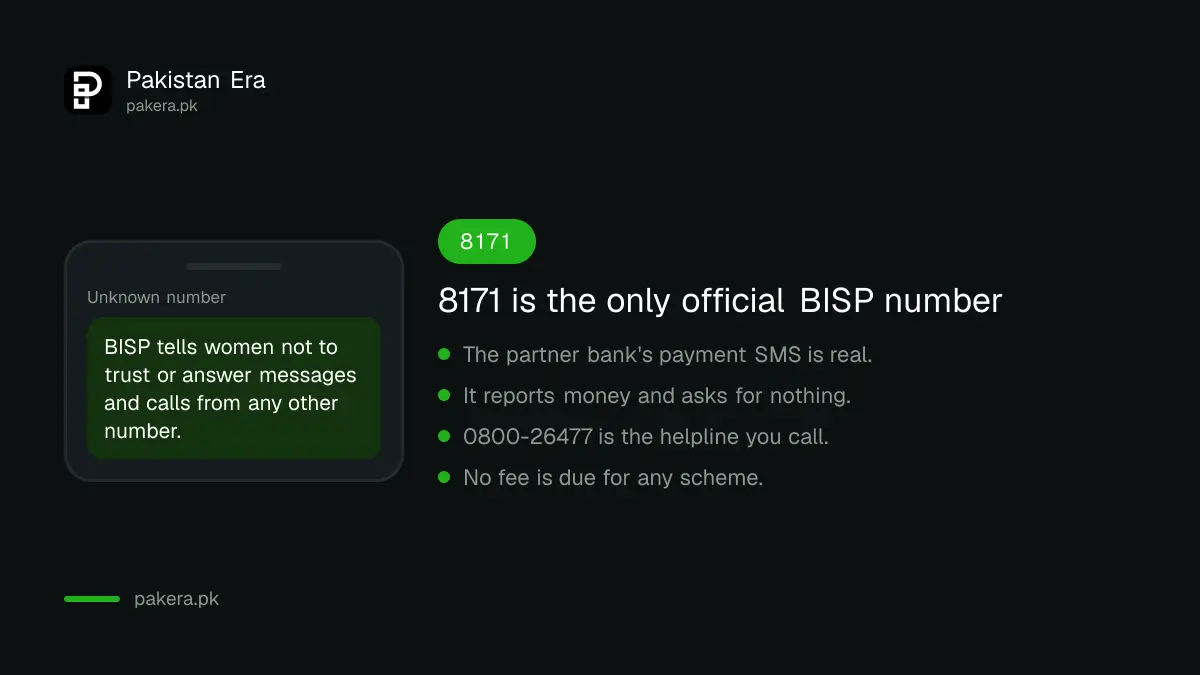
Real BISP messages never ask you for anything
The real bank SMS only reports a credit or a withdrawal, and BISP tells you to keep it as proof. A fake message wants you to do something: pay, send a code, click a link, or meet someone. That one difference catches most frauds.
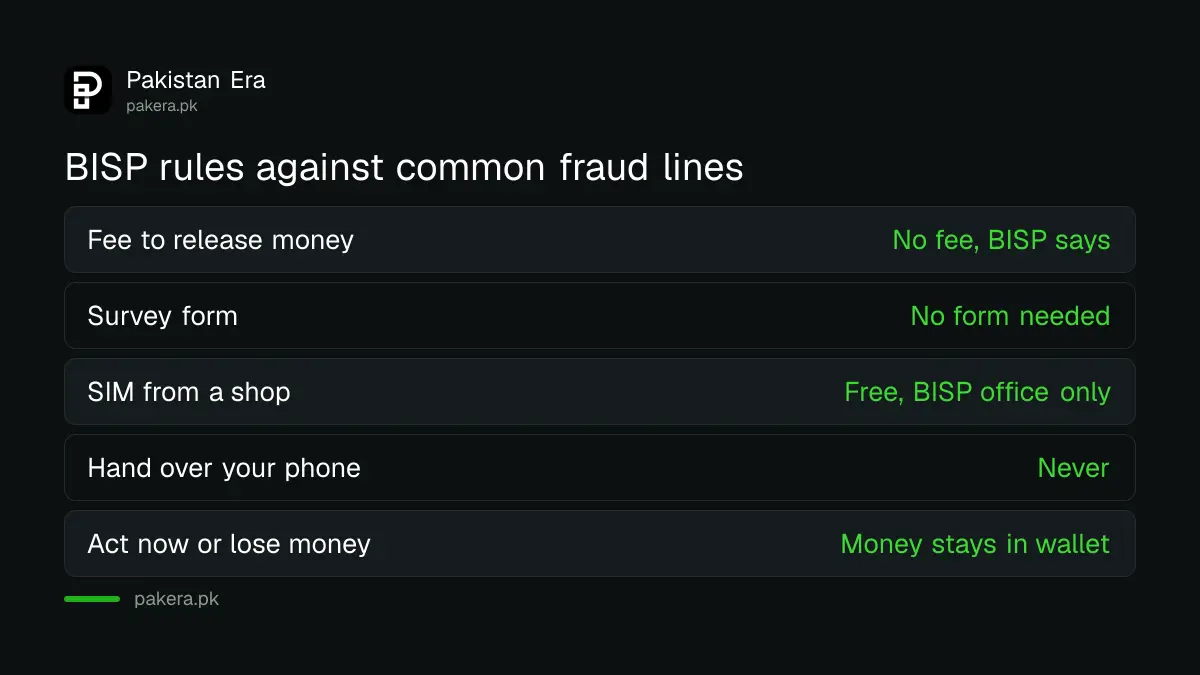
| What the message or caller says | What BISP's rules say | Your answer |
|---|---|---|
| Your money has reached your wallet (from the bank) | Real, BISP says keep this SMS | Keep it. Go when it suits you |
| Pay a fee to release your payment | BISP charges no fee for any scheme or service | Do not pay. Report it |
| Fill a form for the survey | BISP says no form is needed for the survey | Go to a BISP office |
| Buy this SIM to get your money | The SIM is free, from a BISP office only | Do not buy it |
| Give me your phone so I can check | BISP says never hand it over | Keep your phone |
| Your payment will stop unless you act now | BISP says money stays safe in the wallet | Call 0800-26477 yourself |
The Rs 280 cash withdrawal charge is the one exception worth knowing. BISP says this charge has been fixed for a cash withdrawal. It is not a fee to release your money, and it is not something to send ahead by SMS. If an agent takes more at the counter, that belongs in the complaint steps below, and the pattern is set out in illegal deductions by BISP agents.
Your Benazir SIM is your wallet, so guard it like cash
BISP says the Benazir SIM serves as your digital wallet and its security is your responsibility. If someone holds that SIM, or a code sent to it, they may reach your money. So no agent, neighbour or caller ever needs it.
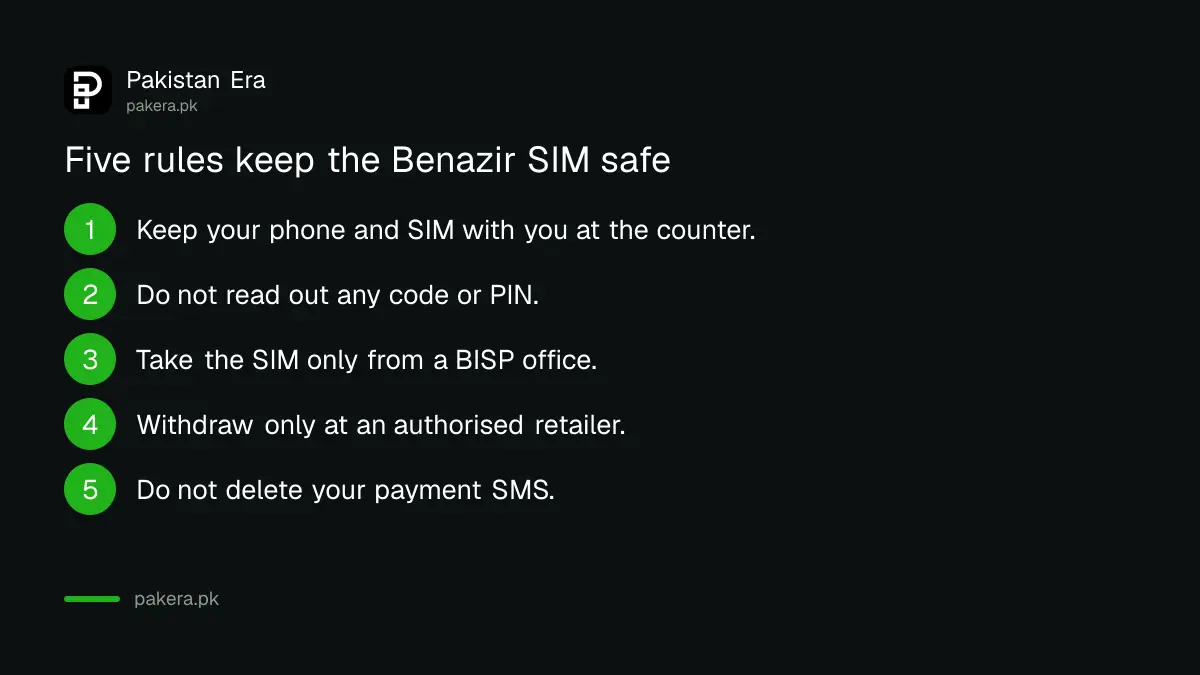
Follow these five rules every time:
- Keep the phone and the SIM with you, even at the agent's counter.
- Do not read out any code or PIN that arrives by SMS, to anybody.
- Take the SIM only from a BISP office, for free. BISP says a shop or home SIM will not work for payments.
- Withdraw only from an authorised retailer of a partner bank, never from a private house.
- Do not delete your payment SMS. BISP calls it your proof.
Only three things are needed for cash, BISP says: your original CNIC, confirmation of your registered number and your biometric. Anything beyond that is a warning sign, however polite the person is.
Check any BISP website or page before you trust it
BISP tells women to get information only from its official social media accounts with the verified blue tick. Its website is bisp.gov.pk. A site on any other address, even one with BISP colours, is not BISP, and it should not get your CNIC.
Many sites use "8171" in their own address and ask you to type a CNIC. We tested the official links last month, and the tested list of BISP links shows which ones are real. A quick test: read the address. If it does not end in bisp.gov.pk, close it.
Be careful with the name too. Ehsaas is an older name that some pages still use. If a message says your "Ehsaas" money is waiting behind a link, it deserves the same answer as any other: do not click, and check by 8171.
Report a fake BISP message in three places
Tell BISP first, because it can warn others and act against its own staff or agents. Then report the number to your mobile operator and the telecom regulator, which can act against the SIM. Keep the message on your phone as evidence.
- Take a photo or screenshot of the message or the caller's number.
- Call the BISP helpline on 0800-26477, or go to your nearest BISP office.
- Report the number through the steps in reporting a scam number to your operator and PTA.
- If you lost money, tell the wallet's bank straight away and ask it to log the fraud.
BISP also takes complaints in its live sessions with the chairperson, explained in the BISP e-Katcheri. Sharing a warning with other women in your area helps as well, because a caller who knows your name can still be a fraud.
Common questions
What is the official BISP number?
8171 is the only official number, BISP says. The free helpline you can call is 0800-26477.
Does BISP send a message asking for money?
No. BISP says it charges no fee for any scheme, service or survey. A message asking for money is a fraud.
Is the SMS from a bank about my BISP money real?
It can be. BISP says the partner bank sends one SMS when money arrives and another after withdrawal. Neither should ask you to pay or share a code.
Do I need to fill a form for the BISP survey?
No. BISP's chairperson said no form is required for the survey. Go to a BISP office and do not buy a form from anyone.
What should I do if I shared my code with a caller?
Call your wallet's bank and 0800-26477 straight away. Tell them what you shared and when, and keep the message or number as evidence.
Is the Rs 280 withdrawal charge a scam?
No. BISP says a Rs 280 service charge is fixed for cash withdrawal. Report any agent who takes more, or anyone asking you to send it in advance.
How we verified this
What we checked, where we read it, and what we could not confirm.
Last checked 7 November 2026. The 8171 rule, the Rs 280 charge and the work with the IT ministry are from BISP release No. 70 (24 August 2026). The free SIM, no fee, no survey form, wallet security and blue tick advice are from No. 71 (25 August 2026). The SMS proof and helpline are from No. 66 (3 August 2026). What an agent may ask for is from No. 57 (15 July 2026). All are listed on BISP's 2026 press release page. The examples in the table are our own wording, set against BISP's rules. We did not test a live fraud.
About the author

Public Services and Education Journalist
Fajr Riaz is a journalist and content writer at Pakistan Era, based in Lahore. She covers the questions people meet in everyday life in Pakistan: how a public service works, what a change in the rules means, and where to find a reliable answer.