How to Claim From the Other Driver's Car Insurance in Pakistan After an Accident
Another driver hit your car in Pakistan? Get their insurance details under section 98, claim from their insurer, and what the Motor Vehicles Act 1939 gives you.
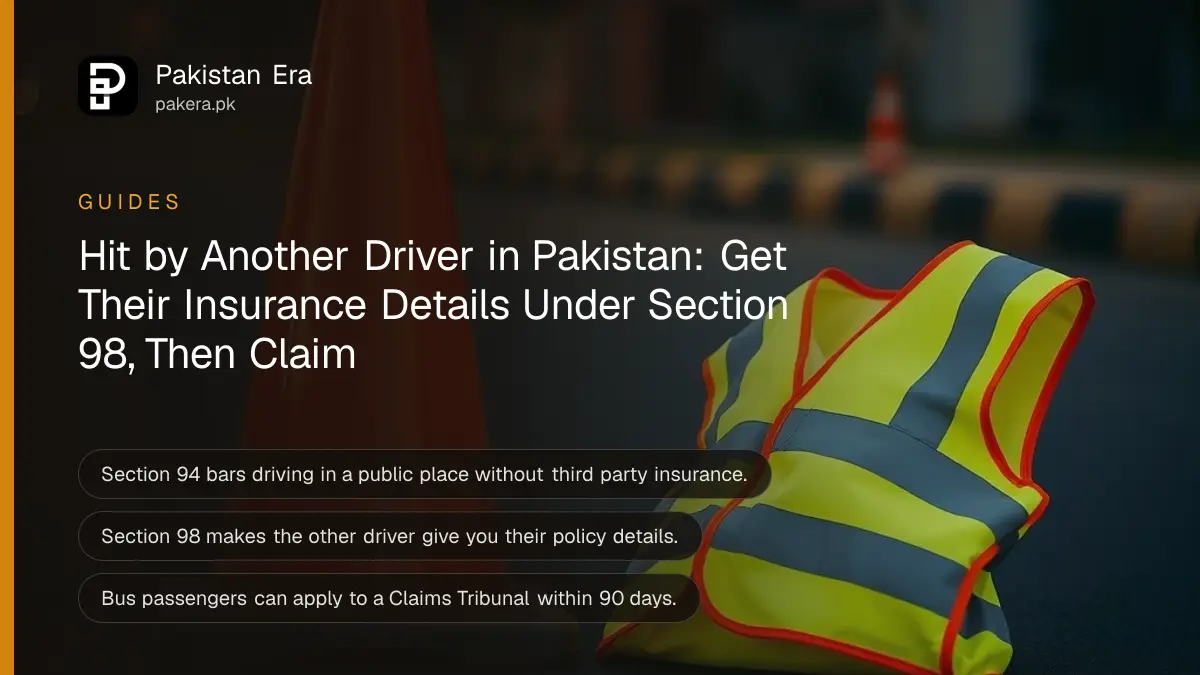
If another driver hit you in Pakistan, ask them on the spot for their certificate of insurance. Section 98 of the Motor Vehicles Act, 1939 says they must tell you whether they are insured and give the policy details. Then report the accident to the police, notify the other driver's insurer in writing, and claim on your own policy too if you have comprehensive cover.
| What the law says | Section |
|---|---|
| No one may drive in a public place without third party insurance | Section 94, Motor Vehicles Act 1939 |
| The policy must cover death or bodily injury to other people | Section 95 |
| The insurer must pay a court judgment against its insured | Section 96 |
| The other driver must give you their insurance details on demand | Section 98 |
| The police or registering authority must give you the vehicle and driver details | Section 109 |
Third party insurance is the one cover every vehicle in Pakistan must carry, yet few drivers know it gives the victim of an accident rights of their own. Those rights sit in Chapter VIII of the Motor Vehicles Act, 1939, a federal law that still applies alongside the provincial motor vehicle rules.
Every vehicle on a public road must carry third party insurance
Section 94 bars anyone from using a motor vehicle in a public place, or letting someone else use it, unless a third party insurance policy is in force. Vehicles owned by the federal and provincial governments are exempt. A paid driver is not at fault if they had no reason to know the policy had lapsed.
Section 95 sets what the policy must cover: liability for the death of, or bodily injury to, any person caused by the vehicle in a public place. For a private car, the law sets no rupee cap on that liability. It must cover the amount the driver is liable for.
Note what the law requires and what it does not. The compulsory part is injury and death. Damage to your car is covered only if the other driver bought a policy that includes third party property damage, so check the other driver's schedule. EFU's private car policy, for example, lists "damage to property other than property belonging to the insured".
Driving without insurance is also a ticketed offence. The federal text of the Provincial Motor Vehicles Ordinance, 1965 lists "driving motor vehicles without insurance coverage" in its fines schedule at Rs 400. Provinces set their own fine amounts, so the ticket in your city may differ.
Get the other driver's insurance details at the scene
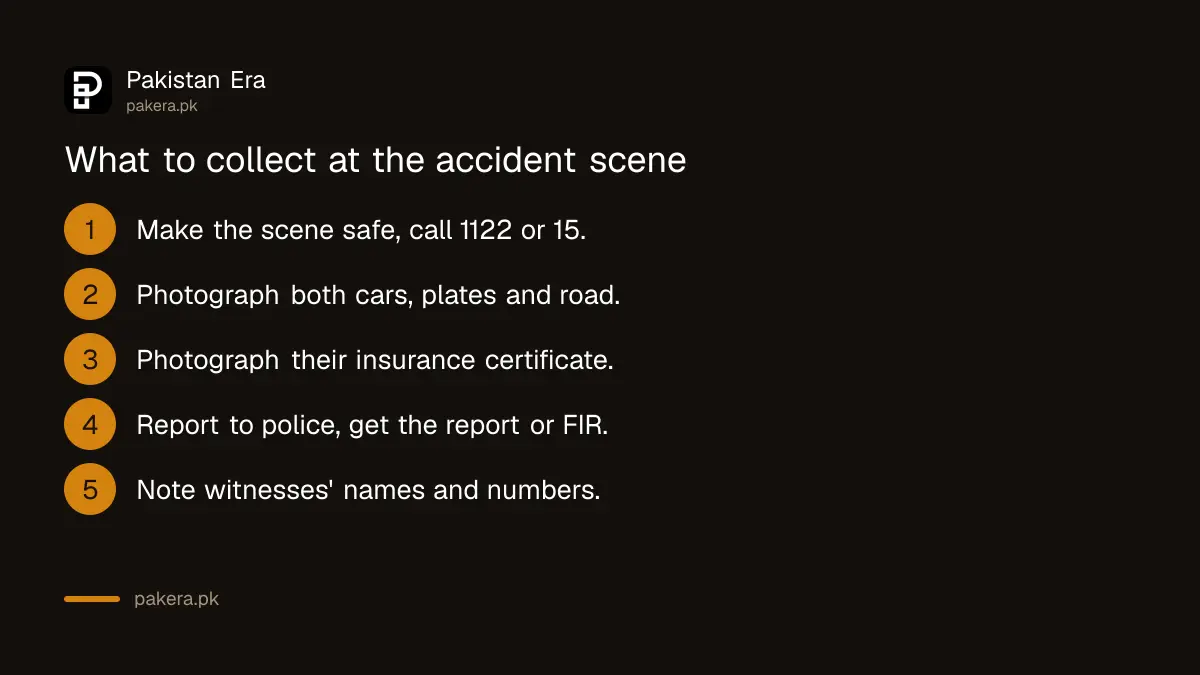
Ask the other driver for their certificate of insurance, and photograph it with their CNIC and the number plate. Section 98 says a person facing a claim cannot refuse to say whether they are insured, or refuse the policy particulars on the certificate. Write down the insurer, policy number and expiry date.
- Make the scene safe and call 1122 or 15 if anyone is hurt.
- Photograph both cars, the plates, the road and any skid marks.
- Ask for the other driver's certificate of insurance, CNIC and driving licence, and photograph them.
- Report the accident at the police station and get a copy of the report or FIR.
- Note witnesses' names and mobile numbers.
If the driver drives off or refuses, section 109 helps. It says the registering authority or the officer in charge of a police station must, on request and payment of the prescribed fee, give a person claiming compensation the vehicle's particulars and the name and address of the person driving it.
Section 106 also lets a police officer demand the certificate. After an accident with injury, a driver who cannot show it on the spot must produce it at the police station within 7 days. Ask the police to record whether the certificate was shown. The first hour after a crash is covered step by step in what to do after a road accident in Pakistan.
Write to the other driver's insurer, and claim on your own policy too
Send a written claim to the other driver's insurer with the policy number, police report, photos and repair estimate. If you have comprehensive cover, also tell your own insurer the same day. Your insurer can pay you first and recover the money from the other side.
Many claims for car damage end this way, because your own insurer moves faster for its own customer. Expect your own policy's deductible and claim rules to apply. The general steps with your own insurer, including the survey, are in the car insurance claim process in Pakistan.
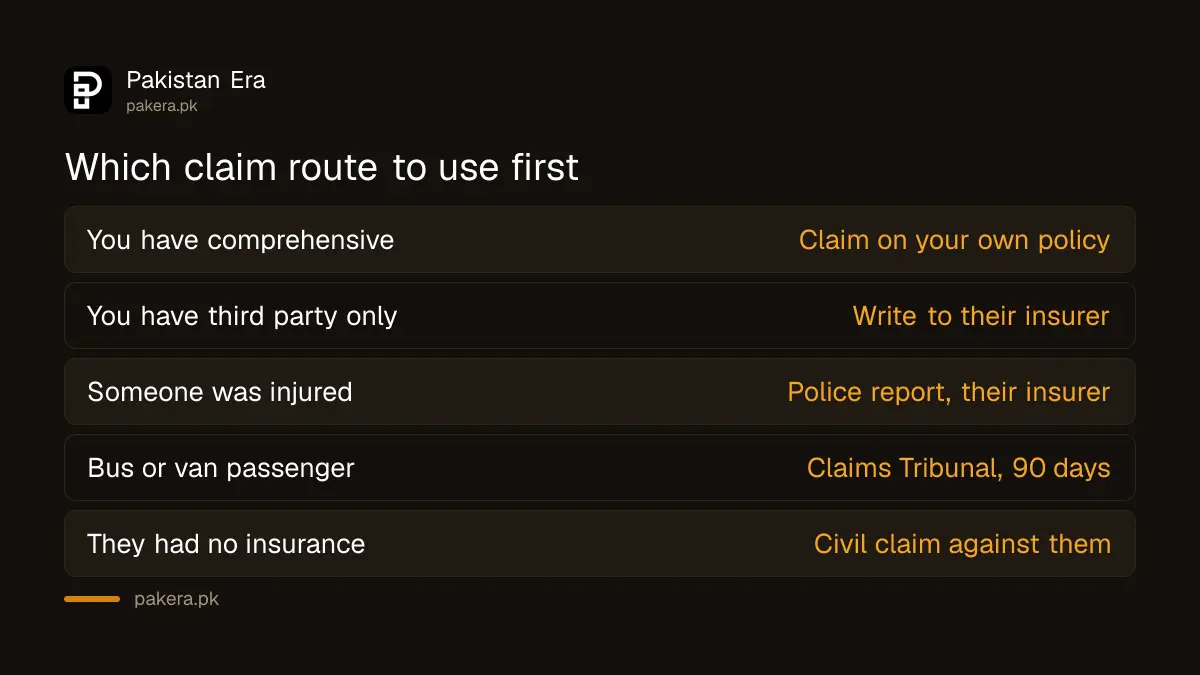
| Your situation | Best first route |
|---|---|
| You have comprehensive cover | Claim on your own policy, tell your insurer who hit you |
| You have third party only cover | Claim from the other driver's insurer in writing |
| Someone was injured or killed | Police report, then claim from the other driver's insurer |
| You were a passenger on a bus or van | Claims Tribunal under the 1965 Ordinance, within 90 days |
| The other driver had no insurance | Civil claim against the driver and owner |
Section 99 protects you here. An insurer's settlement with its own customer over your claim is not valid unless you are a party to it. So do not accept that a claim was "settled" between the other driver and their insurer without you.
If the insurer refuses, a court judgment binds it
When the other driver's insurer will not pay, you can sue the driver. Under section 96, once you win, the insurer must pay the judgment for any liability the law requires it to cover, even if it could cancel the policy. The insurer must be given notice of the case through the court.
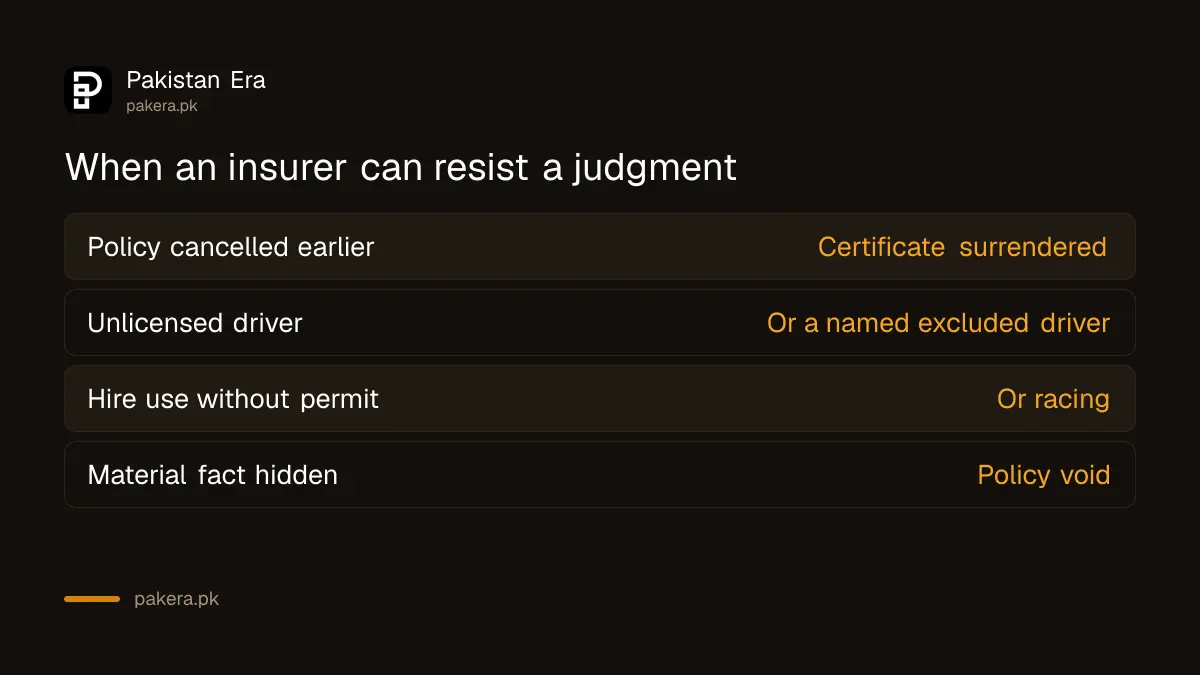
The insurer can defend itself only on a short list of grounds in section 96(2). These include a policy cancelled before the accident with the certificate surrendered, a driver who had no valid licence or was named as excluded, use for hire without a permit, racing, or a policy obtained by hiding a material fact.
Passengers have a separate route. Under sections 67 to 67-G of the Provincial Motor Vehicles Ordinance, 1965, a passenger hurt in a stage or contract carriage, such as a bus, can apply to a Claims Tribunal within 90 days of the accident. The Tribunal can accept a late application for sufficient cause. Its order can be appealed within 90 days.
On national highways and motorways there is a further layer of no-fault cover for victims, explained in the guide to no-fault accident insurance on national highways. For the cover types to buy for yourself, see car insurance in Pakistan.
Common questions
Is third party car insurance compulsory in Pakistan?
Yes. Section 94 of the Motor Vehicles Act, 1939 bars using a motor vehicle in a public place without a policy against third party risk. Government owned vehicles are exempt.
Can the other driver refuse to show their insurance?
No. Section 98 says a person facing a claim must, on demand, say whether they are insured and give the particulars on their certificate.
Does third party insurance pay for my car's damage?
The law makes only death and injury cover compulsory. Car damage is paid if the other driver's policy includes third party property damage, which many policies do.
What if the other driver has no insurance?
You can still claim against the driver and the owner in a civil court. Claim on your own comprehensive policy first if you have one.
What is the fine for driving without insurance?
The federal text of the 1965 Ordinance lists Rs 400 for driving without insurance coverage. Provinces can set different amounts.
Can my own insurer recover from the other driver?
Yes, that is common with comprehensive cover. Tell your insurer who hit you and hand over the other driver's insurance details.
How we verified this
What we checked and where we read it.
We read Chapter VIII of the Motor Vehicles Act, 1939 (sections 93 to 111) and the Provincial Motor Vehicles Ordinance, 1965 (sections 67 to 67-G and the fines schedule) on the Pakistan Code on 24 November 2026, and EFU General's private car policy page for the third party property wording. The rupee limits in section 95(2) for goods and passenger vehicles date from 1947 amendments and still appear in the text; for private cars the section sets no cap.
Free on WhatsApp
Get last dates and rule changes on WhatsApp
We post new last dates, fee changes and fixes for common problems, a few short posts a day.
Follow Pakera on WhatsAppOther followers cannot see your number.
Pakera Solves It
Which online process wasted your time this week?
A portal that will not load, a form nobody explains, a complaint that went nowhere. Tell us. Every week we pick one, solve it step by step and publish the answer.
About the author

Senior Writer, Public Services and Technology
Shahid joined us in 2024 as an author. He is a senior contributor to Pakistan's leading technology websites. He writes detailed articles, mostly covering his expertise in the latest tech, mobiles, apps, gadgets, and step-by-step guides. His ideology is to help people understand the latest trends and explain complex methods through very easy-to-understand guides.