How to File a Car Insurance Claim in Pakistan After an Accident or Theft
Hit, hurt or stolen: how a car insurance claim actually moves in Pakistan, the papers your insurer wants, the surveyor's role, and where to go if it stalls.
A car insurance claim in Pakistan starts at the scene, not at the insurer's counter. Call your insurer the same day, before any repair starts, and keep the FIR if there is theft or injury. The insurer assigns a licensed surveyor to assess the damage, and that survey report is what decides the payout.
We looked at how Pakistani insurers actually run this process, and at SECP's draft Insurance Market Conduct Rules 2026, published for public consultation on 20 August 2026. The draft would set hard deadlines on claim decisions for the first time. It has not been notified yet, so nothing below is binding law, but it tells you what a reasonable insurer should already be doing.
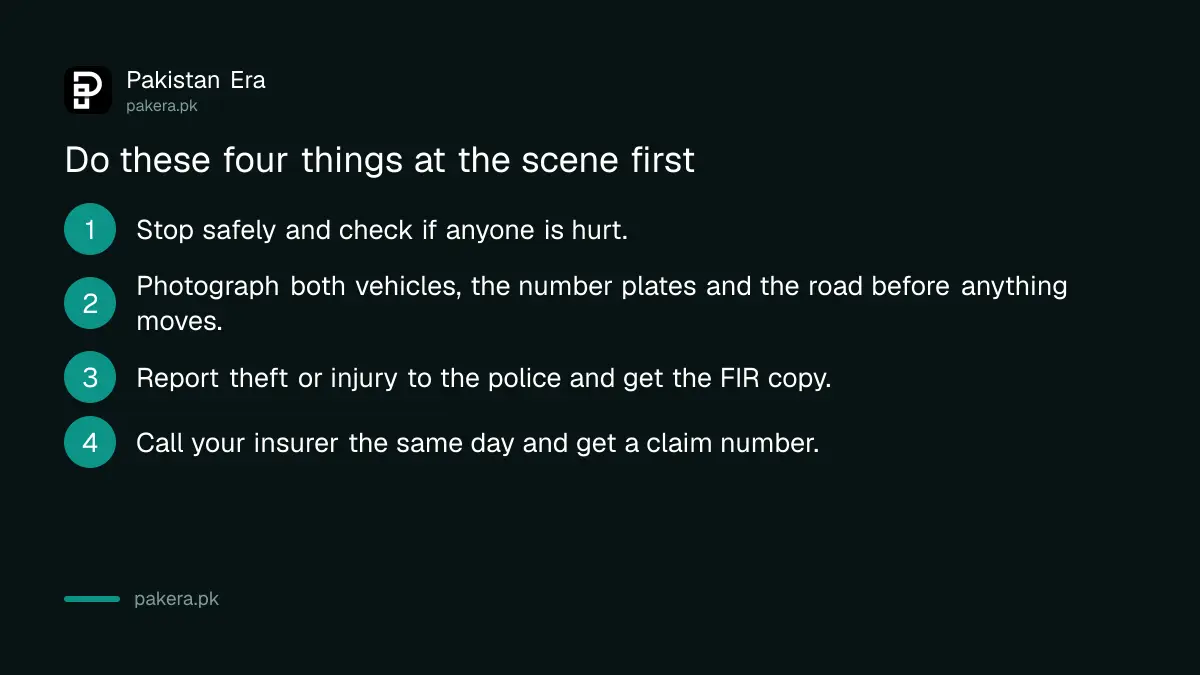
Do these things at the scene before you call anyone
Check for injuries first, then protect the evidence. A claim is only as strong as what you can show happened, and that evidence disappears fast once cars are moved or a crowd gathers.
- Stop safely, turn on hazard lights, and check if anyone is hurt.
- Photograph both vehicles, the number plates, the road position and any skid marks before anything moves.
- Report theft or any injury to the police station with jurisdiction and get a copy of the FIR.
- Call your insurer's claim line the same day. Ask for a claim number and write it down.
Don't admit fault at the roadside and don't promise cash to the other driver. That conversation belongs to the insurer and the surveyor, not to you standing on the road.
Your insurer will ask for a specific set of documents
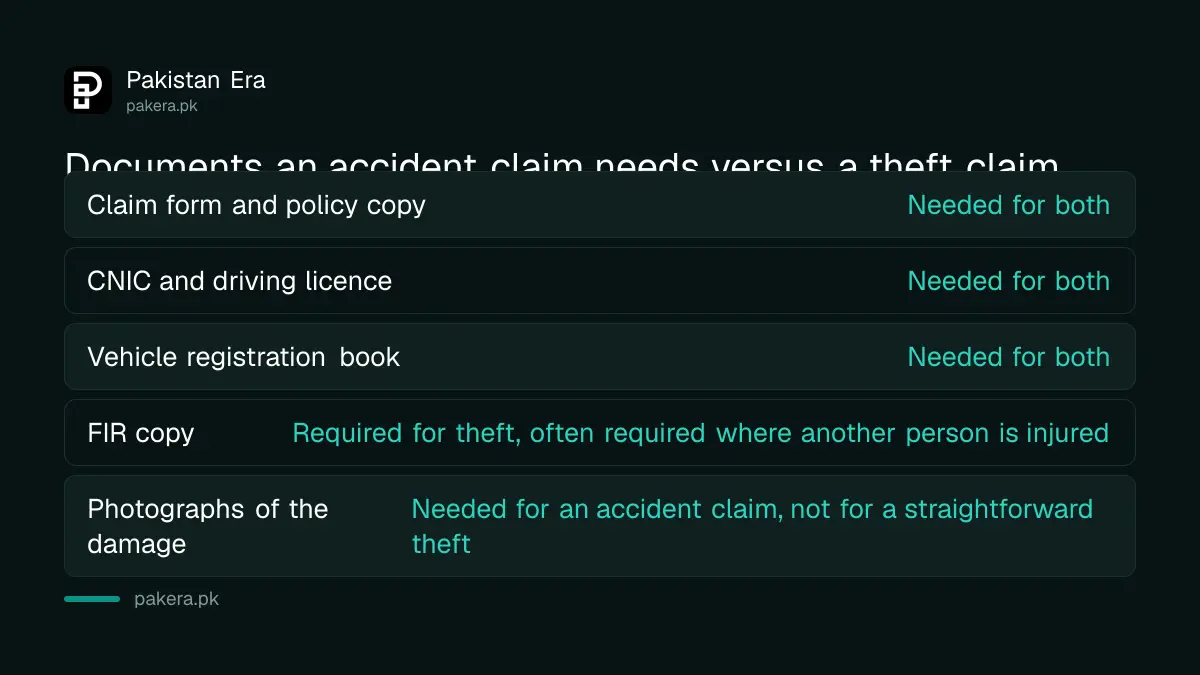
Every insurer wants the same core papers: the claim form, your CNIC, your driving licence, the vehicle's registration book and the policy schedule. What changes is whether an FIR and photographs are required, and that depends on what actually happened to the car.
| Document | Accident claim | Theft claim |
|---|---|---|
| Claim form and policy schedule | Required | Required |
| CNIC and driving licence | Required | Required |
| Vehicle registration book | Required | Required |
| FIR copy | Usually required if another person is hurt | Always required |
| Photographs of the damage | Required | Not applicable |
| Spare keys and service history | Not applicable | Often asked for |
SECP's draft rules would stop insurers asking for anything beyond what is actually relevant to the claim. That is a real problem today: a delayed claim is sometimes a document request that keeps growing, one form at a time, rather than a clean list given up front.
A licensed surveyor decides what the damage is worth
Once you report the claim, the insurer sends a surveyor to inspect the car. SECP licenses insurance surveyors separately from insurers, so the person in your driveway with a camera and a clipboard is answerable to the regulator, not just to the company that hired them.
The surveyor photographs the damage, estimates the repair cost against the garage's quote, and writes a survey report. That report is what the insurer's claim department actually works from, more than anything you say on the phone. If you disagree with the surveyor's estimate, say so in writing before repairs begin, because once the car is fixed there is nothing left to re-inspect.
For a theft claim there is no damage to survey, so the insurer instead checks the FIR, the registration papers and how long the recovery effort by police has run, usually a fixed waiting period set out in your policy before a car is treated as a total loss.
How long the insurer has to decide and pay
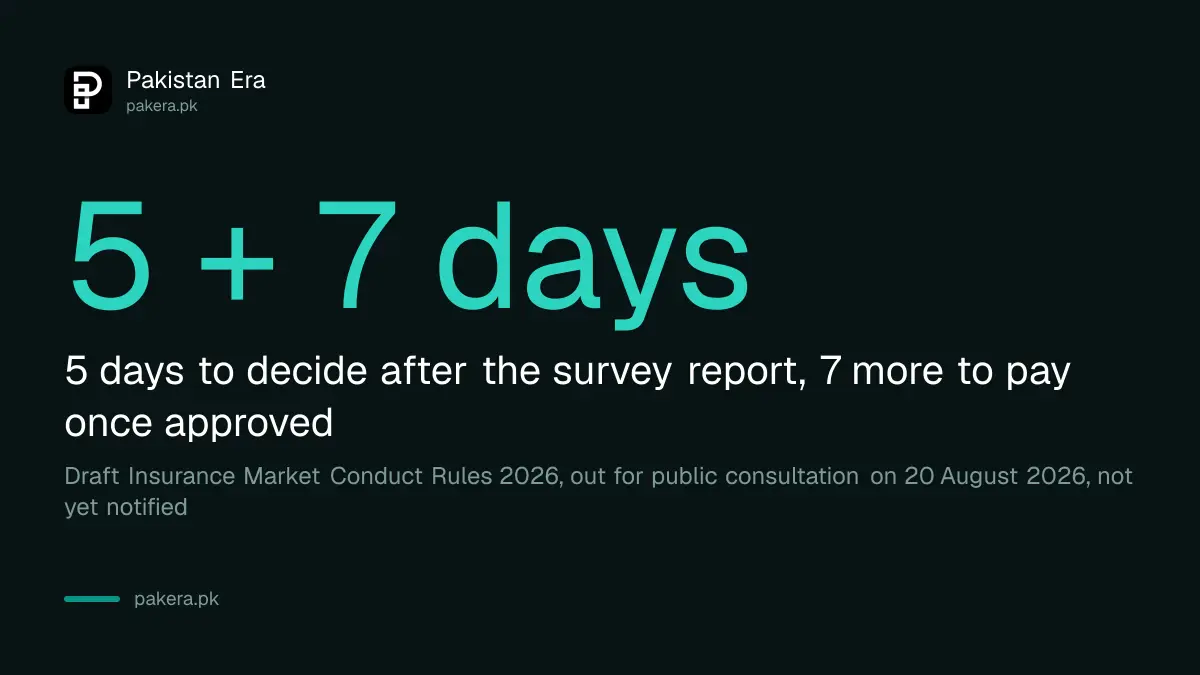
Under SECP's draft Insurance Market Conduct Rules 2026, a motor claim would have to be decided within 5 days of the surveyor's report, and the insurer would then have 7 more days to pay once it approves the claim, with approved repairs generally finished within 15 days. Insurers that miss these timelines would face a fine of up to Rs 1 million, rising by Rs 10,000 a day for a continuing breach.
That draft is still out for consultation. It is not the law today, and no insurer is bound by a 5 day clock yet. We're including the figures because they show what SECP itself considers a reasonable turnaround, and because a claim that drags on for months longer than that is worth pushing back on now rather than waiting for the rule to take effect.
Common reasons a car insurance claim gets rejected
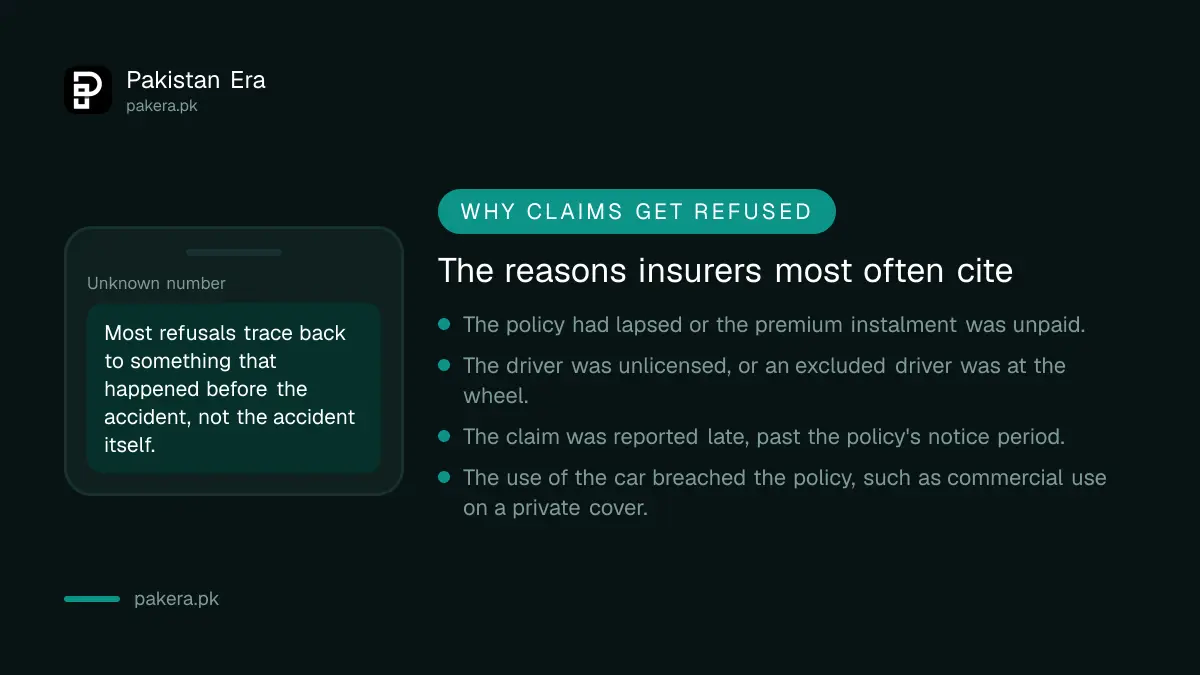
Most refusals trace back to something that happened before the accident, not the accident itself. Knowing these in advance saves you a shock at claim time.
- The policy had lapsed, or a premium instalment was unpaid when the accident happened.
- An unlicensed or excluded driver was behind the wheel.
- The claim was reported after the policy's notice period, which is usually a matter of days, not weeks.
- The car was being used outside what the policy covers, such as commercial use on a private policy.
Check your policy schedule for its notice period today, before you need it. Insurers set this clause differently, and nothing in SECP's current or proposed rules fixes one number for every policy.
If the insurer delays or refuses, escalate in writing
Write to the insurer first and ask for the refusal in writing, with reasons. If that goes nowhere, you can take the complaint to SECP or to the Federal Insurance Ombudsman, which investigates maladministration by insurers at no cost. We've already laid out that full route, the address, the helpline and what the online form asks for, in how to complain when an insurance claim is refused, so this piece won't repeat it.
Keep every letter, the claim number, the survey report and the FIR together in one file. An ombudsman complaint moves faster when the paper trail is already assembled rather than being reconstructed from memory months later.
Common questions
How soon must I report a car accident to my insurer?
The same day, or as soon as reasonably possible. Most policies set a short notice period in the schedule, so check yours rather than assuming a standard number.
Do I need an FIR for every car insurance claim?
You need it for theft and for any accident involving injury. For a straightforward own-damage accident claim, insurers usually ask for photographs instead, but confirm with yours.
Who pays the surveyor, me or the insurer?
The insurer appoints and pays the surveyor as part of handling your claim. You don't pay for the survey itself.
Can I get my car repaired before the insurer approves the claim?
Don't. Repairing before approval removes the evidence the surveyor needs and gives the insurer a reason to dispute the cost later.
What if my claim is for less than the excess on my policy?
Then the claim isn't worth filing. The excess is the amount you pay yourself before the insurer pays anything, so a small claim under that figure comes out of your own pocket either way.
How we verified this
What we checked, where we read it, and what we could not confirm.
We read the 20 August 2026 reporting on SECP's draft Insurance Market Conduct Rules 2026 and SECP's insurance surveyor licensing pages on 5 October 2026. The draft rules are out for public consultation and had not been notified as law at the time of writing, which the body states throughout. We did not quote any single insurer's premium figures, since these are policy and insurer specific. Sources: Securities and Exchange Commission of Pakistan and Federal Insurance Ombudsman of Pakistan.
About the author

Public Services and Education Journalist
Fajr Riaz is a journalist and content writer at Pakistan Era, based in Lahore. She covers the questions people meet in everyday life in Pakistan: how a public service works, what a change in the rules means, and where to find a reliable answer.