How to Get Car Insurance in Pakistan: Third Party, Comprehensive or Takaful
Third-party car cover is required by law in Pakistan, but it pays for injury, not the car you hit. We read the Act and SECP rules: how to buy, claim, complain.
Car insurance in Pakistan has one part the law requires and one part you choose. The law requires third-party cover: insurance for death or injury your car causes to other people. Comprehensive cover, which also pays for your own car, is optional. Buy either from an insurer or takaful operator registered with the SECP, and keep the certificate in the car.
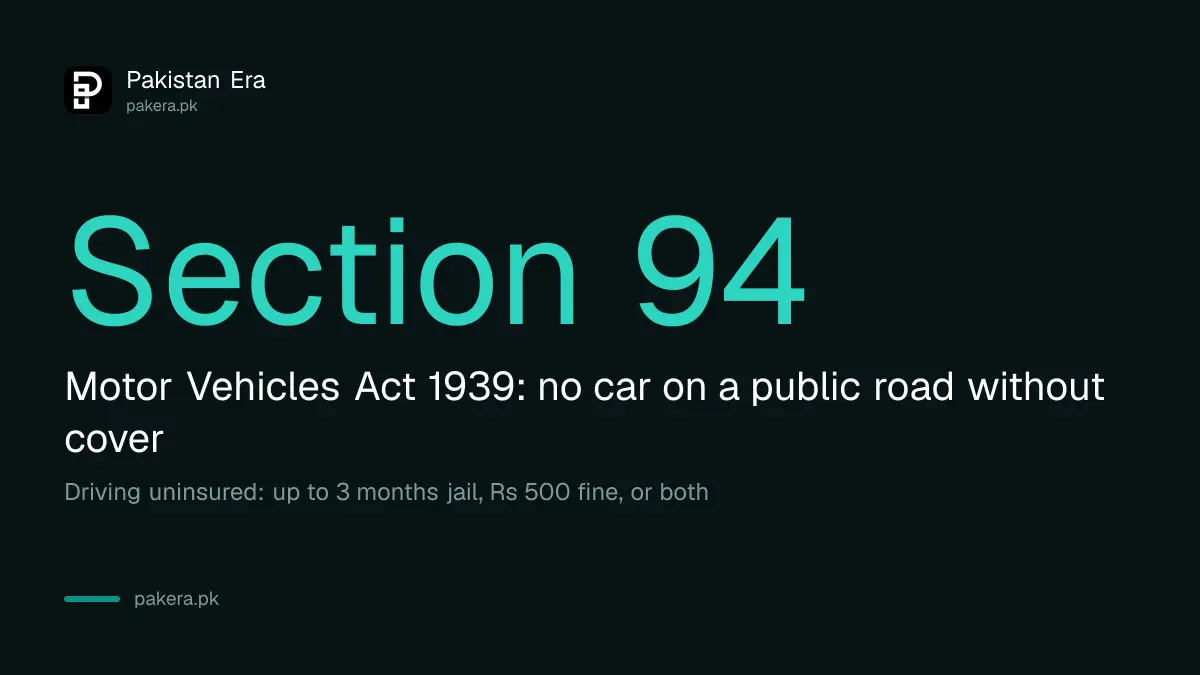
We read the law itself before writing this. Section 94 of the Motor Vehicles Act 1939, in the copy published in the Punjab Code, says no one may use a motor vehicle in a public place without a policy that meets the Act. Section 125 makes driving without one an offence, with up to three months in jail, a fine of up to Rs 500, or both. That fine is tiny. The real cost of driving uninsured comes when your car hurts someone.
Third-party car insurance is required by law in Pakistan
Every car used on a public road must carry third-party insurance. This covers your legal liability if your car kills or injures another person. It does not pay for your own car. Driving without it is an offence under section 125 of the Motor Vehicles Act 1939.
The detail in section 95 surprises most drivers. The legal minimum covers death or bodily injury to other people. It does not mention damage to another person's car, wall or shop. So the cheapest policy that keeps you legal may not pay for the car you hit.
For a private car, section 95 sets no rupee cap: the policy must cover "the amount of the liability incurred". The old caps of Rs 20,000 in the Act apply only to goods vehicles and vehicles that carry passengers for hire.
Insurance also ties into registration. Section 34 of the Provincial Motor Vehicles Ordinance 1965, again in the Punjab copy, lets the registering authority suspend a car's registration if it is "not insured as required by law". Other provinces keep their own copies of these laws, so check your province's version for local changes.
Comprehensive cover pays for your own car as well
Comprehensive insurance adds cover for your own car on top of third-party liability. It usually pays for accident damage, theft and fire, minus any amount you pay yourself. It costs much more, and it is what a bank asks for when you buy a car on finance.
| Point | Third party | Comprehensive |
|---|---|---|
| Required by law | Yes | No |
| Death or injury to others | Covered | Covered |
| Damage to another car or property | Not in the legal minimum, check your policy | Usually covered |
| Damage to your own car | Not covered | Covered |
| Theft and fire of your car | Not covered | Usually covered |
Read the schedule of your own policy, not a brochure. The schedule lists the car, the sum insured, the excess and the exclusions. Exclusions often include an unlicensed driver, racing, and using a private car as a taxi.
Takaful car cover works on shared risk, not interest
Takaful is the Islamic form of insurance. Policyholders pay into a shared fund, and claims are paid from that fund. SECP licenses general takaful operators and window takaful operators, which are conventional insurers with a separate takaful window. Cover for your car is broadly the same.
SECP's licensing page sets a minimum paid-up capital of Rs 500 million for non-life insurers and general takaful companies. Window takaful operations are licensed under the Takaful Rules 2012. If you want Shariah-compliant cover, ask the operator to show the takaful window's own policy wording, not the conventional one.
How to get car insurance in Pakistan, step by step
Pick a registered insurer, get a written quote, check the sum insured matches your car's real value, pay, and keep the policy schedule and certificate. Do not pay cash to an agent who cannot show which company the policy is from.
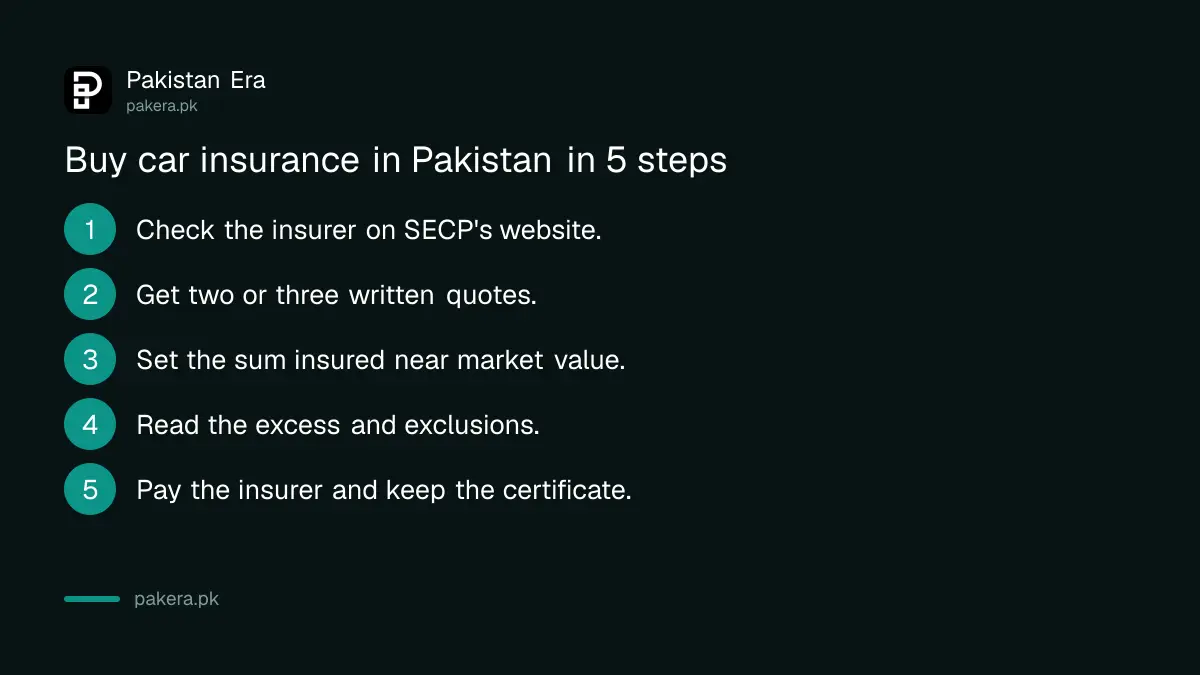
- Check the insurer. SECP's website lists insurance companies, window takaful operators, brokers and surveyors under Licensing, Insurance Sector.
- Get two or three written quotes. Give each the same details: car make, model, year, value and city.
- Set the sum insured near the market value. Set it too low and a claim is cut. Set it too high and you pay extra premium for nothing.
- Read the excess and exclusions. The excess is the part of each claim you pay yourself.
- Pay the insurer directly and get the documents. You need the policy schedule and the certificate of insurance, which section 95(4) requires before the policy has legal effect.
Premiums are set by each insurer, not by SECP. Insurers usually look at the car's value, its age, the city, the driver's claim history and whether a tracker is fitted. We have not quoted any company's prices here, because they change by car and by month. If you just paid token tax and registration in Islamabad or are mid-way through a vehicle transfer to another province, update the insurer with the new owner and number, or a claim can be refused.
How to claim on car insurance and what to keep
Tell the insurer as soon as possible, in writing, and before any repair starts. Keep photos, the police report where there is theft or injury, and every receipt. The insurer usually sends a surveyor to assess the damage, and SECP licenses insurance surveyors.
- Photograph the scene, both cars and the number plates before anything moves.
- Report theft or any injury to the police and keep the copy of the report.
- Do not admit fault or promise money at the roadside.
- Get the insurer's claim number, and its decision in writing.
Most policies set a short time limit for telling the insurer, so check the clause on your schedule today, not after an accident.
Where to complain if the insurer will not pay
Complain to the insurance company in writing first. If that fails, you can go to the SECP or to the Federal Insurance Ombudsman. The ombudsman is free, its helpline is 1082, and its online form asks for your policy number and claim amount.
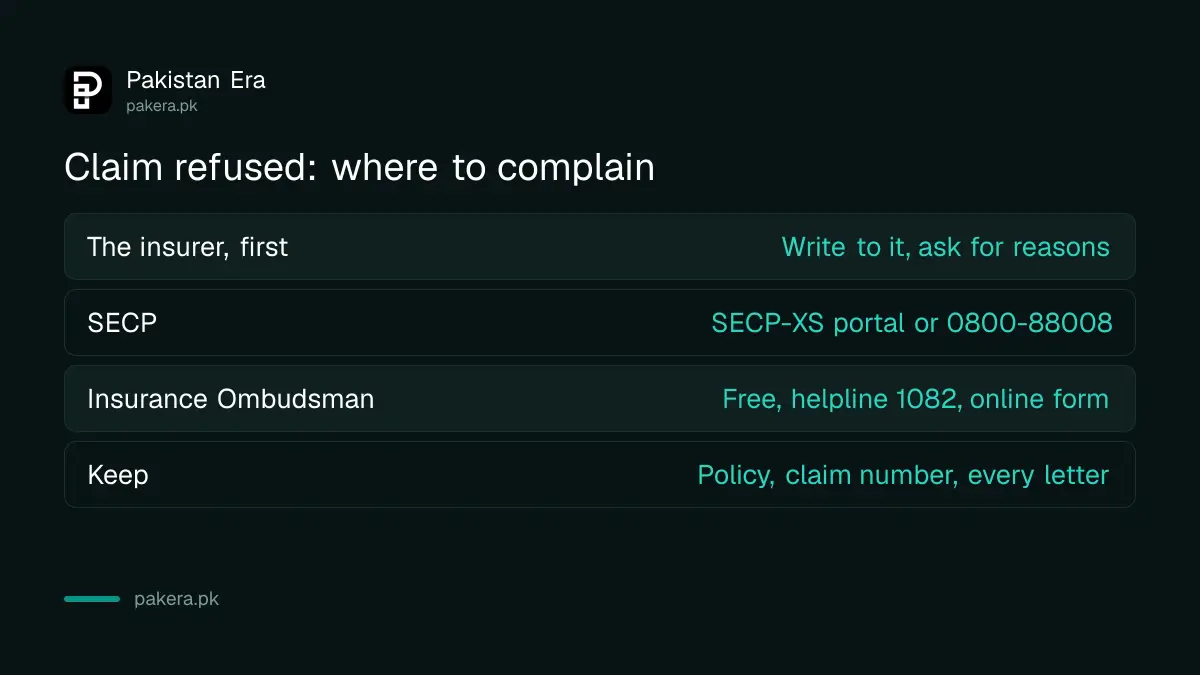
SECP's complaints page tells people to raise the problem with the company first. Its queries line is 0800-88008, toll free from a landline, and the email is queries@secp.gov.pk. SECP's home page links its complaints and queries portal, SECP-XS, where you sign up with your CNIC. Its older SDMS portal showed "Server unavailable" when we tried it on 1 October 2026.
The Federal Insurance Ombudsman deals with maladministration by insurers, such as a refused or delayed claim. Its form asks for your name, CNIC, the policyholder's name, policy number, claim amount and city. The full route, with the ombudsman's address and the appeal stages, is in how to complain when an insurance claim is refused.
Common questions
Is car insurance compulsory in Pakistan?
Third-party insurance is compulsory under section 94 of the Motor Vehicles Act 1939. Comprehensive cover is optional unless your car finance requires it.
What is the fine for driving without insurance?
Section 125 of the Act, in the Punjab Code copy we read, sets up to three months in jail, a fine of up to Rs 500, or both. Your registration can also be suspended.
Does third-party insurance pay for the other car?
Not under the legal minimum, which covers death and bodily injury. Some third-party policies add property damage, so read the schedule.
Is takaful car insurance the same as normal insurance?
The cover is similar, but takaful runs as a shared fund without interest. SECP licenses takaful operators separately under the Takaful Rules 2012.
How do I check an insurance company is real?
Look it up on SECP's website, under Licensing, Insurance Sector. Pay the company directly, not an agent's personal account.
How we verified this
What we checked, where we read it, and what we could not confirm.
We read sections 93 to 111 and 125 of the Motor Vehicles Act 1939 and section 34 of the Provincial Motor Vehicles Ordinance 1965 in the Punjab Code on 1 October 2026. We read SECP's insurance licensing and complaints pages and the Federal Insurance Ombudsman's complaint form the same day. We did not read the Sindh, KP or Balochistan copies of these laws, and we quote no insurer's prices. Sources: Motor Vehicles Act 1939, Punjab Code, SECP complaints and Federal Insurance Ombudsman.
About the author

Tax, Bills and Technology Writer
Ali Akhtar is a young and curious voice here at Pakistan Era. He is currently pursuing his A-Levels and has a growing interest in Pakistan’s changing industrial landscape and educational trends. Ali likes to write in a way that helps him explain and explore the world around him. His writing reflects the perspective of the new generation navigating the evolving trends of Pakistan where technology, youth innovation, and shifting opportunities are reshaping the country’s future.