Stop Loudspeaker Noise in Punjab: Rs 25,000 Minimum Fine and How to Report
Punjab's Sound Systems Act fines loudspeaker misuse Rs 25,000 to Rs 100,000 with up to 6 months in jail. What is banned, what is allowed and how to report it.
Loud sound systems that disturb people are against the law in Punjab. Under the Punjab Sound Systems (Regulation) Act 2015, the offence carries up to six months in jail and a fine of Rs 25,000 to Rs 100,000. Report it to your local police station, which can seize the equipment.
It is 1 am, there is an exam tomorrow, and a speaker two streets away is still playing. Many people in Punjab think nothing can be done. The law says otherwise. We read the full Act on the Punjab Code, the provincial government's own statute portal, on 1 October 2026. It is short, and it is stricter than most people expect.
The offence is cognizable, which means the police can act without a court order. It is also non-bailable, so it is not a minor matter for the person running the speaker.
What the Punjab loudspeaker law bans
Section 3 bans any sound system making noise that annoys, disturbs or endangers the comfort, rest, health or safety of people nearby. Section 4 adds specific bans near hospitals, schools, courts and homes, and limits how far sound can travel from a place of worship.
The Act defines a "sound system" as a loudspeaker, a sound amplifier or other equipment the government names. "Vicinity" means anywhere within ten yards of the speaker. Section 4 says nobody may use a sound system:
- In a public place in a way that annoys or harms people nearby.
- Near a hospital with indoor patients, at any time of day or night.
- Near a school, a court, a clinic or a public office during working hours, at a volume that disturbs its work.
- Near a home, at times the government sets by rules.
- Near a place of worship during prayer times.
- Inside a place of worship so that sound carries more than ten yards beyond its boundary.
- Anywhere, for sectarian or other speech likely to cause public disorder, if it can be heard outside.
Loudspeakers the law allows in Punjab
A place of worship may use up to four external speakers, but only for the azan, the Arabic khutba on Friday and Eid, death announcements, and lost or found announcements. A speaker outside in a public place needs prior government permission and must follow that permission's conditions.
The original 2015 text allowed one external speaker at a place of worship. The Punjab Code shows it changed to "not more than four" by the Punjab Sound Systems (Regulation) (Amendment) Ordinance 2018. Even then, the speakers are for those uses only, and the ten yard limit on sound from inside still applies.
| Situation | Allowed? | Section |
|---|---|---|
| Azan on a mosque's external speaker | Yes, up to four speakers | 4(2)(a) |
| Friday or Eid Arabic khutba on external speaker | Yes | 4(2)(a) |
| Death or lost and found announcement | Yes | 4(2)(a) |
| Speech from inside heard beyond 10 yards | No | 4(1)(c) |
| Speaker in a street or park for an event | Only with prior permission | 4(2)(b) |
| Music disturbing neighbours at night | No | 3(1) |
| Any speaker near a hospital with patients | No, at any time | 4(1)(b) |
The Act does not name the officer who grants permission for a public place. It says "the Government or an officer authorized by the Government". We could not find a published form or a notification naming that officer. Ask at your local police station or your Assistant Commissioner's office before the event, and get the permission in writing.
How to report a loudspeaker nuisance in Punjab
Call or visit the police station for the area where the speaker is. The offence is cognizable, so police can act straight away, and an officer of Assistant Sub-Inspector rank or above can seize the equipment. If the station does nothing, escalate.
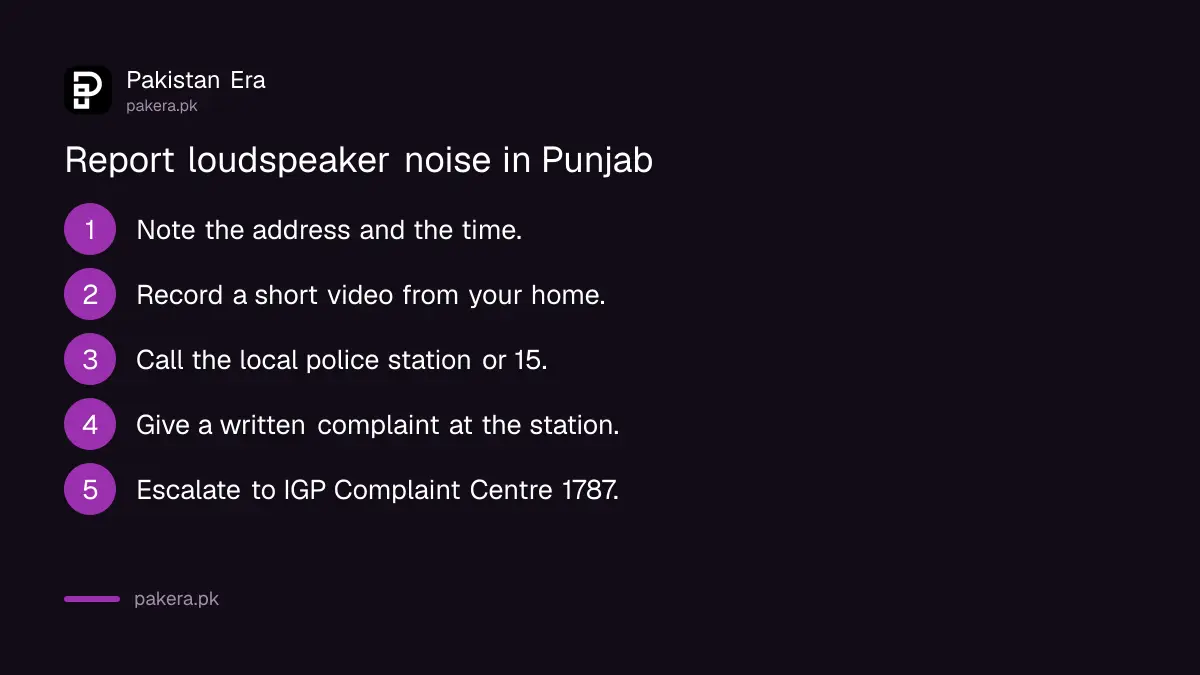
- Note the details. The address, the time it started, and what it is: a wedding, a shop, a rally or a place of worship.
- Record it. A short video from your own home with the time showing is the best proof that the sound reaches beyond ten yards.
- Ask politely once, if it is safe to do so. Many organisers do not know the law.
- Call the police. Use the local police station's number or 15, the police emergency line. Mention the Punjab Sound Systems (Regulation) Act 2015.
- Go to the station if it keeps happening. Give a written complaint and ask for a receipt.
- Escalate to the Punjab Police IGP Complaint Centre, which the police website lists as 1787, or the Pakistan Citizen's Portal.
For a complaint that keeps getting closed without action, the Pakistan Citizen's Portal is the next step. Learn how to use the Pakistan Citizen's Portal and attach your videos. Keep a list of emergency numbers in Pakistan for real emergencies, and do not tie up 15 with a complaint that can wait for morning.
Punishment for loudspeaker misuse in Punjab
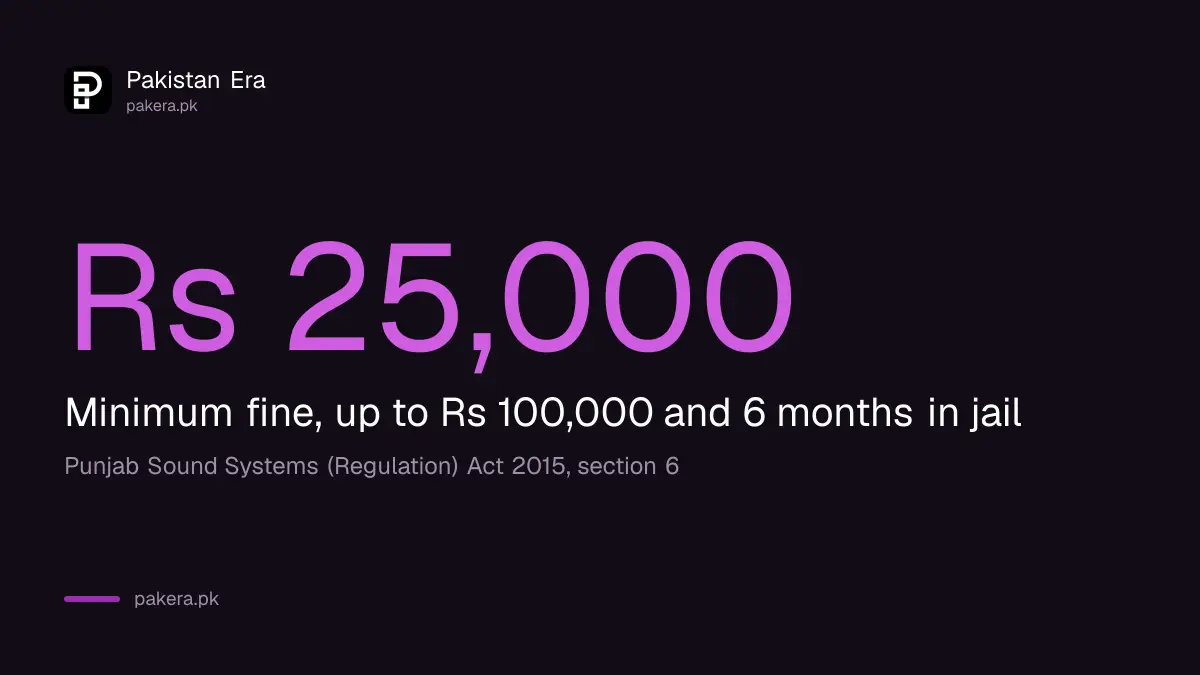
A person who breaks section 3 or 4 faces up to six months in jail and a fine of at least Rs 25,000 and at most Rs 100,000. A first class magistrate tries the case summarily. The court can also confiscate the loudspeaker or amplifier.
The government can settle, or "compound", a first offence instead of a trial, on payment of an administrative penalty of at least Rs 25,000. That option is not available to a repeat offender whose earlier case was convicted or compounded.
The Act also puts duties on the police. The officer in charge of each police station must inspect the sound systems of every place of worship at regular intervals and keep a record. Each district police head must send the government a monthly report on how the Act is being enforced.
Weddings, events and the 10 pm limit
A wedding at home is not exempt. If the sound annoys neighbours beyond ten yards, section 3 applies. Weddings at a public place, such as a marriage hall, must also end by 10 pm under a separate law. A street event with a speaker needs prior permission under section 4(2)(b).
Punjab's wedding rules under the marriage functions law set that 10 pm finish for ceremonies at public places. That is a separate rule from the Sound Systems Act. A function can finish on time and still break the noise law if the speaker is too loud.
If you are the one organising, the safest course is simple. Keep speakers indoors, point them away from neighbours, and turn them off well before people sleep.
Common questions
Is it illegal to play loud music in Punjab?
Yes, if it annoys or disturbs people nearby. Section 3 of the Punjab Sound Systems (Regulation) Act 2015 makes it an offence.
What is the fine for loudspeaker misuse in Punjab?
Between Rs 25,000 and Rs 100,000, and up to six months in jail. The court can also confiscate the equipment.
How many loudspeakers can a mosque use in Punjab?
Up to four external speakers, after the 2018 amendment, and only for the azan, the Arabic khutba on Friday and Eid, death announcements and lost or found announcements.
Who do I complain to about loudspeaker noise?
The local police station. Police can act without a court order and can seize the equipment.
Do I need permission to use a loudspeaker at an event in Punjab?
Yes, for a speaker outside in a public place. The Act requires prior permission from the government or an authorised officer.
Can the police take away the sound system?
Yes. Section 7 lets an officer of Assistant Sub-Inspector rank or above seize it and produce it before the court.
How we verified this
What we checked, where we read it, and what we could not confirm.
Last checked on 1 October 2026. We read the full text of the Punjab Sound Systems (Regulation) Act 2015 on the Punjab Code, including the 2018 amendment shown in it, and the Punjab Police IGP Complaint Centre page on punjabpolice.gov.pk. We could not find rules under the Act that set exact times or sound levels for homes, or a notification naming the officer who gives permission, so we have not stated either. The 15 police emergency number is long standing and not something we read on a page today.
About the author

Tax, Bills and Technology Writer
Ali Akhtar is a young and curious voice here at Pakistan Era. He is currently pursuing his A-Levels and has a growing interest in Pakistan’s changing industrial landscape and educational trends. Ali likes to write in a way that helps him explain and explore the world around him. His writing reflects the perspective of the new generation navigating the evolving trends of Pakistan where technology, youth innovation, and shifting opportunities are reshaping the country’s future.