Punjab Weddings Must End by 10pm and Serve One Dish
The Marriage Functions Act sets a 10pm close and a one dish limit, defines one dish item by item, and fines run to two million rupees.

A wedding at any public place in Punjab must end by 10:00 pm and may serve only one dish. The fine starts at fifty thousand rupees and runs to two million, and the hall owner is liable as well as the family.
The Act also defines what one dish means, item by item, so the argument about whether a menu complies has an answer in the statute.
We read the Punjab Marriage Functions Act 2016 on 6 September 2026 in the text published by the Law and Parliamentary Affairs Department, Government of the Punjab.
What the Act allows and forbids
| Point | What the Act says |
|---|---|
| Closing time | All ceremonies concluded on or before 10:00 pm |
| Food | One dish only, at a public place |
| Fireworks and firing | Not allowed, including crackers and firearms |
| Street decoration | Only the building where the ceremony is held |
| Dowry display | Not to be displayed to the public eye |
| Penalty | Up to one month simple imprisonment, fine fifty thousand to two million rupees |
Marriage is defined widely enough to catch the whole sequence, including mayun, mehndi, barat, nikah, rukhsati and walima.
One dish has a definition
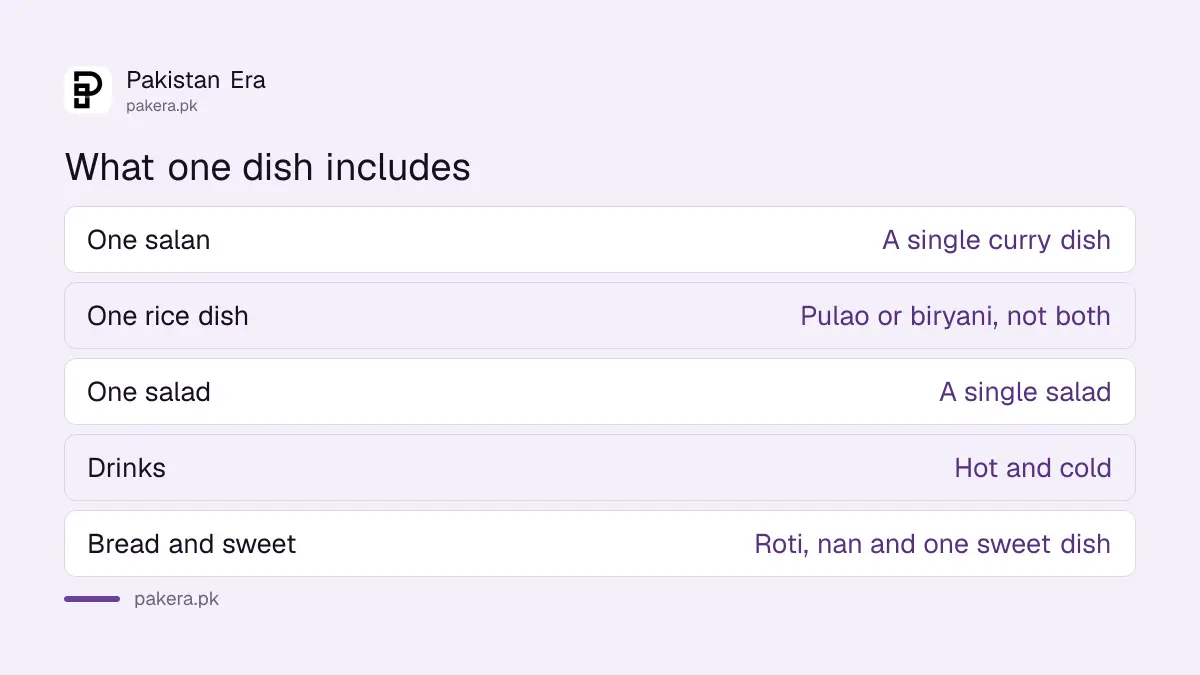
Section 2 defines one dish as one salan, one rice dish, one salad, hot and cold drinks, roti, nan and one sweet dish.
That is more generous than the phrase sounds, and it is also a closed list. A second salan is not inside it. A second sweet dish is not inside it.
Section 4 places the duty on the family. A person celebrating their marriage, or organising somebody else's, shall not serve or allow anyone to serve meals or other edibles at a public place except one dish.
Section 5 places the same duty on the venue. A person owning, managing or running the public place, or a caterer, shall not serve or allow the service of anything beyond what section 4 permits.
So a hall that offers a fuller menu is putting itself inside the offence, not only the client.
Where the rules apply
A public place under the Act means a club, hotel, restaurant, wedding hall, community centre, community park, an open space, or any private property hired for a marriage.
The last item is the one people miss. Hiring a private lawn or a house that is not your own for the function brings it inside the definition.
The prohibitions in section 3 on decoration, fireworks and dowry display are written against the person celebrating or organising the marriage, without the public place qualifier that sections 4 and 5 carry.
The 10:00 pm rule sits on the venue
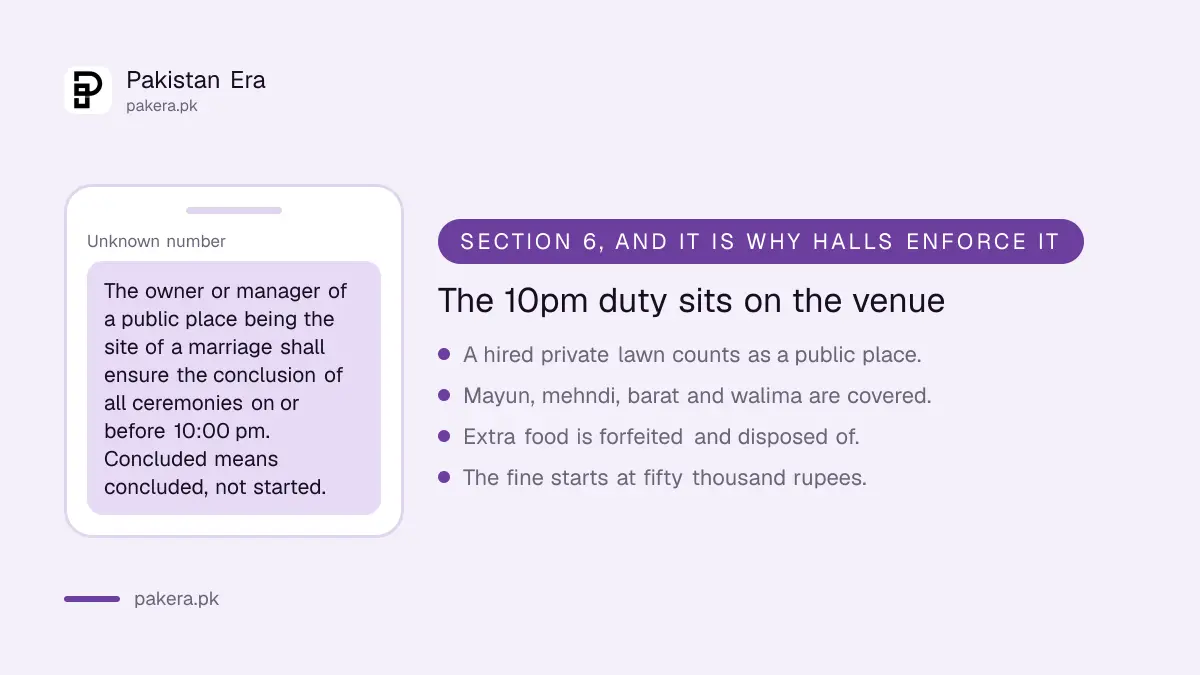
Section 6 is short. A person owning, managing or running a public place being the site of a marriage shall ensure the conclusion of all ceremonies relating to the marriage on or before 10:00 pm.
The duty is on the venue, which is why halls enforce it. Ceremonies concluded means concluded, not started.
When you book, ask what time the hall requires guests to be seated and what time service stops, and get both in writing on the booking slip. A hall that promises a late finish is promising something the Act does not allow it to deliver.
What section 3 actually forbids
- Decorating any street, road or public park, or any place other than the building where the ceremony is held, with lights or illumination.
- Exploding a cracker or other explosive device, including firing by firearms.
- Displaying fireworks.
- Displaying dowry to the public eye.
- Causing nuisance or disturbance to the neighbourhood beyond reasonable celebration.
Aerial firing is the one that turns a wedding into a criminal case beyond this Act as well. Our guide to fireworks and road plans on Independence Day covers the wider position on fireworks and public safety.
How it is enforced, and what it costs
Section 8 sets the punishment for contravening sections 3, 4, 5 or 6. Simple imprisonment which may extend to one month, and a fine of not less than fifty thousand rupees and not more than two million rupees.
Section 9 says the offence is bailable, and is cognizable on a complaint by an officer notified by the Government. A magistrate of the first class tries it summarily on that officer's report. The police must associate the notified officer when entering a public place where a marriage is being held to take cognizance.
Section 10 deals with the food. Anything procured, prepared, arranged or set for serving, to the extent it contravenes the Act, is forfeited and disposed of in the prescribed manner.
That is the practical risk for a family. Not a raid with handcuffs, but food taken away in front of the guests, and a fine that starts at fifty thousand rupees.
Our guide to tax on wedding functions covers the separate money the federal side collects, and our guide to registering a Nikah covers the paperwork after the ceremony.
Common questions
What time must a wedding end in Punjab?
All ceremonies must conclude on or before 10:00 pm, and the duty is on the owner or manager of the venue.
What does one dish mean?
One salan, one rice dish, one salad, hot and cold drinks, roti, nan and one sweet dish.
Does the rule cover a private lawn?
Yes, if it is hired for the marriage. Any private property hired for a marriage is a public place under the Act.
Which ceremonies are covered?
Marriage includes ceremonies before and after the wedding, such as mayun, mehndi, barat, nikah, rukhsati and walima.
What is the fine?
Not less than fifty thousand and not more than two million rupees, with simple imprisonment up to one month.
Is the hall owner liable too?
Yes. Sections 5 and 6 place duties on the owner, manager or caterer as well as on the family.
How we verified this
What we checked, where we read it, and what we could not confirm.
Last checked 6 September 2026. We downloaded the Punjab Marriage Functions Act 2016 from the Punjab Code portal at punjablaws.punjab.gov.pk, in the text published by the Law and Parliamentary Affairs Department, Government of the Punjab, and read it. The Act was passed by the Provincial Assembly of the Punjab on 14 April 2016, assented to on 19 April 2016 and published in the Punjab Gazette (Extraordinary) dated 20 April 2016. The definition of marriage as including ceremonies preceding and succeeding the formal wedding such as mayun, mehndi, barat, nikah, rukhsati and walima; the definition of one dish as one salan, one rice dish, one salad, hot and cold drinks, roti, nan and one sweet dish; the definition of a public place as a club, hotel, restaurant, wedding hall, community centre, community park, an open space or any private property hired for a marriage; section 3 prohibiting decoration of streets, roads and public parks, crackers and firing by firearms, fireworks, display of dowry, and nuisance beyond reasonable celebration; section 4 restricting food at a public place to one dish; section 5 placing the same restriction on the owner, manager or caterer; section 6 requiring conclusion of all ceremonies on or before 10:00 pm; section 8 setting simple imprisonment up to one month and a fine of not less than fifty thousand and not more than two million rupees; section 9 making the offence bailable and cognizable on the complaint of a notified officer with summary trial by a magistrate of the first class; and section 10 requiring forfeiture and disposal of food served in contravention, are all taken from that text. Section 12 repeals the Marriage Functions (Prohibition of Ostentatious Displays and Wasteful Expenses) Ordinance 2000 in its application to the Punjab and the Punjab Marriage Functions Ordinance 2015. This is the Punjab Act and applies in the Punjab. Nothing here is legal advice.
About the author

Tax, Bills and Technology Writer
Ali Akhtar is a young and curious voice here at Pakistan Era. He is currently pursuing his A-Levels and has a growing interest in Pakistan’s changing industrial landscape and educational trends. Ali likes to write in a way that helps him explain and explore the world around him. His writing reflects the perspective of the new generation navigating the evolving trends of Pakistan where technology, youth innovation, and shifting opportunities are reshaping the country’s future.