How to Check a Vaccine or Antivenom Lot Is Released by DRAP's NCLB in Pakistan
DRAP's NCLB must release every vaccine and antivenom lot before sale. Search your batch number in the 2026 table of 410 lots and check the status says Released.
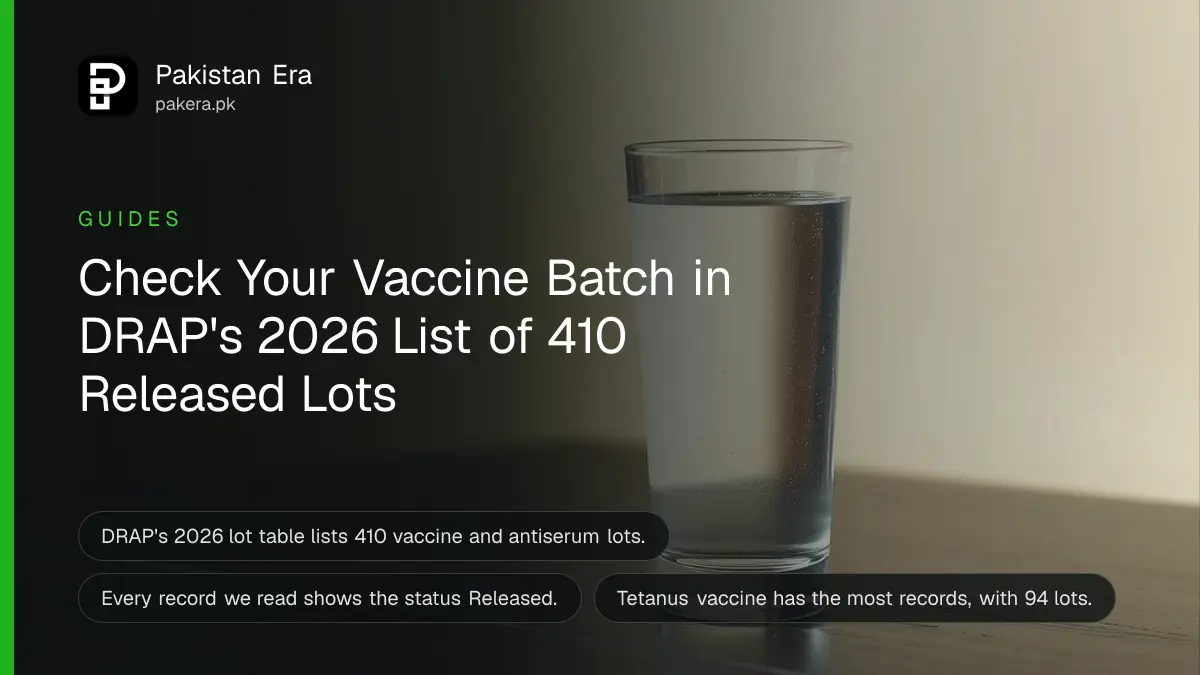
Short answer: Every lot of a human vaccine, blood product or antivenom must get a Lot Release Certificate from DRAP's National Control Laboratory for Biologicals (NCLB) before sale. DRAP publishes the 2026 lot list as a public table. Find your batch number in it and check that the status says Released.
A tetanus shot after a rusty nail. A rabies course after a dog bite. A vial of snake antiserum in a district hospital. In each case the patient trusts a cold-chain product that cannot be tested at the bedside. Pakistan has a legal check for exactly this, and DRAP puts the results online. We opened the NCLB lot release page on 15 October 2026 and read the 2026 table, which DRAP's file name dates to 16 September 2026.
The law bars sale of a biological until NCLB releases the lot
DRAP's NCLB page quotes the DRAP Act 2012: no human biological drug may be sold or used until a Lot Release Certificate has been obtained from the Federal Government Analyst of the National Control Laboratory for Biologicals in Islamabad. The rule covers local and imported lots.
A "lot" or "batch" is one production run, marked with a batch number on the vial or the box. NCLB reviews the maker's summary protocol, which is the maker's own test record for that lot. For some lots it also tests samples itself. Only then does it release the lot to the market.
DRAP's guideline for lot release has a fourth edition, effective 18 March 2026. It covers human vaccines, blood products made from plasma, and anti-sera. NCLB says it can test vaccines, albumins, antibodies, toxins and antitoxins, clotting factors, plasma pools and hormones.
The 2026 table lists 410 lots, all marked Released
The 2026 file runs from 2 January to mid September. We counted 410 lot records, and every one shows the status Released. The table rows carry the brand, the product, the importer or maker, the batch number, the manufacture and expiry dates, a certificate number and the release date.
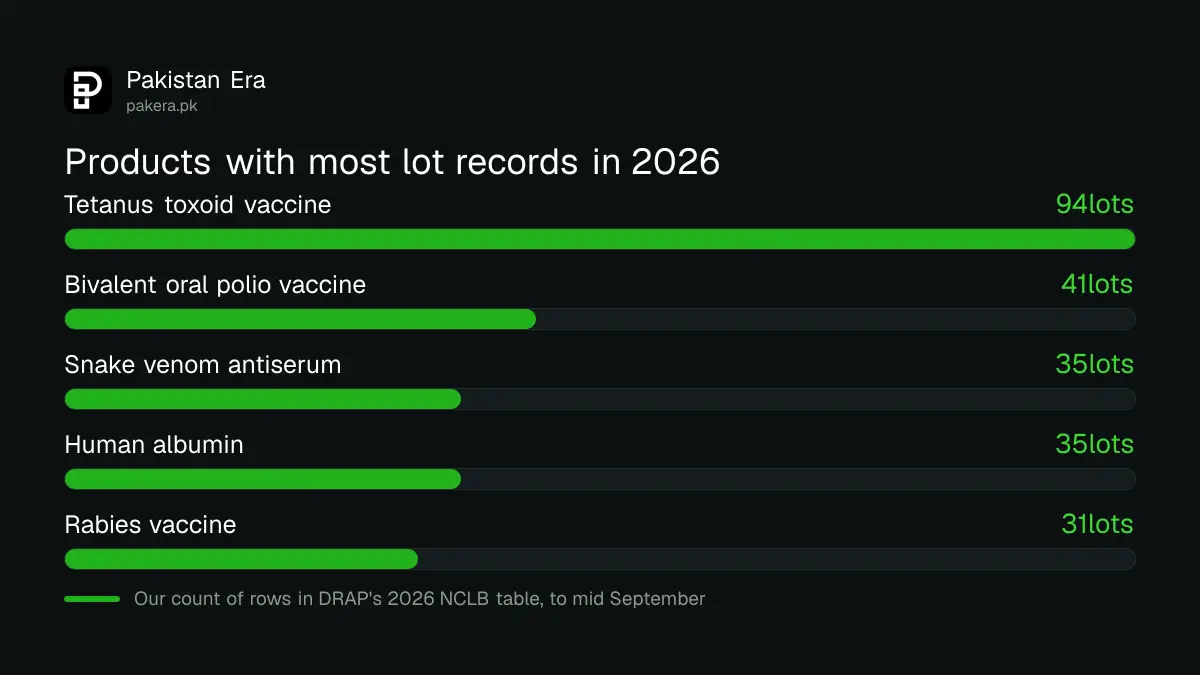
Five products make up more than half of the records. Tetanus toxoid vaccine has the most lots, followed by oral polio vaccine, snake venom antiserum, human albumin and rabies vaccine.
| Product | Lot records in 2026 table |
|---|---|
| Tetanus toxoid vaccine | 94 |
| Bivalent oral polio vaccine | 41 |
| Snake venom antiserum | 35 |
| Human albumin | 35 |
| Rabies vaccine | 31 |
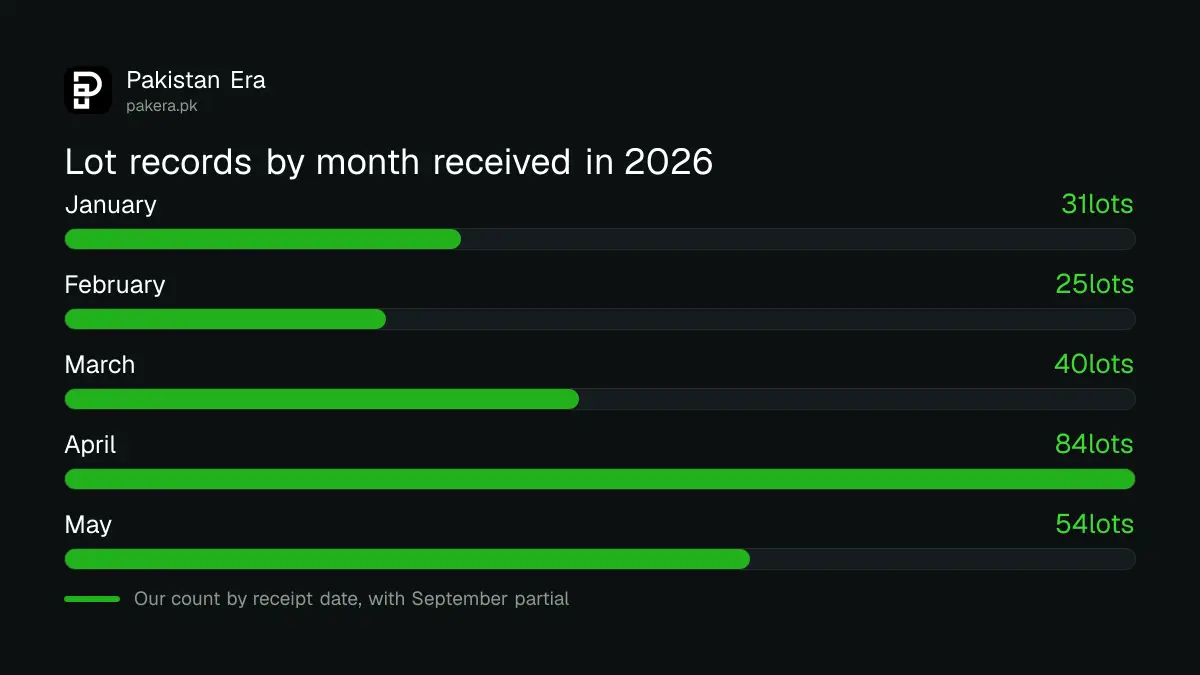
The count is ours, taken from the rows of DRAP's file, not a DRAP total. By receipt date the busiest month was April, with 84 lots. September had 14 because the file stops mid month.
Read one row to see what a release record shows
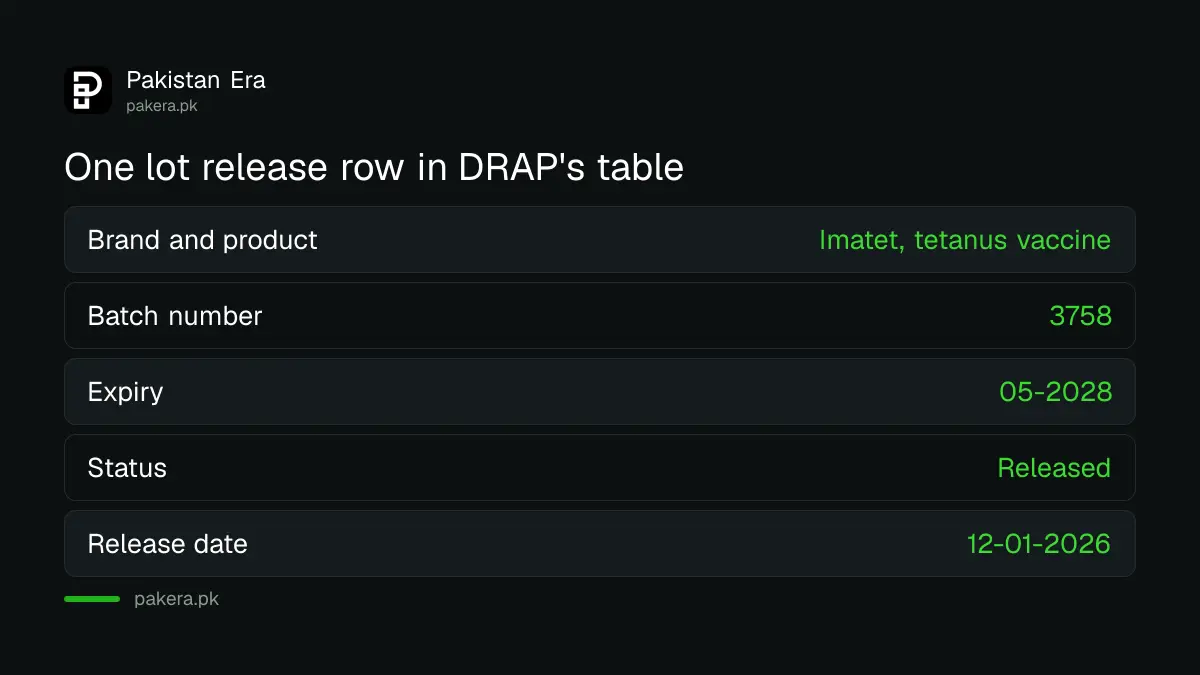
A row tells you the batch was reviewed and when. One example in the file is a tetanus toxoid vaccine sold under the brand Imatet, made by a company in Islamabad. Batch 3758 shows a manufacture date of 06-2025, an expiry of 05-2028 and a release date of 12-01-2026.
Another row is a snake venom antiserum with batch 01AS25111, made in India, with an expiry of 07-07-2029 and a release date of 16-01-2026. Each row also gives a pack type, such as ampoule or vial, and a certificate number.
The status column is the part to read. In the file we saw, the word is Released on every line. If your batch is not there, that is not proof it is bad. The file is a list up to a date, and a new lot may not be added yet.
Check your own batch in six steps
You need the batch number from the vial, ampoule or box. It is usually printed beside the expiry date. A photo of the label on your phone is enough, so take it before the pack is thrown away.
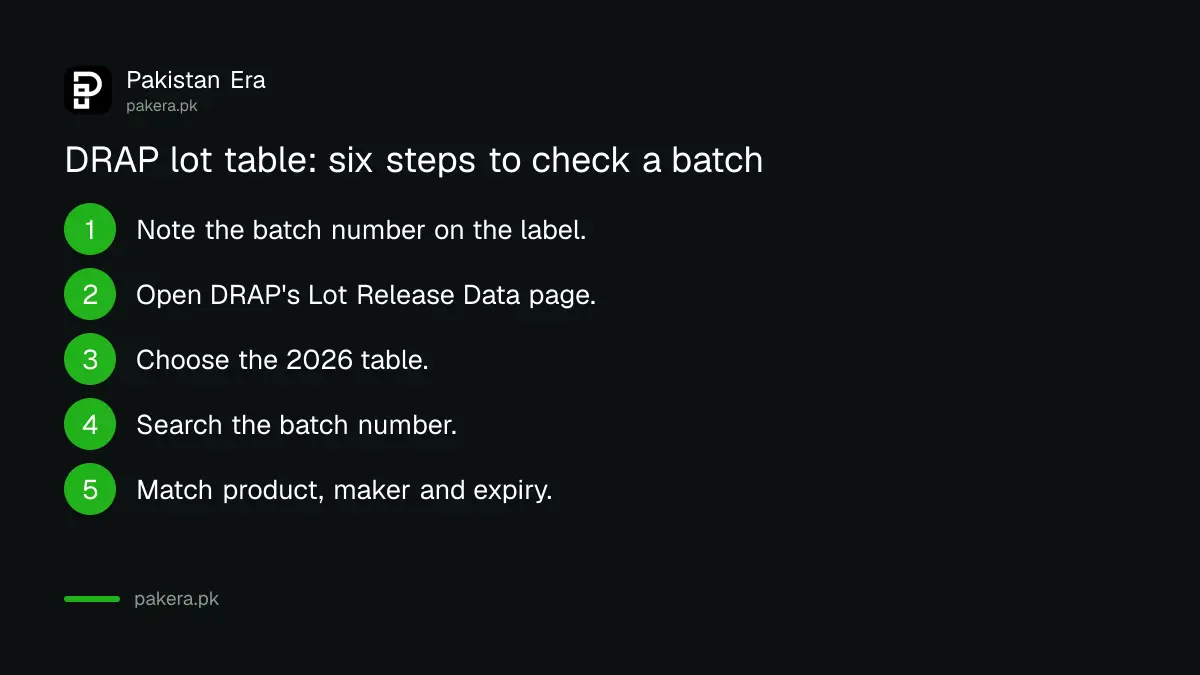
- Note the product name, the batch number and the expiry date from the label.
- Open DRAP's Lot Release Data page and choose the year, 2026 for a new pack.
- Open the table file and search for the batch number.
- Match the product, the maker and the expiry date in that row.
- Check that the status says Released and note the release date.
- If the batch is missing, ask the clinic or the importer and write to DRAP.
Search the batch number exactly as printed. Some batch numbers mix letters and digits, and a missing character will give no match. If your pack is from an earlier year, the page also links the 2016 to 2025 tables.
Missing from the table is a reason to ask, not to panic
The table is large and updated in batches. DRAP's 2025 file was uploaded on 20 January 2026 for the complete year, and the 2026 file on 16 September 2026. A lot released last week may not show yet. A lot from a donation or a government programme may be listed under a programme name.
For example, oral polio vaccine lots in the file appear under an importer such as a provincial medical store or the Federal Directorate of Immunization. Free vaccines at government centres are part of the programme described in the baby vaccination schedule.
If a clinic charges for a vaccine and cannot show a batch number, treat that as a red flag. Ask for the product box, not just the syringe. And if you suspect a fake, DRAP's channel is in how to report counterfeit medicine.
The same check helps after a bite or a booster
The table is most useful when the product matters and time is short. After a dog bite, the rabies course is a series of doses, and you can read the batch of each dose. The first steps after a bite are in what to do after a dog bite.
For adults, the shots to ask about are listed in typhoid, hepatitis B, tetanus and flu vaccines for adults. In each case, check the batch after the dose, not before the dose in an emergency. Treatment should not wait for a table search.
Common questions about vaccine lot release in Pakistan
What is a lot release certificate?
It is a certificate from NCLB, DRAP's national control laboratory for biologicals, saying a lot has been reviewed and, where needed, tested. DRAP says no human biological drug can be sold until it is issued.
Where do I find a vaccine batch number?
Look on the vial, ampoule or outer box. It is usually printed next to the expiry date and may be marked Batch, Lot or B.No.
Does DRAP publish lot release data for the public?
Yes. The NCLB Lot Release Data page links a table for each year from 2016 to 2026. We read the 2026 table, which lists 410 lots.
Which products are in the 2026 table?
Tetanus, polio, rabies, hepatitis B, meningococcal, varicella, flu and typhoid vaccines are in it. So are snake venom antiserum, human albumin and several immunoglobulins.
My batch is not in the table. Is the vaccine fake?
Not necessarily. The table is updated in batches and may lag. Ask the importer or clinic for the lot release record, and report to DRAP on 0800-03727 if they cannot give one.
Does this check replace a doctor's advice?
No. It tells you a lot was released by NCLB. It says nothing about your health or your dose, so follow the doctor or health worker.
How we verified this
What we checked, where we read it, and what we could not confirm.
Last checked 15 October 2026. The legal rule and the NCLB testing scope come from DRAP's National Control Laboratory for Biologicals page at dra.gov.pk. The lot counts, products and example rows come from DRAP's 2026 lot release table, which we downloaded and counted on 15 October 2026. The guideline details come from DRAP's lot release guideline, fourth edition. We did not test any vaccine or check any pack. All counts are our own tally of the file rows. DRAP can update the table at any time.
About the author

Tax, Bills and Technology Writer
Ali Akhtar is a young and curious voice here at Pakistan Era. He is currently pursuing his A-Levels and has a growing interest in Pakistan’s changing industrial landscape and educational trends. Ali likes to write in a way that helps him explain and explore the world around him. His writing reflects the perspective of the new generation navigating the evolving trends of Pakistan where technology, youth innovation, and shifting opportunities are reshaping the country’s future.