How to Report Counterfeit Medicine to DRAP in Pakistan
Report suspected counterfeit or spurious medicine to DRAP with its Quality Defect form. What to keep, what happens after you report, and how fakes get seized.
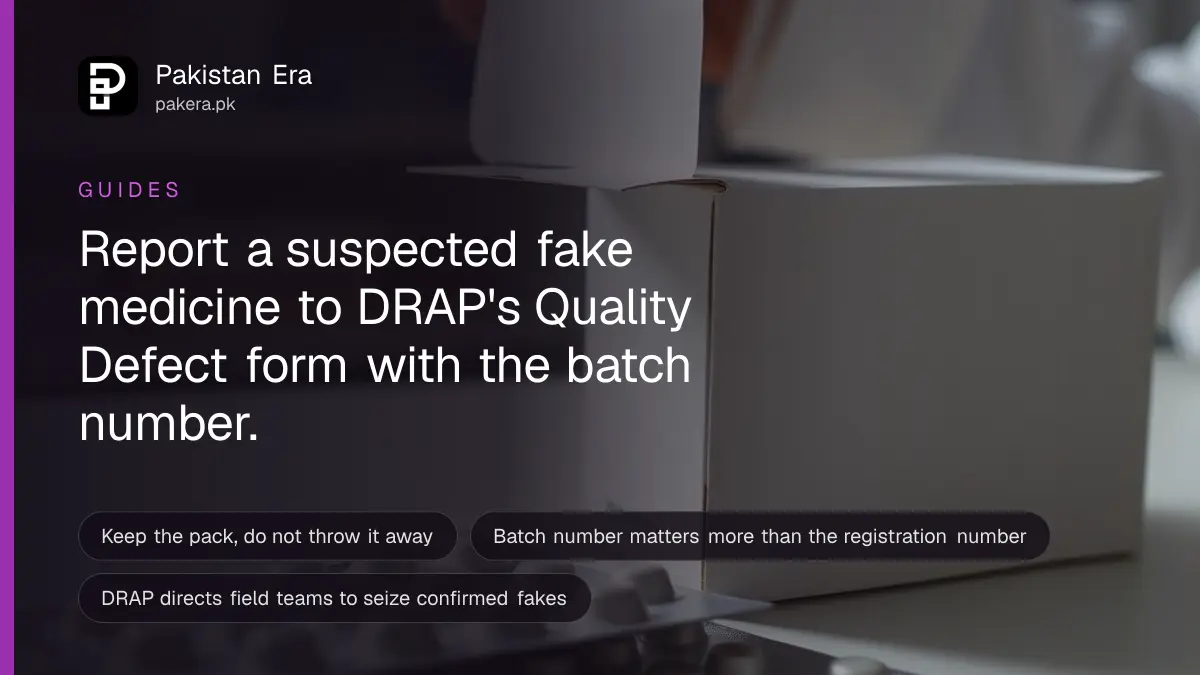
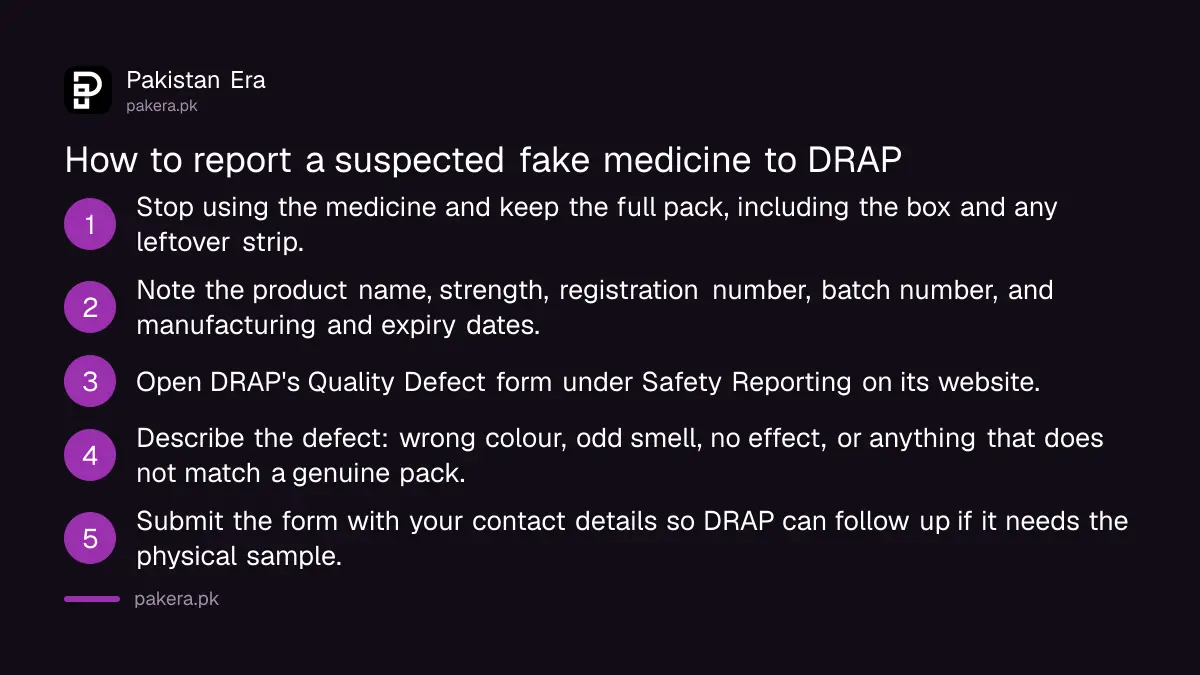
To report a suspected fake medicine, keep the full pack, note the product name, registration number, batch number, and manufacturing and expiry dates, then file DRAP's Quality Defect form under Safety Reporting on dra.gov.pk. This is a different channel from reporting a side effect, and it is the one that actually triggers lab testing and a possible seizure.
We read DRAP's own Quality Defect page directly on 4 October 2026. It asks for your contact details, the full product description down to the batch number, and whether you still have a sample available for testing. That last part matters more than people think: without the physical pack, DRAP's field team has nothing to send to a lab.
Counterfeit medicine is not a rare problem in Pakistan. DRAP has issued multiple Rapid Alerts through 2026 naming specific fake batches found carrying real registration numbers, which is exactly why checking the registration alone is not enough, and why reporting what you find matters.
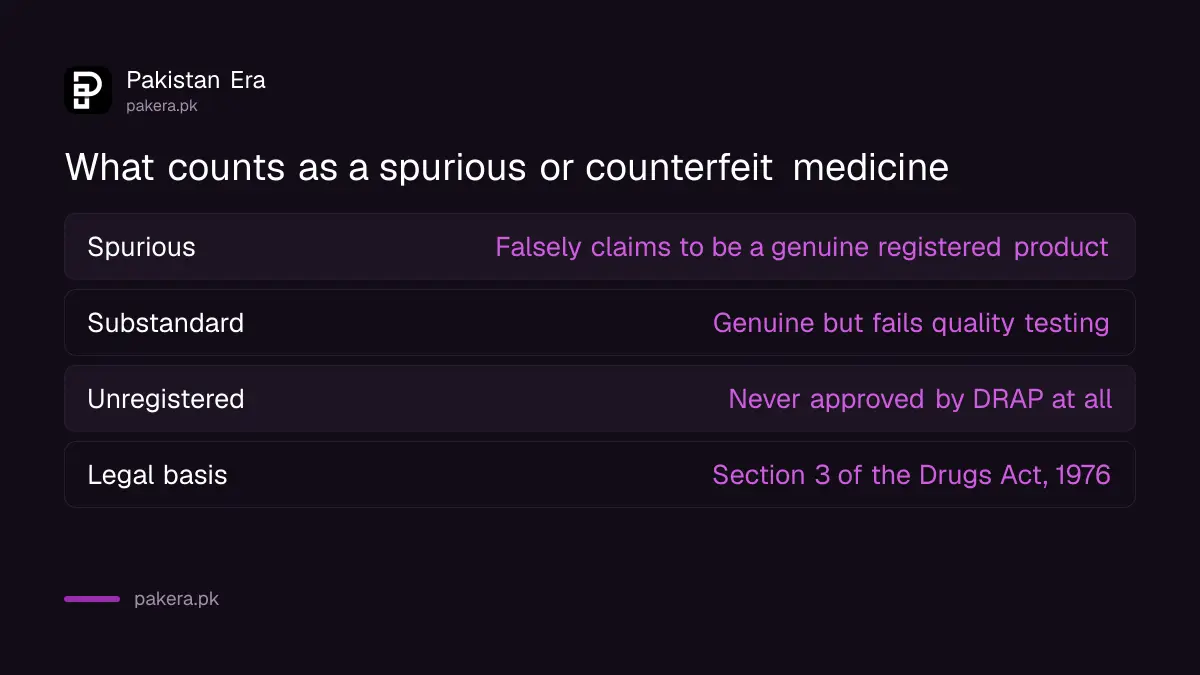
A spurious medicine and a substandard one are legally different
A spurious medicine is one that falsely passes itself off as a genuine registered product, while a substandard medicine is a real product that fails quality testing, and an unregistered one was never approved by DRAP at all. These sit under different parts of the Drugs Act, 1976, and DRAP treats them differently.
This distinction decides what happens next. A spurious batch gets pulled as a counterfeiting and enforcement matter, with provincial drug inspectors directed to seize stock. A substandard batch, from a real manufacturer, triggers a different kind of recall aimed at that company's production process.
You do not need to know which category your find falls into before reporting it. DRAP's Quality Defect form is built to take the description and sort out the classification on its side, through lab testing.
| Term | What it means |
|---|---|
| Spurious | Falsely claims to be a genuine registered product |
| Substandard | Genuine product that fails quality testing |
| Unregistered | Never approved by DRAP in the first place |
File DRAP's Quality Defect form, not the side effect form
The Quality Defect form is DRAP's channel for a suspected fake, wrong, or physically off product, separate from the Adverse Event form used for a bad reaction to a genuine medicine. Using the right one the first time avoids a report sitting in the wrong queue.
We read the form's own fields directly on DRAP's site. It is organised in three parts.
- Reporter information: your title, full name, contact number, mobile, email, address and city.
- Product information: the product name, strength, active ingredients, dosage form, packaging, registration or enlistment number, batch number, manufacturing and expiry dates, the manufacturer, and where you bought it.
- Quality defect details: a description of what is wrong, whether you have reported it anywhere else, whether a sample is still available, and your consent to be contacted for follow-up.
The form sits under Safety Reporting on dra.gov.pk. Once submitted, DRAP's own text says the report goes to its complaint handling system for further action, not into a general inbox.
Keep the sample, since DRAP's process depends on testing it
DRAP's own form explicitly asks whether a sample is still available, because a physical pack is what gets sent for lab testing. A description alone, without the product, usually cannot be confirmed as spurious.
Stop using the medicine the moment you suspect it. Do not throw away the box, the strip, or any leftover tablets or liquid, even if you already bought a replacement. The batch number on the pack is often the single detail that separates a one-off bad pack from a wider counterfeit batch DRAP needs to pull from shelves.
If you already consulted a doctor or pharmacist about the medicine, mention that in the form. It helps DRAP judge how urgently to act, and whether other patients nearby may have the same batch.
If the medicine actually caused a reaction rather than simply looking wrong, that is a separate report. The steps for reporting a medicine side effect use a different DRAP form built around patient harm, not product counterfeiting.
What DRAP does once a report is confirmed
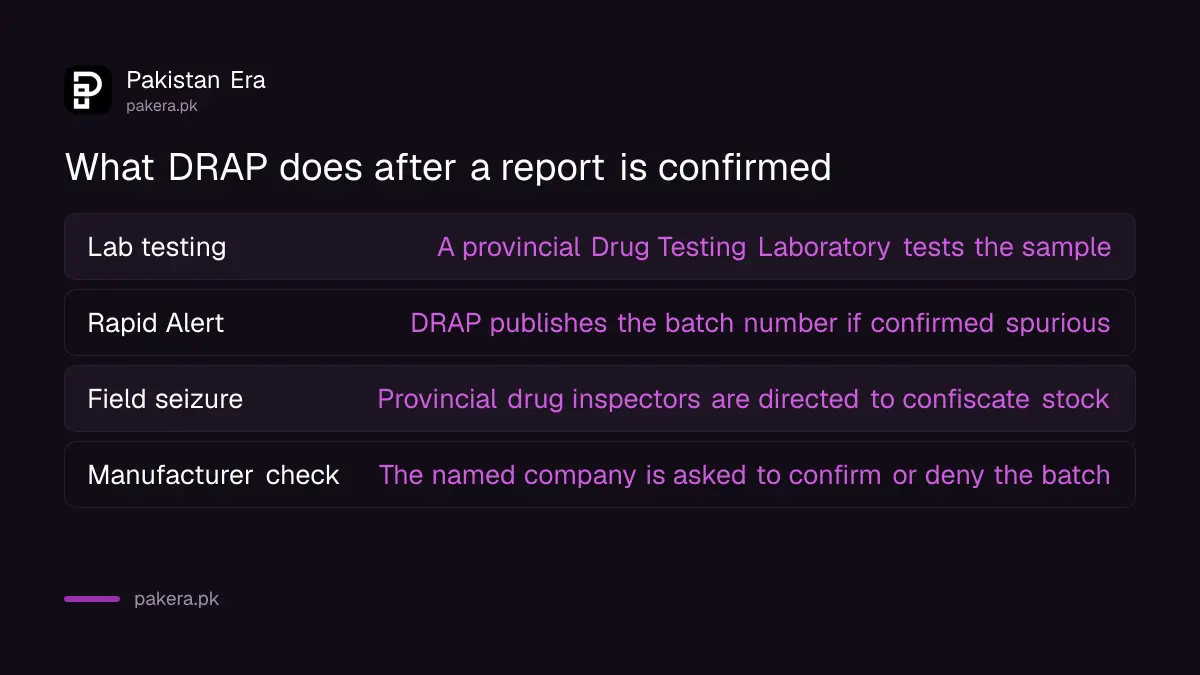
Once DRAP's assessment and lab testing confirm a product is spurious or substandard, it investigates the manufacturing site and supply chain, issues a public Rapid Alert naming the exact batch, and directs provincial drug control departments to seize remaining stock from the market.
We read one of DRAP's own rapid alert pages directly. It instructs consumers holding a named batch to report it to DRAP and to see their physician, and tells healthcare professionals to pass supplier information to DRAP's regulatory field force. The provincial angle is real: drug inspectors on the ground, not DRAP's federal office alone, are the ones confiscating stock from pharmacies.
A confirmed manufacturer is also asked to confirm or deny the batch. In past alerts, companies have stated publicly that a counterfeit batch carrying their name was not something they produced, which is part of how DRAP separates a genuine quality failure from outright counterfeiting of someone else's brand.
| Step | What happens |
|---|---|
| Lab testing | A provincial Drug Testing Laboratory tests the reported sample |
| Rapid Alert | DRAP publishes the batch number if confirmed spurious |
| Field seizure | Provincial drug inspectors are directed to confiscate stock |
| Manufacturer check | The named company is asked to confirm or deny the batch |
Checking the registration number first can still help
Before you report, it is worth a quick check of whether the registration number on the pack even exists, since that can shape what you tell DRAP. A number the index cannot find is a different kind of problem from a real number used on a fake pack.
DRAP's own records have shown real registration numbers appearing on confirmed spurious products, so a match on the registration index does not clear a pack. If you want to run that check yourself before filing the Quality Defect form, the steps for using DRAP's registered drugs search cover exactly that, though it is a separate tool from the reporting form this article covers.
Either way, the registration number is only one field on the Quality Defect form. Fill in the batch number too, since that is usually what ties a specific report to a specific alert.
If what bothers you is the price rather than the product itself, that is a separate complaint. Overcharging above the printed maximum retail price runs through the Pakistan Citizen's Portal, not the Quality Defect form.
Common questions
Where do I report a suspected counterfeit medicine in Pakistan?
Through DRAP's Quality Defect form, found under Safety Reporting on dra.gov.pk. It is a separate channel from the form used for reporting a side effect.
What information does DRAP's Quality Defect form ask for?
Your contact details, the product name, strength, registration number, batch number, manufacturing and expiry dates, the manufacturer, where you bought it, and a description of the defect.
Should I throw away a medicine I think is fake?
No. Keep the full pack and any leftover tablets or liquid. DRAP's form asks whether a sample is still available, since testing it is how a report gets confirmed.
What is the difference between a spurious and a substandard medicine?
A spurious medicine falsely claims to be a genuine registered product. A substandard one is genuine but fails quality testing. Both are treated differently once confirmed.
Is reporting a fake medicine the same as reporting a side effect?
No. A suspected fake goes through the Quality Defect form. A reaction to a genuine medicine goes through DRAP's separate Adverse Event reporting channel.
What happens after DRAP confirms a medicine is fake?
DRAP publishes a Rapid Alert with the batch number and directs provincial drug control departments to seize remaining stock from pharmacies carrying that batch.
How we verified this
What we checked, where we read it, and what we could not confirm.
Last checked on 4 October 2026. The Quality Defect form's fields and DRAP's description of its post-submission process were read directly on dra.gov.pk's safety reporting pages. The seizure and field force process was read directly on one of DRAP's own rapid alert pages. The general distinction between spurious, substandard and unregistered medicine reflects the framework of the Drugs Act, 1976, though a specific subsection was not read on a primary legal text in this check. We did not submit a test report ourselves.
About the author

Senior Writer, Public Services and Technology
Shahid joined us in 2024 as an author. He is a senior contributor to Pakistan's leading technology websites. He writes detailed articles, mostly covering his expertise in the latest tech, mobiles, apps, gadgets, and step-by-step guides. His ideology is to help people understand the latest trends and explain complex methods through very easy-to-understand guides.