Maternity Leave Rights for Private Sector Employees in Pakistan
Most provinces still run on 12 weeks fully paid under a 1958 law, while Sindh gives 16 weeks under its own 2018 Act. What you are owed, and by which law.
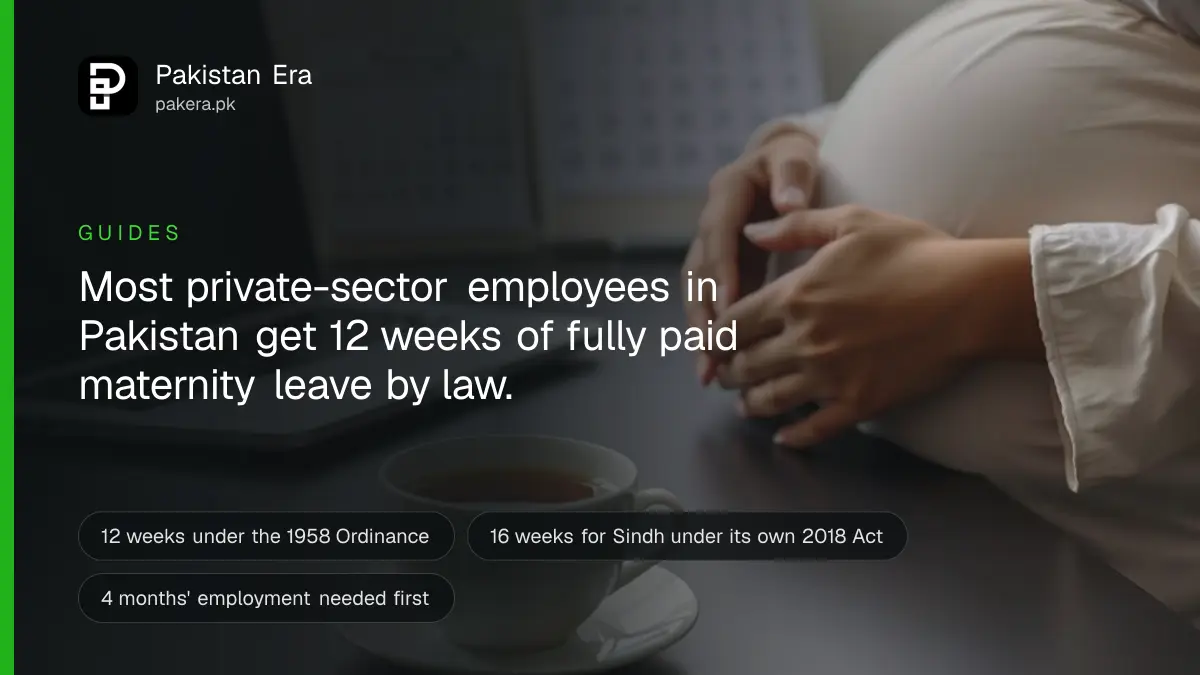
A private-sector employee in Punjab, Khyber Pakhtunkhwa or Balochistan is entitled to 12 weeks of fully paid maternity leave once she has completed four months of service, under a law that dates back to 1958. Sindh raised this to 16 weeks under its own 2018 Act, and dismissing a woman during her leave is against the law everywhere.
This is a different question from claiming a cash payment from the social security department, which is a separate process with its own form and office. This page is about what the law itself entitles you to from your employer, and which law applies depends on where you work.
The old law still covers most of the country
Punjab, Khyber Pakhtunkhwa and Balochistan private-sector employers still operate under the West Pakistan Maternity Benefit Ordinance, 1958. It gives 12 weeks of maternity leave, fully paid, once an employee has worked at least four months for that employer.
| Province or scope | Governing law | Leave duration |
|---|---|---|
| Punjab, KP, Balochistan | West Pakistan Maternity Benefit Ordinance, 1958 | 12 weeks, fully paid |
| Sindh | Sindh Maternity Benefits Act, 2018 | 16 weeks, fully paid |
| Federal government establishments | Maternity and Paternity Leave Act, 2023 | Up to 180 days, first child |

We read the 1958 Ordinance's wording on a law firm's page reproducing it, since the government PDFs hosting the same text on wdd.punjab.gov.pk and balochistan.gov.pk would not convert to readable text when we checked. Both confirm the Ordinance is still published as current law by two provincial governments, even though we could not extract its exact wording from those copies ourselves.
Pay is based on your wage before leave, not a flat rate
The Ordinance calculates your maternity pay using your wages over the six weeks immediately before the leave starts, not your base salary alone or an average over a longer period. A recent raise or a run of overtime in those six weeks changes the number.
This matters most for anyone paid partly on commission or shift allowances, where the six weeks before leave can look very different from a quiet month three months earlier. Ask your employer in writing which six weeks they are using to calculate it, before the payment is made rather than after.
Sindh employees get more, under a newer law
Sindh passed its own maternity law in 2018, giving 4 weeks before childbirth and 12 weeks after, which is 16 weeks in total and longer than the 1958 Ordinance everywhere else. It also adds extra leave for a miscarriage, a stillbirth or a premature delivery.
- Four weeks of leave before the expected date of delivery.
- Twelve weeks of leave after childbirth, paid at the regular wage rate.
- One additional week of leave in the case of a miscarriage.
- Four additional weeks in the case of a stillborn delivery.
- Sixteen additional weeks in the case of a premature delivery.

Sindh's law also sets a longer qualifying period, reported at one year of service rather than four months, so a Sindh employee newer to a job may actually qualify later than someone in another province under the older Ordinance. Check your own hire date against this before assuming the longer Sindh leave applies to you automatically.
A federal law exists, but it does not cover every private company
The Maternity and Paternity Leave Act, 2023 gives up to 180 days of fully paid leave for a first child, 120 days for a second and 90 for a third, which sounds far larger than anything above. The catch is its scope, since it applies to establishments under the administrative control of the Federal Government, not to private companies generally across the country.
If you work for an ordinary private firm registered under a provincial government, this federal Act most likely does not reach you, and your entitlement comes from your province's own law instead. We flag this because the 180-day figure circulates widely online without the scope limit attached, and reading it as a universal private-sector right is a mistake.
Dismissal during leave, and the trap it closes
The 1958 Ordinance makes it unlawful to dismiss a woman during her maternity leave. It separately targets a specific trick, dismissing her in the months before delivery purely to avoid paying the benefit she would otherwise be owed.
That second rule exists because a straightforward ban on dismissal during leave would do nothing if an employer could simply let someone go two weeks before it starts. Both protections sit in the same section, and reported legal commentary attributes them to Section 7 of the Ordinance.
- A dismissal notice served during maternity leave is unlawful, not merely a dispute to raise later.
- Being let go shortly before your due date, without another clear reason, is covered by the same protection.
- Your right to return to your post applies once the leave period ends.
- Keep your notice of pregnancy and any dismissal paperwork, since timing is the whole argument in this kind of case.
None of this stops a genuine, unrelated dismissal for cause. It stops a dismissal used as cover to avoid the leave and the pay that comes with it.
What to do if your employer refuses
Start by putting your request in writing, stating your hire date and the expected delivery date, so there is a paper trail if the employer later disputes the timeline. Most disputes at this stage are about documentation, not the law itself.
If an employer still refuses the leave or the pay, a labour department complaint in your province, or legal advice from an employment lawyer, is the next step. This is a workplace rights question, not a government cash-benefit claim, so it does not go through NADRA or a social security office.
Common questions
How many weeks of maternity leave does the law give in Pakistan?
12 weeks in Punjab, KP and Balochistan under the 1958 Ordinance, and 16 weeks in Sindh under its own 2018 Act. A federal law gives more, but only for establishments under federal administrative control.
How long do I need to work before I qualify for maternity leave?
At least four months under the 1958 Ordinance. Sindh's own Act is reported to require at least one year of service instead.
Is maternity leave paid in full in Pakistan?
Yes, under both the 1958 Ordinance and the Sindh Act, paid at the employee's regular or recent wage rate rather than a reduced rate.
Can my employer fire me while I am on maternity leave?
No. Dismissal during maternity leave is unlawful under the 1958 Ordinance, and so is dismissing someone shortly before delivery to avoid paying the benefit.
Does the 180-day federal maternity leave apply to all private companies?
No. It applies to establishments under the administrative control of the Federal Government, not to private companies generally across the provinces.
What extra leave does Sindh give for a miscarriage or premature birth?
One additional week for a miscarriage, four for a stillbirth and sixteen for a premature delivery, on top of the regular leave, under Sindh's own Act.
How we verified this
What we checked, where we read it, and what we could not confirm.
Last checked on 4 October 2026. The 1958 Ordinance's leave duration, qualifying period and wage calculation are read on a law firm's reproduction of the Ordinance's text, since the government-hosted PDF copies on wdd.punjab.gov.pk and balochistan.gov.pk would not extract as readable text on the date checked, though both confirm the Ordinance remains in current provincial publication. The Sindh Maternity Benefits Act 2018 figures and the Maternity and Paternity Leave Act 2023 scope and durations are reported from press coverage and legal commentary summarising each Act's section numbers, for the same reason, the primary PDFs we fetched from sindhlaws.gov.pk and na.gov.pk also would not extract as text. None of the three laws' full primary text was read directly by us on the date, and this article does not claim otherwise.
About the author

Tax, Bills and Technology Writer
Ali Akhtar is a young and curious voice here at Pakistan Era. He is currently pursuing his A-Levels and has a growing interest in Pakistan’s changing industrial landscape and educational trends. Ali likes to write in a way that helps him explain and explore the world around him. His writing reflects the perspective of the new generation navigating the evolving trends of Pakistan where technology, youth innovation, and shifting opportunities are reshaping the country’s future.