How to Claim PESSI Maternity Benefit in Punjab
PESSI pays a registered woman worker in Punjab full wages for six weeks before and six weeks after birth. See who qualifies, the steps, and what to confirm.
A registered woman worker in Punjab gets PESSI maternity benefit at 100 per cent of her wages, paid for six weeks before the birth and six weeks after it. Your employer registers you, you get examined at a PESSI hospital or dispensary, and the claim moves through your PESSI directorate, not a form you file alone.
Pregnancy already costs money before the baby arrives, and a worker on an hourly or piece rate feels every week of lost pay. The Punjab Employees Social Security Institution exists for exactly this gap. PESSI maternity benefit is one of the clearest entitlements the scheme offers, and it is also one of the least asked about, because most workers only know PESSI as "the card my employer mentioned once."
We read PESSI's own cash benefits page at pessi.punjab.gov.pk directly, where the institute states maternity benefit is "admissible to concerned woman 100% of her wages for 6 weeks prenatal and 6 weeks postnatal." That is the figure this guide works from, and it matches what PESSI already states on its wider benefits page. Where PESSI's own pages stop short of detail, mainly the exact claim form and deadline, we say so rather than guess.
PESSI pays full wages for six weeks before birth and six weeks after
Maternity benefit replaces a worker's full wage, not a partial rate, for twelve weeks split evenly around the delivery date. That is a stronger rate than PESSI's own sickness benefit, which pays 75 per cent for ordinary illness.
Six weeks prenatal cover the period leading up to the expected date, assessed by a PESSI medical officer. Six weeks postnatal follow the birth itself. Together that is close to three months of paid leave on top of whatever your employer separately owes under Punjab's labour law, which we cover in the guide to leave entitlement at work.
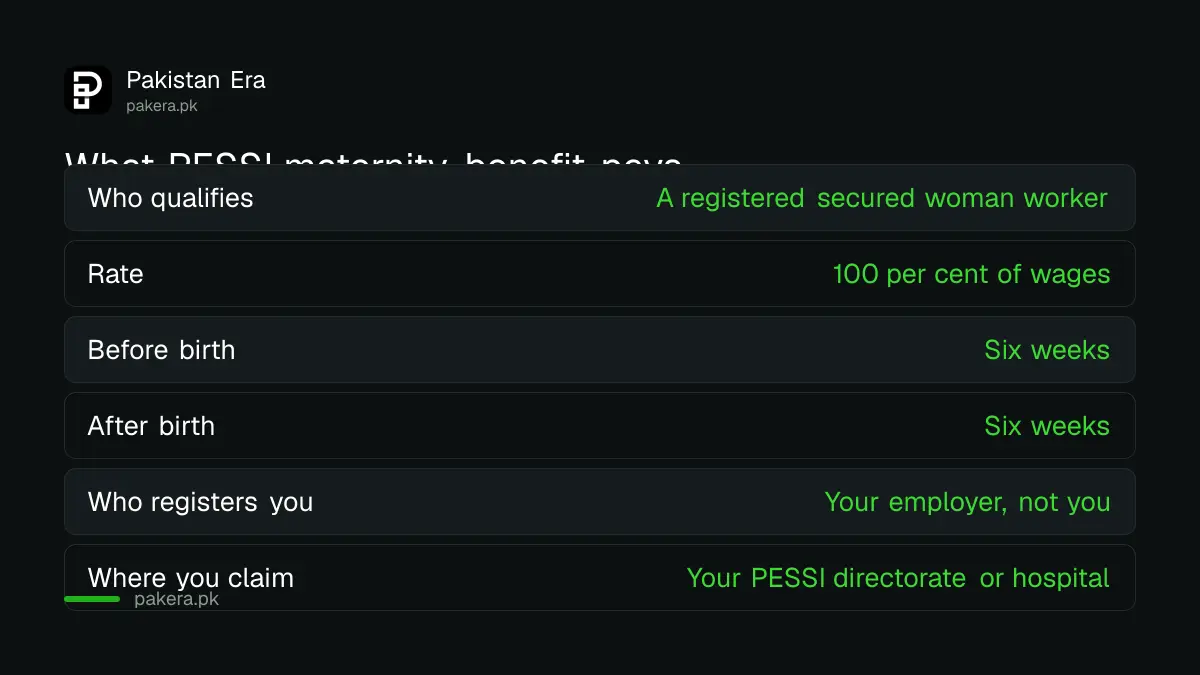
Only a worker registered through her employer can claim this benefit
PESSI registration is the employer's job, not yours. A worker cannot walk into a PESSI office and sign herself up, so the maternity benefit only exists for someone whose employer already pays contributions against her name.
If you are not sure whether you are registered, that question comes first, before the maternity claim. We set out exactly how to check your status and get your card in the guide to getting a PESSI social security card, including what an unregistered employer means for you and how to raise it safely.
Start the claim at a PESSI hospital or dispensary, not with your employer alone
A maternity claim begins with a medical examination at a PESSI facility, where a panel doctor confirms the pregnancy and the expected delivery date. Your employer's role is to confirm your employment and wage record, but the medical side has to come from PESSI itself.
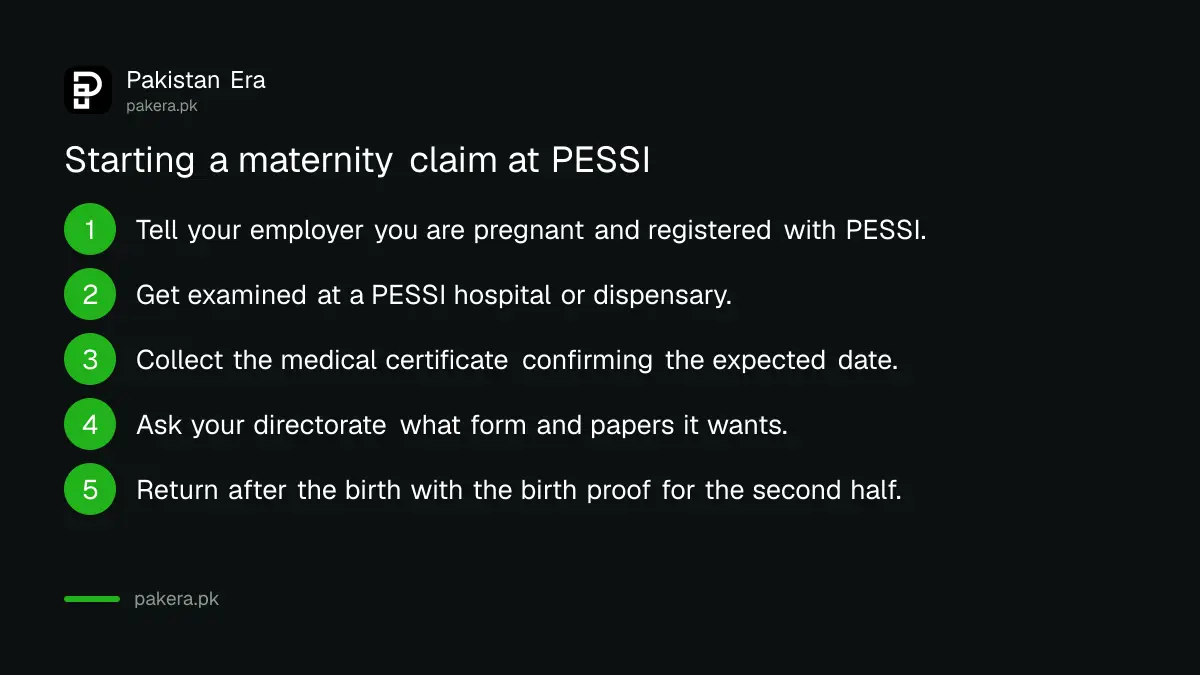
- Tell your employer you are pregnant and that you are a PESSI registered worker.
- Visit a PESSI hospital or dispensary in your area and get examined by its medical officer.
- Collect the medical certificate that records your expected delivery date.
- Take that certificate, your CNIC and your PESSI card to your local directorate, and ask exactly which form it wants filled for the prenatal half.
- After the birth, return with proof of the birth, such as the child's birth certificate or a hospital discharge note, to claim the postnatal half.
This is the same pattern PESSI uses for its other cash benefits: a medical certificate from its own facility starts the claim, and the directorate decides the paperwork from there. Treat the directorate visit as a question session as much as a filing step. Ask what proof it accepts, and get the answer before your due date, not after.
The claim runs in two halves, one before birth and one after
PESSI pays maternity benefit as two linked claims rather than one lump sum. The table below sets out what each half needs, based on how PESSI structures the benefit on its own cash benefits page.
| Stage | What PESSI pays | What you bring |
|---|---|---|
| Prenatal | 100% of wages for 6 weeks | PESSI medical certificate of expected delivery date, CNIC, PESSI card |
| Postnatal | 100% of wages for 6 weeks | Proof of birth, your prenatal claim reference, CNIC |
| Medical care | Treatment at PESSI hospitals during pregnancy and delivery | Your PESSI card, no separate claim |
The medical care row matters on its own. PESSI hospitals treat a registered worker through pregnancy and delivery regardless of the cash claim, so a worker who is unsure about the paperwork should still use the hospital for checkups and the birth itself.
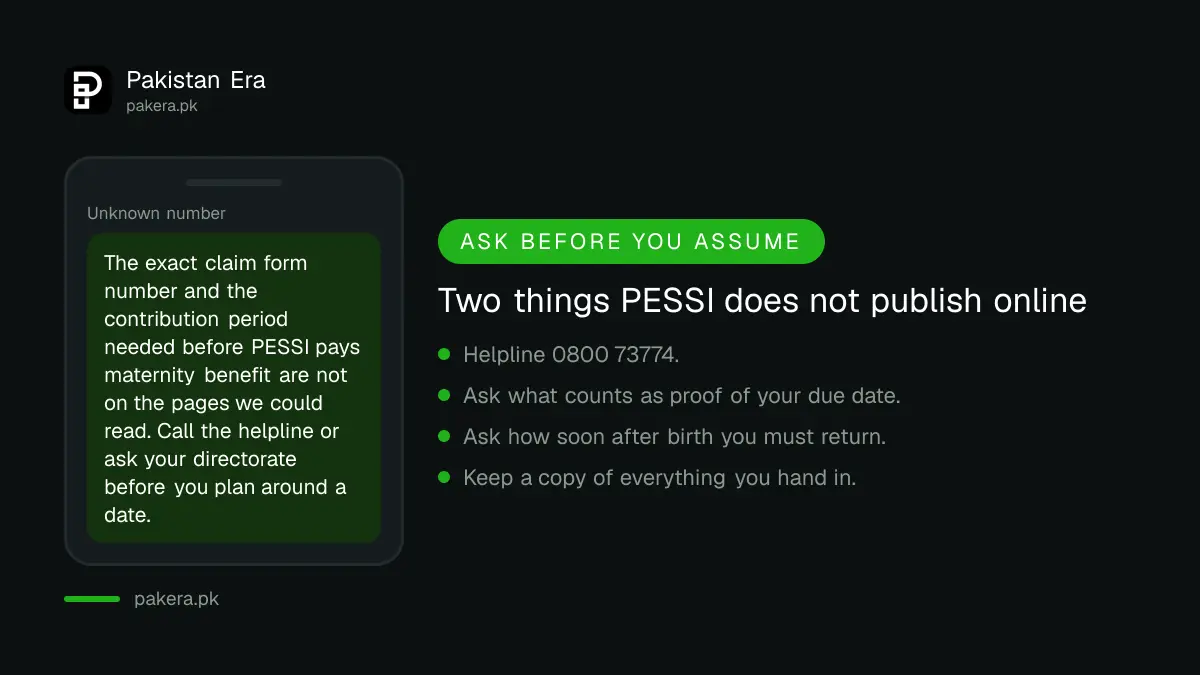
PESSI does not publish the exact form number or deadline online
We looked for a published maternity claim form and a fixed number of days to file, the way Sindh's SESSI publishes its own B-6 and M-9 forms with a 15 day window. PESSI Punjab's pages we could read did not give an equivalent form number or deadline for maternity benefit.
That gap is worth stating plainly rather than filling with a guess. A wrong deadline on a workers' benefit page does more damage than an honest "ask the office." Call the PESSI helpline on 0800 73774, or ask your directorate directly, what form it wants and how soon after the medical certificate or the birth you must submit it. Write down the answer and the name of whoever gave it to you.
Other PESSI benefits sit alongside maternity pay, not instead of it
Maternity benefit is one line in a wider set of cash benefits PESSI pays registered workers, covering sickness, injury, disablement and death. A worker claiming maternity pay keeps every other entitlement she is otherwise due.
We set out the full table of rates, including sickness, injury and the death grant, in the guide to PESSI benefits for workers in Punjab. Reading that alongside this one avoids the trap of thinking maternity pay is the scheme's only cash benefit, or that claiming it uses up an entitlement you need later.
Where to escalate if PESSI delays your maternity claim
Start with your own PESSI directorate and ask for a timeline in writing or by message. If weeks pass with no answer, call the helpline on 0800 73774 and quote the date you submitted your medical certificate.
Keep a photo or photocopy of every document you hand in, and note the name of the staff member who received it. A worker with no record of what she submitted has a much weaker position if a claim gets lost. If PESSI's own channels do not move the claim, a provincial ombudsman complaint is the next step for a government body that has stopped responding.
Common questions
How much does PESSI pay for maternity benefit in Punjab?
Full wages, which PESSI states as 100 per cent, for six weeks before the expected delivery date and six weeks after the birth.
Who is eligible for PESSI maternity benefit?
A woman worker whose employer has registered her with PESSI and pays contributions against her. Self employed women and workers whose employers never registered them are outside the scheme.
Do I apply for PESSI maternity benefit myself?
You start the medical side yourself at a PESSI hospital or dispensary, but your employer's wage and employment record also has to go in, so the claim is not something you file entirely alone.
What if my employer has not registered me with PESSI?
There is no maternity benefit to claim until registration exists, because PESSI has no contribution record for you. Raise it with your employer and ask for your registration status in writing before you plan around the benefit.
Can I use a PESSI hospital for pregnancy checkups even before I claim cash benefit?
Yes. Medical care at a PESSI hospital is available to a registered worker through pregnancy and delivery without a separate cash claim, which is separate from the six weeks of paid leave either side of the birth.
Is PESSI maternity benefit the same as paid maternity leave from my employer?
No. PESSI's cash benefit and your employer's own leave obligations under labour law are two different things, and one does not cancel the other.
About the author

Public Services and Education Journalist
Fajr Riaz is a journalist and content writer at Pakistan Era, based in Lahore. She covers the questions people meet in everyday life in Pakistan: how a public service works, what a change in the rules means, and where to find a reliable answer.