The Benefits a Registered Worker in Punjab Never Claims
Seventy five per cent of wages for ordinary sickness, full wages for a year on TB or cancer, and Rs 700 a day in hospital.
A registered worker in Punjab whose illness is tuberculosis or cancer is entitled to 100 per cent of wages for 365 days. Ordinary sickness pays 75 per cent for up to 121 days. Almost nobody covered by this claims it.
The scheme is the Punjab Employees Social Security Institution, and the benefits are paid on top of anything an employer owes separately.
We read the cash benefits published on pessi.punjab.gov.pk on 8 September 2026.
The cash benefits, with their rates
| Benefit | What is paid |
|---|---|
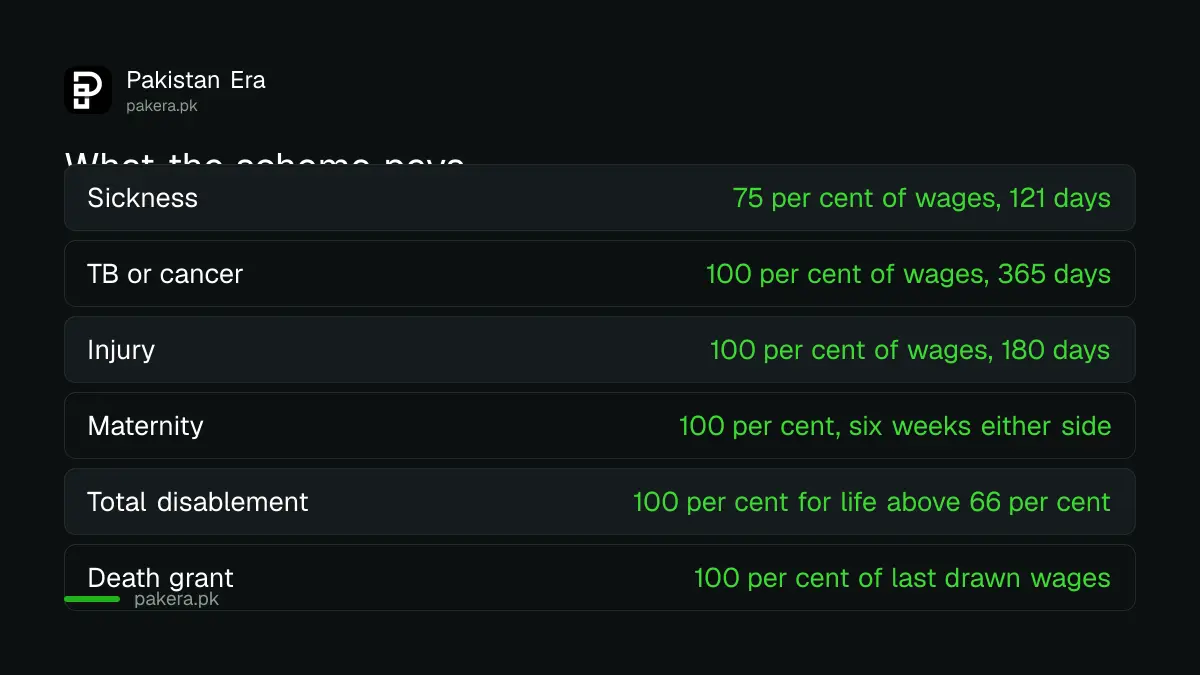
| Sickness | 75 per cent of wages, up to 121 days in a year |
| Sickness, tuberculosis or cancer | 100 per cent of wages for 365 days |
| Injury | 100 per cent of wages, up to 180 days in a year |
| Maternity | 100 per cent of wages, six weeks before and six weeks after |
| Total disablement pension | 100 per cent of wages for life, above 66 per cent disability |
| Survivor's pension | 100 per cent of wages after employment related death |
| Iddat benefit | 100 per cent of wages during the Iddat period |
| Death grant | 100 per cent of last drawn wages, to dependants |
Medical care is attached to the disablement and survivor's pensions rather than ending with the cash.
The tuberculosis and cancer rule
Ordinary sickness benefit is 75 per cent of wages for up to 121 days in a year. For tuberculosis and cancer the scheme pays 100 per cent of wages for 365 days.
Read those two lines together and the difference is the whole point. A worker with a long illness of that kind is not on a reduced rate and is not on a four month limit. They are on full wages for a year.
These are the two diagnoses where a family's income usually collapses, because treatment is long and the worker cannot attend. That is exactly what the higher rate is for, and it is the least known figure in the scheme.
Disablement is graded, not all or nothing
The scheme does not treat disablement as a single category, and the bands decide what is paid.
A disablement gratuity is paid as a lump sum for disability assessed between 5 and 20 per cent, with the amount depending on wages and the degree of disablement. A partial disablement pension covers disability from 21 to 66 per cent, with medical care included. Above 66 per cent, a total disablement pension pays 100 per cent of wages for life, again with medical care.
So the assessed percentage is the number that governs the outcome, and it is worth understanding how it was arrived at before accepting it.
Our guide to the disabled persons employment quota covers the separate employment rights that follow a disability, and our guide to getting a disability certificate and Special CNIC covers the documents.
What a family gets when a worker dies
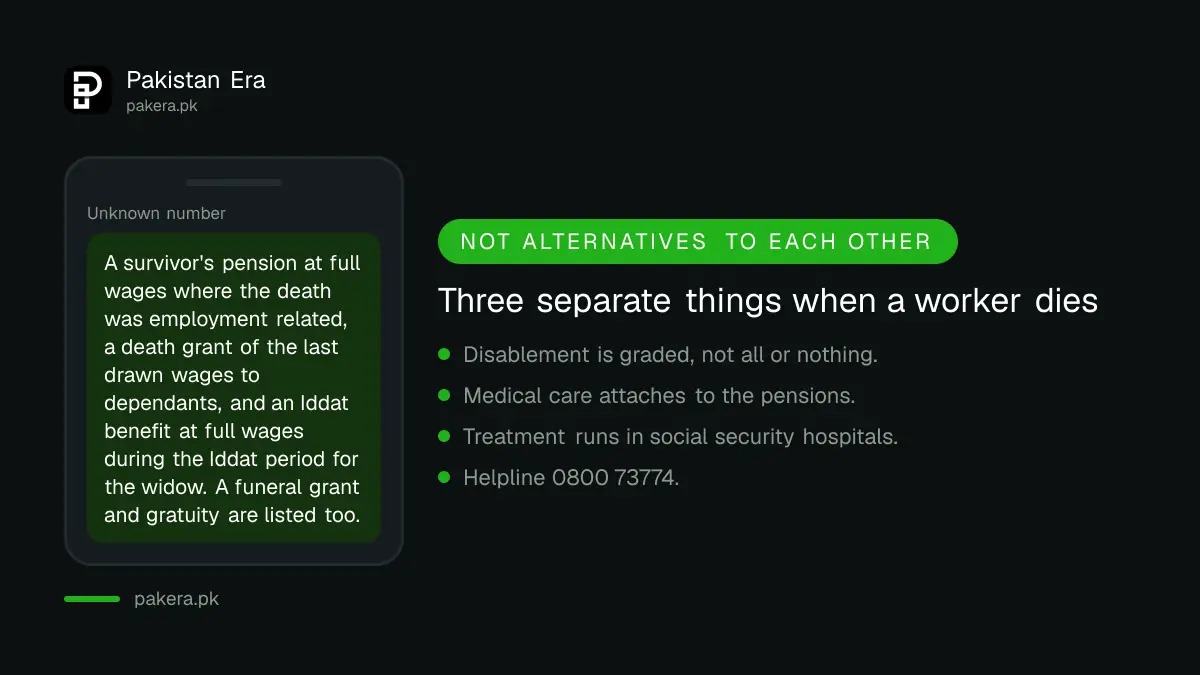
Three separate things are listed, and they are not alternatives to each other.
A survivor's pension of 100 per cent of wages is paid following an employment related death, with medical care. A death grant of 100 per cent of the last drawn wages is paid to dependants. And an Iddat benefit pays 100 per cent of wages during the Iddat period to the widow of a deceased worker.
A funeral grant and gratuity also appear in the institution's own list of benefits.
Families rarely ask about all of these, usually because they are dealing with a death and nobody at the workplace mentions the scheme. Ask about each by name.
The benefits nobody expects
Beyond the cash rates, the institution publishes several things that sit outside what people assume a social security scheme does.
- Diet charges of Rs 700 a day for a hospitalised patient.
- Conveyance charges when a patient is referred to another hospital.
- Artificial parts, listed among the benefits.
- Free education for the children of secured workers, including free MBBS education for nine workers' children each year.
- Hajj sponsorship for four workers annually.
Free MBBS places and Hajj sponsorship are small in number and will not apply to most people. The diet charges and conveyance are not, and they apply every time a covered worker is admitted.
Treatment, not just payments
The institution runs its own social security hospitals and provides comprehensive medical treatment in them, with arrangements through partner hospitals where a facility is not available, and treatment abroad where it is not available in the country.
That matters because the medical side is the part a worker can use without any claim being processed. If you are covered, the hospital is the benefit.
The institution operates directorates across Punjab and publishes a hospitals section and a helpline on 0800 73774. Registration is handled through its employee registration app and online portals.
Our guide to medical assistance from Bait-ul-Mal covers a different scheme for people outside this one, and our guide to free health programmes in Punjab covers what else is available without paying.
How this sits with what your employer owes
Social security is not a substitute for the entitlements that come from the employment relationship itself, and the two are often confused.
Our guide to leave entitlement at work covers paid leave, our guide to gratuity and provident fund covers what is owed when a job ends, and our guide to the workers profit participation fund covers a share of company profits that most workers never encash.
Treat these as separate questions to ask, not one. A worker leaving a covered job may have a claim under each.
What we could not confirm
The pages we read publish the benefit rates but not the wage ceiling for coverage, the employer contribution rate, or the number of contribution days a worker needs to qualify for each benefit.
Those conditions decide whether a particular worker is covered at all, so they matter. We are not going to state figures we did not read. Put the question to the institution on its helpline or through a directorate, and ask specifically about qualifying conditions for the benefit you need.
Common questions
How much does PESSI pay during sickness?
Seventy five per cent of wages for up to 121 days in a year, and 100 per cent for 365 days in tuberculosis or cancer cases.
What is paid for an injury at work?
One hundred per cent of wages for up to 180 days in a year.
What about maternity?
One hundred per cent of wages for six weeks before and six weeks after.
What does a widow receive?
A survivor's pension at 100 per cent of wages where the death was employment related, a death grant of the last drawn wages to dependants, and an Iddat benefit at 100 per cent of wages during the Iddat period.
Are hospital costs covered?
Comprehensive treatment is provided in social security hospitals, with diet charges of Rs 700 a day for a hospitalised patient.
Who do I ask about eligibility?
The institution, on 0800 73774 or through a directorate. The wage ceiling and contribution conditions were not published on the pages we read.
How we verified this
What we checked, where we read it, and what we could not confirm.
Last checked 8 September 2026. We read the Punjab Employees Social Security Institution site at pessi.punjab.gov.pk on that date, including its cash benefits page. The rates quoted, sickness benefit at 75 per cent of wages up to 121 days in a year and 100 per cent of wages for 365 days in tuberculosis and cancer cases; injury benefit at 100 per cent of wages up to 180 days in a year; maternity benefit at 100 per cent of wages for six weeks prenatal and six weeks postnatal; disablement gratuity as a lump sum for disability of 5 to 20 per cent depending on wages and degree of disablement; partial disablement pension for disability from 21 to 66 per cent with medical care; total disablement pension at 100 per cent of wages for disability exceeding 66 per cent as a lifetime pension with medical care; survivor's pension at 100 per cent of wages following employment related death with medical care; Iddat benefit at 100 per cent of wages during the Iddat period for widows of deceased workers; death grant at 100 per cent of last drawn wages to dependants; diet charges of PKR 700 daily for hospitalised patients; conveyance charges for hospital referrals; annual Hajj sponsorship for four workers; and free MBBS education for nine workers' children yearly, are all taken from that page. The list of benefits including sickness, Iddat, gratuity, survivor's pension, funeral grant, injury, maternity, disablement pension, artificial parts, financial assistance and free education of secured workers' children, the description of comprehensive medical treatment in social security hospitals with arrangements through partner hospitals and abroad where a facility is unavailable, the employee registration app and online portals, and the helpline 0800 73774, are taken from the institution's own pages. The wage ceiling for coverage, the employer contribution rate and the contribution days required to qualify for each benefit were not published on the pages we read, so this article states none of them and readers are directed to the institution. Confirm your own coverage and the current rates with the institution before relying on any figure. Nothing here is legal or medical advice.
About the author

Tax, Bills and Technology Writer
Ali Akhtar is a young and curious voice here at Pakistan Era. He is currently pursuing his A-Levels and has a growing interest in Pakistan’s changing industrial landscape and educational trends. Ali likes to write in a way that helps him explain and explore the world around him. His writing reflects the perspective of the new generation navigating the evolving trends of Pakistan where technology, youth innovation, and shifting opportunities are reshaping the country’s future.