The Workers Profit Fund Nobody Claims in Pakistan
Covered companies pay five per cent of profits into a workers fund each year. You can encash the units in your name at any time.
Companies covered by the scheme must pay five per cent of their annual profits into a fund for their workers. Most workers have never heard of it, and it is money standing in their name.
You can also take it out. A worker still in employment may encash the units in their name at any time, at their own discretion.
We read the Companies Profits (Workers Participation) Act, 1968 on 6 September 2026, in the text published by the Law and Parliamentary Affairs Department, Government of the Punjab.
What the company has to do
| Obligation | What the Act says |
|---|---|
| Establish a fund | A Workers Participation Fund, under the scheme |
| Pay into it | Five per cent of its profits each year |
| Deadline | Not later than nine months after the close of the year |
| Extension | Government may extend by one month for sufficient reasons |
| Accounts | Audited accounts furnished within the same nine months |
Note that the nine month deadline is not the company's own accounting timetable. It runs from the close of the year, and the only extension contemplated is a single month granted by Government for sufficient reasons.
Who is eligible, and the six month rule
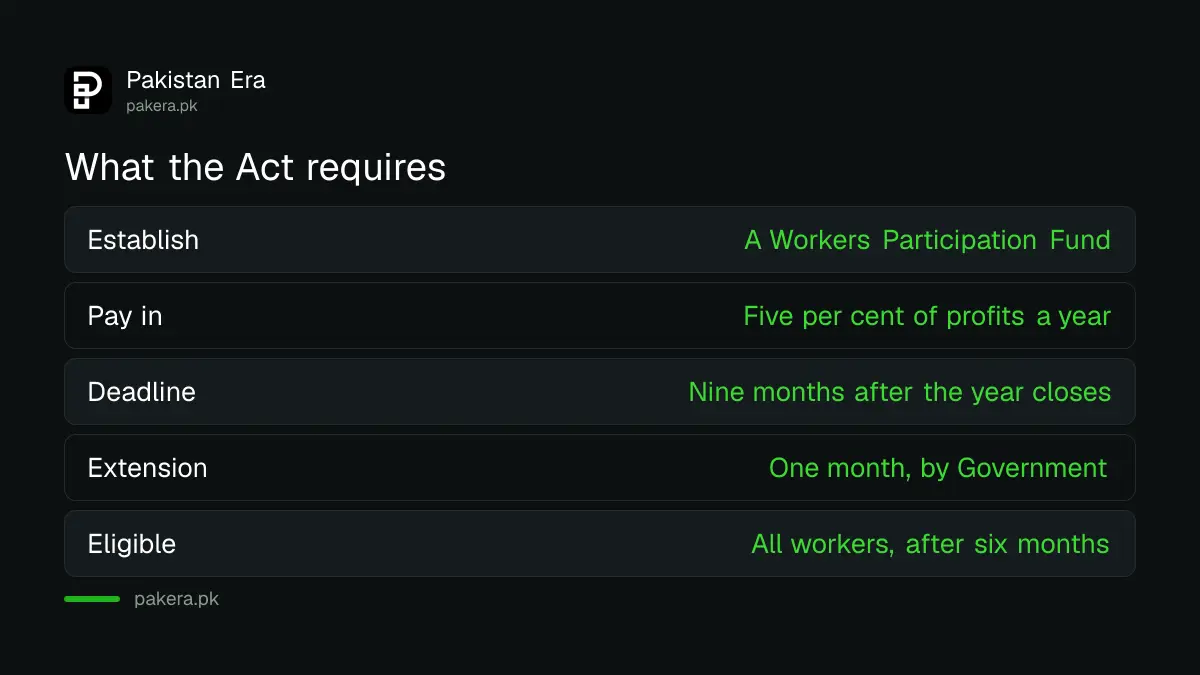
The scheme states that all workers shall be eligible to the benefits of the scheme and to participate in the Fund.
There is one cut off. A worker who does not complete six months of employment with the company during a year of account does not participate in the Fund for that year. So a job started in the last five months of an accounting year builds nothing that year, and starts building in the next.
Your share is expressed in units, or fractions of units worked out to two decimal places, with a face value of Rs 10.
The money you can actually take
Disbursement is where this stops being theoretical, and the provisions are more generous than people expect.
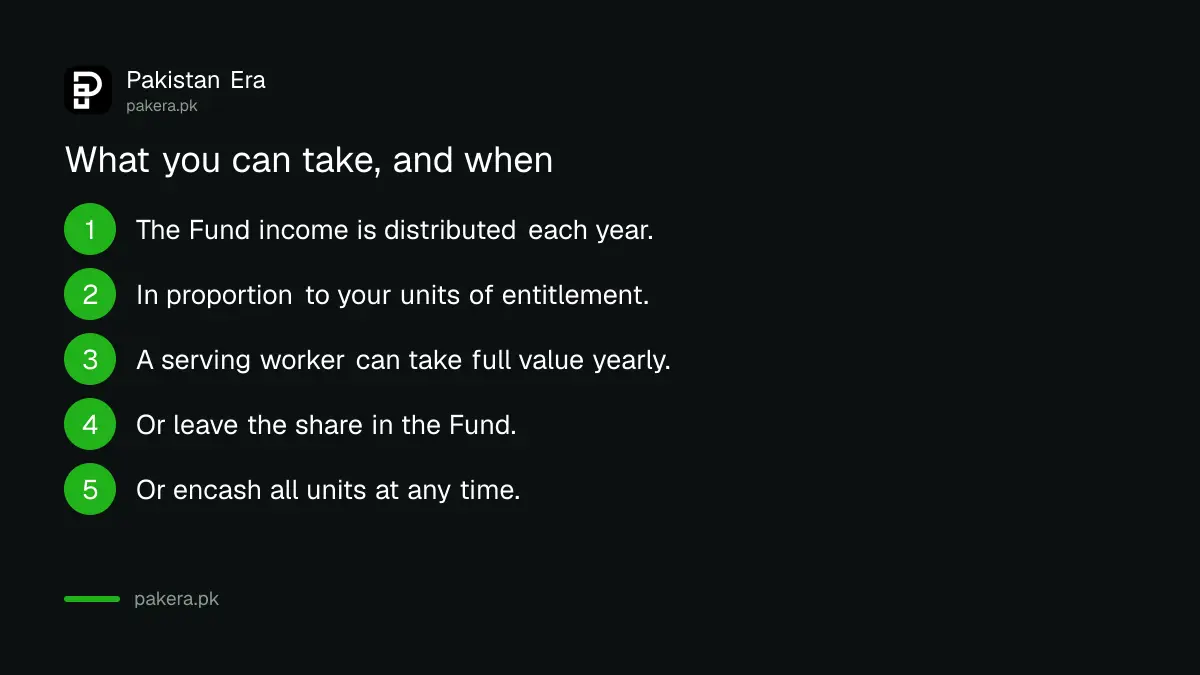
- The Fund's annual income, including realised capital gains, is distributed in full each year.
- It goes to workers in proportion to their units of entitlement.
- A worker still in service may take the full net asset value of their units each year.
- Or they may choose to leave their share in the Fund.
- A worker in employment may encash all their units at any time, at their discretion.
That last line is the one worth reading twice. The proviso says a worker while in employment may choose to encash all the units standing in his name at any time at his discretion. It is not tied to leaving, or to retirement, or to a company decision.
What happens when you leave
The scheme covers three exits, and treats them the same way.
A worker who voluntarily leaves the company, or whose services are terminated, is entitled to receive one hundred per cent of the net asset value of the units standing in their name. Resigning does not forfeit it, and neither does being dismissed.
On retirement, the worker receives one hundred per cent of the net asset value of their units. On death in the employment of the company, from whatever cause, the worker's nominated beneficiary receives it.
That nomination matters. If there is a nomination form for this fund at your workplace, it is worth completing and worth keeping current, in the same way our guide to inheritance shares matters for everything else a family has to establish afterwards.
It is in addition to everything else
The scheme includes a clause stating that its benefits are in addition to other benefits. It is not an alternative to what you are otherwise owed.
So this sits alongside gratuity and provident fund, which our guide to gratuity and provident fund rules covers, and alongside leave that is paid out on exit, which our guide to leave entitlement at work sets out.
When a job ends, those are three separate things to ask about, and this is the one nobody asks about.
How to find out whether it applies to you
The Act applies to companies to which the scheme applies, which is a defined category rather than every employer. A small business or a partnership is a different question from a company with audited accounts.
Ask your employer directly whether a Workers Participation Fund is maintained, and if it is, ask how many units stand in your name and what their current net asset value is. Ask in writing, because the answer is a number that should exist in audited accounts.
The Act requires those audited accounts to be furnished to the Government and the Board within nine months of the year end, so the information is not something the company has to construct for you.
The Act has been amended recently
The version we read carries amendments made by the Companies Profits (Workers Participation) (Amendment) Act 2021, published in the Punjab Gazette, and a further amendment by an Act of 2025 published in the Gazette of Pakistan in May 2025.
So this is live legislation rather than a dormant 1968 relic, which is worth knowing if somebody tells you the scheme is historical. Check the version applying in your province before quoting a section, since labour is a provincial subject and the text we read is the Punjab one.
Common questions
How much do companies pay into the fund?
Five per cent of profits each year, not later than nine months after the close of that year.
Am I eligible?
All workers are stated to be eligible, except that a worker not completing six months of employment during a year of account does not participate for that year.
Can I take the money while still employed?
A worker in employment may choose to encash all the units standing in their name at any time at their discretion.
What if I resign or am dismissed?
Both are covered. The worker is entitled to one hundred per cent of the net asset value of their units.
What happens if I die while employed?
The nominated beneficiary receives one hundred per cent of the net asset value of the units.
Does it replace gratuity?
No. The scheme states its benefits are in addition to other benefits.
How we verified this
What we checked, where we read it, and what we could not confirm.
Last checked 6 September 2026. We downloaded the Companies Profits (Workers Participation) Act, 1968 from the Punjab Code portal at punjablaws.punjab.gov.pk, in the text published by the Law and Parliamentary Affairs Department, Government of the Punjab, and read it. The obligation on every company to which the scheme applies to establish a Workers Participation Fund and to pay to the Fund five per cent of its profits each year not later than nine months after the close of that year, with a possible one month extension by Government for sufficient reasons, and to furnish audited accounts within the same period; the eligibility of all workers subject to the exclusion of a worker not completing six months of employment during a year of account; the expression of a worker's share in units or fractions of units to two decimal places with a face value of Rs 10; and the disbursement provisions distributing one hundred per cent of the Fund's annual income including realised capital gains in proportion to units, entitling a worker who voluntarily leaves or whose services are terminated to one hundred per cent of the net asset value of their units, entitling a continuing worker to the same each year or to leave the share in the Fund, permitting a worker in employment to encash all units at any time at their discretion, and providing for retirement and for a nominated beneficiary on death in employment, are all taken from that text, as is the clause stating that the scheme's benefits are in addition to other benefits. The text carries amendments by the Companies Profits (Workers Participation) (Amendment) Act 2021 and a 2025 amendment. Whether the scheme applies to a particular employer is a defined question we have not resolved here, so ask your employer in writing. Labour is a provincial subject and this is the Punjab text. Nothing here is legal advice.
About the author

Tax, Bills and Technology Writer
Ali Akhtar is a young and curious voice here at Pakistan Era. He is currently pursuing his A-Levels and has a growing interest in Pakistan’s changing industrial landscape and educational trends. Ali likes to write in a way that helps him explain and explore the world around him. His writing reflects the perspective of the new generation navigating the evolving trends of Pakistan where technology, youth innovation, and shifting opportunities are reshaping the country’s future.