Who Gets What Under Pakistani Inheritance Law
Heirs' shares are fixed and a will generally reaches only a third. The proportions, what comes out first, and the NADRA route for the paperwork.
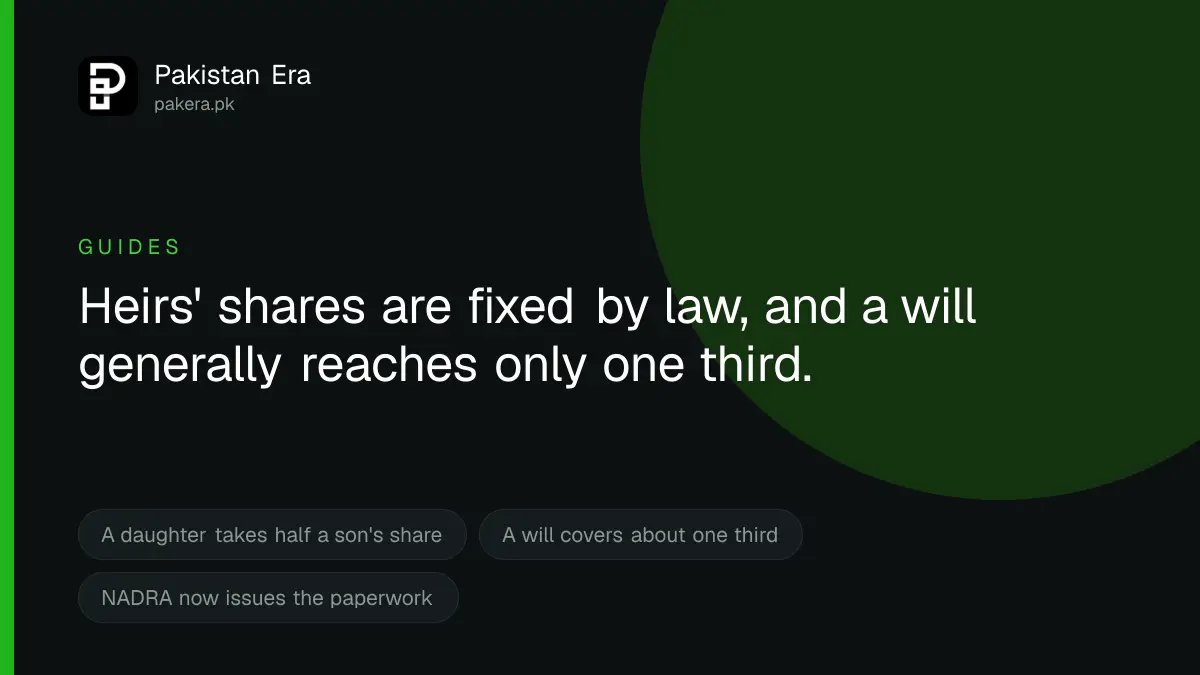
You cannot leave your property to whoever you choose. Under the inheritance rules applying to Muslims in Pakistan, the shares of the people who inherit are fixed, and a will can generally cover only one third of the estate. The other two thirds go to the heirs in the proportions the law sets.
That surprises people who have written a will assuming it settles everything. It does not, and the part it cannot reach is the part most families argue about.
The shares, in general terms
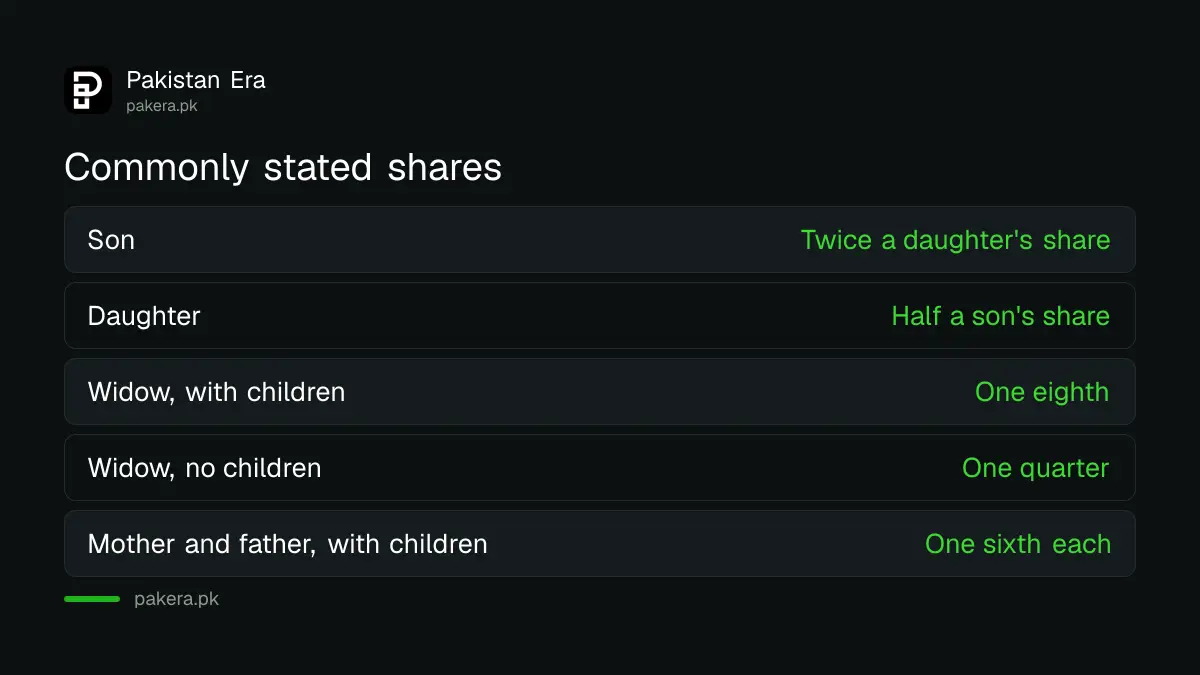
These are the commonly stated proportions. Which of them apply depends entirely on who survives, so read this as the shape of the rules rather than as your own answer.
| Heir | Commonly stated share |
|---|---|
| Son | Twice a daughter's share |
| Daughter | Half a son's share |
| Widow, where there are children | One eighth |
| Widow, where there are no children | One quarter |
| Husband, where there are children | One quarter |
| Husband, where there are no children | One half |
| Mother and father, where there are children | One sixth each |
The presence or absence of children changes several of these, which is why two families with the same assets can divide them very differently. Where there are multiple widows, the widow's share is divided among them rather than given to each.
A will reaches one third, and no further
The commonly stated position is that a bequest is valid for up to one third of the estate, and that it cannot be used to change what a legal heir receives unless every other heir agrees.
So a will is useful for the third, which can go to someone who would not otherwise inherit, to a charity, or to a cause. It is not a tool for disinheriting a daughter or favouring one son, and attempts to use it that way are the origin of a great many disputes.
If you want a different outcome, the honest route is a lifetime transfer rather than a will, and that has its own consequences and its own paperwork. Take advice before doing either.
Nothing is divided until the debts are paid
Funeral expenses and the deceased's debts come out of the estate first. Any bequest under the will comes next, within its one third. Only what remains is divided among heirs in their shares.
Families frequently divide assets first and discover a debt afterwards, which is a much harder conversation than establishing the position at the start. List what is owed as carefully as what is owned.
NADRA is now the route for the paperwork
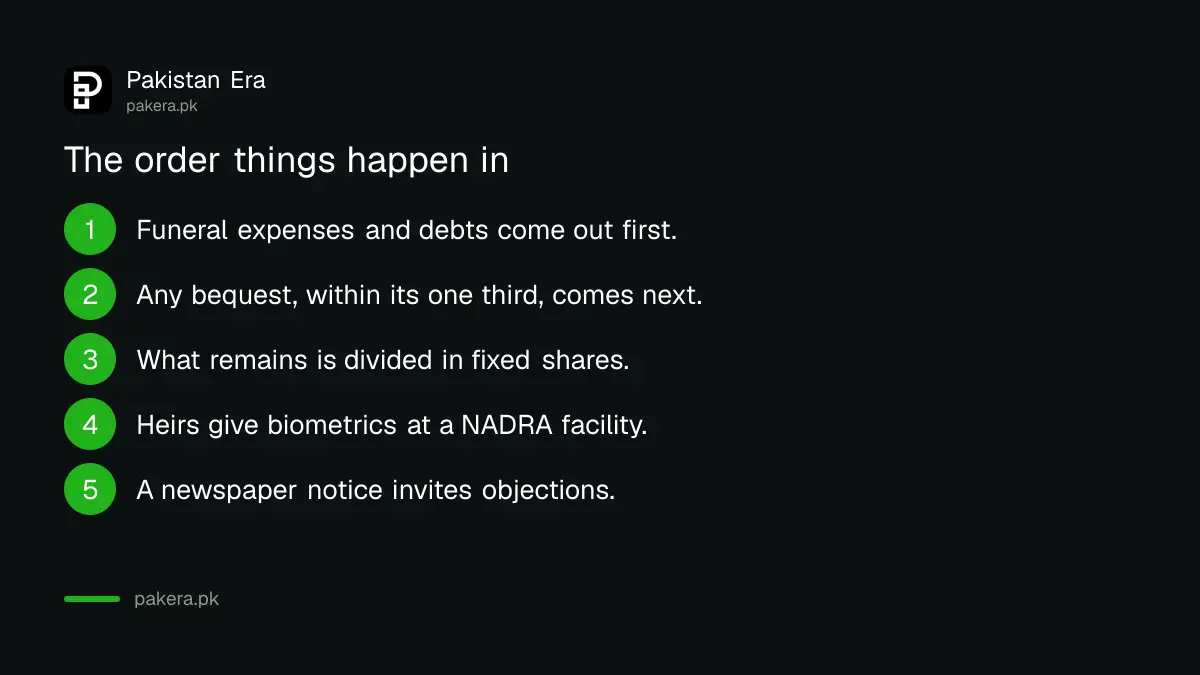
- Identify every heir, because the process needs all of them.
- List the assets, separating movable from immovable.
- Attend the NADRA succession facility, where heirs give biometrics.
- A newspaper notice is published, reported at fourteen days, inviting objections.
- If no objection is raised, the certificate or letter is issued.
Movable assets such as bank accounts and vehicles are dealt with by a succession certificate, while houses, plots and land go through a letter of administration. Asking for the wrong one costs months, and our guide to getting a succession certificate from NADRA covers the process in detail.
Reported timelines put an undisputed case at roughly fifteen to thirty days. A disputed one is a different matter entirely and belongs in court.
Heirs abroad can take part
The requirement that every heir participates used to strand families with relatives overseas. Reported practice now allows biometrics through the Pak-ID mobile application or at a Pakistani mission abroad.
Where a relative abroad cannot take part directly, a properly executed power of attorney is the usual route, and our guide to making a power of attorney from abroad covers the attestation chain. Keep it narrow and specific rather than general.
Check what is actually in the deceased's name
Before dividing anything, establish what the record says. Property often remains registered to a grandparent, which means the current generation is dealing with an inheritance that was never completed rather than a fresh one.
For Punjab land, our guide to getting a fard covers pulling the record. If it shows a name from two generations back, deal with that first, because a transfer cannot skip a generation that never inherited on paper.
Common questions about inheritance shares
Can I disinherit a child in my will?
The commonly stated position is no. A will reaches about one third of the estate and cannot alter a legal heir's share without the agreement of the other heirs.
What does a daughter get?
Generally half of what a son receives. The exact fraction depends on which other heirs survive.
What does a widow get?
Commonly one eighth where there are children and one quarter where there are none. Multiple widows share that portion between them.
Do these rules apply to everyone in Pakistan?
These are the rules applying to Muslims. Other communities are governed by their own personal law, so take advice specific to your position.
How long does the paperwork take?
Reported at roughly fifteen to thirty days through NADRA where nothing is disputed. A contested estate is a court matter and takes far longer.
How we verified this
What we checked, where we read it, and what we could not confirm.
Last checked 29 August 2026. Nothing here is read on a government or court source. The shares, the one third limit on a will, the order in which debts and bequests come before distribution, the NADRA succession route with biometrics and a reported fourteen day newspaper notice, the fifteen to thirty day timeline and the overseas biometric options are all reported, drawn from legal commentary, and marked so. Inheritance turns entirely on which heirs survive and on the facts of the estate, and no general table can answer an individual case. This is general information and not legal advice. Where property or a dispute is involved, use a lawyer rather than a web page.
About the author
Public Services and Education Journalist
Fajr Riaz is a journalist and content writer at Pakistan Era, based in Lahore. She covers the questions people meet in everyday life in Pakistan: how a public service works, what a change in the rules means, and where to find a reliable answer.