Sister Does Not Exclude a Paternal Cousin From Inheritance Under Sunni Law in Pakistan, Federal Constitutional Court Rules
FCC rules that under Sunni law a full sister takes her fixed share and a paternal cousin the residue. See the 1/4, 2/3, 1/12 split and how to fix a mutation.
یہ صفحہ اردو میں پڑھیں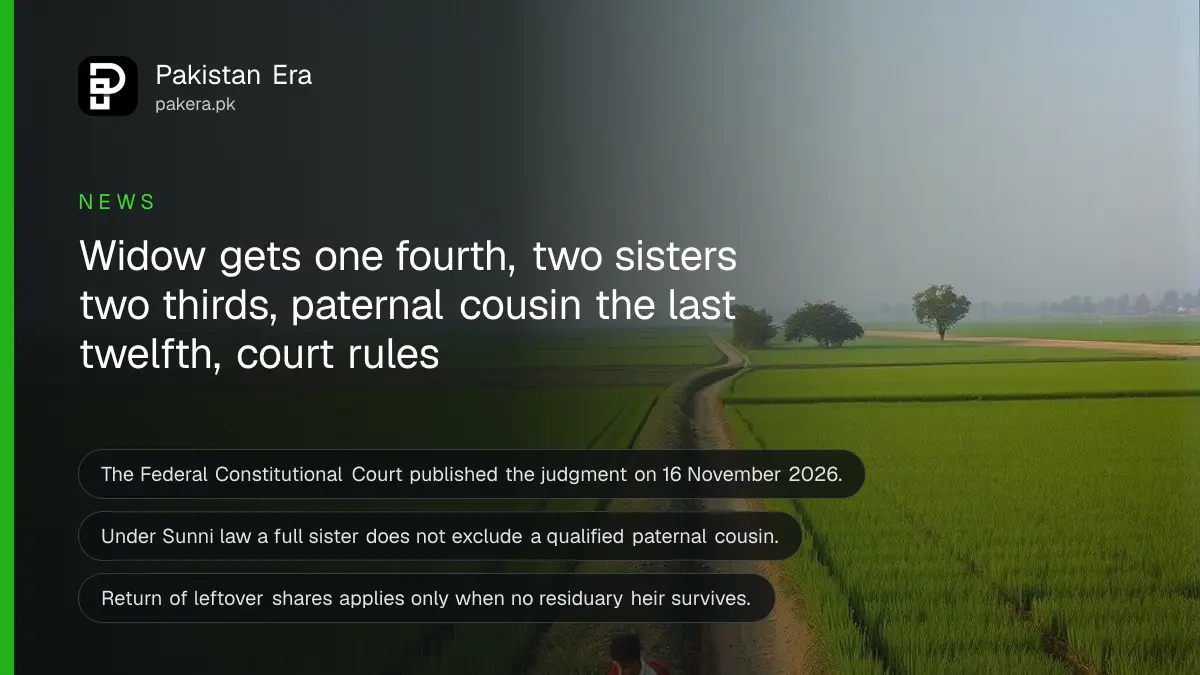
Short answer: A full sister does not shut out the deceased's paternal cousin under Sunni inheritance law in Pakistan, the Federal Constitutional Court (FCC) has ruled. The sister takes her fixed Qur'anic share and a qualified paternal cousin takes what is left. In this case a widow got one fourth, two sisters two thirds, and the cousins one twelfth.
The judgment, by Chief Justice Amin-ud-Din Khan and Justice Ali Baqar Najafi, was published on the FCC's judgments page on 16 November 2026. It dismissed a sister's petition against a cousin's share in a Punjab inheritance mutation (intiqal) and kept a Lahore High Court judgment of 6 November 2024 in place.
The court split the estate three ways
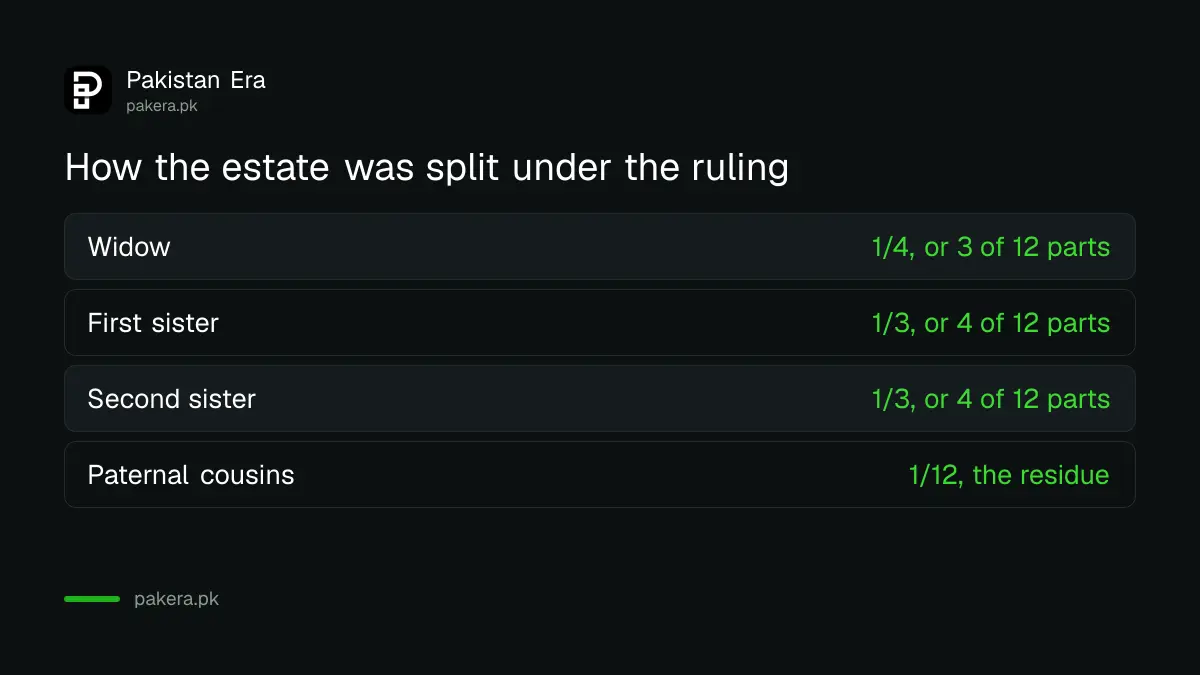
Muhammad Asghar died leaving a widow, two full sisters and paternal cousins, with no children. The FCC held the widow gets one fourth, the two sisters two thirds between them, and the remaining one twelfth goes to the paternal cousins as residuaries.
The revenue office had sanctioned Inheritance Mutation No. 4659 on 6 June 2018. It gave one fourth to the widow and the other three fourths to the two sisters. A paternal cousin challenged it, saying he was entitled to the residue. The court agreed with him.
| Heir | Share under the 2018 mutation | Share under the ruling | On a 12 kanal estate |
|---|---|---|---|
| Widow | 1/4 | 1/4 | 3 kanal |
| First sister | 3/8 | 1/3 | 4 kanal |
| Second sister | 3/8 | 1/3 | 4 kanal |
| Paternal cousins | Nothing | 1/12 | 1 kanal |
The 12 kanal column is our own example to make the fractions easy to read. The same split applies to a house, a bank balance or any other part of the estate.
Fixed shares come first, then the residue
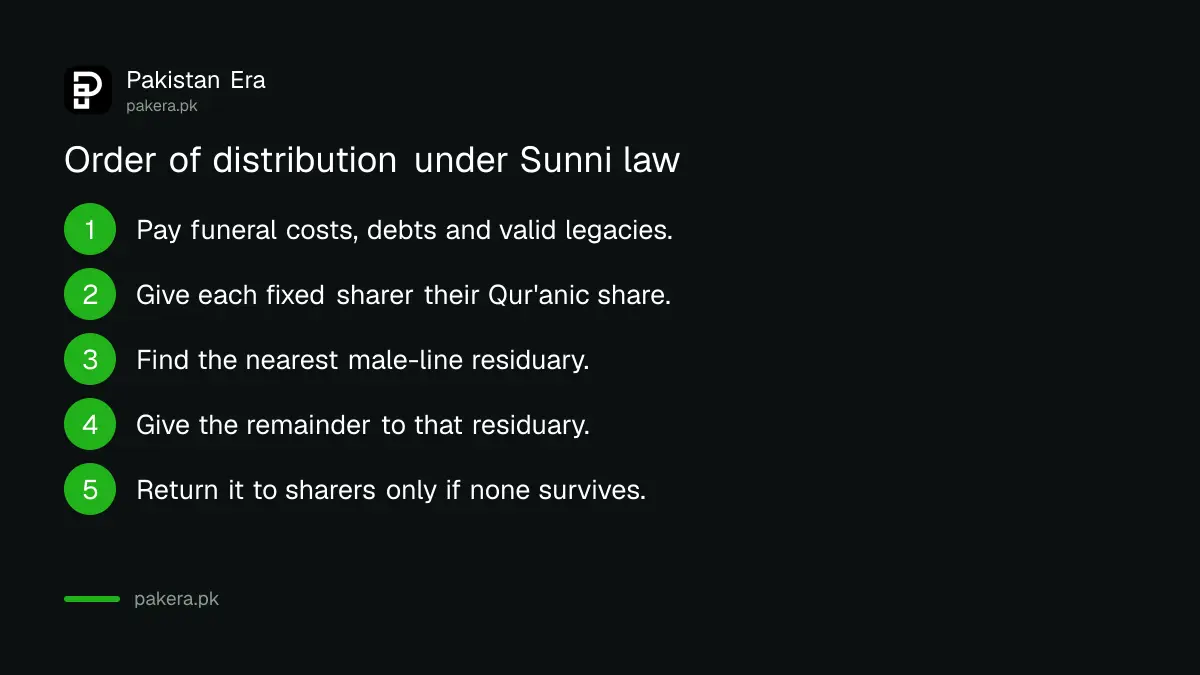
Sunni law pays the fixed Qur'anic shares first. Whatever is left goes to the nearest male-line relative, called a residuary or asaba. A nearer relative with a fixed share does not, by being nearer, cancel a residuary's claim to the balance.
The court relied on Surah Al-Nisa. Verse 12 gives a widow one fourth when there is no child. Verse 176 gives one sister half, and two sisters two thirds, when a man dies without a child. Those shares add up to eleven twelfths, which leaves one twelfth.
That last twelfth goes to the residuaries. The court cited a hadith in Sahih al-Bukhari (No. 6732): give the fixed shares to those entitled, and what remains goes to the nearest male relative. A paternal uncle's son is in that male line, so he can inherit as a residuary in his own right.
- Pay funeral costs, debts and any valid legacies.
- Give each fixed sharer their Qur'anic share, such as one fourth to the widow.
- Check whether any male-line residuary survives, in the order the law sets.
- If one does, the remainder goes to him.
- Only if no residuary survives does the remainder return to the sharers.
The sisters could not take the rest by return
Return, called radd, means leftover property goes back to the sharers in proportion. The FCC said radd only works when no residuary exists. It cannot be used to push out a cousin who is a valid residuary, so the sisters could not keep three fourths.
The court said the sister's closer blood tie does not decide the matter. What matters is the capacity in which each heir inherits. A full sister becomes a residuary only in set cases, such as with a full brother or with a daughter. None of those applied here.
One sister, Nasreen Akhtar, later died. The court said her estate is a new succession. On the heirs accepted below, the surviving sister gets one half of Nasreen Akhtar's share, and the residue again goes to the qualified paternal cousins.
The court also said being called a "cousin" is not enough on its own. A cousin's claim depends on his exact place in the male-line order and on no nearer residuary, such as a brother or a brother's son, being alive.
The general table of shares for wives, children, parents and siblings is in who gets what under Pakistani inheritance law.
Shia families follow a different rule
The ruling applies to Sunni succession. The FCC noted that under Ithna Ashari (Shia) law, siblings are a preferred class who exclude paternal uncles and their sons. So in a Shia family, a sister would exclude a paternal cousin.
The court said each sect's rules must be applied within that sect's own framework, as Article 227(1) of the Constitution provides. The rule of one sect cannot be carried over into a succession governed by the other. Families should first confirm which school of law applies to the deceased.
The legal basis is section 2 of the West Pakistan Muslim Personal Law (Shariat) Application Act, 1962. It makes Muslim personal law the rule for succession among Muslims, whatever local custom says.
What families with a wrong mutation can do
A sanctioned mutation does not make a wrong split final. The court said sections 42 and 42-A of the Punjab Land Revenue Act, 1967 only record rights, and section 44 covers disputes about entries. An heir left out can challenge the mutation through the revenue officers.
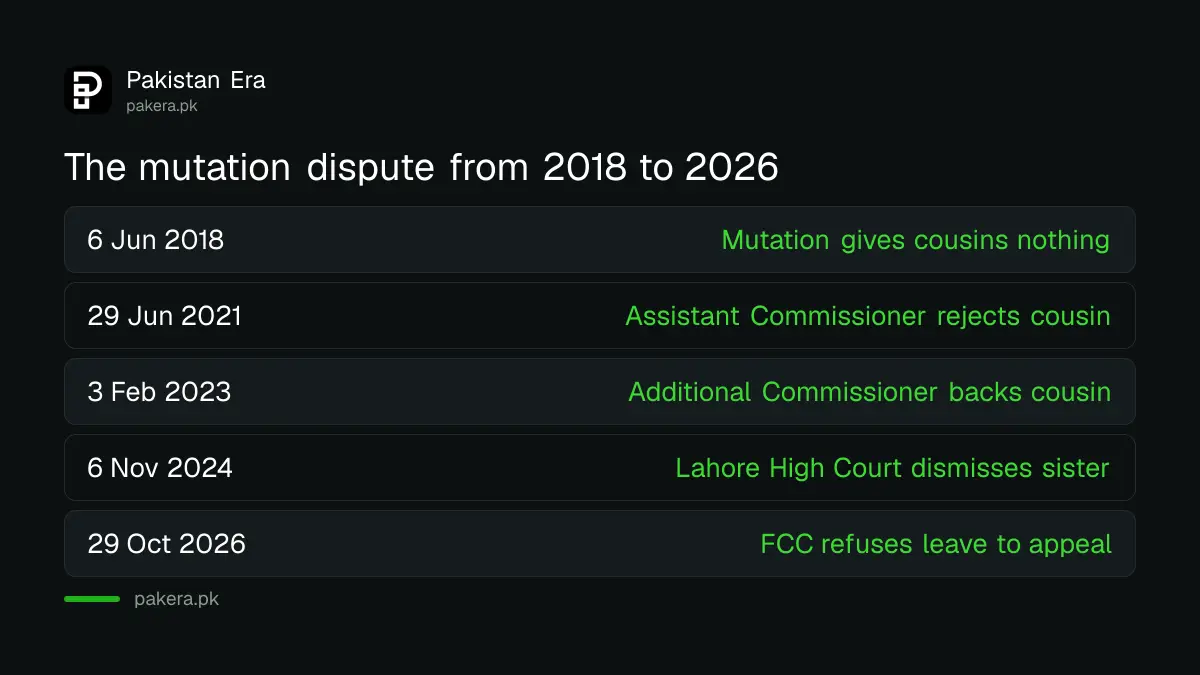
In this case the cousin's claim went through every level. The table below shows the path, which is the usual route for a disputed inheritance mutation in Punjab.
| Date | Forum | Outcome |
|---|---|---|
| 6 June 2018 | Revenue office | Mutation No. 4659 sanctioned, nothing to cousins |
| 29 June 2021 | Assistant Commissioner | Cousin's claim rejected |
| 3 February 2023 | Additional Commissioner | Order reversed in the cousin's favour |
| 8 November 2023 | Member, Board of Revenue | Sister's revision dismissed |
| 6 November 2024 | Lahore High Court | Sister's writ petitions dismissed |
| 29 October 2026 | Federal Constitutional Court | Leave refused, published 16 November 2026 |
To start or correct a mutation, see the documents and steps in transfer inherited land in Punjab through intiqal virasat. A related question on grandchildren is covered in whether grandchildren inherit if their father died first.
Common questions
Does a sister exclude a paternal cousin from inheritance in Pakistan?
Not under Sunni law, the FCC ruled. The sister takes her fixed share and a qualified paternal cousin takes the remainder. Under Shia law, a sister does exclude a paternal cousin.
What share does a widow get if there are no children?
One fourth of the estate, under Surah Al-Nisa verse 12. The court applied that share to the widow in this case.
What do two sisters get when there is no child?
Two thirds between them, so one third each. That two thirds is worked out on the whole estate, not on what is left after the widow's share.
What is radd in inheritance?
Radd, or return, sends leftover property back to the sharers in proportion to their shares. The FCC said it applies only when no residuary heir survives.
Can a mutation be changed after it is sanctioned?
Yes. The court said a sanctioned mutation can still be examined, and a split that goes against the law of succession cannot be saved because the paperwork was done correctly.
Which case is this?
C.P.L.A. Nos. 5383, 5384, 5385 and 5622 of 2024, Kaniz Haider against Khaliq Dad and others, heard on 29 October 2026 and approved for reporting.
How we verified this
What we checked and where we read it.
We read the full 11 page judgment on the judgments page of the Federal Constitutional Court of Pakistan on 16 November 2026, listed as C.P.L.A. No. 5383 of 2024, author Chief Justice Amin-ud-Din Khan, uploaded 16 November 2026. The judgment carries the date 29 October 2026. The shares, dates and legal references above are from it; the 12 kanal column is our own illustration.
About the author

Public Services and Education Journalist
Fajr Riaz is a journalist and content writer at Pakistan Era, based in Lahore. She covers the questions people meet in everyday life in Pakistan: how a public service works, what a change in the rules means, and where to find a reliable answer.