Do Grandchildren Inherit If Their Father Died First? Section 4 in Pakistan
Grandchildren in Pakistan inherit their dead father's or mother's share under section 4 of the Muslim Family Laws Ordinance. See the rule, an example and steps.
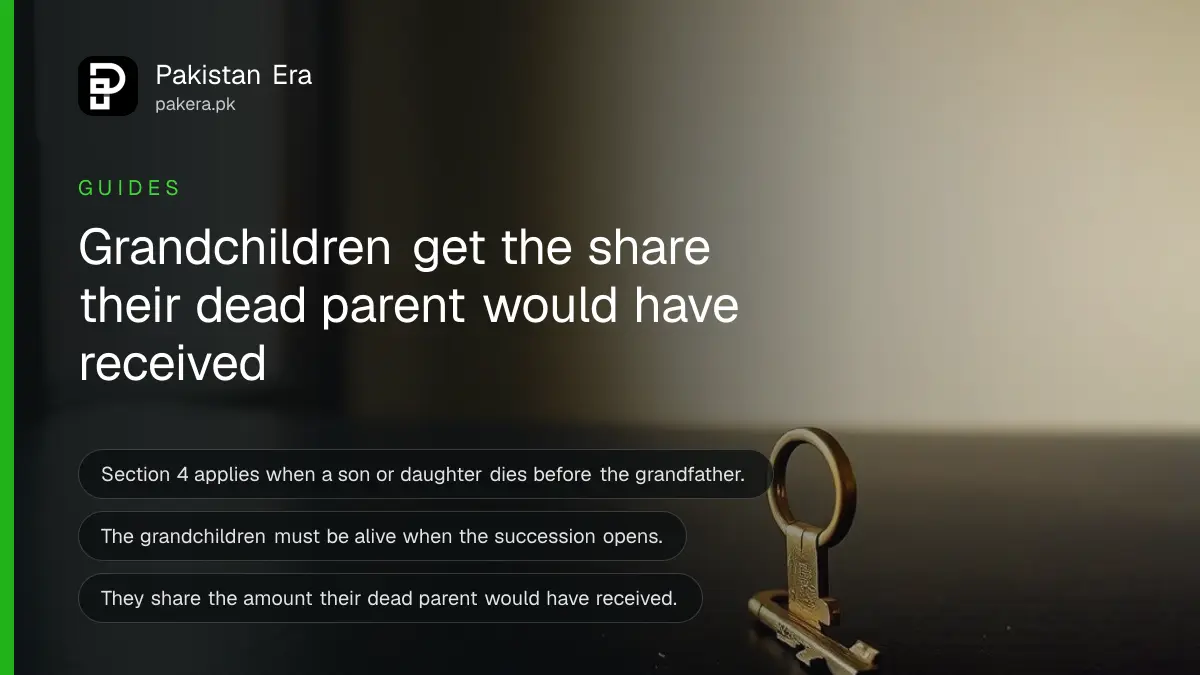
Short answer: Yes. Section 4 of the Muslim Family Laws Ordinance says that if a son or daughter dies before the person whose estate is being shared, that child's own children take the share their parent would have received, provided the grandchildren are alive when the estate opens.
Many families still say that grandchildren get nothing if their father dies before the grandfather. That is not what the law says. The rule is called per stripes, which means the grandchildren step into their dead parent's place.
We read the Ordinance on the Pakistan Code website on 14 October 2026. The text we read is marked as updated till 10 March 2022. We did not read the full tables of Muslim inheritance shares at an official page, so the numbers below are an example only.
Section 4 protects the children of a dead son or daughter
Section 4(1) covers a son or daughter who dies before the succession opens. Their children, if living when it opens, receive per stripes a share equal to what that son or daughter would have received if alive.
Succession opens on the death of the person who owned the property. The word propositus in the law means that person. A grandchild born after the death is not covered by the text, because the section says the grandchild must be living at that time.
The rule covers both a dead son and a dead daughter. A daughter's children are protected in the same way as a son's children. The text does not make a difference between them.
The grandchildren share one parent's portion
The grandchildren do not each get a full share. Together they take only the one portion their dead parent would have had. If there are several grandchildren, they divide that single portion among themselves, and nobody else's share shrinks.
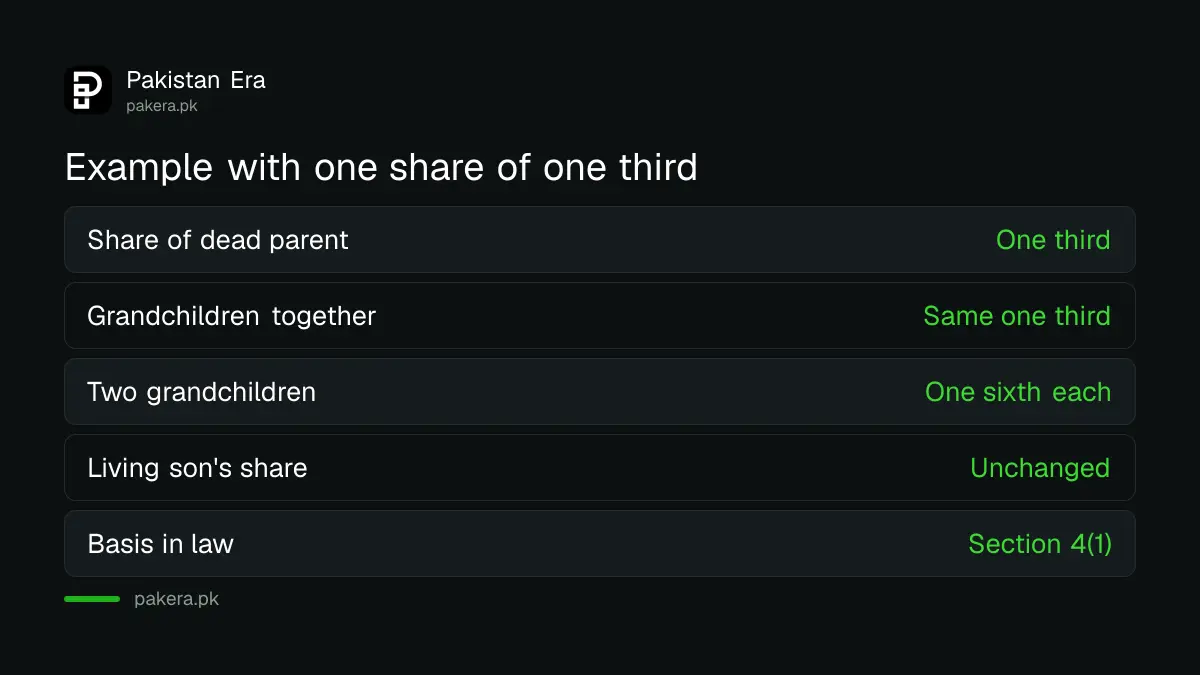
Here is a simple example with an invented fraction, only to show the method. Suppose the dead father would have received one third. His two children then share that one third, so each gets one sixth. The living sons and daughters are not affected by this, and their shares stay as the law gives them.
| Who | What they receive under section 4(1) |
|---|---|
| Grandchildren of a dead son or daughter | Together, the share that parent would have had |
| Each grandchild of that parent | An equal portion of that share, as the family law divides it |
| Living sons and daughters | Their own shares, as the law gives them |
| Grandchild not yet born at the death | Not covered by the section, which needs a living grandchild |
The Ordinance does not print the fractions for each heir. Those come from the personal law, so ask a lawyer to work out the exact figures for your family before anyone signs a paper.
Shia families follow a different rule for some points
Section 4 has later additions that apply to Ahl-e-Tashih, meaning Shia Muslims. Under section 4(8), their inheritance matters are decided according to Fiqah-e-Jafria. If your family follows it, get advice that is specific to that law.
Those additions came from an Act of 2021. They give a widow a share in the immovable property, at the value on the day of payment and not the value at death. We did not read the full effect of this for your case, so we do not apply it to the example above.
If there is a dispute, the Ordinance says the parties can go to a court or, for Fiqah-e-Jafria matters, to a Mujtahid-e-Alam from the panel kept by the Council of Islamic Ideology.
Steps to claim the share
Start with the death certificate of the grandfather and a list of heirs, including children who died earlier. Then apply for the heirship record in your province, or go to court if the family disputes the shares. Get the claim in writing.
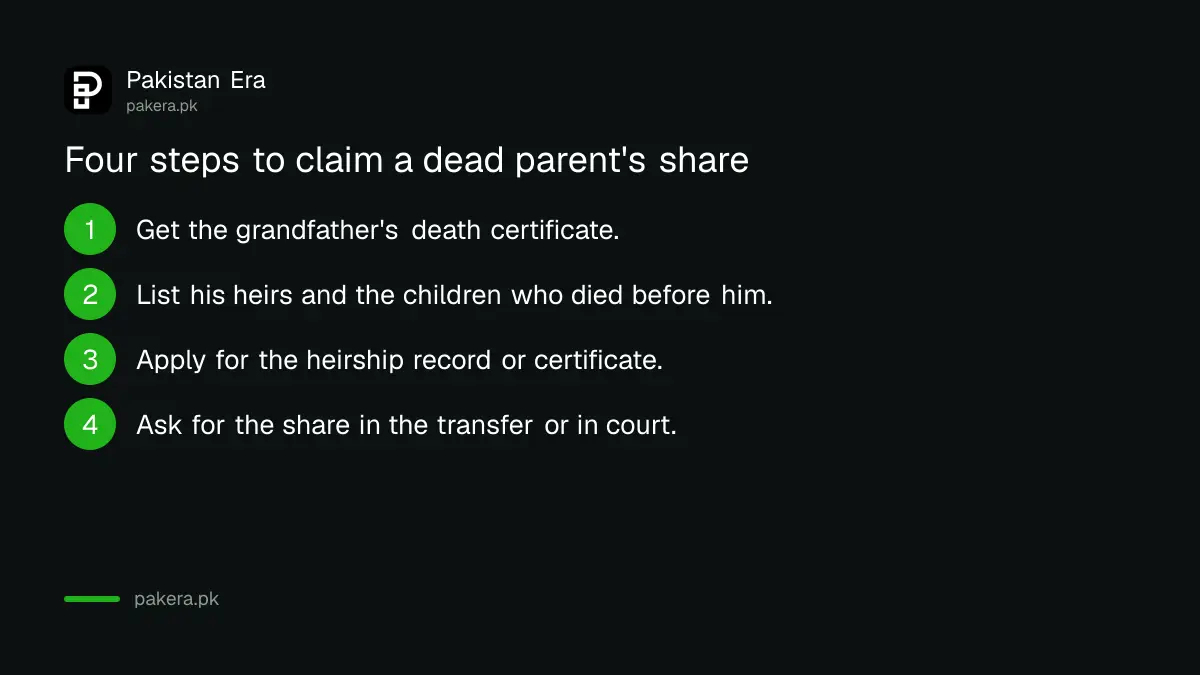
- Get the grandfather's death certificate and the death certificate of your own parent.
- Collect the birth certificates or CNIC records that show you are your parent's child.
- List every heir, including the dead child and the grandchildren.
- Apply for the heirship entry. In Punjab, see how to transfer inherited land through an intiqal.
- For bank accounts and other assets, see how to get a succession certificate from NADRA.
For the general rules of who gets what, read who gets what under Pakistani inheritance law. If a relative refuses to record your name, a court case may be the only way, and a family lawyer can tell you the time limit.
If you cannot pay a lawyer, ask about a free lawyer in Punjab or the legal aid line in your province.
Common questions
Do grandchildren inherit if their father died before the grandfather?
Yes, if they are alive when the succession opens. Section 4(1) gives them the share their father would have received.
Does a daughter's child inherit in the same way?
Yes. The section covers a dead son or a dead daughter, and it treats their children the same way.
Do the grandchildren each get a full share?
No. They divide the one portion their dead parent would have had.
Can an uncle refuse to record the grandchildren's names?
He should not, because the section is law. If he refuses, ask the revenue office or a court to record the heirs.
Does the rule apply to Shia families?
Section 4(8) says Shia inheritance is decided under Fiqah-e-Jafria. Ask a lawyer who knows that law about your case.
How we verified this
What we checked, where we read it, and what we could not confirm.
Last checked on 14 October 2026, Pakistan time. We read the Muslim Family Laws Ordinance, 1961 on the Pakistan Code. We did not read the full tables of heir shares or any court judgment, and the example fraction is invented to show the method. Ask a lawyer to work out your family's exact figures.
About the author

Senior Writer, Public Services and Technology
Shahid joined us in 2024 as an author. He is a senior contributor to Pakistan's leading technology websites. He writes detailed articles, mostly covering his expertise in the latest tech, mobiles, apps, gadgets, and step-by-step guides. His ideology is to help people understand the latest trends and explain complex methods through very easy-to-understand guides.